
Homeborn Servants and Sons

Jesus answered them, “Truly, truly I say to you, whoever commits sin is a slave of sin. Now a slave does not remain in the house forever, but a son remains forever.

John 8:34–35 — Modern English Version (Thinline Edition.; Lake Mary, FL: Passio, 2014)

Not having a full understanding of the Torah hinders us Gentiles. We want to understand the things Jesus says, and we do in a shallow sense. There are deeper things we need to be diligent in searching out.

It would not occur to me to understand what Jesus is saying in light of the Torah. In this case, Jesus is referring to some of the first things about an elect people God will call His servants and the origins of that.

Therefore she said to Abraham, “Throw out this slave woman and her son, for the son of this slave woman shall not be heir with my son, Isaac.”

Genesis 21:10 — Modern English Version (Thinline Edition.; Lake Mary, FL: Passio, 2014)

We know that Isaac was the chosen heir. But there is an important distinction being made between servants and heirs. There is also an apparent distinction inherent among servants. There are those bought with money and there are those homeborn.

Is Israel a servant? Is he a homeborn slave?
Why has he been plundered?

Jeremiah 2:14 — Modern English Version (Thinline Edition.; Lake Mary, FL: Passio, 2014)

I understand that these texts will have layers of meanings. The first question asked here lends itself to be prophetic in nature as it speaks of Jesus. It also encompasses the entire nation of Israel. While it causes us to remember the son of Isaac, Jacob.

The Homeborn Servant.

But Abram said, “Lord God, what will You give me, seeing I am childless and the heir of my house is Eliezer of Damascus?” Abram said, “Since You have not given me any children, my heir is a servant born in my house.”

Genesis 15:2–3 — Modern English Version (Thinline Edition.; Lake Mary, FL: Passio, 2014)

We get a tiny glimpse into the realities of life in those times. To a childless couple, the first homeborn servant is heir apparent. It was no different for Abram and Sarai.

In their haste to work God’s promises for themselves, Sarai’s servant Hagar was given to Abram. The homeborn son is named Ishmael.

As Ishmael had the distinction of being fathered by Abram with the servant Hagar, he was now heir-apparent. This by the distinction of not being bought, but homeborn. More important is the fact that he is the firstborn son.

When the promise of God came after Abraham and Sarah’s names were changed, Isaac was born. Isaac is not firstborn and not heir-apparent. Therefore, the servant-child had to be driven out. Even though Isaac was a son, he was also a servant.

Though Ishmael benefits of the promise made to Abraham, the promise was on Isaac, not Ishmael. Isaac was the son of promise. God would also establish a covenant with Isaac.

The Lord appeared to him that same night and said, “I am the God of Abraham your father. Do not fear, for I am with you. I will bless you and multiply your descendants for the sake of My servant Abraham.”

Genesis 26:24 — Modern English Version (Thinline Edition.; Lake Mary, FL: Passio, 2014)

It is my contention that Abraham typifies the bought servant, while Isaac, the homeborn. Genetic heritage does not change, and the people descended from Abraham through the homeborn slave-son Ishmael and the son Isaac are innumerable. The son of bondage heir apparent had to be removed.

This hints as to the work of the cross. When Jesus died, the son of bondage was driven out. It made room for the son of promise. In other words, death was removed that life could be received.

Jacob is Born.

Now Isaac pleaded with the Lord for his wife, because she was barren; and the Lord granted his plea, and Rebekah his wife conceived. But the children struggled together within her, and she said, “If all is well, why am I like this?” So she went to inquire of the Lord. Then the Lord said to her,
“Two nations are in your womb,
and two peoples will be separated from your body;
one people will be stronger than the other,
and the older will serve the younger.”

Genesis 25:21–23 — Modern English Version (Thinline Edition.; Lake Mary, FL: Passio, 2014)

Paralleling the plight of his parents, Isaac and Rebekah were also barren. The promises of God entail countless progeny. In these times people waited years for the promises of God to come. It is not that He is slack or slow, but all things happen in due time.

When Isaac and Rebekah conceived, two babies would be born. This provides another important distinction. The older shall serve the younger. The covenant promise will be to the younger.

We follow that covenant promise. Just as Isaac was chosen and the slave driven away. The younger would be chosen as the conveyance of God’s promise.

We know the account of how Jacob bought the birthright with a pot of red lentils. We also know how Rebekah and Jacob connived to obtain the blessing of Isaac. It teaches us another important lesson, a birthright can be bought (I will leave that to you to figure out how that points to Jesus.)

Then the man said, “Your name will no more be called Jacob, but Israel. For you have fought with God and with men, and have prevailed.”

Genesis 32:28 — Modern English Version (Thinline Edition.; Lake Mary, FL: Passio, 2014)

It is this Jacob that serves as a further typification of Jesus in many ways. God’s covenant comes to Jacob, and his name is changed. The way the Bible weaves together the names of Israel, Jacob, and Jesus provide an easily accessible entree to a deeper truth.

Jacob prevailed. I think this to be prophetic in nature as it foreshadows Jesus.

But no one in heaven or on earth or under the earth was able to open the scroll or to look in it. I began to weep loudly, because no one was found worthy to open and read the scroll, or to look in it. Then one of the elders said to me, “Do not weep. Look! The Lion of the tribe of Judah, the Root of David, has triumphed. He is able to open the scroll and to loose its seven seals.”

Revelation 5:3–5 — Modern English Version (Thinline Edition.; Lake Mary, FL: Passio, 2014)

Jesus has prevailed. But what of this fought with God?

The Hebrew word behind the English fought is from the same root of Jacob’s grandmother’s name Sarah. It doesn’t mean physical fighting, but more like persistence and perseverance. As an aside, Sarah had to persist and persevere with Abraham! Yet something else about Jesus comes to mind…

Let us look to Jesus, the author and finisher of our faith, who for the joy that was set before Him endured the cross, despising the shame, and is seated at the right hand of the throne of God. For consider Him who endured such hostility from sinners against Himself, lest you become weary and your hearts give up.

Hebrews 12:2–3 — Modern English Version (Thinline Edition.; Lake Mary, FL: Passio, 2014)

Jacob my Servant.

Here is My servant, whom I uphold,
My chosen one, in whom My soul delights.
I have put My Spirit upon him;
he shall bring forth justice to the nations.

Isaiah 42:1 — Modern English Version (Thinline Edition.; Lake Mary, FL: Passio, 2014)

You are My witnesses, says the Lord,
and My servant whom I have chosen
that you may know and believe Me,
and understand that I am He.
Before Me there was no God formed,
nor shall there be after Me.

Isaiah 43:10 — Modern English Version (Thinline Edition.; Lake Mary, FL: Passio, 2014)

Yet now listen, O Jacob, My servant,
and Israel, whom I have chosen.

Isaiah 44:1 — Modern English Version (Thinline Edition.; Lake Mary, FL: Passio, 2014)

Remember these things, O Jacob,
and Israel, for you are My servant;
I have formed you; you are My servant;
O Israel, you shall not be forgotten by Me.

Isaiah 44:21 — Modern English Version (Thinline Edition.; Lake Mary, FL: Passio, 2014)

There are many witnesses to attest to the fact that Israelis are servants. The texts also have prophetic implications. They show us plainly that the names Jacob, Israel, and my servant all point to Jesus.

A Son is Forever.

In the Tanakh, we see Israel presented as a servant. Since Abraham, these would be the homeborn servants. But as clearly seen, there is a better relationship. That is to be a son (or child of God.) Jesus said a son remains forever.

A physical birthright doesn’t convey salvation. Salvation comes by promise. With all of this, what Paul writes to the Galatians is clear.

Sons by Faith.

You are all sons of God by faith in Christ Jesus. For as many of you as have been baptized into Christ have put on Christ. There is neither Jew nor Greek, there is neither slave nor free, and there is neither male nor female, for you are all one in Christ Jesus. If you are Christ’s, then you are Abraham’s seed, and heirs according to the promise.

Galatians 3:26–29 — Modern English Version (Thinline Edition.; Lake Mary, FL: Passio, 2014)

Homeborn servants are not necessarily sons of promise. Salvation isn’t conferred by election or birthright. It comes by faith.

No Longer a Servant, but a Son and Heir.

Now I say that as long as the heir is a child, he does not differ from a servant though he is lord of all. But he is under tutors and governors until the time appointed by the father. So when we were children, we were in bondage to the elements of the world. But when the fullness of time came, God sent forth His Son, born from a woman, born under the law, to redeem those who were under the law, that we might receive the adoption as sons. And because you are sons, God has sent forth into our hearts the Spirit of His Son, crying, “Abba, Father!” Therefore you are no longer a servant, but a son, and if a son, then an heir of God through Christ

Galatians 4:1–7 — Modern English Version (Thinline Edition.; Lake Mary, FL: Passio, 2014)

Adam sold his birthright for some food just like Esau. Jesus bought that birthright by obedience. He bought it to give it back to you as children of God received by faith.
Those Who are Sanctified are All of One

Concerning this salvation, the prophets who prophesied of the grace that should come to you have inquired and searched diligently, seeking the events and time the Spirit of Christ, who was within them, signified when He foretold the sufferings of Christ and the glories to follow. It was revealed to them that they were not serving themselves but you, concerning the things which are now reported to you by those who have preached the gospel to you through the Holy Spirit, who was sent from heaven—things into which the angels desire to look.

1 Peter 1:10–12 — Modern English Version (Thinline Edition.; Lake Mary, FL: Passio, 2014)

Remember how we discussed previously how our salvation will be revealed in the last time. This is a reference to a time yet future that will be the end of this temporal existence. But this salvation is not hidden from us or others but is continuously being received until its full revelation at the end.

The Old Testament prophets received from God the revelations of the Spirit of the Anointed One, Jesus. Though they didn’t clearly understand the mysteries hidden in the revelations they were given. That is, the grace extended to the gentile nations. Of which we benefit.

Paul also spoke of it. He called himself a steward of God over a commission given specifically to him for us gentiles.

I have been made a servant of it according to the commission of God, which has been given to me for you, to fulfill the word of God, even the mystery which has been hidden from past ages and generations, but now is revealed to His saints. To them God would make known what is the glorious riches of this mystery among the nations. It is Christ in you, the hope of glory, whom we preach, warning everyone and teaching everyone in all wisdom, so that we may present them perfect in Christ Jesus.

Colossians 1:25–28 — Modern English Version (Thinline Edition.; Lake Mary, FL: Passio, 2014)

It was a truth hidden in the past.

Now, it’s almost fully revealed. What I mean is, those old-time Israeli prophets spoke of both a suffering Messiah and a triumphant Messiah. Though the prophets diligently sought to know what we know, His suffering has already been revealed to the world. It is recorded for us to read.

The glories to come are still for some future time when our salvation will be fully revealed. And that to the glory of Jesus!

We know the sufferings of the Messiah and in a similar fashion as they, we look forward to the glorious appearing and consummation of time when all is fulfilled. (The time when the New Jerusalem comes down from God.)

His triumphs and glories, though very real today and being revealed in us His saints… Are yet for a future time when He returns to Earth. When He defeats the evil that preys on humans and the world. He then takes the throne of David and rules Jerusalem and Earth. It will be as God had desired from the beginning, humanity having dominion over creation. After which Jesus will finally and gloriously put an end to the rebellion.

Those prophets knew they were serving a people yet future. Such things have resulted in your salvation. Those first-century Christians shared the testimony of the Jewish prophets who spoke of the sufferings of the Anointed One. They could show them this very same Jesus that was known among them and attested of long ago.

Why would angels want to look into these things?

Angels serve humanity. These are things also revealed by these messengers of God to men. These messengers desire to look in on. It’s salvation. The hope of glory that lives in each of us who are saints.

Considering that humans were made of the dust of the ground, with the breath of God breathed into us, we are not made in the same hierarchy as angels. We are made a little lower and intimately united with the physical reality we occupy. Humans are made of the very dust of which the earth is made.

We also have a spirit that connects to the reality that supersedes ours. Better said, it is the supernatural realm where spirits dwell. Because of sin, that reality has been veiled to us.

It’s these glorious heavenly angels who were assigned to serve the dirt creatures. It’s like that in God’s economy. The older serves the younger, the least is greatest.

That idea has been corrupted, though. When sin entered, the dirt creatures took upon themselves the desire to be like God. They fell away. And corrupted His order by serving their own selfishness. Not serving others, let alone the least.

What is this?

That the very Creator of these dusty men would humble Himself and add that very same dusty nature. He would step that low, placing Himself even under the angels.

I am thinking wholly of the first two chapters of the book of Hebrews and how eloquently it describes the suffering and then triumphant Messiah. This is how the author says it:

But someone in a certain place testified, saying: “What is man that You are mindful of him, or the son of man that You care for him?
You made him a little lower than the angels; You crowned him with glory and honor, and set him over the works of Your hands. You have put all things in subjection under his feet.”
For in subjecting all things under him, He left nothing that is not subjected to him. Yet now we do not see all things subject to him.

Hebrews 2:6–8 — Modern English Version (Thinline Edition.; Lake Mary, FL: Passio, 2014)

This speaks of how Jesus came to us as One of us, made lower than the angels. Yet at the same time, crowned with glory and honor. (Yet to be revealed in the last times and for which we patiently wait.)

It was that sin. Rebellion was taken on by creatures made of dust. That very thing would be used to defeat sin and death.

Sin earns wages paid in blood. The God of all paid His own blood to satisfy the wages of sin. Sin had no claim on Him, but death attempted to master Him.

The enemy, thinking this would be a perfect way to vanquish God, seized Him. He was crucified and died. Being perfect, death really had no claim on Him.

Yet His blood was shed.

His divine-human blood was the perfect payment for an infinite human debt. A debt He didn’t owe, but one that encumbered all of humanity was completely satisfied.

But we see Jesus, who was made a little lower than the angels to suffer death, crowned with glory and honor, so that He, by the grace of God, should experience death for everyone.

Hebrews 2:9 — Modern English Version (Thinline Edition.; Lake Mary, FL: Passio, 2014)

I can scarcely comprehend that. Even as I write this stuff. It’s above my pay-grade. Yet I know it is true.

There is more.

This Son of God is now (also) a Man. (I am writing it like that for lack of a better way to understand. The Son of God took on humanity. The divine and human United in One. I italicized the One to emphasize not only this but the Unity of Father-Son-Spirit.)

He has wrested the rights to dominion over the creation as God had intended at creation. Men will master it. In this case, One Perfect Man.

For it was fitting for Him, for whom and by whom all things exist, in bringing many sons to glory, to make the Author of their salvation perfect through suffering. For both He who sanctifies and those who are sanctified are all of One.

Hebrews 2:10–11a — Modern English Version (Thinline Edition.; Lake Mary, FL: Passio, 2014)

Things into which angels desire to look.

Now is the time to recall why One is emphasized earlier.

God becomes the Author of salvation by that suffering. The suffering that came by submission to His own creation.

It could only be done with blood. Without the shedding of blood, there is no remission of sins.

Blood that only exists in our temporal physical reality. Angels don’t have blood. Blood cannot be shed for them. That is why those fallen spirits tremble at the name of Jesus. Their destiny is sure and there is no hope for them.

Angels were made higher than humans. The Creator made Himself human. He placed Himself lower than them. He died, rose again. Setting humans higher than angels. (Do you not know you are going to judge angels?)

Just as Jesus partook of the nature of humanity, taking it wholly upon Himself… He invites us dirt-creatures to partake of the divine nature. It starts at our salvation when He comes to live in us.

Those who are sanctified are all of One.

We celebrate that every single time that we come to the Lord’s Table. As we hold in our hands the broken bread and the wine, these represent His human body broken for us and His human-yet-divine bloodshed from it. We are to take that inside of us. It’s a typification of what is yet to be revealed. We partake of the divine nature.

But to partake, one needs to be like Him. We all need to humble ourselves.

1. Acknowledge in our minds that the things written about Him are really real.

2. Believe that what He says is really real. That He rose again. That is for us. Trusting in it like you would trust a chair to hold you up by sitting in it.

3. Confess the truth out loud with our mouths. And the. Confess our sins to Him asking Him to remove them completely.

That’s the first step to partaking in the divine nature. You are then given new hope through the resurrection.

A Child is Born

And in the same area there were shepherds living in the fields, keeping watch over their flock by night. And then an angel of the Lord appeared to them, and the glory of the Lord shone around them, and they were very afraid.

Luke 2:8–9 — Modern English Version (Thinline Edition.; Lake Mary, FL: Passio, 2014)

It was a night like any other for those shepherds. They were keeping watch over the clocks that would be used for the daily sacrifice in the temple in Jerusalem. From our perspective, shepherding is quaint and bucolic. Being a shepherd in that day was among the lowest of the rungs of that society. Meekly, they attended to their flocks with great care.

It was God (in Theophany) Who appeared to them suddenly. He came without notice of fanfare. His glory encompassed them in a flash. From darkness, it was suddenly brighter than daylight. It made them very afraid — as it would any of us.

But the angel said to them, “Listen! Do not fear. For I bring you good news of great joy, which will be to all people. For unto you is born this day in the City of David a Savior, who is Christ the Lord. And this will be a sign to you: You will find the Baby wrapped in strips of cloth, lying in a manger.”

Luke 2:10–12 — Modern English Version (Thinline Edition.; Lake Mary, FL: Passio, 2014)

Fear not! It wasn’t a command to them. They are intended as words of comfort. God was announcing favor to those most undesirable. A shepherd’s testimony in that society trusted or even sought out. The favor announced to them wouldn’t be for them alone but to all people. Who could believe them?

Yet… This is Christmas!

God announces His favor to even you. I don’t know anything about you. If you’re like me, you couldn’t think God would be favorable in your direction. Yet He is. Christmas demonstrates it. For God has caused it to be written:

For unto us a child is born, unto us a son is given, and the government shall be upon his shoulder. And his name shall be called Wonderful Counselor, Mighty God, Eternal Father, Prince of Peace.

Isaiah 9:6 — Modern English Version (Thinline Edition.; Lake Mary, FL: Passio, 2014)

Unto us, a child is born. That is for you and me, too. He is born just a wee human Babe from our perspective. God gave dearly… A Son. He didn’t give just any Son, but His unique Son. There’s not another like Him anywhere.

This Babe would eventually rule the world. He would be wise beyond His years. He is God, the One Who brings peace.

These are the good tidings to all people. God has set aside His anger toward people. Glory goes to God. Yet in the transaction, we get goodwill and peace from Him.

Suddenly there was with the angel a company of the heavenly host praising God and saying, “Glory to God in the highest, and on earth peace, and good will toward men.”

Luke 2:13–14 — Modern English Version (Thinline Edition.; Lake Mary, FL: Passio, 2014)

Take His Gift to you.

God’s Bread

In those days a decree went out from Caesar Augustus that the entire inhabited earth should be taxed. This taxation was first made when Quirinius was governor of Syria. And everyone went to his own city to be taxed.
So Joseph also departed from the city of Nazareth in Galilee to the City of David which is called Bethlehem, in Judea, because he was of the house and lineage of David, to be taxed with Mary, his betrothed wife, who was with child. So while they were there, the day came for her to give birth. And she gave birth to her firstborn Son, and wrapped Him in strips of cloth, and laid Him in a manger, because there was no room for them in the inn.

Luke 2:2–7 — Modern English Version (Thinline Edition.; Lake Mary, FL: Passio, 2014)

As we’ve discussed before, God is present in every moment. The fact that Caesar Augustus decreed a tax that would ensure Joseph to be in the city of his lineage was known to God when David called the prophet Samuel.

The Lord said to Samuel, “How long will you mourn for Saul, since I have rejected him from ruling over Israel? Fill your horn with oil and go. I will send you to Jesse the Bethlehemite, for I have chosen a king for Myself from among his sons.”

1 Samuel 16:1 — Modern English Version (Thinline Edition.; Lake Mary, FL: Passio, 2014)

Bethlehem is the birthplace of Kings. It is the birthplace of God’s Chosen. In this way, God’s choosing of David was a pattern for Israel, and by extension the whole world. That’s for us!

David’s anointing would be when Israel already had a king… Saul. In the same way, Jesus’ advent was when Israel already had a king… Caesar.

It is Bethlehem. The word that means house of bread. The Bread of Heaven would be born there.

But you, Bethlehem Ephrathah, although you are small among the tribes of Judah, from you will come forth for Me one who will be ruler over Israel. His origins are from of old, from ancient days.

Micah 5:2 — Modern English Version (Thinline Edition.; Lake Mary, FL: Passio, 2014)

Least among the tribes of Judah.

Everything about His birth doesn’t make us think of kings or rulers. Jesus was born to a regular working-class couple. He was born away from home, in a stall for animals. His first resting place was most likely a trough hewn from stone used for fodder. And Bethlehem… Which was a relative backwater near bustling Jerusalem.

David was born there, too. He was the least of his brothers. He was the shortest in stature. He was a dirty shepherd. Shepherds in those days were the least esteemed of people if they were even considered that. David serves as the pattern.

We were to know that pattern.

God chooses the weak to confound the strong. He chooses the base to offend the intellectual. We choose according to stature, prowess, mental acumen and wealth. These are the things humans esteem. This is not so with God.

A dirty and lowly shepherd boy was chosen to be king over Israel. This David is like a sling stone forging through time to that lands in the midst of that lowly carpenter’s Boy’s circumstance of birth.

It’s that day.

Today (the eve of Christmas,) when you think of Jesus and His birth, it’s not the trappings of silver and gold, the red and the white and the green… Santa Claus or turkey… Or even what skeptics say that really matters.

It’s Who Jesus is that does. God’s desire is that you eat His Bread! Seriously. He wants you to take Jesus into your body by believing He is Emmanuel, God among men… Your King.

Christmas, Behold the Lord’s Female Slave

Now in the sixth month, the angel Gabriel was sent from God to a town of Galilee named Nazareth, to a virgin legally promised in marriage to a man named Joseph of the house of David. And the name of the virgin was Mary. And he came to her and said, “Greetings, favored one! The Lord is with you.” But she was greatly perplexed at the statement, and was pondering what sort of greeting this might be. And the angel said to her,
“Do not be afraid, Mary, for you have found favor with God. And behold, you will conceive in the womb and will give birth to a son, and you will call his name Jesus. This one will be great, and he will be called the Son of the Most High, and the Lord God will give him the throne of his father David. And he will reign over the house of Jacob forever, and of his kingdom there will be no end.
And Mary said to the angel, “How will this be, since I have not had sexual relations with a man?” And the angel answered and said to her,
“The Holy Spirit will come upon you, and the power of the Most High will overshadow you. Therefore also the one to be born will be called holy, the Son of God.
And behold, your relative Elizabeth—she also has conceived a son in her old age, and this is the sixth month for her who was called barren. For nothing will be impossible with God.”
So Mary said, “Behold, the Lord’s female slave! May it happen to me according to your word.” And the angel departed from her.

Luke 1:26–38 — The Lexham English Bible (Bellingham, WA: Lexham Press, 2012)

Yeah… That title.

It is what Mary said. It wasn’t that she didn’t have a choice in the matter. She could have refused. Yet she didn’t. She called herself the Lord’s slave.

Did God make her do it?

No.

We tend to think about things that happen linearly because that is our only experience in this time-matter-space existence. All of this could have been orchestrated to happen to bring forth the Savior at the right time. It is well within the power of God. Such a concept as that brings to mind a child posing his toys in play, to do as such imagined. God doesn’t do that.

I think people live their lives and make choices just as Mary made. Those choices could be to honor God or more likely not. God didn’t cause Mary’s choice. Nor did He predict it. (I am sure that will cause some to gasp. Relax.) He gave us patterns for which to expect. We refer to this as prophecy.

Prophecy is just ‘truth-telling.’ In this particular situation, Isaiah recorded a truth for Ahaz, which had a dual pattern, like much of these prophecies. That dual pattern found its ultimate completion in the birth of Jesus. He is God in human form. Not appearing as God, but adding humanity to God.

God can tell us the beginning from the end. He is the only One able to do such things. He can do that because of His omniscience and omnipresence. Every moment is a present reality for God. He is present in the moment Isaiah penned ‘a maiden shall conceive.’ Just as He is present in the moment that Mary met the angel, and when Mary conceived. He is even present at that moment with Eve when He told her that her ‘seed’ would bring the redemption of humanity.

I am certain through the noisy bustle of this season, you’re going to hear the skeptical claims of holy rape and mistranslation.

Mary fully participated, yielding herself to what would happen to her. What we do know, is the conception of the Babe wasn’t sexual, and it wasn’t rape. Otherwise, she couldn’t be a virgin when she gave birth.

And that brings us to the second point. The contention over the term virgin. Many will say the Hebrew word almah cannot be translated to virgin, as it only means maiden. Yet, virgin is an acceptable translation from Hebrew just by looking at how it is used elsewhere in the Bible. Regardless, it never refers to a married woman.

Let’s look deeper.

“Behold, the virgin will become pregnant and will give birth to a son, and they will call his name Emmanuel,”

Matthew 1:23 — The Lexham English Bible (Bellingham, WA: Lexham Press, 2012)

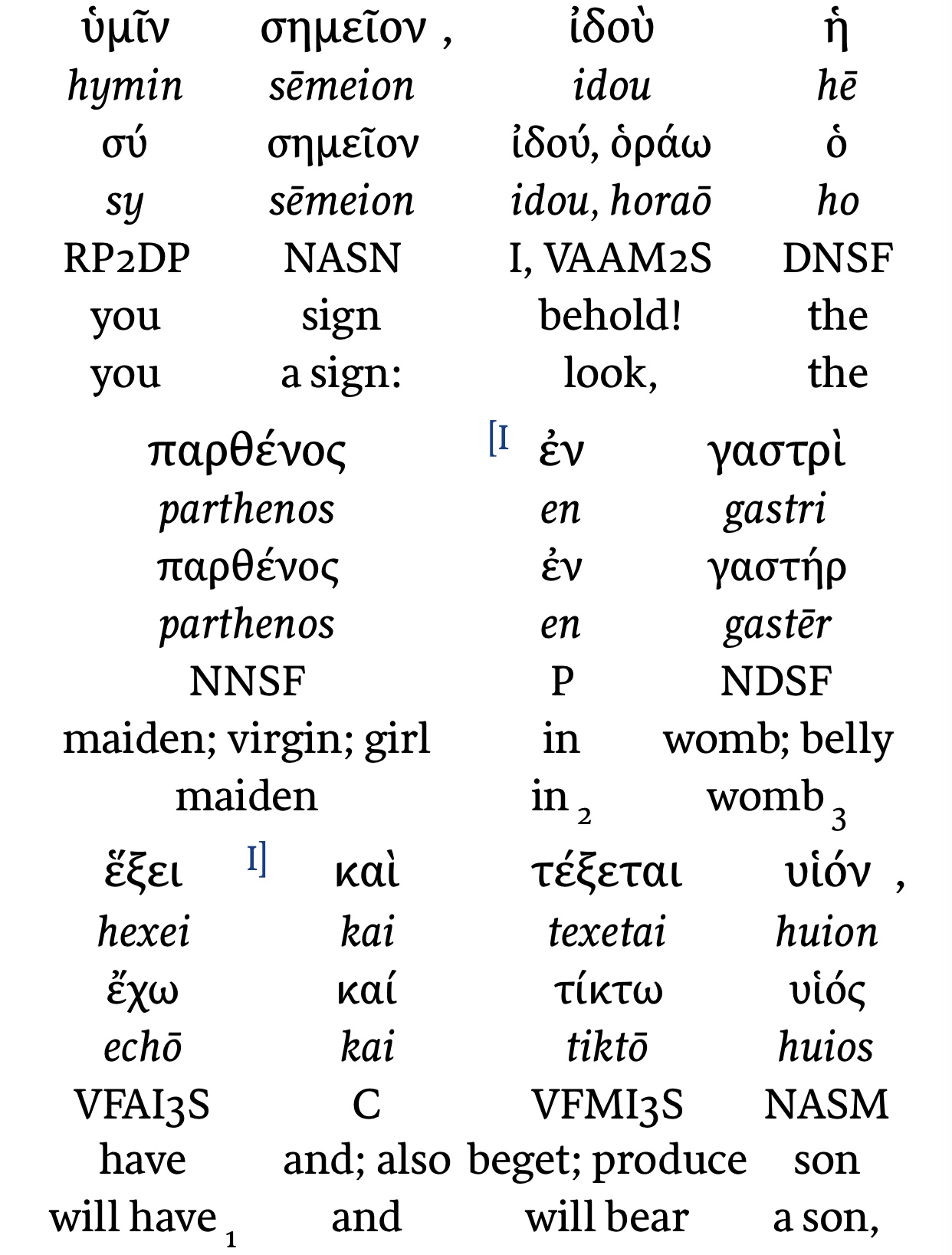
Notwithstanding the subtle controversies surrounding the Septuagint. This is a Greek translation thought to have been in common use around the time of Jesus’ birth. Here is an English translation of the Septuagint for the quotation from Matthew’s Gospel above.

Because of this, the Lord himself will give you a sign: Look, the maiden will become pregnant and will bear a son, and you will call his name Immanuel.

Isaiah 7:14— The Lexham English Septuagint (Bellingham, WA: Lexham Press, 2012)

Here we see the term maiden as it is translated from Hebrew to Greek and then into English. This seems to offer the skeptic some refuge, but does it really?

With a bit of assistance from interlinear tools… We discover something important.

Do you see it?

Parthenos does mean maiden and virgin. This tells us the skeptics are wrong. This could be accepted scholarship for those. I offer it because skeptics seldom take the time to really understand their objections.

Yet somewhere in the back of my mind, I simply prefer to believe what God has said. He moved in such a way as to have Isaiah write of that, using a Hebrew word that includes the meaning of virgin. After that miracle of the birth of the God-Man, He then moved Matthew in a similar fashion to Isaiah. In his Gospel, he used the word parthenos in translating Isaiah 7:14 (Matthew 1:23.)

That is how we know Jesus was born of a virgin. God is not constrained to (or by) time, matter and space. And His Word is true and reliable.

He Shall Send Them

Rejoice greatly, O daughter of Zion! And cry aloud, O daughter of Jerusalem! See, your king is coming to you; he is righteous and able to deliver, he is humble and riding on a donkey, a colt, the offspring of a donkey.

Zechariah 9:9 — Modern English Version (Thinline Edition.; Lake Mary, FL: Passio, 2014)

I know. This is more of an appropriate post for springtime. It works for this season simply for the fact that we ought to know Who it is Whose birth we celebrate.

This is a familiar prophecy to lag of us. I’m reading in Matthew of the Messiah’s Triumphal Entry into Jerusalem just before He was crucified.

When they drew near to Jerusalem and came to Bethphage, on the Mount of Olives, then Jesus sent two disciples, saying to them, “Go over into the village opposite you, and immediately you will find a donkey tied, and a colt with her. Untie them and bring them to Me. If anyone says anything to you, you shall say, ‘The Lord has need of them.’ And he will send them immediately.”
All this was done to fulfill what was spoken by the prophet, saying: “Tell the daughter of Zion, ‘Look, your King is coming to you, humble, and sitting on a donkey, and on a colt, the foal of a donkey.’”

Matthew 21:1–5 — Modern English Version (Thinline Edition.; Lake Mary, FL: Passio, 2014)

I couldn’t help but to notice, “he will send them immediately.”

Them… That word. There was more than one animal that was sent. It says a donkey and a colt.

When I read Scripture, I like to pay attention to the precision of the text. Oft times, it has caused me to rethink what I thought I knew Scripture teaches. What is God trying to convey here?

I am going to say something about the translations. I use the MEV for reading. It is sufficient for that task. I will use others to grasp the nuances in meaning or to be aware of the biases of the translators.

When comparing the translation of Matthew’s quotation of the Zechariah passage with how the translators actually rendered Zechariah 9:9… There are some differences. Notably, the Zechariah passage could be vaguely referring to one or two animals in the MEV. As rendered it isn’t clear. In other translations, we see the conjunction. The donkey would be joined with the colt. What is literally written in Zechariah is this: “and riding on an ass, And on a colt — a son of she-asses.” The literal rendering says Jesus is riding on two donkeys.

Think about that.

No earthly king would present himself on a donkey if the more majestic horse was available. Jesus riding on a donkey would immediately bring to mind lowliness and humility. It would be without comeliness, that is it wouldn’t be attractive.

I know the picture we have conjured in our mind’s eye of this event. Consider this: Jesus did ride into Jerusalem. He did it on a date precisely foretold almost 500 years earlier by a prophecy shown to and recorded by Daniel. Jesus expected the Israelis than to know of their visitation.

The disciples went and did as Jesus commanded them. They brought the donkey and the colt, laid their garments on them, and He sat on them.

Matthew 21:6–7 — Modern English Version (Thinline Edition.; Lake Mary, FL: Passio, 2014)

He sat on them.

This is as precise a picture of the presentation of the Messiah as Daniel’s dating. The King would be riding on an ass and a colt of she-asses. This was foretold by Zechariah. We see it fulfilled precisely in Matthew.

The presentation of the lowly Servant-King riding on the back of a wobbly donkey barely able to support Him. A colt who needed help from his own mother.

Now… How many kings are presented on two donkeys like that?

The True Israel

I the Lord have called You in righteousness,
and will hold Your hand,
and will keep You and appoint You
for a covenant of the people,
for a light of the nations,
to open the blind eyes,
to bring out the prisoners from the prison,
and those who sit in darkness out of the prison house.

Isaiah 42:6–7 — Modern English Version (Thinline Edition.; Lake Mary, FL: Passio, 2014)

This Servant is now being identified in another unique way. He is being given the same identity as Israel. The nation was called in righteousness, with the sure promise of God to uphold and defend it. It was given a covenant and a particular calling. These things are established beginning in Exodus chapter 19.

Now therefore, if you will faithfully obey My voice and keep My covenant, then you shall be My special possession out of all the nations, for all the earth is Mine. And you will be to Me a kingdom of priests and a holy nation.’ These are the words which you shall speak to the children of Israel.

Exodus 19:5–6 — Modern English Version (Thinline Edition.; Lake Mary, FL: Passio, 2014)

These are God’s words to Moses which he was to deliver to the people. Israel is to be a light to the nations. Priests are the ones who make God known to people, they intercede. This peculiar kingdom of priests was called to be a witness to all nations of the goodness of God.

For you are a holy people to the Lord your God. The Lord your God has chosen you to be His special people, treasured above all peoples who are on the face of the earth.

Deuteronomy 7:6 — Modern English Version (Thinline Edition.; Lake Mary, FL: Passio, 2014)

For you are a holy people to the Lord your God, and the Lord has chosen you to be a peculiar people to Himself, treasured above all the nations that are on the earth.

Deuteronomy 14:2 — Modern English Version (Thinline Edition.; Lake Mary, FL: Passio, 2014)

The intertwined calling of the Chosen Servant is applicable to the nation Israel. As prophecy is given to us as patterns, the calling of the nation Israel serves as a pattern for the Messiah. He would ultimately fulfill the mission the nation failed at. Jesus is the True Israel.

This is purposeful, in the earliest texts that tell the history of Israel.

Israel is My son, even My firstborn.

Exodus 4:22b — Modern English Version (Thinline Edition.; Lake Mary, FL: Passio, 2014)

The calling of Israel is extended to Jesus by another prophet.

When Israel was a child, I loved him, and out of Egypt I called My son.

Hosea 11:1 — Modern English Version (Thinline Edition.; Lake Mary, FL: Passio, 2014)

The way Israel is called by God serves as a pattern to identify the Coming Messiah.

Not so unexpectedly, I find a particular peculiarity in this pronouncement of the Chosen Servant. As the One called to open blind eyes, heal the sick, and release captives, this is the calling of priests. Israel is a kingdom of priests.

Yet we know they were blinded in their own pride. Some couldn’t recognize the Messiah. The most likely cause is an errant identity. The nation identified in their calling and not the One Who called them. Even when He spoke clearly of Who He is.

He came to Nazareth, where He had been brought up. And as His custom was, He went to the synagogue on the Sabbath day. And He stood up to read. The scroll of the prophet Isaiah was handed to Him. When He had unrolled the scroll, He found the place where it was written:
“The Spirit of the Lord is upon Me,
because He has anointed Me
to preach the gospel to the poor;
He has sent Me to heal the broken-hearted,
to preach deliverance to the captives
and recovery of sight to the blind,
to set at liberty those who are oppressed;
to preach the acceptable year of the Lord.”
Then He rolled up the scroll, and He gave it back to the attendant, and sat down. The eyes of all those who were in the synagogue were fixed on Him. And He began to say to them, “Today this Scripture is fulfilled in your hearing.”

Luke 4:16–21 — Modern English Version (Thinline Edition.; Lake Mary, FL: Passio, 2014)

We see all of these things fulfilled in Jesus’ ministry on earth by His own words. Jesus would build His church and give to them all of the privileges of service extended to the nation Israel. It would be another body identified solely in Him. But would mean the nation Israel would be set aside for a time.

For I could wish that I myself were accursed from Christ for my brothers, my kinsmen by race, who are Israelites, to whom belong the adoption, the glory, the covenants, the giving of the law, the service of God, and the promises, to whom belong the patriarchs, and from whom, according to the flesh, is Christ, who is over all, God forever blessed. Amen.

Romans 9:3–5 — Modern English Version (Thinline Edition.; Lake Mary, FL: Passio, 2014)

There is a different body that has been grafted into these privileges through Jesus. It is the body that does those things cited by the prophet Isaiah as part of the identity of the Chosen One.

That is how the church is now called elect… Chosen… To serve God in a peculiar way. It is to shine the light of Jesus to all nations.

We see clearly that the call of election is not to salvation, nor would salvation be limited to a group of people. It was the calling to a peculiar appointment of service to God.