
Homeborn Servants and Sons

Jesus answered them, “Truly, truly I say to you, whoever commits sin is a slave of sin. Now a slave does not remain in the house forever, but a son remains forever.

John 8:34–35 — Modern English Version (Thinline Edition.; Lake Mary, FL: Passio, 2014)

Not having a full understanding of the Torah hinders us Gentiles. We want to understand the things Jesus says, and we do in a shallow sense. There are deeper things we need to be diligent in searching out.

It would not occur to me to understand what Jesus is saying in light of the Torah. In this case, Jesus is referring to some of the first things about an elect people God will call His servants and the origins of that.

Therefore she said to Abraham, “Throw out this slave woman and her son, for the son of this slave woman shall not be heir with my son, Isaac.”

Genesis 21:10 — Modern English Version (Thinline Edition.; Lake Mary, FL: Passio, 2014)

We know that Isaac was the chosen heir. But there is an important distinction being made between servants and heirs. There is also an apparent distinction inherent among servants. There are those bought with money and there are those homeborn.

Is Israel a servant? Is he a homeborn slave?
Why has he been plundered?

Jeremiah 2:14 — Modern English Version (Thinline Edition.; Lake Mary, FL: Passio, 2014)

I understand that these texts will have layers of meanings. The first question asked here lends itself to be prophetic in nature as it speaks of Jesus. It also encompasses the entire nation of Israel. While it causes us to remember the son of Isaac, Jacob.

The Homeborn Servant.

But Abram said, “Lord God, what will You give me, seeing I am childless and the heir of my house is Eliezer of Damascus?” Abram said, “Since You have not given me any children, my heir is a servant born in my house.”

Genesis 15:2–3 — Modern English Version (Thinline Edition.; Lake Mary, FL: Passio, 2014)

We get a tiny glimpse into the realities of life in those times. To a childless couple, the first homeborn servant is heir apparent. It was no different for Abram and Sarai.

In their haste to work God’s promises for themselves, Sarai’s servant Hagar was given to Abram. The homeborn son is named Ishmael.

As Ishmael had the distinction of being fathered by Abram with the servant Hagar, he was now heir-apparent. This by the distinction of not being bought, but homeborn. More important is the fact that he is the firstborn son.

When the promise of God came after Abraham and Sarah’s names were changed, Isaac was born. Isaac is not firstborn and not heir-apparent. Therefore, the servant-child had to be driven out. Even though Isaac was a son, he was also a servant.

Though Ishmael benefits of the promise made to Abraham, the promise was on Isaac, not Ishmael. Isaac was the son of promise. God would also establish a covenant with Isaac.

The Lord appeared to him that same night and said, “I am the God of Abraham your father. Do not fear, for I am with you. I will bless you and multiply your descendants for the sake of My servant Abraham.”

Genesis 26:24 — Modern English Version (Thinline Edition.; Lake Mary, FL: Passio, 2014)

It is my contention that Abraham typifies the bought servant, while Isaac, the homeborn. Genetic heritage does not change, and the people descended from Abraham through the homeborn slave-son Ishmael and the son Isaac are innumerable. The son of bondage heir apparent had to be removed.

This hints as to the work of the cross. When Jesus died, the son of bondage was driven out. It made room for the son of promise. In other words, death was removed that life could be received.

Jacob is Born.

Now Isaac pleaded with the Lord for his wife, because she was barren; and the Lord granted his plea, and Rebekah his wife conceived. But the children struggled together within her, and she said, “If all is well, why am I like this?” So she went to inquire of the Lord. Then the Lord said to her,
“Two nations are in your womb,
and two peoples will be separated from your body;
one people will be stronger than the other,
and the older will serve the younger.”

Genesis 25:21–23 — Modern English Version (Thinline Edition.; Lake Mary, FL: Passio, 2014)

Paralleling the plight of his parents, Isaac and Rebekah were also barren. The promises of God entail countless progeny. In these times people waited years for the promises of God to come. It is not that He is slack or slow, but all things happen in due time.

When Isaac and Rebekah conceived, two babies would be born. This provides another important distinction. The older shall serve the younger. The covenant promise will be to the younger.

We follow that covenant promise. Just as Isaac was chosen and the slave driven away. The younger would be chosen as the conveyance of God’s promise.

We know the account of how Jacob bought the birthright with a pot of red lentils. We also know how Rebekah and Jacob connived to obtain the blessing of Isaac. It teaches us another important lesson, a birthright can be bought (I will leave that to you to figure out how that points to Jesus.)

Then the man said, “Your name will no more be called Jacob, but Israel. For you have fought with God and with men, and have prevailed.”

Genesis 32:28 — Modern English Version (Thinline Edition.; Lake Mary, FL: Passio, 2014)

It is this Jacob that serves as a further typification of Jesus in many ways. God’s covenant comes to Jacob, and his name is changed. The way the Bible weaves together the names of Israel, Jacob, and Jesus provide an easily accessible entree to a deeper truth.

Jacob prevailed. I think this to be prophetic in nature as it foreshadows Jesus.

But no one in heaven or on earth or under the earth was able to open the scroll or to look in it. I began to weep loudly, because no one was found worthy to open and read the scroll, or to look in it. Then one of the elders said to me, “Do not weep. Look! The Lion of the tribe of Judah, the Root of David, has triumphed. He is able to open the scroll and to loose its seven seals.”

Revelation 5:3–5 — Modern English Version (Thinline Edition.; Lake Mary, FL: Passio, 2014)

Jesus has prevailed. But what of this fought with God?

The Hebrew word behind the English fought is from the same root of Jacob’s grandmother’s name Sarah. It doesn’t mean physical fighting, but more like persistence and perseverance. As an aside, Sarah had to persist and persevere with Abraham! Yet something else about Jesus comes to mind…

Let us look to Jesus, the author and finisher of our faith, who for the joy that was set before Him endured the cross, despising the shame, and is seated at the right hand of the throne of God. For consider Him who endured such hostility from sinners against Himself, lest you become weary and your hearts give up.

Hebrews 12:2–3 — Modern English Version (Thinline Edition.; Lake Mary, FL: Passio, 2014)

Jacob my Servant.

Here is My servant, whom I uphold,
My chosen one, in whom My soul delights.
I have put My Spirit upon him;
he shall bring forth justice to the nations.

Isaiah 42:1 — Modern English Version (Thinline Edition.; Lake Mary, FL: Passio, 2014)

You are My witnesses, says the Lord,
and My servant whom I have chosen
that you may know and believe Me,
and understand that I am He.
Before Me there was no God formed,
nor shall there be after Me.

Isaiah 43:10 — Modern English Version (Thinline Edition.; Lake Mary, FL: Passio, 2014)

Yet now listen, O Jacob, My servant,
and Israel, whom I have chosen.

Isaiah 44:1 — Modern English Version (Thinline Edition.; Lake Mary, FL: Passio, 2014)

Remember these things, O Jacob,
and Israel, for you are My servant;
I have formed you; you are My servant;
O Israel, you shall not be forgotten by Me.

Isaiah 44:21 — Modern English Version (Thinline Edition.; Lake Mary, FL: Passio, 2014)

There are many witnesses to attest to the fact that Israelis are servants. The texts also have prophetic implications. They show us plainly that the names Jacob, Israel, and my servant all point to Jesus.

A Son is Forever.

In the Tanakh, we see Israel presented as a servant. Since Abraham, these would be the homeborn servants. But as clearly seen, there is a better relationship. That is to be a son (or child of God.) Jesus said a son remains forever.

A physical birthright doesn’t convey salvation. Salvation comes by promise. With all of this, what Paul writes to the Galatians is clear.

Sons by Faith.

You are all sons of God by faith in Christ Jesus. For as many of you as have been baptized into Christ have put on Christ. There is neither Jew nor Greek, there is neither slave nor free, and there is neither male nor female, for you are all one in Christ Jesus. If you are Christ’s, then you are Abraham’s seed, and heirs according to the promise.

Galatians 3:26–29 — Modern English Version (Thinline Edition.; Lake Mary, FL: Passio, 2014)

Homeborn servants are not necessarily sons of promise. Salvation isn’t conferred by election or birthright. It comes by faith.

No Longer a Servant, but a Son and Heir.

Now I say that as long as the heir is a child, he does not differ from a servant though he is lord of all. But he is under tutors and governors until the time appointed by the father. So when we were children, we were in bondage to the elements of the world. But when the fullness of time came, God sent forth His Son, born from a woman, born under the law, to redeem those who were under the law, that we might receive the adoption as sons. And because you are sons, God has sent forth into our hearts the Spirit of His Son, crying, “Abba, Father!” Therefore you are no longer a servant, but a son, and if a son, then an heir of God through Christ

Galatians 4:1–7 — Modern English Version (Thinline Edition.; Lake Mary, FL: Passio, 2014)

Adam sold his birthright for some food just like Esau. Jesus bought that birthright by obedience. He bought it to give it back to you as children of God received by faith.
They Shall Come Into the Land Restored from the Sword

And the word of the Lord came to me, saying: Son of man, set your face against Gog of the land of Magog, the prince of Rosh, Meshek and Tubal, and prophesy against him, and say: Thus says the Lord God: I am against you, O Gog, the prince of Rosh, Meshek and Tubal.

Ezekiel 38:1–3 — Modern English Version (Thinline Edition.; Lake Mary, FL: Passio, 2014)

Ezekiel is prophesying against the nations around Israel. This particular passage, it comes as a stark contrast to what comes before. That is, speaking of the restoration of Israel. I would think that the timeliness of that could also be considered prophetic. That restoration reads specifically as both Judah and Israel being gathered together as one nation. That assembly is happening today.

It comes as the backdrop for the set-up for what most scholars agree is something yet future. I contend that yet future is almost now.

The term Gog refers to an unidentifiable person; some think it is even a supernatural entity. The other names in the text are geographical in nature. These places are named in what is referred to as the Table of Nations in Genesis 10. Magog refers to part of Asia. Josephus identified Magog as the land of the Scythians. It is said by some the Great Wall of China was called the Ramparts of Magog. This most likely identifies the area around and including Ukraine and Russia.

The entire area is marked by three names, Rosh, Meshek, and Tubal. These would include the area directly north of Israel. This would fit with many of the prophetic warnings to Israel and Judah that were recorded at the same time. The invasion would come from the north (mentioned later in the text.) As it happened with Babylon.

And I will turn you back and put hooks into your jaws, and I will bring you out, and all your army, horses, and horsemen, all of them clothed with all sorts of armor, even a great company with buckler and shield, all of them handling swords.

Ezekiel 38:4 — Modern English Version (Thinline Edition.; Lake Mary, FL: Passio, 2014)

There are words here that are noteworthy. “I will turn you back.” God is saying that to these nations; He will make them turn back. It sounds like a reverse course; at least that is what seems to be said. Perhaps it is an about-face on a peripheral approval of peace accords.

It looks as if something is being used as bait to draw them. That fits with what is spoken of later in this. Some speculate that it is the massive gas deposits Israel has recently discovered. But I will leave that for the reader to discover.

This will be a vast military invasion of Israel. The text states horses will be used. Could that be literal?

What is intriguing to me is what is missing. In the other prophetic warnings of invasion recorded by Ezekiel and other prophets, the machines of warfare are mentioned… Camps and siege works along with a prolonged period of time. These are not mentioned here, which lends itself to happenings that are more sophisticated and short-lived.

Persia, Ethiopia, and Put with them, all of them with shield and helmet.

Ezekiel 38:5 — Modern English Version (Thinline Edition.; Lake Mary, FL: Passio, 2014)

Roughly… Iran, Ethiopia, and Libya would help with the invasion.

I will do so to Gomer and all its troops, Beth Togarmah of the north quarters and all its troops, and many peoples with you.

Ezekiel 38:6 — Modern English Version (Thinline Edition.; Lake Mary, FL: Passio, 2014)

This names what is the modern area of Turkey. It will also join the coalition. All of these nations would be allies in an invasion of Israel.

Be prepared and prepare yourself, you and all your companies that are assembled to you, and be a guard to them. After many days you shall be called. In the latter years you shall come into the land that is restored from the sword, whose inhabitants have been gathered out of many peoples, against the mountains of Israel which had been always a waste. But its people were brought out of the nations, and they, all of them, are dwelling safely.

Ezekiel 38:7–8 — Modern English Version (Thinline Edition.; Lake Mary, FL: Passio, 2014)

As God speaks to this confederation of invaders, He establishes some specific markers with a precision that seems to fit the current situation. I mean that they fit right into events of late.

This invasion is prophesied to be in the latter years. That is where we are… In what the Bible calls the last days. It is the latter years of the last days.

They shall come into the land restored from the sword.

This is huge! That is exactly what we are seeing today. Unprecedented peace agreements are being made between Israel and some of her age-old enemies. The land is being restored from the sword… And the centuries of warfare over it.

The modern-day inhabitants of Israel are gathered from many places. They have returned to Israel and settled. They have restored the mountains of Israel, which have always been a waste. The mountainsides are now terraced, and homes are built on them.

And all of these people were brought from other lands to the wasteland. They’ve trained it. They’ve made it alive again. It’s happening right before our eyes. And soon, Israel will be dwelling safely.

You shall ascend and come like a storm; you shall be like a cloud to cover the land, you and all your troops, and many peoples with you.

Ezekiel 38:9 — Modern English Version (Thinline Edition.; Lake Mary, FL: Passio, 2014)

It will be a sight to see…

You Are the Children of the Living God

Yet the number of the children of Israel will be as the sand of the sea, which cannot be measured nor numbered. And in the place where it was said to them, “You are not My people,” there it will be said to them, “You are the children of the living God.” Then will the Judahites and the children of Israel be gathered together, and appoint themselves one head, and they will come up out of the land, for great will be the day of Jezreel.

Hosea 1:10–11 — Modern English Version (Thinline Edition.; Lake Mary, FL: Passio, 2014)

The things that are hidden just below the surface reading of the text are amazing. In reading tonight, there were many things to see. This one stands out.

The prophet Hosea took a wife by the command of God. Not just any wife, but he was told to take a wife of harlotry. In the entire account of Hosea, there is much to learn about relationships with people and to forgive them their foibles as we have our own, too. Most importantly, the book shows us God’s love for His people.

The union of Hosea and Gomer produced children. The firstborn was Ammi, meaning my people. The second was Lo-Ruhamah, meaning not pitied. The third was Lo-Ammi, meaning not my people. Already one can perceive a story is written in the meanings of the names. It is in this account of the third that leads to the discovery at hand.

Here is God saying to those who are His people that you aren’t pitied and are not His people. Those who aren’t His people are to be His people. The overt meaning is that Gentiles would be called His people. This is the mystery hidden in the text. Part of what Paul wrote about is a body that consisted of Gentiles being called His people.

Being the people of God isn’t a birthright thing. This is part of what kept Israelites from believing Jesus when He came to them. They thought they had a physical birthright to the Father. And they did. But that alone didn’t make them His people.

Jesus answered him, “Truly, truly I say to you, unless a man is born again, he cannot see the kingdom of God.”

John 3:3 — Modern English Version (Thinline Edition.; Lake Mary, FL: Passio, 2014)

This is God saying that any person could be His people.

Then… That word then imposes itself in the text. This adds a timey-wimey element to the discussion. In this case, after those “not His people” become His people, something else happens. That something else is what we are eyewitnesses of today.

Of course, the translation I used says the Judahites and the children of Israel will come up out of the land… But is better understood that the whole of Israel will be gathered together as one in the land.

Oh, I know there was a previous regathering of Israelis from the diaspora, but that was limited to Judah and part of another tribe as they returned from Babylon. Throughout the prophets, there is a second exile that isn’t quite explained as a second exile. Maybe it was a continuation of the first. But the twelve tribes have not been regathered into the land until recent times.

Jesus as Stones

Coming to Him as to a living stone who is rejected by men, but chosen by God and precious, you also, as living stones, are being built up into a spiritual house as a holy priesthood to offer up spiritual sacrifices that are acceptable to God through Jesus Christ.

1 Peter 2:4–5 — Modern English Version (Thinline Edition.; Lake Mary, FL: Passio, 2014)

Peter presents Jesus in a metaphor using a series of stones. Beginning here, the worth of Jesus is going to be portrayed solidly (pun intended.) It will be in relation to some Old Testament passages he has in mind.

For also it is contained in the Scripture, “Look! I lay in Zion a chief cornerstone, elect, precious, and he who believes in Him shall never be put to shame.”
Therefore, to you who believe, He is precious. But to those who are disobedient, “The stone that the builders rejected has become the cornerstone,” and, “A stone of stumbling, and a rock of offense.”
They stumble because they are disobedient to the word, to which also they were appointed.

1 Peter 2:6–8 — Modern English Version (Thinline Edition.; Lake Mary, FL: Passio, 2014)

This is cited from Isaiah.

Therefore, thus says the Lord God: See, I lay in Zion a stone, a tested stone, a precious cornerstone, firmly placed; he who believes shall not act hastily.

Isaiah 28:16 — Modern English Version (Thinline Edition.; Lake Mary, FL: Passio, 2014)

Jesus is the Living Stone

I lay in Zion a stone. Zion is the mountain where Jesus stands in Revelation 14 with the 144,000. But we must understand the importance of the usage of Zion. The contrast is not addressed directly by Peter. It is an underlying tension for sure.

But you have come to Mount Zion and to the city of the living God, the heavenly Jerusalem, and to an innumerable company of angels; to the general assembly and church of the firstborn, who are enrolled in heaven; to God, the Judge of all; and to the spirits of the righteous ones made perfect; and to Jesus, the Mediator of a new covenant; and to the sprinkled blood that speaks better than that of Abel.

Hebrews 12:22–24 — Modern English Version (Thinline Edition.; Lake Mary, FL: Passio, 2014)

Coming to Mount Zion is in contrast of coming to another mountain, Sinai.

These things are an allegory, for these are the two covenants. The one is from Mount Sinai, which gives birth to bondage; she is Hagar. Now this Hagar is Mount Sinai in Arabia, and represents the present Jerusalem, and is in bondage with her children. But the Jerusalem which is above is free, which is our mother.

Galatians 4:24–26 — Modern English Version (Thinline Edition.; Lake Mary, FL: Passio, 2014)

A stone laid in Zion must be living. It is this Living Stone, Jesus. He is the unmoving and unchanging Mediator of a new covenant. This is in sharp contrast to the other mountain of the old covenant, Sinai. That is the mountain that gave birth to bondage. The Living Stone in Zion sets us free by sprinkled blood. (Remember how Peter used that term previously.)

Jesus is the tested Stone. He is the One Who did as God asked all the way to the cross, enduring its shame for the joy set before Him.

Jesus is the Cornerstone

No builder erects a structure without a cornerstone. It’s the same thought as the Hebrews passage alludes to, the church of the firstborn. The firstborn is Jesus. He is the Creator of all. Without Him, nothing exists. Every living creature owes fealty to Him just for drawing breath.

In the beginning was the Word, and the Word was with God, and the Word was God. He was in the beginning with God. All things were created through Him, and without Him nothing was created that was created. In Him was life, and the life was the light of mankind.

John 1:2–4 — Modern English Version (Thinline Edition.; Lake Mary, FL: Passio, 2014)

He is worthy. He is precious.

Jesus is the Rejected Stone

This idea comes from this passage.

The stone that the builders rejected has become the cornerstone.

Psalm 118:22 — Modern English Version (Thinline Edition.; Lake Mary, FL: Passio, 2014)

The psalmist is saying that a stone purposed for a particular purpose can become unwanted. In this case, the Jewish leaders rejected Jesus as their King. The Jewish people were chosen as God’s heritage. They were the ones purposed in the old covenant to make salvation known to the whole world. In that essence, these were the builders of the kingdom of God.

God chose Him for that purpose of being the foundation for salvation. Jesus was firmly placed as attested to us in the Scriptures. He is unmovable and He could not be conquered by rejection. In this case, death. This is a continuing theme from the first chapter.

Jesus is the Stumbling Stone

Peter also cites this passage.

He shall become a sanctuary, but a stone of stumbling and a rock of offense to both the houses of Israel, and a trap and a snare to the inhabitants of Jerusalem.

Isaiah 8:4 — Modern English Version (Thinline Edition.; Lake Mary, FL: Passio, 2014)

Take the time to consider the truths of the Bible, that is to study its claims and test them. God says He will be found by those who seek Him. In that sense, the Stone-lain becomes a sanctuary for those who take the time to seek Him.

But for the hasty, and the others who have ulterior motives, Jesus becomes a rock of offense. It is precisely because of Who He is that exposes such nefarious evil for what it is.

Though the people these Scriptures are taking to task were also appointed to the same word as all are. They were to consider the revelation of the Jewish Scriptures carefully and were expected to know Jesus when He came. In so doing, to believe in His mercies and be saved.

Mature by Coming to Jesus.

He is the Living Stone of New Jerusalem, the firmly placed Cornerstone. For us who desire the pure milk of the word and to be like Him, He is a sanctuary. He is a place of rest from work.

To the builders, the ones working to make something for themselves, He is hastily rejected.

The Olivet Discourse: 02 – The Destruction of the Temple Foretold

Continuing from the previous post, there are things to keep in mind. The first is the perspective of the author and the ideas he chooses to convey. Here is the foundation text beginning with the account in Matthew.

Jesus departed from the temple and was leaving when His disciples came to show Him the temple buildings.
Jesus answered them, “Do you not see all these things? Truly I say to you, not one stone shall be left here upon another that shall not be thrown down.”

Matthew 24:1–2 — Modern English Version (Thinline Edition.; Lake Mary, FL: Passio, 2014)

As Matthew starts, he relates the impetus for the conversation; the temple is mentioned, but no attention is given to describing it. The group was leaving the temple, and the disciples wanted to show Him the buildings. Imagine the change in the conversation. One moment it was about the temple; The next, destruction is foretold. This conversation was probably still in public, as the group had not yet come to the Mount of Olives. There may have been others privy to this part of the conversation.

Let’s examine the other synoptic accounts.

As He went out of the temple, one of His disciples said to Him, “Teacher, see what great stones and what great buildings are here.”
Jesus answered him, “Do you see these great buildings? Not one stone shall be left upon another that shall not be thrown down.”

Mark 13:1–2 — Modern English Version (Thinline Edition.; Lake Mary, FL: Passio, 2014)

Already one can discern some differences. Mark doesn’t just relate the gist of the conversation. He relates what is said. That is the action that is occurring. We also see the usage of the title Teacher.

Look at the mention of the great stones. Though the temple wasn’t yet complete, the stones they were looking at were 10 to 12 feet long. It was Herod’s goal for the temple mount to be a massive 1600 by 900 feet edifice soaring to nine stories in height. The walls were to be up to 16 feet thick. All this still wouldn’t match the glory of Solomon’s temple, had it been finished. Its destiny was to be toppled.

We come to Luke.

As some spoke of how the temple was adorned with beautiful stones and gifts, He said, “As for these things which you see, the days will come when not one stone shall be left on another that will not be thrown down.”

Luke 21:5–6 — Modern English Version (Thinline Edition.; Lake Mary, FL: Passio, 2014)

Like Matthew, Luke relates the impetus of the conversation. He too points out the stones. He also mentions the gifts. These are the decorative items donated by others to adorn the temple. Herod gave a golden vine that had bunches of grapes that were as tall as a human.

All three accounts, though differing, are conveying the same basic information. The temple’s beauty would come to be ruined.

The stylistic differences also become apparent in how the content is conveyed. Matthew draws attention to the temple building as if the reader is already familiar with it. Mark’s style is about title and action. He gives a bit of detail, perhaps as his audience may need help to understand how great the stones are, as if they are unfamiliar with them. Luke points to the ornate decorations and gifts. It’s a bit of humanity, and the artistry is of great interest to a Greek.

This is also a perfect example of what not to see. The disciples were concerned with the outward beauty of the temple. Absent from the conversation is what went on inside it. The temple was certainly the focal point of life in Jerusalem at the time. Its beauty was certainly something to admire.

Considering the words here, perhaps there is an underlying message to keep a light touch on the things of this world, as they will fade away. Perhaps to keep what is inside of the temple kosher instead of fixating on the outward appearances.

The Eagles Will be Gathered Together

It was something said by Pastor Greg tonight (would love to link to the video, but it is nearly impossible to do.) He held his Bible up and said there were things in it he didn’t understand. He said he understood much, and as he grew in wisdom, his understanding grew. Yet there were some things he didn’t get.

I was sitting on a bench in the back of church. My friends Dan on my right, Brian on my left. I showed them this verse.

Wherever the carcass is, there the eagles will be gathered together.

Matthew 24:28 — Modern English Version (Thinline Edition.; Lake Mary, FL: Passio, 2014)

I said I don’t understand that.

I read the immediate context before…

“So, if they say to you, ‘Look, He is in the desert,’ do not go there; or, ‘Look, He is in the private chambers,’ do not believe it. For as the lightning comes from the east and flashes to the west, so will be the coming of the Son of Man. Wherever the carcass is, there the eagles will be gathered together.

Matthew 24:26–28 — Modern English Version (Thinline Edition.; Lake Mary, FL: Passio, 2014)

Nothing immediately stood out for an explanation.

A bit of background… At the moment, I am endeavoring to search out the similarities and differences in the synoptic accounts of the Olivet Discourse. (For those less technical-minded, that would be Matthew 24, Mark 13, and Luke 21 where Jesus spoke to a small group of disciples about the end of the age.)

As it were, I peeked at the Faithlife Study Bible notes for that verse, and they were a bit lot short on the subject. The only note indicated that the word eagles is better understood as vultures. I kind of knew that.

The software I use had an annotation that pointed me here:

They asked, “Where, Lord?”
He replied, “Where the body is, there the eagles will be gathered together.”

Luke 17:37 — Modern English Version (Thinline Edition.; Lake Mary, FL: Passio, 2014)

Checking the immediate context for better understanding…

Just as it was in the days of Noah, so will it be in the days of the Son of Man. They were eating, drinking, marrying, and were given in marriage until the day when Noah entered the ark. Then the flood came and destroyed them all.
“Likewise as it was in the days of Lot: They ate, they drank, they bought, they sold, they planted, they built. But on the day that Lot departed from Sodom, fire and brimstone rained from heaven and destroyed them all.
“So will it be on the day when the Son of Man is revealed. On that day let him who is on the housetop, with his goods in the house, not come down to take them away. And likewise let him who is in the field not return to the things behind.
Remember Lot’s wife. Whoever seeks to save his life will lose it, and whoever loses his life will preserve it. I tell you, on that night two men will be in one bed; the one will be taken and the other will be left. Two women will be grinding grain together; the one will be taken and the other will be left. Two men will be in the field; the one will be taken and the other will be left.”

Luke 17:26–36 — Modern English Version (Thinline Edition.; Lake Mary, FL: Passio, 2014)

Now I know that what I didn’t understand is somehow connected to the second coming of the Messiah and not the rapture. This is clear by the very next statement in Scripture. They asked, “Where, Lord?”

They are asking where the people taken will end up. I have to admit, it isn’t a pretty sight. Many have used this portion of Scripture to demonstrate the rapture. It’s not here. This is more of a judgment. And I daresay, the judgment of a specific kind for a specific group of people. The ones taken are going to end up as food for vultures and other animals.

Arriving back in Matthew 24, it is clearly seen that the immediate context is also speaking of the second coming and not the rapture. (If one reads a bit backward in Luke 17, we also see the use of flashing lightning as a typification of the second coming. Yet… The immediate contexts in both passages speak of some not-so-good things for them.

As I thought about this throughout this evening and am now reclined in bed (it’s really late,) another particular piece of Scripture gnaws at the back of my mind, so to say.

Here, God is speaking of the defeat of Gog, and how there will be 7 months of cleansing the land of the dead bodies that resulted from that defeat. But before that, there’s this:

You shall fall upon the mountains of Israel, you and all your troops and the peoples who are with you. I will give you to the ravenous birds of every sort, and to the beasts of the field to be devoured.

Ezekiel 39:4 — Modern English Version (Thinline Edition.; Lake Mary, FL: Passio, 2014)

That’s the judgment against Gog. There is going to be a banquet for vultures and other animals. I hate to be graphic, but this is what the Bible clearly says.

My heritage is to Me as a speckled vulture; the vultures all around are against her. Come, assemble all the beasts of the field, bring them to devour.

Jeremiah 12:9 — Modern English Version (Thinline Edition.; Lake Mary, FL: Passio, 2014)

It will be after God defeats Israel’s enemies.

As for you, son of man, thus says the Lord God: Speak to every kind of fowl and to every beast of the field: Assemble and come. Gather on every side to My sacrifice that I sacrifice for you, even a great sacrifice upon the mountains of Israel, that you may eat flesh and drink blood. You shall eat the flesh of the mighty and drink the blood of the officials of the earth as though of rams, of lambs, and of goats, of bulls, all of them fatlings of Bashan. You shall eat fat until you are full and drink blood until you are drunk from My sacrifice which I have sacrificed for you. Thus you shall be filled at My table with horses and chariots, with mighty men, and with all the men of war, says the Lord God.

Ezekiel 39:17–20 — Modern English Version (Thinline Edition.; Lake Mary, FL: Passio, 2014)

This is something different than the other judgments. This is for those who actively oppose Israel, whether government officials or not. It’s for those who wanted her spoils.

It’s at the end of the age. It’s a sacrificial meal from God to the birds and beasts. Those specifically working to defeat Israel are the kibble.

Where I Am Going, You Cannot Come

Again, Jesus said to them, “I am going away, and you will seek Me, and you will die in your sins. Where I am going, you cannot come.”

John 8:21 — Modern English Version (Thinline Edition.; Lake Mary, FL: Passio, 2014)

That simple truth is a stumbling block for many. Jesus said it to the very leaders of His chosen people, Israel. Their leaders were told that where Jesus is going, they cannot come.

It wasn’t an outright prohibition to them, nor were they born condemned for that destiny. Quite the contrary, they were born Jewish, with all of the privileges that entail. (Paul outlines these in the first few verses of Romans 9.) Jesus was really saying… Where they could not go is heaven.

In this verse are some important things we can glean about salvation and election. Most importantly, they aren’t the same. Election doesn’t guarantee salvation.

Israelites are elect. They are God’s people. But clearly, being chosen isn’t enough to get one into heaven.

In the conversation preceding Jesus’ statement we’re considering, He is telling these Pharisees that they do not know the Father. Nor do they know Him. Consider that. The Father’s (and the Son’s) chosen didn’t know Him.

Furthermore, because they did not know Him they cannot know where He is going. He is going to heaven. They wouldn’t know where.

It’s not that Jesus condemned them to such a fate either. Jesus explained that succinctly to Nicodemus.

For God did not send His Son into the world to condemn the world, but that the world through Him might be saved. He who believes in Him is not condemned. But he who does not believe is condemned already, because he has not believed in the name of the only begotten Son of God.

John 3:17–18 — Modern English Version (Thinline Edition.; Lake Mary, FL: Passio, 2014)

The apparent condemnation Jesus proclaimed over these Pharisees wasn’t from Him. It was because they didn’t know Him. Not knowing Him means they would not know the Father. Jesus said so (John 8:19.)

Jesus told them He would go away. After He left, these Pharisees would seek Him but not find Him. They would die in their sins.

Many today are in that same condition… In danger of dying in their sins because they refused to believe Jesus. Many still seek Him. Some do it in vain; they never believe. Others believe and are saved.

Which are you?

The ones who seek Jesus and never find Him, because one doesn’t believe they themselves have fallen short and are in need of rescue.

Or…

Of the redeemed, who know Jesus and the Father. They know where Jesus was going. Therefore, they are going there, too.

Men Fainting from Fear and Expectation

“There will be signs in the sun and the moon and the stars; and on the earth distress of nations, with perplexity, the sea and the waves roaring; men fainting from fear and expectation of what is coming on the inhabited earth. For the powers of heaven will be shaken. Then they will see the Son of Man coming in a cloud with power and great glory. When these things begin to happen, look up and lift up your heads, for your redemption is drawing near.”

Luke 21:25–28 — Modern English Version (Thinline Edition.; Lake Mary, FL: Passio, 2014)

These are the words of Jesus to His disciples during a private briefing He gave them in the week before His death. Clearly, we can understand that the events portrayed here will happen around the time closely preceding Jesus’ return to judge the world.

Reading through this, there was something that stood out. Jesus speaks of the signs that seem to be unprecedented at any time heretofore. He then makes an interesting statement that there will be humans “fainting from fear and expectation of what is coming.”

What is Coming

Perhaps He is speaking to that period of signs and distress He spoke of in the immediately preceding context. But then He could be speaking of the immediately preceding context; as bad as it was, things coming would be more perilous and frightening.

I am thinking the latter is probably a better explanation. Those people who faint from fear connect right here:

In those days men will seek death but will not find it. They will desire to die, but death will elude them.

Revelation 9:6 — Modern English Version (Thinline Edition.; Lake Mary, FL: Passio, 2014)

As the revelation unfolds beginning in Revelation 6, seals are opened. As each seal is opened, it reveals an event among other things.

The Seals

As the first is opened, it reveals a horseman given the ability to conquer. This is most likely what will bring a one-world leader into power. Yet it will not be without bloodshed. The second reveals peace being taken from the earth. Again, this will probably prove fatal to some humans. The next brings massive inflation. How much death would occur during each of these?

The fourth horseman brings death to one-quarter of the Earth’s population. The next seal reveals comfort and encouragement given to the servants of God murdered during this time. They seem to have already been informed that God would avenge them. They ask God, “How long?”

The sixth seal reveals massive earthquakes and signs in the sky. The stars of heaven fall to the Earth. This could be figurative, or it could be the fallen angels coming to Earth as the marshaling of forces to confront Jesus when He comes to Earth to judge at the end of these events.

So far we see that this stuff is so disconcerting that people will go underground and hide in caves. They will hide from what they know is the great day of His (Jesus’) wrath.

A pause ensues; the servants of God on Earth are marked. We also see the saints that were murdered for their testimony during this time of perplexity worshipping Jesus. We see the prayers from those still alive being heard in the heavens, and answers to them are prepared.

As the seventh seal is opened, there is a short period of silence. After the silence, angels are revealed; seven of them have trumpets.

The first angel sounds his trumpet, and a third of all vegetation burns up. The second sounds, and a great rock falls into the sea, destroying a third of the living creatures in it and a third of the ships on it. The third blares, a star falls from heaven and makes a third of the freshwater rivers bitter, killing those who drink the water. The fourth angel sounds, and a third of the day and a third of the night have no light.

There is yet another pause.

Then I watched, and I heard an angel flying through the midst of heaven, saying with a loud voice, “Woe, woe, woe to the inhabitants of the earth, because of the other trumpet blasts of the three angels, who are yet to sound!”

Revelation 8:13 — Modern English Version (Thinline Edition.; Lake Mary, FL: Passio, 2014)

Now, considering all that has been revealed so far from Revelation 6 through 8 and how it is easily and succinctly summed up in Luke 21:25. Think of the reaction you might have to an angel flying over your head saying loudly, “Woe, woe, woe.” Would there be overwhelming fear so bad you would want to die?

God says they will desire to die, but death will elude them.

men fainting from fear and expectation of what is coming on the inhabited earth. For the powers of heaven will be shaken.

Luke 21:26 — Modern English Version (Thinline Edition.; Lake Mary, FL: Passio, 2014)
The Powers of Heaven Will Be Shaken

The fifth angel sounded, and I saw a star fallen from heaven to the earth. The star was given the key to the bottomless pit. He opened the bottomless pit, and smoke ascended from the pit, like the smoke of a great furnace. The sun and the air were darkened by the smoke from the pit. And out of the smoke locusts came upon the earth. Power was given them as the scorpions of the earth have power. They were commanded not to harm the grass of the earth, or any green thing, or any tree, but only those men who did not have the seal of God on their foreheads. They were given authority, not to kill them, but to torment them for five months. Their torment was like the torment of a scorpion when it stings a man. In those days men will seek death but will not find it. They will desire to die, but death will elude them.

Revelation 9:1–6 — Modern English Version (Thinline Edition.; Lake Mary, FL: Passio, 2014)

I cannot even begin to imagine the things that would follow. An angel opens a pit, from which locusts thick as clouds come. These won’t bother anything other than those men who do not have the seal of God. These will have a painful sting and cannot kill either.

That Time Approaches Quickly

Given the greater context of our primary text in Luke 21, this setting is in the period before these things happen. By the parable of the fig tree that comes immediately after, we can surmise we are most likely in that time period.

What is coming is a drastic and systematic reduction of the population of the Earth. It’s going to happen. God didn’t write this to scare anyone, but to warn those who have ears to hear… So they may prepare.

That preparation is to become a servant of God… Not a servant of the needy, the culture, or yourself.

Harmonizing the Tribulation of Those Days

“Immediately after the tribulation of those days, ‘the sun will be darkened, the moon will not give its light; the stars will fall from heaven, and the powers of the heavens will be shaken.’
“Then the sign of the Son of Man will appear in heaven, and then all the tribes of the earth will mourn, and they will see the Son of Man coming on the clouds of heaven with power and great glory. And He will send His angels with a great sound of a trumpet, and they shall gather His elect from the four winds, from one end of the heavens to the other.

Matthew 24:29–31 — Modern English Version (Thinline Edition.; Lake Mary, FL: Passio, 2014)

“But in those days, after that distress, ‘the sun will be darkened, and the moon will not give her light; the stars of heaven will fall, and the powers that are in heaven will be shaken.’
“Then they will see the Son of Man coming in clouds with great power and glory. Then He will send His angels and gather His elect from the four winds, from the farthest part of the earth to the farthest part of heaven.

Mark 13:24–27 — Modern English Version (Thinline Edition.; Lake Mary, FL: Passio, 2014)

“There will be signs in the sun and the moon and the stars; and on the earth distress of nations, with perplexity, the sea and the waves roaring; men fainting from fear and expectation of what is coming on the inhabited earth. For the powers of heaven will be shaken. Then they will see the Son of Man coming in a cloud with power and great glory. When these things begin to happen, look up and lift up your heads, for your redemption is drawing near.”

Luke 21:25–28 — Modern English Version (Thinline Edition.; Lake Mary, FL: Passio, 2014)

In the harmony of these presentations of the special briefing that Jesus gave His disciples at the end of the age, there are similarities that can be harmonized. All three are describing a time of great tumult, with signs in the sun, moon, and stars, and the heavens being shaken. We also see Jesus coming in the clouds.

To understand the coming in the clouds, we must delve into the Old Testament. We find over the many mentions of clouds associated with God it came in the form of divine intervention for His people. During the Exodus, God led the Israelites in a pillar of cloud by day. When the cloud descended on the tent of meeting, it signified the presence of God. God coming in the clouds is a powerful and symbolic way to demonstrate divine intervention, divine judgment, or divine provision for the preservation of His people.

In this ‘sign’ we see ALL three. There is also another truth in the harmony that isn’t discussed. That is, Jesus is referring to Himself as God. If one understands the trial with the high priest, Jesus was asked if He was the Messiah, the Son of God. In His reply, He affirmed the questions the priest asked and claimed He is God. This is understood when we know the identity of Who comes in the clouds. Jesus said it would be Him by the title He chose for Himself. This title is also a direct reference to all of this.

I saw in the night visions, and there was one like a Son of Man coming with the clouds of heaven. He came to the Ancient of Days and was presented before Him. There was given to Him dominion, and glory, and a kingdom, that all peoples, nations, and languages should serve Him. His dominion is an everlasting dominion, which shall not pass away, and His kingdom that which shall not be destroyed.

Daniel 7:13–14 — Modern English Version (Thinline Edition.; Lake Mary, FL: Passio, 2014)

The differences are also important. Let’s poke at some of these.

The first is the introductory phrase to this time. In the Matthew and Mark account, the audience’s attention is drawn toward the period after these distresses. More things would happen on Earth and in the heavens, and then the Son of Man would appear. The elect would be gathered, and a kingdom established (The latter part is inferred.) Both accounts seem to give a contemporaneous account of events.

Now note how Luke explains it, paying special attention to where he wants the audience’s attention drawn. From the outset, Luke is asking his reader to understand the time before these events occur. This is clearly understood by this phrase: “of what is coming on the inhabited earth.” Luke describes the same events that will happen, not contemporaneously.

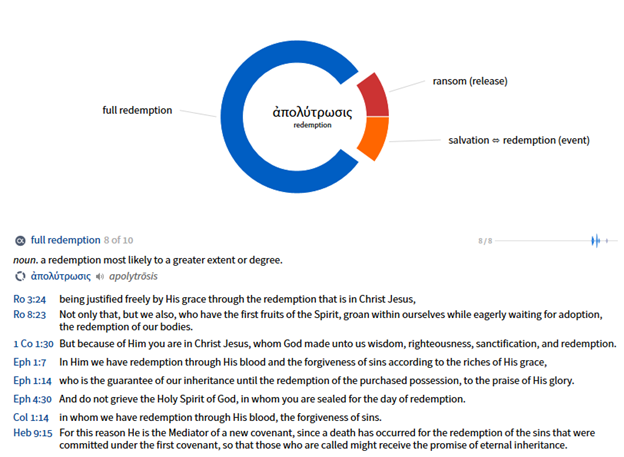
Then we encounter the last sentence. “When these things begin to happen, look up and lift up your heads, for your redemption is drawing near.” Luke is a gentile writing to Gentiles. He is admonishing them to pay attention when these things begin to happen. We also have the use of a unique word, ‘redemption.’

Matthew and Mark are drawing attention to the time of God’s intervention, judgment, and preservation of His people. Perhaps it could be redemption. Yet they did not use the word. I think it is because the attention of the reader is being drawn to two different events. Luke is drawing attention to redemption that occurs before the harmonized disasters that are described.

Considering redemption and the way the word is used in the New Testament, we can readily see the references to the majority of forms in the graphic. There are two other uses: one reference meaning ransom/release is cited in Hebrews 11:35 (Red.) The other is referencing an event and is the one word from Luke 21:28 we are discussing, ‘Redemption.’

God’s Bread

In those days a decree went out from Caesar Augustus that the entire inhabited earth should be taxed. This taxation was first made when Quirinius was governor of Syria. And everyone went to his own city to be taxed.
So Joseph also departed from the city of Nazareth in Galilee to the City of David which is called Bethlehem, in Judea, because he was of the house and lineage of David, to be taxed with Mary, his betrothed wife, who was with child. So while they were there, the day came for her to give birth. And she gave birth to her firstborn Son, and wrapped Him in strips of cloth, and laid Him in a manger, because there was no room for them in the inn.

Luke 2:2–7 — Modern English Version (Thinline Edition.; Lake Mary, FL: Passio, 2014)

As we’ve discussed before, God is present in every moment. The fact that Caesar Augustus decreed a tax that would ensure Joseph would be in the city of his lineage was known to God when David called the prophet Samuel.

The Lord said to Samuel, “How long will you mourn for Saul, since I have rejected him from ruling over Israel? Fill your horn with oil and go. I will send you to Jesse the Bethlehemite, for I have chosen a king for Myself from among his sons.”

1 Samuel 16:1 — Modern English Version (Thinline Edition.; Lake Mary, FL: Passio, 2014)

Bethlehem is the birthplace of Kings. It is the birthplace of God’s Chosen. In this way, God’s choosing of David was a pattern for Israel, and by extension the whole world. That’s for us!

David’s anointing would be when Israel already had a king… Saul. In the same way, Jesus’ advent was when Israel already had a king… Caesar.

It is Bethlehem. The word means house of bread. The Bread of Heaven would be born there.

But you, Bethlehem Ephrathah, although you are small among the tribes of Judah, from you will come forth for Me one who will be ruler over Israel. His origins are from of old, from ancient days.

Micah 5:2 — Modern English Version (Thinline Edition.; Lake Mary, FL: Passio, 2014)

Least among the tribes of Judah.

Everything about His birth doesn’t make us think of kings or rulers. Jesus was born to a regular working-class couple. He was born away from home, in a stall for animals. His first resting place was most likely a trough hewn from stone used for fodder. And Bethlehem… Which was a relative backwater near bustling Jerusalem.

David was born there, too. He was the least of his brothers. He was the shortest in stature. He was a dirty shepherd. Shepherds in those days were the least esteemed of people if they were even considered that. David serves as the pattern.

We were to know that pattern.

God chooses the weak to confound the strong. He chooses the base to offend the intellectual. We choose according to stature, prowess, mental acumen, and wealth. These are the things humans esteem. This is not so with God.

A dirty and lowly shepherd boy was chosen to be king over Israel. This David is like a sling stone, forged through time to land in the midst of that lowly carpenter’s Boy’s circumstance of birth.

It’s that day.

Today (the eve of Christmas,) when you think of Jesus and His birth, it’s not the trappings of silver and gold, the red and the white and the green… Santa Claus or turkey… Or even what skeptics say that really matters.

It’s Who Jesus is that does. God’s desire is that you eat His Bread! Seriously. He wants you to take Jesus into your body by believing He is Emmanuel, God among men… Your King.