Paneas and Sacrifice

But He turned and said to Peter, “Get behind Me, Satan! You are an offense to Me, for you are not mindful of the things that are of God, but those that are of men.”

Matthew 16:23

This is a startling and sharp rebuke to Peter. It is evidence of His emotionally humanistic conception. Because of that, Peter is aligning himself with Satan’s plan. One that would deter Jesus from fulfilling His mission. The rebuke is harsh and demonstrates to us the focus Jesus had on His mission. He was sent to die.

Peter’s fear is revealed at the thought of Jesus dying. That fear also gives an opportunity for offense. Peter stumbles. This Foundation the church is built upon is not Peter, but it is the Rock of offense. In the last post, the idea of the Rock Jesus spoke of would be Himself. Testified to previously by Peter himself.

Long after the death and resurrection of Jesus, Peter expounds on this theme by cutting the Tanakh.

Coming to Him as to a living stone who is rejected by men, but chosen by God and precious, you also, as living stones, are being built up into a spiritual house as a holy priesthood to offer up spiritual sacrifices that are acceptable to God through Jesus Christ.

1 Peter 2:4–6

Peter now understands the issue clearly. Jesus is the Rock chosen by God Himself and would give the greatest sacrifice. Jesus is the Foundation the church is being built upon. Peter is one of those living stones, as is every believer. Like every believer, we are like Jesus, kings and priests working for God.

To Him who loved us and washed us from our sins in His own blood, and has made us kings and priests to His God and Father, to Him be glory and dominion forever and ever. Amen.

Revelation 1:5b–6

The Acceptance of Obedience

Just as Jesus laying down His life was a spiritual sacrifice; we believers are called to do the same.

I urge you therefore, brothers, by the mercies of God, that you present your bodies as a living sacrifice, holy, and acceptable to God, which is your reasonable service of worship. Do not be conformed to this world, but be transformed by the renewing of your mind, that you may prove what is the good and acceptable and perfect will of God.

Romans 12:1–2

The idea of sacrificing ourselves to the work of Jesus is the same as that of living stones in a spiritual house. Like Murray’s, or denial of ourselves comes with gifts for service to Him and others. Paul explains it this way.

For I say, through the grace given to me, to everyone among you, not to think of himself more highly than he ought to think, but to think with sound judgment, according to the measure of faith God has distributed to every man. For just as we have many parts in one body, and not all parts have the same function, so we, being many, are one body in Christ, and all are parts of one another. We have diverse gifts according to the grace that is given to us: if prophecy, according to the proportion of faith; if service, in serving; he who teaches, in teaching; he who exhorts, in exhortation; he who gives, with generosity; he who rules, with diligence; he who shows mercy, with cheerfulness.

Romans 12:3–8

Just as each stone is selected and purposefully cut to fit into the overall structure, the same is with the spiritual house (or body of Christ.) A stone crafted to be a lintel does not fit as a doorpost or wall stone. Each has a carefully crafted purpose. This is the idea, that we yield ourselves to be conformed to the purposes God has chosen for us. In this, we prove His perfection.

The Rejection of the Disobedience

For also it is contained in the Scripture, “Look! I lay in Zion a chief cornerstone, elect, precious, and he who believes in Him shall never be put to shame.”
Therefore, to you who believe, He is precious. But to those who are disobedient, “The stone that the builders rejected has become the cornerstone,” and, “A stone of stumbling, and a rock of offense.” They stumble because they are disobedient to the word, to which also they were appointed.

1 Peter 2:7–8

As believers, we will never be put to shame no matter what we may do. That is a simple truth.

The same is not valid for those who disobey and never believe. These are offended at the thought that the Anointed King would have to die. Let alone Him dying for their sins. Obedient belief is appointed to Israelis. Yet they reject it stumbling in their own disobedience.

Jesus calls all of us to a living sacrifice, just as He did. We know He died and rose again. And we can expect the same for us because of His promises.

Sacrifice at the Gates of Hell

The sacrifices offered at the Gates of Hell stood in stark contrast. The pagan gods worshipped there completely consumed the dead sacrifices offered to them.

The Grotto of Pan is a cave. It was the reason the nearby sanctuary was built. A natural spring gushed water into what is now called the Banias River. This river feeds the Jordan River. In ancient times, water entered the cave and disappeared into a deep fissure in the rock. It is estimated to have been over 800 feet deep. Subsequent seismic activity destroyed much of the features of the cave.

When a sacrifice was made, the dead carcass was thrown into the mouth of the cave. The waters carried it into the natural abyss at the back of the cave. The victim disappeared into the water. If no blood appeared in the nearby springs, the offering was thought to be accepted.

Panic and the Cure

It is fitting in this setting to speak of these things as a rich backdrop to what Jesus is saying and doing. This is the Gates of Hell, the Grotto of Pan. Pan is considered by some to be one of the first deities. He is a fertility god and is the embodiment of nature. He is also known for enticing fear with panic. The word panic is derived from his name.

Way back in the garden, the idea of death was whitewashed by the shining one (serpent.) Even was persuaded to partake of the forbidden, and in turn, gave to her husband. Something changed. They knew they were naked and covered themselves. When God called, they hid in fear. Death came to humanity, and with it came fear. Death became the bondage of Adam’s race.

Yet Adam was not supposed to know death. This bondage to death is the very thing the enemy has used to shackle people. When people are confronted with sudden death, fear and then panic take hold. The shining one brought war to God through humans. The mythologies of old subtly obscure the truth.

Jesus in rebuking Peter, hoped to shock him from panic. It was Jesus on His mission to end the war of the gods and free humanity. Jesus was going to do it by dying. His resurrection destroyed the power of death. Fear and panic are decimated. We know that by hindsight. Think of how many times the Bible tells us to not be afraid, even in the presence of God.

So then, as the children share in flesh and blood, He likewise took part in these, so that through death He might destroy him who has the power of death, that is, the devil, and deliver those who through fear of death were throughout their lives subject to bondage.

Hebrews 2:14–15

It is my opinion that the eventual devastation of this grotto is proof that God destroyed the power of death. The sacred places of the old gods are in ruins now.

That fear of death that binds no longer has power. Jesus died to give us precious respite from the justice due to us for our sins. He rose again to give us victory over sin. It is in that freedom we have an opportunity to be reconciled to God Himself.

Rest assured, though… If one dies in their sins, the destiny is everlasting perdition.

Paneas and Peter’s Rebuke of Jesus

Then Peter took Him and began rebuking Him, saying, “Far be it from You, Lord! This shall not happen to You.”

Matthew 16:22

Peter attempts to teach the Teacher. He criticizes Jesus assuming he knows better. Peter is primed with (to him) contemporary thinking that the Messiah came to vanquish enemies. Jesus couldn’t do that if He died, right?

The Conquering Messiah

In the political climate of the time, there was a short list of agreement among Jewish sects. This included important differences on the expectation of the Messiah. The Essenes were expecting a military hero that would reform temple worship. The Sadducees had no messianic expectations, denied resurrection, and therefore had limited expectations of a future Davidic Kingdom. The Idumaeans (Herodians) would also not be interested in a competing leader. The Pharisees however, expected a Messiah.

One particular agreement amongst the sects was a longing for freedom from Roman rule. This idea had roots in the earlier Maccabean revolt and eventually culminated in AD70. There are important Jewish writings that many are unfamiliar with, and this would include an apocryphal work called the Psalms of Solomon. This book has ties to the Maccabean revolt and is considered non-canonical, yet it was part of the Septuagint. Some of these psalms demonstrate an awareness of the Roman conquest of Jerusalem. Others are clearly Messianic. One in particular Psalms of Solomon 17 is similar to Psalm 72 (also attributed to Solomon.)

It was this Psalms of Solomon 17 that seems to have formed much of the political expectations that the Pharisees had of the Messiah. This idea would also be known among the citizenry of Israel. This particular Psalm is messianic. I will cite a part of it from the Septuagint that demonstrates the expectation.

See, O Lord, and raise up their king for them, a son of David, for the proper time that you see, God, to rule over Israel your servant. And undergird him with strength to shatter unrighteous rulers. Cleanse Jerusalem from the nations that trample it in destruction, to expel sinners from the inheritance in wisdom, in righteousness, to rub out the arrogance of the sinner like a potter’s vessel, to crush all their support with an iron rod; to destroy lawless nations by the word of his mouth, for Gentiles to flee from his face at his threat, and to reprove sinners by the word of their heart.

Psalms of Solomon 17:23–27 — The Lexham English Septuagint (Bellingham, WA: Lexham Press, 2012)

The Servant

It is a line in that Psalm above that takes us to the next point, the identity of the servant. Second Temple era Judaism interpreted much of the texts speaking of the suffering servant as an identification of the nation Israel. Just as it is above.

But what does the Bible show us?

Here is My servant, whom I uphold, My chosen one, in whom My soul delights. I have put My Spirit upon him;
he shall bring forth justice to the nations.

Isaiah 42:1

You are My witnesses, says the Lord, and My servant whom I have chosen that you may know and believe Me, and understand that I am He. Before Me there was no God formed, nor shall there be after Me.

Isaiah 43:10

He said to me, “You are My servant, Israel, in whom I will be glorified.”

Isaiah 49:3

See, My servant shall deal prudently; he shall be exalted and extolled, and be very high.

Isaiah 52:13

Hear this, O Joshua the high priest, you and your friends sitting before you, for these men are a sign. I am bringing My servant, the Branch. The stone that I have set before Joshua, on that single stone is seven eyes. And I will engrave an inscription, says the Lord of Hosts, and I will remove the iniquity of this land in one day.

Zechariah 3:8–9

I offer a few of the texts to demonstrate that this servant idea applies to both Israel as a nation and to the Messiah. It might be clear to us modern thinkers, but not so much for any Israeli at that time.

Being that an Israeli would consider the servant to be the nation of Israel, writings such as Psalm 22 would be taken as a cry from the nation as a servant. Isaiah 53 would also be understood as not messianic in nature.

Who has believed our report?
And to whom has the arm of the Lord been revealed?
For he grew up before Him as a tender plant and as a root out of a dry ground. He has no form or majesty that we should look upon him nor appearance that we should desire him. He was despised and rejected of men,
a man of sorrows and acquainted with grief.
And we hid, as it were, our faces from him;
he was despised, and we did not esteem him.
Surely he has borne our grief and carried our sorrows; Yet we esteemed him stricken, smitten of God, and afflicted. But he was wounded for our transgressions,
he was bruised for our iniquities;
the chastisement of our peace was upon him, and by his stripes we are healed.
All of us like sheep have gone astray; each of us has turned to his own way, but the Lord has laid on him the iniquity of us all. He was oppressed, and he was afflicted,
yet he opened not his mouth;
he was brought as a lamb to the slaughter,
and as a sheep before its shearers is silent,
so he opened not his mouth.
By oppression and judgment he was taken away, and who shall declare his generation? For he was cut off out of the land of the living; for the transgression of my people he was struck. His grave was assigned with the wicked, yet with the rich in his death,
because he had done no violence,
nor was any deceit in his mouth.
Yet it pleased the Lord to bruise him; He has put him to grief. If he made himself as an offering for sin, he shall see his offspring, he shall prolong his days, and the good pleasure of the Lord shall prosper in his hand. He shall see of the anguish of his soul and be satisfied.
By his knowledge My righteous servant shall justify the many, for he shall bear their iniquities.
Therefore, I will divide him a portion with the great, and he shall divide the spoil with the strong, because he poured out his soul to death, and he was numbered with the transgressors, thus he bore the sin of many
and made intercession for the transgressors.

Isaiah 53:1–12

This portion of Isaiah is not known by many Jewish folk today. It is called the forbidden chapter. It is excluded from haftara portions that are read openly in synagogues.

In hindsight, this particular chapter outlines the mission of the Messiah as told beforehand in excruciating detail. He would necessarily suffer and die for sins.

Perhaps it was overlooked that if Messiah made Himself an offering for sins, it also says “(H)e shall see his offspring, he shall prolong his days, and the good pleasure of the Lord shall prosper in his hand.” Th were is no other way to describe that but as resurrection. No other explanation can be made as to how someone can prolong Their days after One dies.

With all that in mind, it seems apropos that Jesus would begin to speak about resurrection.

The Rock

Zechariah told us the servant is the Rock. The Bible talks about Jesus being the precious cornerstone that to some, specifically Israelis, would be a rock of offense. One to stumble over, just as Peter did.

Why not? Because they did not seek it by faith, but by the works of the law. For they stumbled over the stumbling stone. As it is written:
“Look! I lay in Zion a stumbling stone
and rock of offense, and whoever believes in Him will not be ashamed.”

Romans 9:32–33

Peter is expecting the Conquering King. He is expecting a Righteous Ruler. A suffering Servant was not expected. The talk of resurrection would also be unexpected and go right over his head.

As Jesus had stated before this rebuke of Peter, He would suffer many things from the elders, chief priests, and scribes. All of which would lead to His death. Yet He boldly said He would prolong His days and be raised on the third day.

Peter’s response to it is disbelief. To his credit, I might be able to understand that thinking. It raises a question in my mind.

Why would a Conquering King need to die before taking His rightful place on the throne?

There are other messianic texts that fill in details. The prophecies were clear.

“Know therefore and understand that from the going forth of the command to restore and to rebuild Jerusalem until the Prince Messiah shall be seven weeks, and sixty-two weeks. It shall be built again, with plaza and moat, even in times of trouble. After the sixty-two weeks Messiah shall be cut off and shall have nothing. And the troops of the prince who shall come shall destroy the city and the sanctuary.

Daniel 9:25–26

Messiah will be cut off and have nothing. The euphemism cut off is a reference to sudden death. Peter has no excuse not to know this as the penalty for sin that is ascribed in the law. Yet plainly, the mission of the Messiah is clearly outlined in the Tanakh. Peter is taking an emotionally humanistic view, not quite understanding the precise timing.

Seventy weeks have been determined for your people and upon your holy city, to finish the transgression, and to make an end of sins, and to make atonement for iniquity, and to bring in everlasting righteousness, and to seal up the vision and prophecy, and to anoint the Most Holy Place.

Daniel 9:24

That text comes before the prophecy of the Messiah being cut off. It lays out the planned timing. 70 weeks are given (that’s a figure of speech meaning 490 years.) Messiah is cut off after 69 weeks.

It follows that if Messiah is to put an end to all of that, one week is left after being cut off. He would need to prolong His days to accomplish the task. He would have to be alive after dying.

To this day, controversy is afoot concerning these passages in Daniel. Some say the prophecies are done. Others say seven more years remain for Israel. One must also consider why a nation was destroyed and its people scattered, survived as a people for millennia. They are now being gathered into a nation called Israel born in a day. A student of prophecy knows that the nation as a whole has not been regathered in history. We are witnesses to God keeping His Word.

End Thoughts

Daniel 9:24 speaks to a finish of transgression, end of sins, atonement and to bring in everlasting righteousness. Our experience demonstrates these things are yet (very near) future. As the scattered Israelis are continually being called home.

To the first century Jewish mind, it would be murky at best. Especially when the nation is under brutal Roman occupation. Read that as being lorded over by Gentile mutts. Peter wanted a King. He did not want what seemed a suicide mission.

ImOur attention must be brought into focus. Jesus spoke of His death and His resurrection. Both are an integral part of His mission. And each accomplish different tasks. One a Satisfaction off the justice due for sins. The other as complete removal of sins.

This two-fold mission of the Rock is also the very thing that presents itself as a stumbling block. It is that sense, this same Rock is the Cornerstone Jesus is going to build His church on. Some are going to stumble over that. The mensch Peter didn’t get the death part because he didn’t expect the victory in resurrection.

Paneas and Resurrection

From that time on, Jesus began to show His disciples that He must go to Jerusalem and suffer many things from the elders and chief priests and scribes, and be killed, and be raised on the third day.

Matthew 16:21

This is the beginning of a marked change in Jesus’ ministry. His ministerial focus moves from primarily around the area of Galilee toward Jerusalem. He must go to Jerusalem. This is where the elders, scribes, and priests are. It is also home to Herod’s Temple containing the Holy Place where the presence of God is. The very place the chief priest ministered in the presence of God once a year.

For Israelis, Jerusalem is the entire center of the religious world. It is there that the maturest and most venerated leaders of the religious world were. The chief priests were those who presided over the 24 courses established by Daniel. These had charge of the temple. And finally, there are the scribes. At that time, these worked as if in the position of prophets.

There are many hints as to what Jesus is going to face in Jerusalem written of long ago. David sang of them in the Psalms. A few come to mind, Psalms 22, 27, and 35. That is far from a complete list, but as the Pesach (Passover) Lamb, He must be presented to the household of Israel, where He must be inspected as perfect.

The importance of this moment is reflected in the way Matthew thinks of this moment. He writes “(f)rom that time on.” Signifying the paradigm shift in reality. Jesus was going to die. His resurrection, though, would remain mysterious in the minds of the disciples. For the disciples, the resurrection was unexpected until it happened. (This is one of my favorite ideas that shows the four Gospels to be authentic, you can read it here, It Was Unexpected.)

Passover

Many typologies in the Torah point to Jesus. An important one is Passover (Pesach.) In the Exodus, it was the perfect Passover lamb slain, and its blood splashed on the lintel and doorposts of the house. The significance of this sign spared the firstborn of the house from death.

Romans 3:23–26 (MEV): For all have sinned and come short of the glory of God, being justified freely by His grace through the redemption that is in Christ Jesus, whom God has set forth to be a propitiation through faith, in His blood, for a demonstration of His righteousness, because in His forbearance God had passed over the sins previously committed, to prove His righteousness at this present time so that He might be just and be the justifier of him who has faith in Jesus.

From my understanding, the blood of Jesus already abides on every person sparing the firstborn in that house from death. 2 Corinthians 5:1 teaches us that our body is a house. Because we are spared death when we sin, the blood of Jesus applies. The book of Revelation also tells us that the work of the Lamb slain from the foundation of the world is not confined to one moment in time.

Good or bad, believer or not… It is the blood of Jesus that stops the angel of death when you sin. That is one typology.

Blood Atonement

There is another typology presented in Leviticus 16. That is the command for Yom Kippur (the Day of Atonement.)

Aaron shall cast lots for the two goats: one lot for the Lord and the other lot for the scapegoat. Aaron shall bring the goat on which the lot of the Lord falls and offer him for a sin offering. But the goat on which the lot falls to be the scapegoat shall be presented alive before the Lord to make atonement with it, that it may be sent away as a scapegoat into the wilderness.

Leviticus 16:8–10

Already there is a distinction in the text. Two offerings, one dead and one alive. This points to the death of Jesus and His Resurrection.

Then he shall kill the goat of the sin offering, which is for the people, and bring its blood within the veil, and do with that blood as he did with the blood of the bull, and sprinkle it over and in front of the mercy seat. And he shall make atonement for the Holy Place, because of the uncleanness of the children of Israel and because of their transgressions in all their sins, and so he shall do for the tent of meeting that remains among them in the midst of their uncleanness.

Leviticus 16:15–16

The blood of the slain goat was sprinkled in the presence of God, for the people, for all of their sins. This is done even while they were yet sinners!

Remember when Jesus died, the veil separating the presence of God was torn in two. There is no more separation because the blood of Jesus is sprinkled in the presence of God for the people and all of their sins.

But only the high priest went into the second part once a year, not without blood, which he offered for himself and for the sins of the people, committed in ignorance. The Holy Spirit was signifying through this that the way into the Most Holy Place was not yet revealed, because the first part of the tabernacle was still standing.

Hebrews 9:7–8

But Christ, when He came as a High Priest of the good things to come, by a greater and more perfect tabernacle, not made with hands, that is to say, not of this creation, neither by the blood of goats and calves, but by His own blood, He entered the Most Holy Place once for all, having obtained eternal redemption. For if the blood of bulls and goats, and the ashes of a heifer, sprinkling the unclean, sanctifies so that the flesh is purified, how much more shall the blood of Christ, who through the eternal Spirit offered Himself without blemish to God, cleanse your conscience from dead works to serve the living God?

Hebrews 9:11–14

It is essential to understand these things as the Bible presents them. The presence of God is no longer reserved for a privileged few.

Therefore, brothers, we have confidence to enter the Most Holy Place by the blood of Jesus, by a new and living way that He has opened for us through the veil, that is to say, His flesh, and since we have a High Priest over the house of God, let us draw near with a true heart in full assurance of faith, having our hearts sprinkled to cleanse them from an evil conscience, and our bodies washed with pure water.

Hebrews 10:19–22

Understand that it is only by the blood of Jesus that you are sanctified. Sanctified means to be set aside. That is true for all, believer or not. Everyone has respite from the wages of sin. I repeat it, everyone.

That’s the first part of the atonement. And it is unconditional for all people. The second part is also for all people with a condition.

Removal of Sin

When he has made an end of atonement for the Holy Place, and the tent of meeting, and the altar, then he shall bring the live goat.

Leviticus 16:20–22

As we have gone back to the typologies, the high priest leaves the presence of God. This is important, as it proves the offering of blood is accepted as the priest walks out alive. That is the work of the cross, Jesus is declaring to everyone they are free.

Watch how the priest uses that freedom. He makes his way to the living offering. He presses onto the head confessing sins, in a sense transferring them to the goat. The goat is sent away, carrying the sins confessed on it into the wilderness never to return.

That is what the writer of Hebrews is saying… There is a new and living Way opened through the veil of separation. It was done by the blood that any may approach the live offering to confess our sins and have them removed forever. Jesus is the live offering, and He has taken a seat at the right hand of the Father.

We just confess our sins to have them removed. For that, we need a living offering. Jesus rose again.

Conclusion

For by one offering He has forever perfected those who are sanctified.

Hebrews 10:14

You and I cannot add to what Jesus did. It abides on us, and we acknowledge and celebrate that. Furthermore, it is a call to action. If we are forever perfected, and we are… What is there to really fear?

If we mess up and sin, we have an Advocate. A Living Offering Who takes away sin forever.

Paneas and the Church

He said to them, “But who do you say that I am?”
Simon Peter replied, “You are the Christ, the Son of the living God.”
Jesus answered him, “Blessed are you, Simon son of Jonah, for flesh and blood has not revealed this to you, but My Father who is in heaven. And I tell you that you are Peter, and on this rock I will build My church, and the gates of Hades shall not prevail against it.

Matthew 16:15–18

Peter’s declaration is the truth. It is a truth that is revealed to people by the Father. It is the truth that changes the world. It is the truth that changes people.

Blessed are you Simon… I tell you that you are Peter. Putting these two phrases together helps to see the significance. It is here that Jesus gives a new name to Simon. By this very thing, Jesus is once again demonstrating that He is God. We have to refer back to Genesis for the first occurrence.

No longer will your name be called Abram, but your name will be Abraham, for I have made you the father of a multitude of nations.

Genesis 17:5

God changed Abram’s name to Abraham. It signifies a few things. In Abram’s situation, the Hebrew letter heh, was added. Because the Hebrew letters connote significant meaning, heh conveys the idea of spirit of breath. Abram had that inserted into his name. It becomes a sort of prophecy to God putting His Spirit in believers. In the same way, Sarai’s name was changed.

We also know that there are other places where people’s names have been changed. Daniel has his name changed, as well as his friends’ names when they were assimilated into Babylon.

When Jesus changes Peter’s name, we must think back to these things. That God changes names, Jesus is showing that He is God. The name change show Peter to be assimilated into a new culture. Peter is connected to the promises of God, and like Abraham, he serves God by making Him known to the world. Abraham was an integral part of the promise of God, as was Sarah. And now we see Peter, too in the same way. In that moment, Peter overcame.

He who has an ear, let him hear what the Spirit says to the churches. To him who overcomes I will give the hidden manna to eat. And I will give him a white stone, and on the stone a new name written, which no one knows except he who receives it.

Revelation 2:17

The believer is granted a new name. One that shows such has been assimilated into a new culture. One that says this one is an integral part of the promises of God.

Of course, Revelation is speaking of a future time. In the present, the moment we believe, each of us is given a new name. We are called Christian. The new name also includes a new identity as a child of God, and joint-heir with Jesus Himself. We are part of a new culture.

You Are Petros

When Jesus gives that name to Peter, and then declares He will build His church, there is a play on words. In the underlying Greek, Peter (Petros) is a name that means stone or pebble.

When Jesus says “on this rock” (ho petra) He is NOT speaking about Peter. Though the words are almost the same, there are differences. One is masculine and the other feminine. In English, this distinction is insignificant at best. But in other languages, the genders of the nouns and the verbs associated with them must match. Peter (stone; Petros; masculine) is not the same as rock (petra; feminine.)

“On this rock” is a reference to bedrock or massive rock formations like the mountain that towered by them. This isn’t a declaration that Peter is the first pope. Nor is it a declaration that Peter is the stand-in for Jesus on Earth.

No. It is on the bedrock truth, that Jesus is the living Son of God and that is the foundation of the church He will build. This Son of God is living as opposed to the disembodied spirits and others remanded to the netherworld.

The Gates of Hell

The Gates of Hell will not withstand the onslaught of the truth.

In all practical purposes, Jesus is saying the church is not defensive… Waiting for the enemy’s attack. We have the upper hand. Jesus has prevailed. We are the conquerors who take enemy territory. That means we reclaim real ground and help rescue people from fires of perdition.

But you, beloved, build yourselves up in your most holy faith. Pray in the Holy Spirit. Keep yourselves in the love of God while you are waiting for the mercy of our Lord Jesus Christ, which leads to eternal life.

Jude 20–23

Jesus is calling each of us into battle. The idea is to grow to maturity in the faith. The moment you became a believer is when you entered real spiritual warfare. Your testimony in Jesus reminds the fallen of their shame.

Fallen angels and demons have no blood, no life in a body, and no Kinsman Redeemer. Therefore, angels and demons have part in resurrection.

Binding and Loosing

I will give you the keys of the kingdom of heaven, and whatever you bind on earth shall be bound in heaven, and whatever you loose on earth shall be loosed in heaven.”

Matthew 16:19

The previous citation in Jude introduced us to the authority and responsibility we have. You’ve probably been taught that these things are only given to leaders. That would be a mistake to continue to think that. I am going to cite another portion of Jesus’ last words before His assumption.

When He had said this, He breathed on them and said to them, “Receive the Holy Spirit. If you forgive the sins of anyone, they are forgiven them. If you retain the sins of anyone, they are retained.”

John 20:22–23

When Jesus breathed the Spirit on the apostles, it came with great responsibility. A pattern develops, that a believer does exercise the power of binding and loosing. (My stomach just bunches at that thought, I have explored a very similar idea.)

We believers have the authority and ability to save souls!

That means how we treat others for what they do or don’t do to us is heavy with meaning. We can hold anger over a person and bind them. That unforgiving anger can fester. When it does, it means that was given rights. The end result binds the heart that holds resentment. It lives rent-free in the mind.

This idea is sobering. We easily become aware of the striking reality. Each believer can bind or loose. That means whatever we permit will have rights. What we loose, won’t gain foothold. (Tuck that into your mind.)

Then He commanded His disciples to tell no one that He was Jesus the Christ.

Matthew 16:20

It may seem odd to us for Jesus to want some secrecy. This is yet another subtle hint that He is indeed God. He is controlling the timing of what must happen. He was not keeping truth or salvation away from anyone, but that the time was not yet right.

Surprisingly, this is not done. Your bibles may have a topical division that seems to end this encounter with that statement. Jesus has more to say on this subject, and we will continue to examine it.

Tartarus is the Netherworld

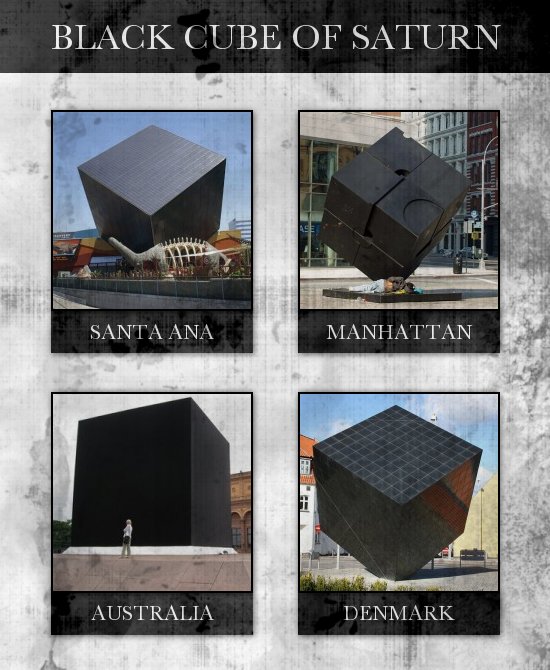
This is the black cube. It conveys an idea you probably have not considered. It represents one of the oldest secret religions. It is a symbol of the worship of Saturn. Saturn is just another name for the deity El. He is the bull-god of the ancients.

The black cube does represent Saturn himself. As such, the black cube represents the dark netherworld where Saturn is now incarcerated.

The Bible says entities like these are chained up in a pit. The ancients called that pit Tartarus. The Bible uses that word Tartarus one time… As the place for fallen angels.

For if God did not spare the angels that sinned, but cast them down to hell and delivered them into chains of darkness to be kept for judgment; and if He did not spare the ancient world, but saved Noah, a preacher of righteousness, with seven others, when He brought a flood upon the world of the ungodly; and if He condemned the cities of Sodom and Gomorrah to destruction by reducing them to ashes, making them an example to those afterward who would live ungodly lives;

2 Peter 2:4–6

In case you thought I was making it up, those gods of old are real and are currently sequestered away… It’s right there. This part of the Scriptures helps us to understand the importance of Paneas and what Jesus was saying.

Cube Imagery

The cube is represented in two dimensions by a hexagon with three lines connecting the opposite points. All of these are various two-dimensional representations of a three-dimensional cube.

Surprisingly, the hexagon also appears on the planet Saturn itself. Modern space exploration has given us images of this anomaly. (For those who do not believe in space flight… It wouldn’t be a coincidence, either.)

Symbology

As employed, the cube is an overt sign of wherever this god of old has influence. How can that god have influence if he’s locked up?

History teaches is that crime bosses continued their operations even while incarcerated.

The hexagon can be divided and unfolded out into a six-point star called a hexagram (which still has a hexagon in the center.)

In like manner, the cube can be unfolded to become a cross.

This is where it can be confusing, because things become blurry. Adherents can embrace a cross and the Star of David albeit it with esoteric meanings and usefulness.

Saturn and his cube are associated with evil and darkness. Those who worship in secret do so to obtain necessary illumination.

This post is a slight deviation but fits well in the current series. It provides necessary information that can help us to be wise in discerning the times. On the surface, things can appear orthodox. But a closer examination is always required.

Examine all things. Firmly hold onto what is good. Abstain from all appearances of evil.

1 Thessalonians 5:21–22

I will leave on last thought… Be of good cheer!

We know that whoever is born of God does not keep on sinning. But whoever has been born of God guards himself, and the wicked one cannot touch him. We know that we are of God, and the whole world lies in wickedness. And we know that the Son of God has come and has given us understanding, so that we may know Him who is true, and we are in Him who is true—His Son Jesus Christ. He is the true God and eternal life.

1 John 5:18–20

Paneas and the Netherworld

When Jesus came into the region of Caesarea Philippi, He asked His disciples, “Who do men say that I, the Son of Man, am?”

Matthew 16:13

With the previous two posts (Read this first, then this,) there is enough background to look at the question. Jesus asks, “Who do men say that I, the Son of Man, am?”

There are great watersheds in history. The Bible is replete with them. The fall of man, Noah’s flood, the Exodus… These events are recorded for our learning. As great as they are, none compares to the birth of Jesus. And as His disciples ministered with Him intimately they were privy to an idea that may not have ever been given a voice. Here is Jesus asking a question to lead His friends to a particular personal watershed conclusion.

They said, “Some say that You are John the Baptist, others say Elijah, and others Jeremiah or one of the prophets.”

Matthew 16:14

The answer sounds pretty much academic. This is the answer many will give. It is just a matter of the facts. People are talking about Jesus.

Without thinking through it too much, the undercurrent in the response shows that the people expected some kind of resurrection. How else could Jesus be one of those as reincarnation is not real?

There must be a resurrection.

I don’t think that the identities of the folks mentioned were the answer He desired them to see. Jesus asks them a question that moves form academic third person to intimate first person.

He said to them, “But who do you say that I am?”

Matthew 16:15

Of any other watershed moment that we could think of, none compares to this question each of us must answer. Here’s why. Your eternity hinges on your response to it. It isn’t a coincidence that it was asked right at the Gates of Hell.

Simon Peter replied, “You are the Christ, the Son of the living God.”

Matthew 16:16

As it is recorded, Peter doesn’t hesitate. He declares the truth. This is the matter, that it is the one most important question we encounter in this life… Who is Jesus Christ?

To some, He’s a good teacher. To others, He’s a mensch. There are still others that will deny He is even real.

To those who know Him, He is the King (Christ, Mashiach.) He is the Son of the living God. This isn’t the first such declaration of the disciples (see Matthew 14:33.)

This confession, though is slightly different. It’s a poignant phrase “Son of the living God.” It is a stark contrast to the unique location of veneration of pagan gods. Ones people worship here in spirit. But they are are not alive and have a body as Jesus is.

What I am saying is that Pan was a Titan. Pan was a real god-king… He is a nephilim.

But nephilim, having physical bodies die, their spirits do not. Nor are their spirits eligible for resurrection. These disembodied spirits are what the Bible calls demons. Demons are not fallen angels, and Nephilim are not fallen angels.

Jesus spoke of the entities.

When an unclean spirit goes out of a man, it passes through dry places seeking rest, but finds none.

Matthew 12:43

So the demons begged Him, saying, “If You cast us out, permit us to go away into the herd of swine.”

Matthew 8:31

These demons look for bodies to inhabit. The account of the demoniac (Matthew 8:28-34) shows this plainly. When Jesus cast legion from the man, they asked permission to be put into a herd of swine. There are hints to other ideas here, demons exercise rights of having dominion. The other idea is the utter destruction they wreak.

All of what we have discussed is important to this location. It is the entrance to the netherworld of dead spirits. They’re dead because they no longer have bodies. Spirits do not die as the body does.

Now to drive up to another point… As we have discussed augmented humanity and the bondage that captivates many today. Reading Revelation 13, we see that there is a point where their is going to be a total rejection of Jesus. The control this coming prince will have will be an augmentation to humanity.

He causes all, both small and great, both rich and poor, both free and slave, to receive a mark on their right hand or on their forehead, so that no one may buy or sell, except he who has the mark or the name of the beast or the number of his name.

Revelation 13:16–17

Clearly, people at that time are willingly taking on the identity of the beast. The scenes recorded in revelation are horrific and very spiritual. We are introduced to real spirits that hate humans.

The boom of Revelation is chiastic in nature, that means it isn’t necessarily linear. It’s linear accounts interwoven. When that is understood, we can examine a sentence that is often overlooked.

In those days men will seek death but will not find it. They will desire to die, but death will elude them.

Revelation 9:6

Death will elude them. Remember the promised augmentation from the serpent in the garden. The serpent promised she wouldn’t die, but would be augmented to be like God.

The educated conjecture is that the mark comes with a sort of biological enhancement that can hinder death. It is not a far stretch to think that this mark alters DNA to something human +. This would make the person that takes it to not have a Kinsman for redemption. After all, this is a seed war… A war of genetics.

Soon, we will discover how important this is. in the next installment, we will look at the response of Jesus.

Jesus is the only One Who has life to give.

Paneas and The Gates of Hell

When Jesus came into the region of Caesarea Philippi, He asked His disciples, “Who do men say that I, the Son of Man, am?”

Matthew 16:13 — Modern English Version (Thinline Edition.; Lake Mary, FL: Passio, 2014)

Most of us are laser-focused on the question asked. That’s for a good reason. But there is a context here that is quite lost in modern times.

Jesus and His disciples came into the region of Caesarea Philippi. In the modern day, it is called the Golan Heights. Jesus will use a phrase a bit later in the account that will tell us exactly the location. (For a refresher, take time and read Matthew 16:13–28. This will help avoid spoiler alerts.)

The Gates of Hell

This location was home to a place called the Grotto of Pan. We have a “Disney-fied” idea of Pan, and a bit of poking around that may surprise some. The Grotto of Pan is a place called Paneas in the Greek and Banias in recent days. It was a town occupied for nearly 2,000 years until destroyed in the Six-Day War. The grotto is at the foot of Mt. Hermon.

It is the place from where hell is defended. You know who the goat-man Pan is.

Mt. Hermon

This is the place of infamy. The Bible often uses this particular mountain as the one that opposes the Mountain of God in Jerusalem. This is the place where angels fell and came down to Earth.

I’ve dropped hints before about fallen angels. There is much to tell, and much to write. I’ve neglected that not quite knowing how to organize my thoughts. Thanks for indulging me.

Anyway, Genesis 6:4–6 clearly tells us something terrible happened in pre-flood times. The important point, angels left heaven and took human wives. They created a hybrid race the Bible calls Nephilim (among other names.) These have more familiar names from other cultures. In Greek, these were the famed Titans.

Rabbit Trail Alert

Has it ever made you wonder why our society is enamored with ancient Greek culture?

Students read The Iliad in the first year of high school. It serves as a sort of primer. The Greek alphabet is memorized. Clubs that mirror secret societies are introduced. Greek terms are preferred in science. Western education systems are Greek in nature. Colleges have Greek culture normalizing the acceptance of exclusive groups with secrets. There are even full-blown secret clubs reserved for a select few.

This could just be a coincidence. Or it could be the subtle trail of the gods of this world (Titans) and how they plan to come back.

Some 50 years ago, the public was introduced to the flying saucer. It invaded many aspects of society. Then fringe stories of abductions came. As time progressed, these accounts increased many times over. Pop culture tells you these are our “sky brothers.” Some scientists believe life on this planet was seeded by other beings (they understand life comes from life.) The acronym UFO has been changed to UAP (Unidentified Arial Phenomenon.) Deftly moving it from the woo-woo into reality. The US has just recently shot down an unidentified object.

Recall a lot of the motion pictures and other entertainment of the last few decades. Then think of these Nephilim as augmented humans (human+angel) and not just as hybrids. These could easily be considered superheroes. Disney’s Hercules introduced your children to that idea 25 years ago. Since then, we have the gamut of both the DC and Marvel universes splashed on giant screens in darkened immersive cinemas.

These children grew up on this constant diet, and many love to cosplay. They dress like these characters, even completely parroting what they see on screen.

It looks like planned desensitization… Because it is. The idea is to normalize someone coming down to augment humanity.

For this Bible and prophecy nerd, I know augmented humanity is already a thing. The richest folks in the world are spending their money on furthering this science in hopes of achieving immortality. Think of the old lie, you shall be as Gods.

The enemy has plans. Plans to make humans after himself. He needs the numbers, as his side is severely outnumbered two-to-one (not counting God, of course.)

Then the serpent said to the woman, “You surely will not die! For God knows that on the day you eat of it your eyes will be opened and you will be like God, knowing good and evil.”

Genesis 3:4–5 — Modern English Version (Thinline Edition.; Lake Mary, FL: Passio, 2014)

The enemy’s plan from the beginning is to delude humanity with the lie. Eve wanted the augmented knowledge the fruit gave. Humanity continues to stumble in that direction.

Back to Mt. Hermon

Some say that the Levant is the location of the garden of Eden. Mt. Hermon is a part of that place. My speculation is that Mt. Hermon is the place where Adam ate. It’s the place where the angels came down and augmented humanity. What is not my speculation is that it is the place of the gates of hell. Gates are defensive… They keep the bad guys outside, stopping an invasion.

I want you to think about how important understanding Paneas is. This is the place of warfare in which we are engaged. This is where the warning shot was given by Jesus.

One last thought, J.M. Barrie desensitized the world to Pan. He wrote Peter Pan. Perhaps the name of that character is a subtlety to point to the question Jesus asked Peter right here. “Who do you say I am?”

The Gates are being crashed! All know God wins! If you didn’t, you do now.

The Warning Shot

When Jesus came into the region of Caesarea Philippi, He asked His disciples, “Who do men say that I, the Son of Man, am?”

Matthew 16:13 — Modern English Version (Thinline Edition.; Lake Mary, FL: Passio, 2014)

Jesus came to Caesarea Philippi with His disciples. This passage of text is important for many, yet it is not without controversy. Like much of what we find in the Bible, there is far more that is unwritten than we might take care to discover.

The Temple of Pan. Creative Commons image.

Mount Hermon

Caesarea Phillippi was home to the Temple of Pan. It is called the Temple of Banias today, Arabic for the Temple of Panias. (In Arabic there is no letter P.) This temple is part of Mount Hermon, legendary as the place where angels came down seeking different flesh.

I know that might be unsettling to some, but there are additional resources to help understand. Genesis 6 is the first mention and like the text above… There is much context that the writer assumes is understood by the intended audience. Much of that context has been explained away over centuries of time. Suffice it to say, angels came down and took wives.

When men began to multiply on the face of the earth and daughters were born to them, the sons of God saw that the daughters of men were fair and took as wives any they chose. The LORD said, “My Spirit will not always strive with man, for he is flesh; yet his days will be a hundred and twenty years.” The Nephilim were on the earth in those days, and also after that, when the sons of God came in to the daughters of men, and they bore children to them. These were the mighty men who were of old, men of renown.

Genesis 6:1–4 — Modern English Version (Thinline Edition.; Lake Mary, FL: Passio, 2014)

Likewise, the angels who did not keep to their first domain, but forsook their own dwelling, He has kept in everlasting chains under darkness for the judgment of the great day. Just as Sodom and Gomorrah, and the surrounding cities in like manner, gave themselves to immorality and went after different flesh, they serve as an example by suffering the punishment of eternal fire.

Jude 6–7 — Modern English Version (Thinline Edition.; Lake Mary, FL: Passio, 2014)

It is for this reason, that Mount Hermon is the mountain of the gods (As a title, it ought to be capitalized, but I want to emphasize these are the little ‘g’ type gods.) It is the sides of the north (Isaiah 14:13.) It is the base of operation for the enemy. One that goes by many names and has many minions.

The Warning Shot

They said, “Some say that You are John the Baptist, others say Elijah, and others Jeremiah or one of the prophets.”

Matthew 16:14 (MEV) — Modern English Version (Thinline Edition.; Lake Mary, FL: Passio, 2014)

His disciples answered Him. Jesus wasn’t surprised at their answer. He then addressed them personally.

He said to them, “But who do you say that I am?”

Matthew 16:15 (MEV) — Modern English Version (Thinline Edition.; Lake Mary, FL: Passio, 2014)

That is the question. Metaphorically, it is a question we must all answer as eternity for each of us hangs on it. Who do you say that I am?

Peter steps up.

Simon Peter replied, “You are the Christ, the Son of the living God.”

Matthew 16:16 (MEV) — Modern English Version (Thinline Edition.; Lake Mary, FL: Passio, 2014)

There it is. That is the warning shot lobbed into enemy territory from inside enemy territory.

Peter states Jesus’ identity out loud.

Jesus answered him, “Blessed are you, Simon son of Jonah, for flesh and blood has not revealed this to you, but My Father who is in heaven. And I tell you that you are Peter, and on this rock I will build My church, and the gates of Hades shall not prevail against it. I will give you the keys of the kingdom of heaven, and whatever you bind on earth shall be bound in heaven, and whatever you loose on earth shall be loosed in heaven.”

Matthew 16:17–19 (MEV) — Modern English Version (Thinline Edition.; Lake Mary, FL: Passio, 2014)

This isn’t about Peter being given a mission. It’s not about Peter starting a church. This isn’t a Catholic thing. Peter wasn’t the only one given the keys to the kingdom. Neither was it the Roman Catholic church. It was to the body of Spirit-baptized believers.

This is Jesus saying in the midst of enemy territory… “I am here. Come and get a piece of Me!” Jesus is picking a fight, and proclaiming that He wins!

Jesus will build His church on the truth that He is indeed the Son of God. He is the Anointed One. He is the Seed of the woman prophesied in Genesis 3:15. This seemingly frail Human is vulnerable, yet the gates of Hell will not prevail in this fight.

The Offensive

The body of Christ is not on the defensive side here. The gates of Hell will not prevail. Gates are primarily a defensive fortification.

Then He commanded His disciples to tell no one that He was Jesus the Christ.

Matthew 16:20 (MEV) — Modern English Version (Thinline Edition.; Lake Mary, FL: Passio, 2014)

Instructions were given to not share this information. But it is from this moment that Jesus began to teach His disciples that He must suffer, be killed, and then raised up again.

The enemy took the best shot they had. Jesus did go to Jerusalem. Jesus suffered much, He died. He rose again. He told them they emphatically would not prevail, and they tried their best. And failed.

Do not ever forget, that in Jesus we all have the high ground. We Spirit-baptized believers are already victorious. The enemy and his minions have no rightful claim on any of His. They are terrified at the name of Jesus.

I will leave you with these words from Paul.

As you have received Christ Jesus the Lord, so walk in Him, rooted and built up in Him and established in the faith, as you have been taught, and abounding with thanksgiving.
Beware lest anyone captivate you through philosophy and vain deceit, in the tradition of men and the elementary principles of the world, and not after Christ. For in Him lives all the fullness of the Godhead bodily. And you are complete in Him, who is the head of all authority and power. In Him you were also circumcised with the circumcision made without hands, by putting off the body of the sins of the flesh, by the circumcision of Christ, buried with Him in baptism, in which also you were raised with Him through the faith of the power of God, who has raised Him from the dead.
And you, being dead in your sins and the uncircumcision of your flesh, He has resurrected together with Him, having forgiven you all sins. He blotted out the handwriting of ordinances that was against us and contrary to us, and He took it out of the way, nailing it to the cross. And having disarmed authorities and powers, He made a show of them openly, triumphing over them by the cross. Therefore let no one judge you regarding food, or drink, or in respect of a holy day or new moon or sabbath days. These are shadows of things to come, but the substance belongs to Christ. Do not let anyone cheat you of your reward by delighting in false humility and the worship of angels, dwelling on those things which he has not seen, vainly arrogant due to his unspiritual mind, and not supporting the head, from which the entire body, nourished and knit together by joints and sinews, grows as God gives the increase.

Colossians 2:6–19 (MEV) — Modern English Version (Thinline Edition.; Lake Mary, FL: Passio, 2014)

Baptism Proclaims Resurrection

For Christ also has once suffered for sins, the just for the unjust, so that He might bring us to God, being put to death in the flesh, but made alive by the Spirit, by whom He also went and preached to the spirits in prison, who in times past were disobedient, when God waited patiently in the days of Noah while the ark was being prepared, in which a few, that is, eight souls, were saved through water.

1 Peter 3:18–20 — Modern English Version (Thinline Edition.; Lake Mary, FL: Passio, 2014)

Peter is writing on the merits of suffering for doing good things. In it, there is the idea to not fear. He says earlier “Do not be afraid of their terror, do not be troubled.” He is paraphrasing something from Isaiah 8.

Jesus likewise also suffered for doing good. And like Jesus, a believer has died to themselves and already been made alive in Him. This is why Peter is saying to not be afraid of their terror. It has no real power.

Peter is going to continue to connect this to the floodwaters of Noah. Jesus goes to have words with spirits in Sheol. The latter idea is not without controversy.

It is my understanding that humanity’s genetics had been corrupted before the flood. Lots of the bodies that perished were of corrupted flesh that was the progeny of certain fallen angels. There is much to explain there and perhaps in future weeks, I may elaborate on that. Suffice it to say, the dead spirits of those progeny were disobedient as well as humans that perished. Their eternity is certain. This is why demons tremble.

What Peter is doing is pointing out that those who went into the water of Noah’s flood… Died. There was no hope for them because of their disobedience. There is no rescue after death.

Peter then uses that idea of the flood and those perishing to connect as anti-type to baptism and the eternal security of the salvation Jesus gives.

Figuratively this is like baptism, which also saves us now. It is not washing off the dirt from the body, but a response to God from a good conscience through the resurrection of Jesus Christ, who has gone into heaven and is at the right hand of God, with angels and authorities and powers being made subject to Him.

1 Peter 3:21–22 — Modern English Version (Thinline Edition.; Lake Mary, FL: Passio, 2014)

Jesus passed into the grave but rose again, ascending to His place with God in heaven. All powers and authorities are subject to Him. What a terrifying thought to those spirits that perished. There is no help for them.

Baptism isn’t like the floodwaters. A believer goes into the water not to be made clean. That has already been done. The believer goes into the water to demonstrate there is no claim death can have on them, whether past, present, or future. This is proclaimed as the believer is raised up out of the water. It is a sure demonstration that the watery grave, or any grave for that matter, has no power whatsoever over the believer.

Don’t fear their terror.

Every single time a soul is baptized it is a public announcement that another soul is set aside for resurrection. The grave has no business with that one.

For me, I explain baptism with a similar metaphor. An athlete may sign a contract to play for a team. The moment he agrees, he is part of that team. A public proclamation may be made to celebrate that signing. But it is real when that athlete dons the identity of that team, putting on the uniform and walking on the field of play.

That is baptism for a believer!

He has already been saved by belief and confession. We rightly celebrate such things when they happen. At baptism, the believer dons the uniform, that is he takes on the identity of the team. in this case, it’s the death, burial, and resurrection of Jesus. For all intents and purposes, when a believer comes out of the water, he is on the field of play!

Hallelujah! It is serious!

Just as death has no claim on Jesus, death has no claim on a believer!

Those that went into the water of Noah’s flood perished. They did not come out of it. It bears repeating. Baptism proclaims Jesus’ victory over death in showing an already saved person is set aside for resurrection and is brought into and then out of the water.

Being Ready for Spiritual Warfare

Finally, my brothers, be strong in the Lord and in the power of His might.

Ephesians 6:10 — Modern English Version (Thinline Edition.; Lake Mary, FL: Passio, 2014)

In my reading, it occurred to me that what we consider to be the epitome of preparation for spiritual warfare as being Paul’s description of the armor we must wear. These are his final thoughts on the subject. In order to understand the necessary function of the armor and to be able to trust it doesn’t work without all of the other preceding things that are the foundation for it. We must roll back a few chapters to understand.

Corporate Life at Church

I, therefore, the prisoner of the Lord, exhort you to walk in a manner worthy of the calling with which you were called. With all humility, meekness, and patience, bearing with one another in love, be eager to keep the unity of the Spirit in the bond of peace.

Ephesians 4:1–3 — Modern English Version (Thinline Edition.; Lake Mary, FL: Passio, 2014)

Paul says lots about corporate fellowship. It’s the start, to walk in a manner worthy of our calling. We are to do it in patience, meekness, and humility. We are to bear one another in love. Paul is not saying we bear the heathen in love, but one another. And with it, we ought to be eager to keep the unity of the Spirit.

I cannot help to think how easy it is for us to break fellowship for the slightest things. People will leave churches because the church ain’t going their way. Someone will be asked to leave a church because he doesn’t toe the line. We don’t bear well with each other as corporate bodies. I’d dare say that in our churches we are sorely fit to do any sort of spiritual warfare.

There is one body and one Spirit, even as you were called in one hope of your calling, one Lord, one faith, one baptism, one God and Father of all, who is above all, and through all, and in you all.

Ephesians 4:4–6 — Modern English Version (Thinline Edition.; Lake Mary, FL: Passio, 2014)

The essentials are in Spirit. We divide in the flesh. We just keep these things in mind.

But grace was given to each one of us according to the measure of the gift of Christ. Therefore He says: “When He ascended on high, He led captivity captive, and gave gifts to men.” (In saying, “He ascended,” what does it mean but that He also descended first into the lower parts of the earth? He who descended is also He who ascended far above all the heavens that He might fill all things.)

Ephesians 4:7–10 — Modern English Version (Thinline Edition.; Lake Mary, FL: Passio, 2014)

There is more here than I am going to speak about, but I will leave that for you to search on your own. What we have spiritually is from Jesus Himself. He gave the gifts to each of us in the exact measurements we needed to fulfill our purpose in the body.

All of us are needed in fellowship. Our local bodies are ill-equipped if we remove ourselves from fellowship, or even kick someone out. Each of us is essential.

He gave some to be apostles, prophets, evangelists, pastors, and teachers, for the equipping of the saints, for the work of service, and for the building up of the body of Christ, until we all come into the unity of the faith and of the knowledge of the Son of God, into a complete man, to the measure of the stature of the fullness of Christ, so we may no longer be children, tossed here and there by waves and carried about with every wind of doctrine by the trickery of men, by craftiness with deceitful scheming.

Ephesians 4:11–14 — Modern English Version (Thinline Edition.; Lake Mary, FL: Passio, 2014)

What gifts we each possess are for the equipping of the saints. Often these giftings are used for self-edification and aggrandizement. They are given to us for others, to equip them. It’s the work of Jesus to which we are called. I can assure you that you know someone who has attached one or more of these titles to the beginning of their name. That doesn’t edify others in the least.

We are to help each other become complete. We are to desire to grow. This is a message and critical foundation for spiritual warfare. If each of us is not now rightly in a fellowship of believers who trust us and whom we can trust, we aren’t prepared for any kind of warfare.

But, speaking the truth in love, we may grow up in all things into Him, who is the head, Christ Himself, from whom the whole body is joined together and connected by every joint and ligament, as every part effectively does its work and grows, building itself up in love.

Ephesians 4:15–16 — Modern English Version (Thinline Edition.; Lake Mary, FL: Passio, 2014)

We need that trust because sometimes there is going to be something we’re not going to want to hear. It’ll be hard to stomach if we don’t trust that the person who speaks it has our best interests before his. It’s necessary. As the whole body must be joined together to effectively work and grow. None of us can do it alone.

Therefore this I say and testify in the Lord, that from now on you walk not as other Gentiles walk, in the vanity of their minds, having their understanding darkened, excluded from the life of God through the ignorance that is within them, due to the hardness of their hearts. Being calloused they have given themselves over to sensuality for the practice of every kind of impurity with greediness.

Ephesians 4:17–19 — Modern English Version (Thinline Edition.; Lake Mary, FL: Passio, 2014)

The unsaved operate in self-imposed ignorance. They refuse to believe. They scoff. It hardens them. Just like a callous on the hand, it becomes a place where there is no feeling. It cannot feel the comfort of warm soap and water. It cannot feel the sharp edge of a razor blade. The unbeliever is in the same predicament unable to feel the things that are good, and the things that may be dangerously deadly. The more a callous is rubbed, the larger and harder it grows.

That’s the sensuality that Paul is speaking about. It takes more of the same old thing just to feel it, yet it makes the hardness even harder. That’s the sensuality of sin.

But you did not learn about Christ in this manner, if indeed you have heard Him and have been taught by Him, as the truth is in Jesus: that you put off the former way of life in the old nature, which is corrupt according to the deceitful lusts, and be renewed in the spirit of your mind; and that you put on the new nature, which was created according to God in righteousness and true holiness.

Ephesians 4:20–24 — Modern English Version (Thinline Edition.; Lake Mary, FL: Passio, 2014)

It’s a new way of life we must put on. Jesus teaches us we don’t have to keep doing the same old chase that never satisfies.

Look at the contrast, without Jesus, it’s seeking sensations, what pleases us personally. That’s the essence of lust. That’s why the Bible uses the term. It’s not just sexual. It is a seeking to satisfy our own desires.

We are to live differently, to renew our minds.

Therefore, putting away lying, let every man speak truthfully with his neighbor, for we are members of one another. Be angry but do not sin. Do not let the sun go down on your anger. Do not give place to the devil. Let him who steals steal no more. Instead, let him labor, working with his hands things which are good, that he may have something to share with him who is in need.

Ephesians 4:25–28 — Modern English Version (Thinline Edition.; Lake Mary, FL: Passio, 2014)

We are to operate truthfully. It means to stop taking from others. Instead, be prepared and ready to give something.

Let no unwholesome word proceed out of your mouth, but only that which is good for building up, that it may give grace to the listeners. And do not grieve the Holy Spirit of God, in whom you are sealed for the day of redemption.

Ephesians 4:29–30 — Modern English Version (Thinline Edition.; Lake Mary, FL: Passio, 2014)

Watch what we say. Make sure that it benefits others. Our eternity is secure. There is nothing anyone can do to steal that from any of us… Not even our own actions. None of us have to operate in our former ways.

Let all bitterness, wrath, anger, outbursts, and blasphemies, with all malice, be taken away from you. And be kind one to another, tenderhearted, forgiving one another, just as God in Christ also forgave you.

Ephesians 4:31–32 — Modern English Version (Thinline Edition.; Lake Mary, FL: Passio, 2014)

Let all the bad stuff be removed. This is telling us that we ought to be willing to give these to God.

Bitterness gets a place when we don’t forgive. Bitterness always gives rise to the enemy. Don’t even give it a place.

Personal Life Everywhere

Therefore be imitators of God as beloved children. Walk in love, as Christ loved us and gave Himself for us as a fragrant offering and a sacrifice to God.
And do not let sexual immorality, or any impurity, or greed be named among you, as these are not proper among saints. Let there be no filthiness, nor foolish talking, nor coarse joking, which are not fitting. Instead, give thanks. For this you know, that no sexually immoral or impure person, or one who is greedy, who is an idolater, has any inheritance in the kingdom of Christ and of God.

Ephesians 5:1–5 — Modern English Version (Thinline Edition.; Lake Mary, FL: Passio, 2014)

We have our example. Imitate God as the children of Him we are. Walk in love Paul says. Sometimes we overlook the idea of love in mind. It’s sacrificial. It gives of itself even unto death.

Don’t practice sexual immorality or other impurities.

Don’t be greedy. That’s a hard one. Each of us wants to be first in line. Few of us want to wait until last.

Watch the language we use. Change the way we talk to be thankful, first to God from Whom good things come, but for others around us.

Let no one deceive you with empty words, for because of these things the wrath of God is coming upon the sons of disobedience. Therefore do not be partakers with them.

Ephesians 5:6–7 — Modern English Version (Thinline Edition.; Lake Mary, FL: Passio, 2014)

Be careful who we listen to and associate with. It’s not that we shouldn’t hang around with them, but we are not to participate in the inane things other unbelievers do.

For you were formerly darkness, but now you are light in the Lord. Walk as children of light— for the fruit of the Spirit is in all goodness and righteousness and truth—proving what is pleasing to the Lord. And do not have fellowship with the unfruitful works of darkness; instead, expose them. For it is shameful even to speak of those things which are done by them in secret. But all things are exposed when they are revealed by the light, for everything that becomes visible is light. Therefore He says: “Awake, you who sleep, arise from the dead, and Christ will give you light.”

Ephesians 5:8–14 — Modern English Version (Thinline Edition.; Lake Mary, FL: Passio, 2014)

We all have our previous lives. We all walked in darkness. Now instead of just walking in darkness, we are light. That is light in the Lord. It’s a new identity. Walk in it, proving it.

We ought not to do those things we used to do. Instead, we expose them. Things that are exposed lose their power and control. Secrets are by nature things not out in the light.

See then that you walk carefully, not as fools, but as wise men, making the most of the time because the days are evil. Therefore do not be unwise, but understand what the will of the Lord is.

Ephesians 5:15–17 — Modern English Version (Thinline Edition.; Lake Mary, FL: Passio, 2014)

Time is short. Don’t waste it on things that have no eternal benefit. We live in evil times. It’s been like that since Adam was expelled out of the Eden of God.

Do not be drunk with wine, for that is reckless living. But be filled with the Spirit.

Ephesians 5:18 — Modern English Version (Thinline Edition.; Lake Mary, FL: Passio, 2014)

Don’t substitute the world’s spirits for the Holy Spirit. Be sober-minded.

Speak to one another in psalms, hymns, and spiritual songs, singing and making melody in your heart to the Lord. Give thanks always for all things to God the Father in the name of our Lord Jesus Christ, being submissive to one another in the fear of God.

Ephesians 5:19–21 — Modern English Version (Thinline Edition.; Lake Mary, FL: Passio, 2014)

These are the things to center our minds on, renewing them. It’s a personal endeavor we must always be cognizant of pursuing. It’s a choice we make every moment of every day. It’s difficult to engage in any form of spiritual warfare if we’re not walking in the light we are.

Interactions with our Spouses

Wives, be submissive to your own husbands as unto the Lord. For the husband is the head of the wife, just as Christ is the head and Savior of the church, which is His body. But as the church submits to Christ, so also let the wives be to their own husbands in everything.

Ephesians 5:22–24 — Modern English Version (Thinline Edition.; Lake Mary, FL: Passio, 2014)

This is not a hierarchy thing or a master-slave relationship. But there is an established order of things. Husbands aren’t the master. Wives aren’t slaves.

Husbands, love your wives, just as Christ also loved the church and gave Himself for it, that He might sanctify and cleanse it with the washing of water by the word, and that He might present to Himself a glorious church, not having spot, or wrinkle, or any such thing, but that it should be holy and without blemish. In this way men ought to love their wives as their own bodies. He who loves his wife loves himself. For no one ever hated his own flesh, but nourishes and cherishes it, just as the Lord cares for the church. For we are members of His body, of His flesh and of His bones.

Ephesians 5:25–30 — Modern English Version (Thinline Edition.; Lake Mary, FL: Passio, 2014)

The admonition is to the husbands. It is necessarily so. The whole idea is to not drift off into some misogynist mindset where a man operates as king of his castle.

No. This is teaching us that the wife ought to be elevated to not just the same treatment as a husband would treat himself, but just a bit higher. The husband is to give himself just as Jesus did. It’s totally selfless.

“For this reason a man shall leave his father and mother and shall be joined to his wife, and the two shall be one flesh.”

Ephesians 5:31 — Modern English Version (Thinline Edition.; Lake Mary, FL: Passio, 2014)

This is for both parties in a marriage. When two people get married, their family is the two in the marriage (and children.) It’s great to have moms and dads, brothers and sisters. But your spouse is your family first and foremost. It goes without saying that the word most needs emphasis.

If mom interferes with our spouse… Side with the spouse. He or she is family. That is what Paul is saying. This is the proper order.

It doesn’t mean we cannot do things with our parents and siblings, but to insist on having every Thanksgiving or other holiday celebrations with them and dragging our spouse along can lead to problems. Even trying to be fair is difficult. Establish your own family traditions. And do the extended family things once in while.

Leave mom and dad and cleave to our spouse. It is difficult to engage in spiritual warfare if we are married and do not cleave to our spouse. Two are one. We need them.

This is a great mystery, but I am speaking about Christ and the church.

Ephesians 5:32 — Modern English Version (Thinline Edition.; Lake Mary, FL: Passio, 2014)

A good marriage becomes a great apologetic.

However, let each one of you love his wife as himself, and let the wife see that she respects her husband.

Ephesians 5:33 — Modern English Version (Thinline Edition.; Lake Mary, FL: Passio, 2014)

A final admonition for a happy marriage. A husband that loves his bride sacrificially, with a bride who respects him.

Behaving as Children

Children, obey your parents in the Lord, for this is right. “Honor your father and mother,” which is the first commandment with a promise, “so that it may be well with you and you may live long on the earth.”

Ephesians 6:1–3 — Modern English Version (Thinline Edition.; Lake Mary, FL: Passio, 2014)

This is pretty much self-explanatory.

Proper Parenting

Fathers, do not provoke your children to anger, but bring them up in the discipline and instruction of the Lord.

Ephesians 6:4–5 — Modern English Version (Thinline Edition.; Lake Mary, FL: Passio, 2014)

It is the job of the parents to pass on their faith.

Relating to Your Employer

Servants, obey those who are your masters according to the flesh, with fear and trembling, in sincerity of your heart, as to Christ, not serving when eyes are on you, but as pleasing men as the servants of Christ, doing the will of God from the heart, with good will doing service, as to the Lord, and not to men, knowing that whatever good thing any man does, he will receive the same from the Lord, whether he is enslaved or free.

Ephesians 6:5–8 — Modern English Version (Thinline Edition.; Lake Mary, FL: Passio, 2014)

As an employee, we are to work for our manager as one would work for Jesus. After all, He is Who we are working for ultimately.

Our work should be the same even when others aren’t watching. That means no running off into the bathroom to check our phone or goofing off in the back of the storeroom.

By doing that, not only do we receive a paycheck from the employer, our good deeds earn eternal rewards. The sincerity of our hearts may be the thing that makes an unbelieving employer become a believer.

Managers Relating to Employees

And masters, do the same things for them, no longer threatening, knowing that your Master also is in heaven, and there is no partiality with Him.

Ephesians 6:9 — Modern English Version (Thinline Edition.; Lake Mary, FL: Passio, 2014)

Do the right thing for those who work for us. Pay them fairly. Treat them rightly, just as we expect to be treated by Jesus.

Finally Brethren

Finally, my brothers, be strong in the Lord and in the power of His might.

Ephesians 6:10 — Modern English Version (Thinline Edition.; Lake Mary, FL: Passio, 2014)

We come to the text which opened the post. It’s long. But it is necessary.

Before we can even endeavor to don the armor of God, we need to shore up every single one of these areas of our lives. If they are not secure and rightly done, there is an opportunity for the enemy.

Don’t just concentrate on the armor, but concentrate on all of the preparation that comes before and is a foundation for it.