
The Olivet Discourse: Introduction

This is an introduction to my own attempt to discover the similarities and distinctions of the presentation of the Olivet Discourse (first post) as given in the synoptic gospels. The Synoptic Gospels are Matthew, Mark, and Luke, as they present themselves similarly in the things they record of Jesus’ ministry on Earth.

The first thing to keep in mind is the distinctiveness of the authors as different people with differing mindsets. Each also had a distinct audience in mind. So, it can be said that each Gospel has a distinct purpose for a distinct audience. One sees this intent recorded by the selective events each author chooses to include, and how they are related to the audience.

Matthew

Matthew’s Gospel is intended to speak to the Israeli, a person who is familiar with the Old Testament. Matthew details the prophecies recorded in the Old Testament that characterize Israel’s Messiah, and how these are fulfilled in Jesus Christ. Therefore, Jesus is portrayed as that Messiah, the King of the Israelis. This is evidenced from the outset, as his gospel opens with the genealogy of Jesus, which would be of utmost importance to an Israeli. Especially as it relates to the Messiah, the Son of David.

The book of the genealogy of Jesus Christ, the Son of David, the son of Abraham:

Matthew 1:1 — Modern English Version (Thinline Edition.; Lake Mary, FL: Passio, 2014)

Herein, one sees that Jesus is the rightful heir to the kingdom of David. It is the opening of the book that establishes the credentials of Jesus as that heir. The promises of the Messiah from the Old Testament are fulfilled in Jesus Christ, beginning with His family tree.

Sum it up this way, Matthew is written to Israelis and is for Israelis.

Mark

Mark is not written to the Israeli or even to those familiar with the Old Testament. Instead, his audience is those people who understand power and authority. That is, those citizens and leaders in the Roman Empire. These folks would be unfamiliar with Judaism and the promises of the Messiah. Mark does not start with the birth of Jesus. He doesn’t start with Jesus’ credentials.

The beginning of the gospel of Jesus Christ, the Son of God. As it is written in the Prophets:
“Look, I am sending My messenger before Your face, who will prepare Your way before You.”
“The voice of one crying in the wilderness: ‘Prepare the way of the Lord, make His paths straight.'”

Mark 1:1–3 — Modern English Version (Thinline Edition.; Lake Mary, FL: Passio, 2014)

He starts with activities for people who understand action. Here is Jesus, the servant of the Lord sent by God to do what God has sent Him to do. With the emphasis on doing, Jesus did what was asked of Him. Because this book records the actions of Jesus, it records more of Jesus’ miracles than does Matthew, Luke, or John.

Mark is summed up as written to the Roman and the authorities in Rome.

Luke

Luke wanted to appeal to intellectuality. The Greeks of Luke’s day were of the intellectual mindset, loving art, philosophy, and literature. It is with that intent that the humanity of Jesus is emphasized. He is like any other human. Yet, He is not, as He is the perfection of humanity. And Luke would give an orderly account.

Whereas many have undertaken to write a narrative of those things which are most surely believed among us, just as they were handed down to us by those who from the beginning were eyewitnesses and ministers of the word, it seemed good to me also, having accurately investigated all things from the very beginning, to write to you an orderly account, most excellent Theophilus, that you might know the certainty of the things which you have been told.

Luke 1:1–4 — Modern English Version (Thinline Edition.; Lake Mary, FL: Passio, 2014)

One can trust that what Luke wrote is an orderly account. It is not the writings of an eyewitness, but as an investigator who has collected and recorded others’ eyewitness testimonies. The humanity of Jesus is emphasized by the focus of events that demonstrate that. Luke’s gospel relates to the reader a very human Jesus.

Luke is summed up as written to the Greek.

John

John was an eyewitness to the life of Jesus. The things recorded are for the purpose of establishing Jesus as the eternal God who became a man.

In the beginning was the Word, and the Word was with God, and the Word was God. He was in the beginning with God. All things were created through Him, and without Him nothing was created that was created.

John 1:1–3 — Modern English Version (Thinline Edition.; Lake Mary, FL: Passio, 2014)

From the very opening words, Jesus is presented as the Creator – God. John intends the reader to believe. The book is written with that purpose.

Jesus performed many other signs in the presence of His disciples, which are not written in this book. But these are written that you might believe that Jesus is the Christ, the Son of God, and that believing you may have life in His name.

John 20:31–32 — Modern English Version (Thinline Edition.; Lake Mary, FL: Passio, 2014)

John stated he is selective in what he has recorded. His goal is personal, it is for the reader to believe.

John writes to believers.

A Point to Consider

With these things in mind, the first point I would like to ponder is that the gospel of John has no recording of the Olivet Discourse. Of course, I understand that the Bible is given to us with a framework of design. Therefore, we must also consider certain points of silence. It is this one that I want to consider and challenge my own thinking.

Maybe, John didn’t record the Olivet Discourse because it wasn’t intended for believers, specifically church-age believers. Let me explain. We have it recorded by three folks who were not eyewitnesses. It is recorded in differing ways, with different ideas emphasized. Given the inherent audiences of the gospels, perhaps the ideas written in the discourse in the Synoptics would be for the unbelieving Israeli, those who love action and authority, and the intellectual. All of which would be unbelievers, given that John’s gospel is written for believers. John’s gospel would exclude such ideas as the church-age believers wouldn’t be present.

Could that hint to church-age believers being removed before these things happen?
The Virgin Birth

And Joseph, when he woke up from sleep, did as the angel of the Lord commanded him, and he took his wife and did not have sexual relations with her until she gave birth to a son. And he called his name Jesus.

Matthew 1:24–25 — The Lexham English Bible (Bellingham, WA: Lexham Press, 2012)

God had visited Joseph to quell his own fears. It would be such a shame for him to have a betrothed who was pregnant.

Joseph did take his wife, sheltering her and honoring God. In his honor to God, he refrained from sexual relations, that the Baby would be born of a virgin.

This is the miracle. This is the virgin birth. This is Salvation for the world. This is the event that changed time. Even though we don’t use the BC and AD descriptors for years, we continue to mark the years in celebration of His birth.

This Baby changed the world!

Christmas, Behold the Lord’s Female Slave

Now in the sixth month, the angel Gabriel was sent from God to a town of Galilee named Nazareth, to a virgin legally promised in marriage to a man named Joseph of the house of David. And the name of the virgin was Mary. And he came to her and said, “Greetings, favored one! The Lord is with you.” But she was greatly perplexed at the statement, and was pondering what sort of greeting this might be. And the angel said to her,
“Do not be afraid, Mary, for you have found favor with God. And behold, you will conceive in the womb and will give birth to a son, and you will call his name Jesus. This one will be great, and he will be called the Son of the Most High, and the Lord God will give him the throne of his father David. And he will reign over the house of Jacob forever, and of his kingdom there will be no end.
And Mary said to the angel, “How will this be, since I have not had sexual relations with a man?” And the angel answered and said to her,
“The Holy Spirit will come upon you, and the power of the Most High will overshadow you. Therefore also the one to be born will be called holy, the Son of God.
And behold, your relative Elizabeth—she also has conceived a son in her old age, and this is the sixth month for her who was called barren. For nothing will be impossible with God.”
So Mary said, “Behold, the Lord’s female slave! May it happen to me according to your word.” And the angel departed from her.

Luke 1:26–38 — The Lexham English Bible (Bellingham, WA: Lexham Press, 2012)

Yeah… That title.

It is what Mary said. It wasn’t that she didn’t have a choice in the matter. She could have refused. Yet she didn’t. She called herself the Lord’s slave.

Did God make her do it?

No.

We tend to think about things that happen linearly because that is our only experience in this time-matter-space existence. All of this could have been orchestrated to happen to bring forth the Savior at the right time. It is well within the power of God. Such a concept as that brings to mind a child posing his toys in play, to do as such imagined. God doesn’t do that.

I think people live their lives and make choices just as Mary made. Those choices could be to honor God or more likely not. God didn’t cause Mary’s choice. Nor did He predict it. (I am sure that will cause some to gasp. Relax.) He gave us patterns for which to expect. We refer to this as prophecy.

Prophecy is just ‘truth-telling.’ In this particular situation, Isaiah recorded a truth for Ahaz, which had a dual pattern, like much of these prophecies. That dual pattern found its ultimate completion in the birth of Jesus. He is God in human form. Not appearing as God, but adding humanity to God.

God can tell us the beginning from the end. He is the only One able to do such things. He can do that because of His omniscience and omnipresence. Every moment is a present reality for God. He is present in the moment Isaiah penned ‘a maiden shall conceive.’ Just as He is present in the moment that Mary met the angel, and when Mary conceived. He is even present at that moment with Eve when He told her that her ‘seed’ would bring the redemption of humanity.

I am certain through the noisy bustle of this season, you’re going to hear the skeptical claims of holy rape and mistranslation.

Mary fully participated, yielding herself to what would happen to her. What we do know, is the conception of the Babe wasn’t sexual, and it wasn’t rape. Otherwise, she couldn’t be a virgin when she gave birth.

And that brings us to the second point. The contention over the term virgin. Many will say the Hebrew word almah cannot be translated to virgin, as it only means maiden. Yet, virgin is an acceptable translation from Hebrew just by looking at how it is used elsewhere in the Bible. Regardless, it never refers to a married woman.

Let’s look deeper.

“Behold, the virgin will become pregnant and will give birth to a son, and they will call his name Emmanuel,”

Matthew 1:23 — The Lexham English Bible (Bellingham, WA: Lexham Press, 2012)

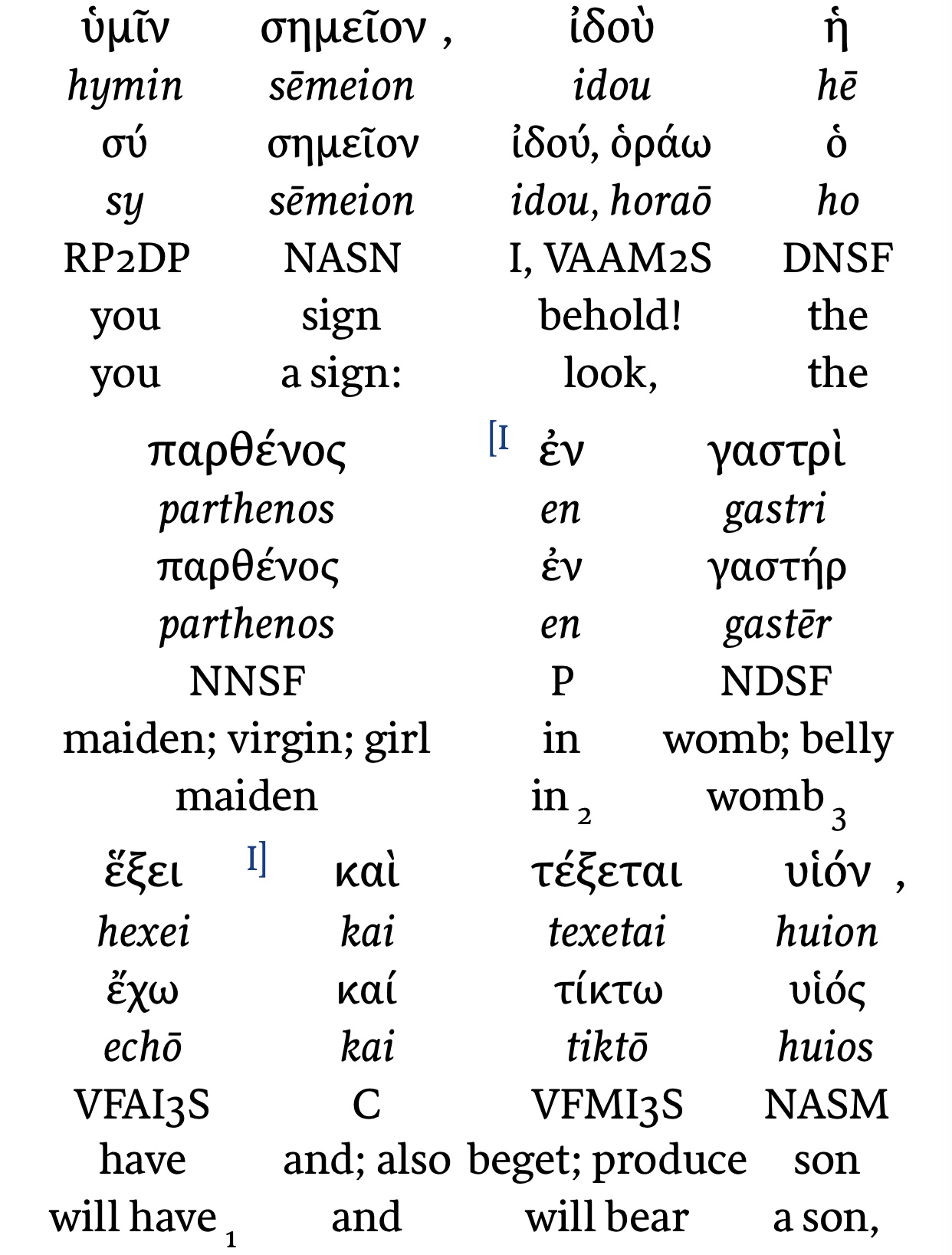
Notwithstanding the subtle controversies surrounding the Septuagint. This is a Greek translation thought to have been in common use around the time of Jesus’ birth. Here is an English translation of the Septuagint for the quotation from Matthew’s Gospel above.

Because of this, the Lord himself will give you a sign: Look, the maiden will become pregnant and will bear a son, and you will call his name Immanuel.

Isaiah 7:14— The Lexham English Septuagint (Bellingham, WA: Lexham Press, 2012)

Here we see the term maiden as it is translated from Hebrew to Greek and then into English. This seems to offer the skeptic some refuge, but does it really?

With a bit of assistance from interlinear tools… We discover something important.

Do you see it?

Parthenos does mean maiden and virgin. This tells us the skeptics are wrong. This could be accepted scholarship for those. I offer it because skeptics seldom take the time to really understand their objections.

Yet somewhere in the back of my mind, I simply prefer to believe what God has said. He moved in such a way as to have Isaiah write of that, using a Hebrew word that includes the meaning of virgin. After that miracle of the birth of the God-Man, He then moved Matthew in a similar fashion to Isaiah. In his Gospel, he used the word parthenos in translating Isaiah 7:14 (Matthew 1:23.)

That is how we know Jesus was born of a virgin. God is not constrained to (or by) time, matter and space. And His Word is true and reliable.