
Harmonizing the Tribulation of Those Days

“Immediately after the tribulation of those days, ‘the sun will be darkened, the moon will not give its light; the stars will fall from heaven, and the powers of the heavens will be shaken.’
“Then the sign of the Son of Man will appear in heaven, and then all the tribes of the earth will mourn, and they will see the Son of Man coming on the clouds of heaven with power and great glory. And He will send His angels with a great sound of a trumpet, and they shall gather His elect from the four winds, from one end of the heavens to the other.

Matthew 24:29–31 — Modern English Version (Thinline Edition.; Lake Mary, FL: Passio, 2014)

“But in those days, after that distress, ‘the sun will be darkened, and the moon will not give her light; the stars of heaven will fall, and the powers that are in heaven will be shaken.’
“Then they will see the Son of Man coming in clouds with great power and glory. Then He will send His angels and gather His elect from the four winds, from the farthest part of the earth to the farthest part of heaven.

Mark 13:24–27 — Modern English Version (Thinline Edition.; Lake Mary, FL: Passio, 2014)

“There will be signs in the sun and the moon and the stars; and on the earth distress of nations, with perplexity, the sea and the waves roaring; men fainting from fear and expectation of what is coming on the inhabited earth. For the powers of heaven will be shaken. Then they will see the Son of Man coming in a cloud with power and great glory. When these things begin to happen, look up and lift up your heads, for your redemption is drawing near.”

Luke 21:25–28 — Modern English Version (Thinline Edition.; Lake Mary, FL: Passio, 2014)

In the harmony of these presentations of the special briefing that Jesus gave His disciples at the end of the age, there are similarities that can be harmonized. All three are describing a time of great tumult, with signs in the sun, moon, and stars, and the heavens being shaken. We also see Jesus coming in the clouds.

To understand the coming in the clouds, we must delve into the Old Testament. We find over the many mentions of clouds associated with God it came in the form of divine intervention for His people. During the Exodus, God led the Israelites in a pillar of cloud by day. When the cloud descended on the tent of meeting, it signified the presence of God. God coming in the clouds is a powerful and symbolic way to demonstrate divine intervention, divine judgment, or divine provision for the preservation of His people.

In this ‘sign’ we see ALL three. There is also another truth in the harmony that isn’t discussed. That is, Jesus is referring to Himself as God. If one understands the trial with the high priest, Jesus was asked if He was the Messiah, the Son of God. In His reply, He affirmed the questions the priest asked and claimed He is God. This is understood when we know the identity of Who comes in the clouds. Jesus said it would be Him by the title He chose for Himself. This title is also a direct reference to all of this.

I saw in the night visions, and there was one like a Son of Man coming with the clouds of heaven. He came to the Ancient of Days and was presented before Him. There was given to Him dominion, and glory, and a kingdom, that all peoples, nations, and languages should serve Him. His dominion is an everlasting dominion, which shall not pass away, and His kingdom that which shall not be destroyed.

Daniel 7:13–14 — Modern English Version (Thinline Edition.; Lake Mary, FL: Passio, 2014)

The differences are also important. Let’s poke at some of these.

The first is the introductory phrase to this time. In the Matthew and Mark account, the audience’s attention is drawn toward the period after these distresses. More things would happen on Earth and in the heavens, and then the Son of Man would appear. The elect would be gathered, and a kingdom established (The latter part is inferred.) Both accounts seem to give a contemporaneous account of events.

Now note how Luke explains it, paying special attention to where he wants the audience’s attention drawn. From the outset, Luke is asking his reader to understand the time before these events occur. This is clearly understood by this phrase: “of what is coming on the inhabited earth.” Luke describes the same events that will happen, not contemporaneously.

Then we encounter the last sentence. “When these things begin to happen, look up and lift up your heads, for your redemption is drawing near.” Luke is a gentile writing to Gentiles. He is admonishing them to pay attention when these things begin to happen. We also have the use of a unique word, ‘redemption.’

Matthew and Mark are drawing attention to the time of God’s intervention, judgment, and preservation of His people. Perhaps it could be redemption. Yet they did not use the word. I think it is because the attention of the reader is being drawn to two different events. Luke is drawing attention to redemption that occurs before the harmonized disasters that are described.
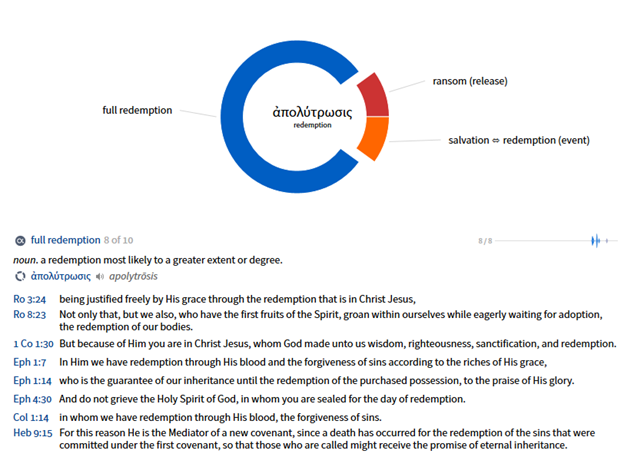
Considering redemption and the way the word is used in the New Testament, we can readily see the references to the majority of forms in the graphic. There are two other uses: one reference meaning ransom/release is cited in Hebrews 11:35 (Red.) The other is referencing an event and is the one word from Luke 21:28 we are discussing, ‘Redemption.’

The End of it Shall Come with a Flood.

After the sixty-two weeks Messiah shall be cut off and shall have nothing. And the troops of the prince who shall come shall destroy the city and the sanctuary. The end of it shall come with a flood. And until the end of the war desolations are determined.

Daniel 9:26 — Modern English Version (Thinline Edition.; Lake Mary, FL: Passio, 2014)

I had highlighted this during the week to pursue later. What caught my attention is the phrase “The end of it shall come with a flood.” In this case, it would be the city of Jerusalem, or better, the temple sanctuary in it.

Yet somewhere in the back of my mind, I remember hearing an account of a certain ancient civilization wanting to extract the last vestiges of gold from a sacked place; they flooded it with water. As the water washed through the ruins, it then gushed over a grassy plain before eventually finding an outlet to a body of water. The treasure was lifted from the ruins by the water and caught in the grass of the plains. It was then retrieved. I think somewhere in my mind I always want to connect this idea with the temple but can find no sources for even the account. There is plenty of speculation on how the alleged melted gold was retrieved, but that is for another time.

Setting out this morning to try and understand, I have at least settled in my mind what is being said.

“The end of it shall come with a flood.”

In the passage, the word flood is translated from the Hebrew sheṭeph (שֶׁטֶף.) I think I want to read an English primary understanding into the translated word, meaning a flood of water. However, it seems as if the idea conveyed is just overwhelming devastation. A little later in Daniel, that same word is used in connection with armies to convey an overwhelming military army that is swept away.

A flood of armies shall be swept away before him and be broken, and the prince of the covenant as well.

Daniel 11:22 — Modern English Version (Thinline Edition.; Lake Mary, FL: Passio, 2014)

I think that helps to understand the context being offered. Still not satisfied, I checked out how the Septuagint translated the idea. The English transliteration is something like this:

Will come its end with destructive anger.

I think that better suits the idea as a judgment sent from God and overwhelming on many fronts: military, vast, and emotional. Given some of the scant historical gleanings, the Israelis were so protective of that sanctuary. That was their identity, as the only ones who could approach and serve God.

Yet clearly in the prophecy, the Anointed One is cut off. We know Jesus was crucified. His death wasn’t for Himself (and shall have nothing.)

It is the troops of the prince who shall come who set out to destroy the sanctuary. The command to do so wasn’t from Rome; a local legion set the fire. I can imagine the overwhelming confusion of the moment.

“And until the end of the war desolations are determined.”

Let’s not confuse the term desolations with what is commonly called the abomination of desolation. The former is specifically speaking of the desolations that are decreed to Jerusalem (and its people.) It is this very thing Jesus spoke of in the Olivet discourse. He was speaking of the second diaspora, the scattering of Israelis, and the desolations to come upon the city and its people.

When you see Jerusalem surrounded by armies, then you know that its desolation has drawn near. Then let those who are in Judea flee to the mountains, and let those who are in the city depart, and let not those who are in the country enter it. For these are the days of vengeance, that all things which are written may be fulfilled. But woe to those who are pregnant and to those who nurse in those days! For there will be great distress in the land and wrath upon this people. They will fall by the edge of the sword and will be led away captive to all nations. And Jerusalem will be trampled on by the Gentiles until the times of the Gentiles are fulfilled.

Luke 21:20–24 — Modern English Version (Thinline Edition.; Lake Mary, FL: Passio, 2014)

There would be a specific season for this diaspora, and it will end when the times of the Gentiles are fulfilled. Even in recent history, we continue to see the desolations that happen to the Jewish people: expulsion from Spain, the pogroms in Russia, and the Holocaust. These readily come to mind as modern desolations. Even now we see continued desolations spoken of in our media. The zeitgeist would shame Israel for settlements, for defending herself. The same would also divide Jerusalem for the sake of peace. Even then, the end of war won’t come until the Messiah arrives.

Then the sign of the Son of Man will appear in heaven, and then all the tribes of the earth will mourn, and they will see the Son of Man coming on the clouds of heaven with power and great glory. And He will send His angels with a great sound of a trumpet, and they shall gather His elect from the four winds, from one end of the heavens to the other.

Matthew 24:30–31 — Modern English Version (Thinline Edition.; Lake Mary, FL: Passio, 2014)

The flood destroyed the city and sanctuary, and with all floods, the aftermath seems hopeless. These are the desolations that are decreed until the end of the war.

Pray for the peace of Jerusalem:
“May they prosper who love you!
Peace be within your walls
and security within your towers!”

Psalms 122:6–7 — Modern English Version (Thinline Edition.; Lake Mary, FL: Passio, 2014)

This is not meant to be an extensive explanation of prophecies, but to clearly understand that phrase in the light of Scripture.

I Am the Lord, I Will not Share my Glory with Another

I am the Lord, that is My name;
and My glory I will not give to another,
nor My praise to graven images.
See, the former things have come to pass,
and new things I declare;
before they spring forth
I tell you of them.

Isaiah 42:8–9 — Modern English Version (Thinline Edition.; Lake Mary, FL: Passio, 2014)

Here is God telling us yet again Who He is.

In the former post, we saw how Jesus quoted the verses before these and said they have come to pass in the very presence of His audience.

My Glory I Will Not Give to Another

There are teachings that abound that deny Who Jesus Christ is. Some declare Him to be just the brother of Satan — another created being. Other teachings say He is Michael. Suffice it to say, those are wrong. It is because of these very words. God doesn’t share His glory with another.

In this Messianic prophecy, the identities of the Father are established. We’ve also witnessed from previous posts that the identity of this Chosen Servant, this Messiah, is Jesus. We’ve also understood that Jesus is the fulfillment of the calling of Israel. The two ideas are so intertwined that Jesus really is the True Israel.

But here, we are given a bit of information that, when coupled with Jesus’ own words… He is clearly God.

When Jesus spoke these words, He lifted His eyes toward heaven and said:
“Father, the hour has come. Glorify Your Son, that Your Son may also glorify You. As You have given Him authority over all flesh, He will give eternal life to all whom You have given Him. This is eternal life: that they may know You, the only true God, and Jesus Christ, whom You have sent. I have glorified You on the earth. I have finished the work You have given Me to do. And now, O Father, glorify Me in Your own presence with the glory which I had with You before the world existed.

John 17:1–5 — Modern English Version (Thinline Edition.; Lake Mary, FL: Passio, 2014)

In the words of Jesus, as He prays, He tells us He shared the glory with the Father.

It is the Son Who reveals the Father. We see the glory of the Father as Jesus went to the cross and was glorified by being raised up, doing the very thing the prophet Isaiah wrote hundreds of years in advance.

There is an assent to the prohibition of graven images. God won’t share the praise given to them. It is an encouragement to us to understand Who Jesus is in the right way. Not running afoul of the command to not praise idols.

Former things have come to pass, and as we read this, it encompasses some of the things prophesied of this Servant.

But… There is only One God Who can tell you of something before it happens. He wrote it in Isaiah as a pattern for us. We see the pattern partially fulfilled. But more is yet to come.

Then they will see the Son of Man coming in a cloud with power and great glory.

Luke 21:27 — Modern English Version (Thinline Edition.; Lake Mary, FL: Passio, 2014)

He is yet to come in great glory. For some, it will be a blessing. To the whole creation that awaits redemption, it will be a blessing. But for many, this will be a day of dread.