
The First Miracle

On the third day there was a wedding in Cana of Galilee. The mother of Jesus was there. Both Jesus and His disciples were invited to the wedding. When the wine ran out, the mother of Jesus said to Him, “They have no wine.”
Jesus said to her, “Woman, what does this have to do with Me? My hour has not yet come.” His mother said to the servants, “Whatever He says to you, do it.” Six water pots made of stone were sitting there, used for ceremonial cleansing by the Jews, containing twenty to thirty gallons each.
Jesus said to them, “Fill the water pots with water.” And they filled them up to the brim.
Then He said to them, “Now draw some out, and take it to the master of the feast.”
And they took it. When the master of the feast tasted the water that had been turned into wine, and did not know where it came from (though the servants who drew the water knew), the master of the feast called the bridegroom, and he said to him, “Every man serves the good wine first, and after men have drunk freely, then the poor wine is served. But you have kept the good wine until now.”

John 2:1–10

I assume that all have read this in their Bible. I also assume many have heard it as part of a sermon or teaching. I post it for you as a quick reference and in case someone has not read it.

In the past, I have not paid any real particular attention to it. At least, not until I started reading Beautiful Outlaw by John Eldredge. This account was used to demonstrate the extravagant generosity of Jesus. I had not even considered that thought in the thinking part of my mind, but I guess it would lurk somewhere in the background. As the Spirit of God would have it, looking deeper into what happened at that wedding He revealed something I had not encountered anywhere else. Come with me and see.

The First Sign

This, the first of His signs, Jesus did in Cana of Galilee, and He revealed His glory, and His disciples believed in Him.

John 2:11

As John recounts in his Gospel what had happened, he closes this punctual account by saying it was the first of Jesus’ signs. This part of the narrative follows the calling of His first disciples. John’s intent is to promote belief in Jesus by telling of His words and the signs He did.

Jesus performed many other signs in the presence of His disciples, which are not written in this book. But these are written that you might believe that Jesus is the Christ, the Son of God, and that believing you may have life in His name.

John 20:30–31

When reading the Gospel of John, pay close attention to the unfolding revelation. He opens with a testimony of Who Jesus is that parallels and expounds on Genesis 1. Later, we encounter John the Baptizer and his ministry of preparing the world for Jesus. Like Elijah speaking truth, John the Baptizer testifies to the ministry of Jesus, just as the apostle John records.

The Lamb of God

The next day John saw Jesus coming toward him and said, “Look, the Lamb of God, who takes away the sin of the world. This is He of whom I said, ‘After me comes a Man who is preferred before me, for He was before me.’ I did not know Him, but for this reason I came baptizing with water: so that He might be revealed to Israel.”

John 1:29–31

The apostle John is unique in recording the words of John the Baptizer. “Behold the Lamb of God” that takes away sin. In a way, he points to this first sign at Cana, which then points to another sign.

Let’s go back to Cana.

On the third day there was a wedding in Cana of Galilee. The mother of Jesus was there. Both Jesus and His disciples were invited to the wedding. When the wine ran out, the mother of Jesus said to Him, “They have no wine.”

John 2:1–3

John recounts the first week of the ministry of Jesus. After being baptized and calling the first disciples, his small troupe is invited to a wedding. Already, we ought to pay attention to the timing mentioned. John is writing in retrospect, recording this decades after the events occurred. He has hindsight of the events in Jesus’ life, it is likely that there is something more to the phrase than just the narrative on the third day. It is something to keep in mind.

As we continue with the account, trouble arises when the open bar runs dry. Mary (Jesus’ mother) says that there is no more wine. There is then nothing left with which to continue the celebration.

A Mother Knows

Jesus said to her, “Woman, what does this have to do with Me? My hour has not yet come.”

John 2:4

This makes me smile. Not just what seems like abrupt language. What did she expect Him to do?

What did she know?

Even more intriguing… How did she know He could help?

I think the Bible helps us to know.

He will be great, and will be called the Son of the Highest. And the Lord God will give Him the throne of His father David, and He will reign over the house of Jacob forever. And of His kingdom there will be no end.”

Luke 1:32–33

Mary had a special briefing given by a messenger from God. She knew her Son. She knew He is the Anointed One, Son of the Most High. She knew He is forever King. I think she even knew Him as God, having command over material things.

Had He done miracles before this?

We are not given any information on that except for John’s telling us this is the first of His signs. It could be a small attestation when as a preteen, He remained behind at the temple and taught. It is something to consider.

What we can determine is that Mary knew Jesus could readily help in this situation. Jesus affirms this by His response to her. We take Jesus’ response to His mother as somewhat sharp. In the language at the time, it was a respectful address. Jesus is telling her that what concerns her doesn’t concern Him. He continues by letting her know to leave Him alone, His time has not yet come.

My Hour

This is the specific phrase used. It refers to a particular time. This is a reference that leads us to the culmination of Jesus’ earthly ministry. It points us to something future.

As John’s narrative unfolds, Jesus uses this word hour to point to a yet future time. He uses it in speaking with the woman at the well in John 4:21; 23. He uses it again to point to a future time period in John 5:25; 28. (The list continues: John 7:30, 8:20, 12:23; 27, 13:1, 16:32, & 17:1.) John explains the hour:

Now before the Passover Feast, Jesus knew that His hour had come to depart from this world to the Father. Having loved His own who were in the world, He loved them to the end.

John 13:1

In my opinion, from reading John’s Gospel, the hour refers to the time period that begins around Jesus’ death and stretches to His return to Earth and the Millennial Kingdom. The hour will be marked with resurrection, I would say multiple resurrections. Yet, I digress.

For the purpose of this sign, my hour refers to the cross as the beginning of it. John is exclusive in his extensive writing of the words and actions of Jesus in the period of time leading to the cross.

That Seeming Reluctance

Did you pick up on the reluctance Jesus demonstrated toward His mother?

Do you think it is significant as a parallel in His hour?

Then Jesus came with them to a place called Gethsemane and said to the disciples, “Sit here while I go and pray close by.” He took with Him Peter and the two sons of Zebedee and began to be sorrowful and troubled. Then He said to them, “My soul is very sorrowful, even to death. Wait here, and keep watch with Me.”
He went a little farther, and falling on His face, He prayed, “O My Father, if it is possible, let this cup pass from Me. Nevertheless, not as I will, but as You will.”

Matthew 26:36–39

It is not necessarily the same way, but I think the reluctance to do His mother’s will belies a very human emotional response. That emotion is amplified many times as demonstrated in His hour. In speaking with His Father, He wanted to find a way out. Nevertheless, as the Man, He honored His father by doing what His father wanted, just as He honored His mother’s will.

His mother said to the servants, “Whatever He says to you, do it.”

John 2:5

It is these few things that leads me to see some things that I think are hidden signs in this sign.

The Specifics

Six water pots made of stone were sitting there, used for ceremonial cleansing by the Jews, containing twenty to thirty gallons each.
Jesus said to them, “Fill the water pots with water.” And they filled them up to the brim.
Then He said to them, “Now draw some out, and take it to the master of the feast.”
And they took it. When the master of the feast tasted the water that had been turned into wine, and did not know where it came from (though the servants who drew the water knew), the master of the feast called the bridegroom, and he said to him, “Every man serves the good wine first, and after men have drunk freely, then the poor wine is served. But you have kept the good wine until now.”

John 2:6–10

Six water pots are filled to the brim. Each can hold a determinate amount of water. I’m not going to go through to the end.

The amount of wine that Jesus made would be the equivalent to 120 to 180 gallons. That is a lot of wine. The master says about the wine, that it is the good stuff and kept until now.

The Sign in the Sign

Consider the specific information given. There are six containers. It is considered by many scholars that six is the number of man. Seven is completion and the number of God, six is just short of that perfection. Humans were made on the sixth day. The number six here points to a human man.

Wine is considered the blood of the grape. Biblically, wine is often a representation of blood. We use the blood of the grape in the Lord’s Supper to remind us of the blood Jesus shed. The wine here ought to also remind us of the shed blood at the cross.

The containers being filled to the brim signify there is no more room for anything else. Think of sufficiency, as the blood of Jesus is sufficient, leaving no room for anything else. More important, had Jesus added something to change the chemical composition of the water, it would easily be detected by overflowing the brim.

Let us consider the quantity mentioned. The amount of wine that Jesus made would be the equivalent of 600 to 900 modern wine bottles. Again, that’s a lot of wine. Especially after the open bar has been emptied out. I don’t think it’s a far stretch to say that the amount of wine Jesus made was far more than sufficient to satisfy all of the guests. Weddings at this time lasted for days, even in the relative austerity the hosts would provide adequate provisions for the length of the celebration.

The wine Jesus made was also considered the best. Like the master of the feast said, the best is usually served first. In this account, the best is saved for last. The best speaks to the efficiency.

The Mediator of the New

This first earthly sign of Jesus was pointing to a future-fulfilling sign. The one when the Lamb of God would have His blood shed for the sins of humanity. It would be a Man. It would be a finite and sufficient amount. None more would be necessary. It would also be an efficient amount to more than satisfy the needs of all. And it would be better than all of the blood of animals shed for sins that came before.

Consider what another writer declares:

Then indeed, the first covenant had ordinances for divine services and an earthly sanctuary. A tabernacle was made. In the first part of the tabernacle, called the Holy Place, were the candlestick, the table, and the showbread. Behind the second veil was the second part of the tabernacle called the Most Holy Place, which contained the golden censer and the ark of the covenant overlaid with gold, containing the golden pot holding the manna, Aaron’s rod that budded, and the tablets of the covenant. Above the ark were the cherubim of glory overshadowing the mercy seat. Concerning these things we cannot now speak in detail.
Now when these things were thus ordained, the priests would regularly go into the first part, conducting the services of God. But only the high priest went into the second part once a year, not without blood, which he offered for himself and for the sins of the people, committed in ignorance. The Holy Spirit was signifying through this that the way into the Most Holy Place was not yet revealed, because the first part of the tabernacle was still standing. This is an illustration for the present time, showing that the gifts and sacrifices offered could not perfect the conscience of those who worshipped, since they are concerned only with foods and drinks, ceremonial cleansings, and fleshly ordinances imposed until the time of reformation. But Christ, when He came as a High Priest of the good things to come, by a greater and more perfect tabernacle, not made with hands, that is to say, not of this creation, neither by the blood of goats and calves, but by His own blood, He entered the Most Holy Place once for all, having obtained eternal redemption. For if the blood of bulls and goats, and the ashes of a heifer, sprinkling the unclean, sanctifies so that the flesh is purified, how much more shall the blood of Christ, who through the eternal Spirit offered Himself without blemish to God, cleanse your conscience from dead works to serve the living God?

Hebrews 9:1–14

There is no room for another.

For this reason He is the Mediator of a new covenant, since a death has occurred for the redemption of the sins that were committed under the first covenant, so that those who are called might receive the promise of eternal inheritance.

Hebrews 9:15

Knowing all of this, one can be assured beyond doubt, that the work of Jesus is sufficient and efficient to cleanse the conscience from sin for any that ask. The way to approach God is no longer veiled to anyone. Jesus’ blood, and only His blood alone, made the Way.

And just like at the wedding, there was no license for the attendees to be drunk. Jesus was not even concerned of that. There was more than enough for each invited guest to enjoy.

Invited Guests

Jesus and His troupe were among the invited guests at the wedding. As with the hosts of the wedding, God invites people to His wedding feast. Where is that invitation?

Jesus spoke to them again by parables, saying, “The kingdom of heaven is like a certain king who arranged a marriage for his son, and sent out his servants to call those who were invited to the wedding, but they would not come.
“Again, he sent out other servants, saying, ‘Tell those who are invited: See, I have prepared my supper. My oxen and fattened calves are killed, and everything is ready. Come to the wedding banquet.’
“But they made light of it and went their ways, one to his farm, another to his business; the rest took his servants, treated them spitefully, and killed them. When the king heard about it, he was angry. He sent in his army and destroyed those murderers and burned up their city.
“Then he said to his servants, ‘The wedding is ready, but those who were invited were not worthy. Go therefore to the streets, and invite to the wedding banquet as many as you find.’ So those servants went out into the streets and gathered together as many as they found, both bad and good. So the wedding hall was filled with guests.
“But when the king came in to see the guests, he saw a man who was not wearing wedding garments. 12 He said to him, ‘Friend, how did you get in here without wedding garments?’ And he was speechless.
“Then the king told the attendants, ‘Bind him hand and foot, take him away, and cast him into outer darkness, where there will be weeping and gnashing of teeth.’
“For many are called, but few are chosen.”

Matthew 22:1–14

I make the case that simply by being born of Adam’s race just as Jesus… You, like I am, are invited to the feast. God wanted you in His creation. It follows He wants you in His presence in heaven.

Being an invited guest, you can enter His presence anywhere at anytime. (Really, you’re already there because of that blood Jesus shed. And there is no place anyone can go to escape Him.) Just talk to Him.

He’s listening.
The Rapture (Part 1) – Ecclesiology

To deviate from the normal posts, I want to offer some clarity on an important doctrine. To do that requires some foundational understanding.

But I would not have you ignorant, brothers, concerning those who are asleep, that you may not grieve as others who have no hope. For if we believe that Jesus died and arose again, so God will bring with Him those who sleep in Jesus. For this we say to you by the word of the Lord, that we who are alive and remain until the coming of the Lord will not precede those who are asleep. For the Lord Himself will descend from heaven with a shout, with the voice of the archangel, and with the trumpet call of God. And the dead in Christ will rise first. Then we who are alive and remain shall be caught up together with them in the clouds to meet the Lord in the air. And so we shall be forever with the Lord. Therefore comfort one another with these words.

1 Thessalonians 4:13–18 — Modern English Version (Thinline Edition.; Lake Mary, FL: Passio, 2014)

Some may scoff that the word rapture doesn’t appear in the text. It’s true, the English word rapture does not appear in the text. But the Greek word harpazo (rapture) translated as caught up is.

The Rapture, to and for Who?

It’s specifically for those in Christ.

You are all sons of God by faith in Christ Jesus. For as many of you as have been baptized into Christ have put on Christ. There is neither Jew nor Greek, there is neither slave nor free, and there is neither male nor female, for you are all one in Christ Jesus. If you are Christ’s, then you are Abraham’s seed, and heirs according to the promise.

Galatians 3:26–29 — Modern English Version (Thinline Edition.; Lake Mary, FL: Passio, 2014)

We now have a clear understanding that the rapture is for those in Christ. To be in Christ is to be baptized into Jesus Christ.

That’s Great. But What Does it Mean?

The rapture is for the body of Christ, His church. We must have a clear understanding of what the church is. That is, we must have a proper ecclesiology.

Let’s get started.

He is the head of the body, the church. He is the beginning, the firstborn from the dead, so that in all things He may have the preeminence.

Colossians 1:18 — Modern English Version (Thinline Edition.; Lake Mary, FL: Passio, 2014)

What we learn here is exactly what the church is. The church is the body of the Messiah.

Therefore remember that formerly you, the Gentiles in the flesh, who are called the “uncircumcision” by the so-called “circumcision” in the flesh by human hands, were at that time apart from Christ, alienated from the citizenship of Israel and strangers to the covenants of promise, without hope and without God in the world. But now in Christ Jesus you who were formerly far away have been brought near by the blood of Christ.
For He is our peace, who has made both groups one and has broken down the barrier of the dividing wall, by abolishing in His flesh the enmity, that is, the law of the commandments contained in ordinances, that in Himself He might make the two into one new man, thus making peace, and that He might reconcile both to God into one body through the cross, thereby slaying the enmity.

Ephesians 2:11–16 — Modern English Version (Thinline Edition.; Lake Mary, FL: Passio, 2014)

This passage basically explains what the composition of the church is.

Paul begins by explaining the initial conditions of God’s dealing with people. There were basically two groups of people, the Israelis, and the Gentiles. There was an advantage to being Israeli because God had a special relationship with those people. One of these groups was set aside by covenants that God made with them. Of those covenants, one called the Mosaic covenant (containing the ten commandments) served as the dividing wall or partition between the two people groups. Gentiles were alienated and far off from the benefits of these covenants even though they could be saved by the same faith as the Israelis.

When Messiah died, He broke down this partitioning wall and took it out of the way. As the wall is now removed, God creates of the two separate groups one new man. The one new man is now a third entity that had not heretofore existed. It is one body through the cross. The body is the church of the Messiah.

The composition of the body is all Israelis and Gentiles who believe.

How Does One Enter this Body?

For by one Spirit we are all baptized into one body, whether we are Jews or Gentiles, whether we are slaves or free, and we have all been made to drink of one Spirit.

1 Corinthians 12:13 — Modern English Version (Thinline Edition.; Lake Mary, FL: Passio, 2014)

The way to enter the body is by baptism by Spirit. This is the one baptism. It isn’t by water.

There is one body and one Spirit, even as you were called in one hope of your calling, one Lord, one faith, one baptism, one God and Father of all, who is above all, and through all, and in you all.

Ephesians 4:4–6 — Modern English Version (Thinline Edition.; Lake Mary, FL: Passio, 2014)

One body. One God. One Spirit. One Father. One Lord. One faith. One baptism.

When did the Church Begin?

This can be a confusing point. There are many different ideas presented on exactly when the church began. Some see it in the Tanakh, thinking it started with Adam or Abraham.

Since we know that entrance into the body called the church is by Spirit baptism, let us see if we can find where Spirit baptism began.

Jesus answered him, “Blessed are you, Simon son of Jonah, for flesh and blood has not revealed this to you, but My Father who is in heaven. And I tell you that you are Peter, and on this rock I will build My church, and the gates of Hades shall not prevail against it. I will give you the keys of the kingdom of heaven, and whatever you bind on earth shall be bound in heaven, and whatever you loose on earth shall be loosed in heaven.” Then He commanded His disciples to tell no one that He was Jesus the Christ.

Matthew 16:17–20 — Modern English Version (Thinline Edition.; Lake Mary, FL: Passio, 2014)

This is the first and only occurrence of the word church in the four gospels. The setting for this is in Caesarea Philippi. It is home to the Grotto of Pan or as Jesus said the gates of Hell. Reading further on from this passage, it can be learned that the church being built is a consequence of Israel for their rejection of the Messiah. The important part is that the church is yet future… I will build my church. It is simple present tense informing us that it is not something that had existed before and will be expanded.

For John baptized with water, but you shall be baptized with the Holy Spirit not many days from now.”

Acts 1:5 — Modern English Version (Thinline Edition.; Lake Mary, FL: Passio, 2014)

Jesus promises Spirit baptism, not many days from now. It is yet future. We know now that the entrance into the church body was still yet future, therefore the church as a body was still to come. But when did Spirit baptism begin?

When the day of Pentecost had come, they were all together in one place. Suddenly a sound like a mighty rushing wind came from heaven, and it filled the whole house where they were sitting. There appeared to them tongues as of fire, being distributed and resting on each of them, and they were all filled with the Holy Spirit and began to speak in other tongues, as the Spirit enabled them to speak.

Acts 2:1–4 — Modern English Version (Thinline Edition.; Lake Mary, FL: Passio, 2014)

On the Day of Pentecost, as the disciples were gathered, the Spirit entered them. They were filled with the Spirit. This is not a new idea, many

For he will be great in the sight of the Lord, and shall drink neither wine nor strong drink, and he will be filled with the Holy Spirit, even from his mother’s womb.

Luke 1:15 — Modern English Version (Thinline Edition.; Lake Mary, FL: Passio, 2014)

But as for me, I am filled with power, with the Spirit of the LORD, and with justice and might, to declare to Jacob his transgression and to Israel his sin.

Micah 3:8 — Modern English Version (Thinline Edition.; Lake Mary, FL: Passio, 2014)

I have filled him with the Spirit of God in wisdom, in understanding, in knowledge, and in all manner of craftsmanship to devise artistic works for work with gold, with silver, and with bronze, and in the cutting of stones for settings, and in carving of wood, to work in all manner of craftsmanship.

Exodus 31:3–5 — Modern English Version (Thinline Edition.; Lake Mary, FL: Passio, 2014)

I posted these to show that being filled with the Spirit is not a new thing. It happened to John the Baptist and to Micah. It happened to Bezalel the son of Uri.

Acts 2 declares nothing about Spirit baptism. Being Spirit-filled is not the same as Spirit baptism.

To understand clearly, we need to move forward in Acts to Chapter 10.

Peter, after receiving a vision Peter was instructed there were three men looking for him. These three were sent by a centurion named Cornelius who had just previously been visited by an angel. Peter invited these three men and provided lodging for them. The next day he went to Joppa with them. Peter entered the house filled with relatives of Cornelius. He spoke to them and shared the details of the Gospel with these Gentiles. We pick it up in the text.

While Peter was still speaking these words, the Holy Spirit fell on all those who heard the word. All the believers of the circumcision who had come with Peter were astonished, because the gift of the Holy Spirit had been poured out even on the Gentiles. For they heard them speaking in other tongues and magnifying God.
Then Peter continued, “Can anyone forbid water for baptizing these, who have received the Holy Spirit as we have?” So he commanded them to be baptized in the name of the Lord. Then they asked him to stay a few days.

Acts 10:44–48 — Modern English Version (Thinline Edition.; Lake Mary, FL: Passio, 2014)

When Peter returned to Jerusalem to report on what happened, there was a bit of controversy. Peter had entered a Gentile home, something forbidden in the law.

Peter tells of his vision, and not wanting to be disobedient to the vision, he did as he was instructed to do.

“As I began to speak, the Holy Spirit fell on them, as He fell on us at the beginning. Then I remembered the word of the Lord, how He said, ‘John indeed baptized with water, but you shall be baptized with the Holy Spirit.’ If then God gave them the same gift as He gave us when we believed in the Lord Jesus Christ, who was I to be able to hinder God?”

Acts 11:15–17 — Modern English Version (Thinline Edition.; Lake Mary, FL: Passio, 2014)

He tells us succinctly that what happened with these Gentiles was the same as what happened to those Jewish disciples gathered on that beginning Pentecost. He remembered what Jesus said in Acts 1:5. The church began in Acts 2 with Spirit baptism. Because that is when Spirit baptism began.

The church is a distinct body that is not Israeli or Gentile. The church had a beginning that is clear. It was the Pentecost day described in Acts 2. That is when Spirit baptism began.

How Shall I Know?

Zechariah said to the angel, “How shall I know this? For I am an old man and my wife well advanced in years.”

Luke 1:18 — Modern English Version (Thinline Edition.; Lake Mary, FL: Passio, 2014)

This is Zechariah’s response to the angel that visited him while he was burning incense in the temple before the Lord. The angel came with good tidings of a promised newborn son. He and his wife were childless and well advanced in years. Yet the angel declared a boy would be born. He named the child and said he would have the power of Elijah.

Zechariah’s response wasn’t to believe what he was told. In fact, his response doesn’t seem quite shocking at all to modern ears. It is the same objection that many of us would offer.

“Prove it to me.”

“I need evidence.”

“Something more than your words is necessary.”

It’s the simple communication of truth from one person to another. In our case, an angel that has true information was tasked to relay it to Zechariah. He needed something more. Paul spoke of the human impediment at work here.

Where is the wise? Where is the scribe? Where is the debater of this age? Has God not made the wisdom of this world foolish? For since, in the wisdom of God, the world through its wisdom did not know God, it pleased God through the foolishness of preaching to save those who believe. For the Jews require a sign, and the Greeks seek after wisdom.

1 Corinthians 1:20–22 — Modern English Version (Thinline Edition.; Lake Mary, FL: Passio, 2014)

In all of the questions Paul asks, he is mocking the wisdom of the world. Technology advances, people compose great written works, wise men debate novel ideas. Yet in none of these is revealed the only truth that matters… To know God and to be saved.

Our friend Zechariah wanted something more. What was told to Him didn’t match what he knew. Older couples were well past the child-bearing years. Zechariah knew this messenger was different than a mere human.

Paul says the Israeli seeks something more… A sign. The Greek needs the wisdom that often arises from the debate of ideas. It’s always something more.

God conveys ideas to us. Without faith, it is impossible to please God. The just shall live by faith.

It pleased God through the foolishness of proclamation (preaching) to save those who believe it. It’s as simple as that. Believe what is said.

Zechariah’s response revealed he didn’t really believe. Yet Zechariah already had his sign.

Then an angel of the Lord appeared to him, standing on the right side of the altar of incense.

Luke 1:11 — Modern English Version (Thinline Edition.; Lake Mary, FL: Passio, 2014)

He was alone, and no other person was permitted to enter the place where he was. We know the angel appeared to him. It wasn’t there when he walked in.

Zechariah didn’t believe the proclamation, it cost him something. He regarded what he was told foolishly. He was a witness to it being all true. His wife conceived. A son was born to him.

If someone were to say to you, “Jesus died for you.” Would your response be to treat the statement with folly or would you want to know more?

The disposition of your soul depends on your response.

The Olivet Discourse: Introduction

This is an introduction to my own attempt to discover the similarities and distinctions of the presentation of the Olivet Discourse (first post) as given in the synoptic gospels. The Synoptic Gospels are Matthew, Mark, and Luke, as they present themselves similarly in the things they record of Jesus’ ministry on Earth.

The first thing to keep in mind is the distinctiveness of the authors as different people with differing mindsets. Each also had a distinct audience in mind. So, it can be said that each Gospel has a distinct purpose for a distinct audience. One sees this intent recorded by the selective events each author chooses to include, and how they are related to the audience.

Matthew

Matthew’s Gospel is intended to speak to the Israeli, a person who is familiar with the Old Testament. Matthew details the prophecies recorded in the Old Testament that characterize Israel’s Messiah, and how these are fulfilled in Jesus Christ. Therefore, Jesus is portrayed as that Messiah, the King of the Israelis. This is evidenced from the outset, as his gospel opens with the genealogy of Jesus, which would be of utmost importance to an Israeli. Especially as it relates to the Messiah, the Son of David.

The book of the genealogy of Jesus Christ, the Son of David, the son of Abraham:

Matthew 1:1 — Modern English Version (Thinline Edition.; Lake Mary, FL: Passio, 2014)

Herein, one sees that Jesus is the rightful heir to the kingdom of David. It is the opening of the book that establishes the credentials of Jesus as that heir. The promises of the Messiah from the Old Testament are fulfilled in Jesus Christ, beginning with His family tree.

Sum it up this way, Matthew is written to Israelis and is for Israelis.

Mark

Mark is not written to the Israeli or even to those familiar with the Old Testament. Instead, his audience is those people who understand power and authority. That is, those citizens and leaders in the Roman Empire. These folks would be unfamiliar with Judaism and the promises of the Messiah. Mark does not start with the birth of Jesus. He doesn’t start with Jesus’ credentials.

The beginning of the gospel of Jesus Christ, the Son of God. As it is written in the Prophets:
“Look, I am sending My messenger before Your face, who will prepare Your way before You.”
“The voice of one crying in the wilderness: ‘Prepare the way of the Lord, make His paths straight.'”

Mark 1:1–3 — Modern English Version (Thinline Edition.; Lake Mary, FL: Passio, 2014)

He starts with activities for people who understand action. Here is Jesus, the servant of the Lord sent by God to do what God has sent Him to do. With the emphasis on doing, Jesus did what was asked of Him. Because this book records the actions of Jesus, it records more of Jesus’ miracles than does Matthew, Luke, or John.

Mark is summed up as written to the Roman and the authorities in Rome.

Luke

Luke wanted to appeal to intellectuality. The Greeks of Luke’s day were of the intellectual mindset, loving art, philosophy, and literature. It is with that intent that the humanity of Jesus is emphasized. He is like any other human. Yet, He is not, as He is the perfection of humanity. And Luke would give an orderly account.

Whereas many have undertaken to write a narrative of those things which are most surely believed among us, just as they were handed down to us by those who from the beginning were eyewitnesses and ministers of the word, it seemed good to me also, having accurately investigated all things from the very beginning, to write to you an orderly account, most excellent Theophilus, that you might know the certainty of the things which you have been told.

Luke 1:1–4 — Modern English Version (Thinline Edition.; Lake Mary, FL: Passio, 2014)

One can trust that what Luke wrote is an orderly account. It is not the writings of an eyewitness, but as an investigator who has collected and recorded others’ eyewitness testimonies. The humanity of Jesus is emphasized by the focus of events that demonstrate that. Luke’s gospel relates to the reader a very human Jesus.

Luke is summed up as written to the Greek.

John

John was an eyewitness to the life of Jesus. The things recorded are for the purpose of establishing Jesus as the eternal God who became a man.

In the beginning was the Word, and the Word was with God, and the Word was God. He was in the beginning with God. All things were created through Him, and without Him nothing was created that was created.

John 1:1–3 — Modern English Version (Thinline Edition.; Lake Mary, FL: Passio, 2014)

From the very opening words, Jesus is presented as the Creator – God. John intends the reader to believe. The book is written with that purpose.

Jesus performed many other signs in the presence of His disciples, which are not written in this book. But these are written that you might believe that Jesus is the Christ, the Son of God, and that believing you may have life in His name.

John 20:31–32 — Modern English Version (Thinline Edition.; Lake Mary, FL: Passio, 2014)

John stated he is selective in what he has recorded. His goal is personal, it is for the reader to believe.

John writes to believers.

A Point to Consider

With these things in mind, the first point I would like to ponder is that the gospel of John has no recording of the Olivet Discourse. Of course, I understand that the Bible is given to us with a framework of design. Therefore, we must also consider certain points of silence. It is this one that I want to consider and challenge my own thinking.

Maybe, John didn’t record the Olivet Discourse because it wasn’t intended for believers, specifically church-age believers. Let me explain. We have it recorded by three folks who were not eyewitnesses. It is recorded in differing ways, with different ideas emphasized. Given the inherent audiences of the gospels, perhaps the ideas written in the discourse in the Synoptics would be for the unbelieving Israeli, those who love action and authority, and the intellectual. All of which would be unbelievers, given that John’s gospel is written for believers. John’s gospel would exclude such ideas as the church-age believers wouldn’t be present.

Could that hint to church-age believers being removed before these things happen?

Christmas, Behold the Lord’s Female Slave

Now in the sixth month, the angel Gabriel was sent from God to a town of Galilee named Nazareth, to a virgin legally promised in marriage to a man named Joseph of the house of David. And the name of the virgin was Mary. And he came to her and said, “Greetings, favored one! The Lord is with you.” But she was greatly perplexed at the statement, and was pondering what sort of greeting this might be. And the angel said to her,
“Do not be afraid, Mary, for you have found favor with God. And behold, you will conceive in the womb and will give birth to a son, and you will call his name Jesus. This one will be great, and he will be called the Son of the Most High, and the Lord God will give him the throne of his father David. And he will reign over the house of Jacob forever, and of his kingdom there will be no end.
And Mary said to the angel, “How will this be, since I have not had sexual relations with a man?” And the angel answered and said to her,
“The Holy Spirit will come upon you, and the power of the Most High will overshadow you. Therefore also the one to be born will be called holy, the Son of God.
And behold, your relative Elizabeth—she also has conceived a son in her old age, and this is the sixth month for her who was called barren. For nothing will be impossible with God.”
So Mary said, “Behold, the Lord’s female slave! May it happen to me according to your word.” And the angel departed from her.

Luke 1:26–38 — The Lexham English Bible (Bellingham, WA: Lexham Press, 2012)

Yeah… That title.

It is what Mary said. It wasn’t that she didn’t have a choice in the matter. She could have refused. Yet she didn’t. She called herself the Lord’s slave.

Did God make her do it?

No.

We tend to think about things that happen linearly because that is our only experience in this time-matter-space existence. All of this could have been orchestrated to happen to bring forth the Savior at the right time. It is well within the power of God. Such a concept as that brings to mind a child posing his toys in play, to do as such imagined. God doesn’t do that.

I think people live their lives and make choices just as Mary made. Those choices could be to honor God or more likely not. God didn’t cause Mary’s choice. Nor did He predict it. (I am sure that will cause some to gasp. Relax.) He gave us patterns for which to expect. We refer to this as prophecy.

Prophecy is just ‘truth-telling.’ In this particular situation, Isaiah recorded a truth for Ahaz, which had a dual pattern, like much of these prophecies. That dual pattern found its ultimate completion in the birth of Jesus. He is God in human form. Not appearing as God, but adding humanity to God.

God can tell us the beginning from the end. He is the only One able to do such things. He can do that because of His omniscience and omnipresence. Every moment is a present reality for God. He is present in the moment Isaiah penned ‘a maiden shall conceive.’ Just as He is present in the moment that Mary met the angel, and when Mary conceived. He is even present at that moment with Eve when He told her that her ‘seed’ would bring the redemption of humanity.

I am certain through the noisy bustle of this season, you’re going to hear the skeptical claims of holy rape and mistranslation.

Mary fully participated, yielding herself to what would happen to her. What we do know, is the conception of the Babe wasn’t sexual, and it wasn’t rape. Otherwise, she couldn’t be a virgin when she gave birth.

And that brings us to the second point. The contention over the term virgin. Many will say the Hebrew word almah cannot be translated to virgin, as it only means maiden. Yet, virgin is an acceptable translation from Hebrew just by looking at how it is used elsewhere in the Bible. Regardless, it never refers to a married woman.

Let’s look deeper.

“Behold, the virgin will become pregnant and will give birth to a son, and they will call his name Emmanuel,”

Matthew 1:23 — The Lexham English Bible (Bellingham, WA: Lexham Press, 2012)

Notwithstanding the subtle controversies surrounding the Septuagint. This is a Greek translation thought to have been in common use around the time of Jesus’ birth. Here is an English translation of the Septuagint for the quotation from Matthew’s Gospel above.

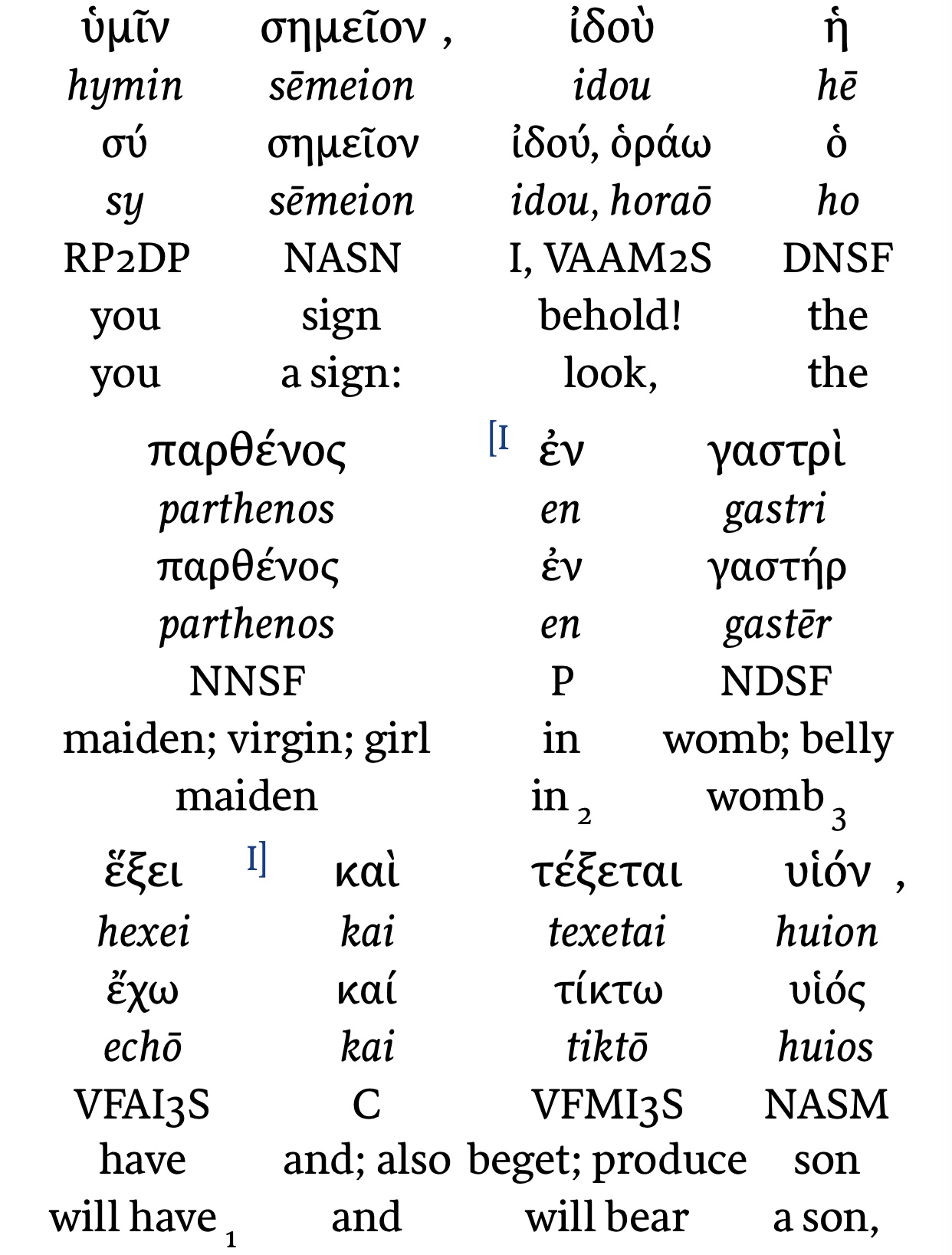
Because of this, the Lord himself will give you a sign: Look, the maiden will become pregnant and will bear a son, and you will call his name Immanuel.

Isaiah 7:14— The Lexham English Septuagint (Bellingham, WA: Lexham Press, 2012)

Here we see the term maiden as it is translated from Hebrew to Greek and then into English. This seems to offer the skeptic some refuge, but does it really?

With a bit of assistance from interlinear tools… We discover something important.

Do you see it?

Parthenos does mean maiden and virgin. This tells us the skeptics are wrong. This could be accepted scholarship for those. I offer it because skeptics seldom take the time to really understand their objections.

Yet somewhere in the back of my mind, I simply prefer to believe what God has said. He moved in such a way as to have Isaiah write of that, using a Hebrew word that includes the meaning of virgin. After that miracle of the birth of the God-Man, He then moved Matthew in a similar fashion to Isaiah. In his Gospel, he used the word parthenos in translating Isaiah 7:14 (Matthew 1:23.)

That is how we know Jesus was born of a virgin. God is not constrained to (or by) time, matter and space. And His Word is true and reliable.