
Jesus has been Gifted Everything

For as the Father raises the dead and gives them life, even so the Son gives life to whom He will. The Father judges no one, but has committed all judgment to the Son, that all men should honor the Son, just as they honor the Father. He who does not honor the Son does not honor the Father who sent Him.

John 5:21–23 — Modern English Version (Thinline Edition.; Lake Mary, FL: Passio, 2014)

Everything the Father has is given to Jesus; just as we see here, Jesus even has the power to raise the dead. More importantly, Jesus has the power to give life!

Maybe you’ve never thought that through. Yet right here… Jesus is making a bold statement. Wait, you’ve never really thought that Jesus is God?

That first statement is an attestation to that simple fact.

The Son Gives Life to Whom He Will

Then the Lord God formed man from the dust of the ground and breathed into his nostrils the breath of life, and man became a living being.

Genesis 2:7 — Modern English Version (Thinline Edition.; Lake Mary, FL: Passio, 2014)

I get it. The Father has to draw. The Father has to grant life. That is also given to Jesus.

He gave life to you! How do I know?

You’re breathing and reading this. He breathed the breath of life into you. Furthermore, the Father wants all of me to honor the Son. So that they may have access to the Father.

He who believes in the Son has eternal life. He who does not believe the Son shall not see life, but the wrath of God remains on him.

John 3:36 — Modern English Version (Thinline Edition.; Lake Mary, FL: Passio, 2014)
That Judgment Thing

God has even given the authority to judge solely to Jesus. He is the One Who chooses. He is the One Who judges.

Yet Jesus would have you honor Him just as any of us would honor God. Remember, He chooses.

All of us have had the wrath of God on us. Some may still be under that encumbrance. Yet we know the Father and the Son don’t want that for you. Don’t believe me. It’s right there…

“that all men should honor the Son, just as they honor the Father. ”

All men is better understood as all humans. He chose to give you life by sending His Son for you to believe and believe in.

The math is simple… Those that want to honor the Father must honor the Son. There is simply no other way.

If you think Jesus was a good man and a great Hebrew, that’s not good enough.

If you think Jesus was a great teacher and an example to follow, that’s not still good enough.

If you think Jesus came to teach us how to love others, that won’t work.

Even if you think Jesus died on a cross thousands of years ago, neither is that good enough.

You must honor Jesus as you honor God. And we do that by first believing He is Who He said He is… God. We can then believe His death was personal… Sufficient for each of us. Proven in that we’re still breathing.

The Father sent the Son to save the world; thus giving everyone enough time to understand these things. All who inhabit the world ought to honor the Son and be given life… Eternal life.
Is This not the Carpenter?

He went away from there and came into His own country. And His disciples followed Him. When the Sabbath came, He began to teach in the synagogue. And many hearing Him were astonished, saying, “Where did this Man get this? What is this wisdom that is given Him, that even miracles are done by His hands? Is this not the carpenter, the Son of Mary and the brother of James and Joseph and Judas and Simon? Are not His sisters here with us?” And they took offense at Him.

Mark 6:1–3 — Modern English Version (Thinline Edition.; Lake Mary, FL: Passio, 2014)

When Jesus returned to the place of His rearing and taught in the synagogue, people were astonished. These knew Him better than the other places He visited. They knew His upbringing. He was the carpenter.

Because these had a more intimate knowledge of Jesus growing up and working… What they thought He is became a stumbling block. How could a carpenter have so much wisdom teaching in the synagogue and even do miracles?

Jesus said to them, “A prophet is not without honor, except in his own country, and among his own relatives, and in his own house.”

Mark 6:4 — Modern English Version (Thinline Edition.; Lake Mary, FL: Passio, 2014)

Speaking truth is just that. For anyone who does it to strangers, they may be more apt to listen. They may have no preconceptions. But when it is done with those who you grew up with, objections start to rise. Not because the truth is spoken. These know you or think they do be preconceptions.

For those who have preconceptions, what you say is going to be measured by who they think you are. A stranger speaking the truth is going to appear to have great wisdom. If that stranger is labeled conservative, what truth offered is going to be measured through what the label means to the person hearing.

What you say is going to be measured by who or what your audience thinks you are. The words themselves will be filtered through that myopia. The more specific the preconception applied to you, the more easily it will provoke some offense.

People will judge what you say by preconceived ideas.

In the instance above, to those who knew Him, it was a carpenter speaking with great wisdom and doing miracles. To the stranger, the inherent baggage of a carpenter didn’t exist. Jesus’ humble upbringing was more of a stumbling block to those who were around Him growing up.

Today, those who have a preconceived notion of what a Christian is will filter the truth spoken by that Christian through that idea. In fact, most likely the Christian will seem hypocritical, even among other Christians.

It’s not that the hometown folks didn’t honor Jesus. It was their preconceived idea of Who they thought He is… That became the offense. In other words, He didn’t fit in their box.

Don’t let the box another person wants to put you in to be the prison for you. It is actually a prison for them.

He could not do any miracles there, except that He laid His hands on a few sick people and healed them. And He was amazed because of their unbelief.

Mark 6:5–6 — Modern English Version (Thinline Edition.; Lake Mary, FL: Passio, 2014)

Because they had imprisoned themselves, it became difficult for Jesus to do anything really good in their lives.

There is a deeper theological issue here, too. It has to do with synergy. There will be lots of folks who balk at that term. What is clearly being taught is that the people themselves weren’t receptive to Jesus. It became an impediment to them. He couldn’t help them.

If He could have changed their hearts by His own will and turned a faith-switch on, don’t you think He would have done that to have compassion on them?

Yet He didn’t. Perhaps it is because we have to come to Jesus in child-like faith, setting aside our own preconceptions of what we think is really real, believing what He says. Only then can He do miracles.

Let’s go Now

When the angels went away from them into heaven, the shepherds said to each other, “Let us now go to Bethlehem and see what has happened, which the Lord has made known to us.”
So they came hurrying and found Mary and Joseph, and the Baby lying in a manger. When they had seen Him, they made widely known the word which was told them concerning this Child.

Luke 2:15–17 — Modern English Version (Thinline Edition.; Lake Mary, FL: Passio, 2014)

After the heavenly choir sang to these shepherds, they immediately left their flocks and went into Bethlehem to see with their own eyes what had happened. After all, God chose to make the birth announcement to them.

They hurried and found the announced babe just as they had been told.

Those shepherds went and spread the word. Despite the fact that a shepherd’s testimony had no value in that society. They spoke plainly of what had happened to them.

Do you think we sometimes consider ourselves in the position of a shepherd?

I mean… People won’t believe our testimony of what God has done in our lives. We don’t share it because of the rejection and disbelief we presume we will get. We might think, why bother?

If we don’t talk about Jesus… Who will?

We must be like the shepherds and speak regardless if those we speak to believe what we say.

Let There be Peace on Earth

Suddenly there was with the angel a company of the heavenly host praising God and saying, “Glory to God in the highest, and on earth peace, and good will toward men.”

Luke 2:13–14 — Modern English Version (Thinline Edition.; Lake Mary, FL: Passio, 2014)

Part of our Christmas tradition is visiting Disney World. We were able to stay and watch one of the final performances of Illuminations in Epcot. At Christmas, there is an additional ending added to the show. It is a song called “Let There be Peace on Earth.”

I love that song, especially in the version used for the show. It is sung by children. The message of the song is simple and can be summed up in the lyrics.

“Let there be peace on earth,
And let it begin with me.”

The fireworks were stunning… As was that verse in my mind.

God has already brought peace to the Earth! That is what we celebrate tonight. Peace on earth, goodwill to men. Peace begins with God. He began that idea from the foundation of the world. He gave us the Prince of Peace.

You can bring peace to earth, especially your parts of it. Let it begin with you. Repent, that is turn around!

Acknowledge the truth. That you and I are helpless to live rightly without Him.

Believe He is God. He lived and died as a human. He rose again, all for you and I.

Confess it aloud. Confess that Jesus is God. It will then lead you to confess sins and other things. Set yourself right toward God while you can.

Let there be peace on earth. It can be with you.

A Child is Born

And in the same area there were shepherds living in the fields, keeping watch over their flock by night. And then an angel of the Lord appeared to them, and the glory of the Lord shone around them, and they were very afraid.

Luke 2:8–9 — Modern English Version (Thinline Edition.; Lake Mary, FL: Passio, 2014)

It was a night like any other for those shepherds. They were keeping watch over the clocks that would be used for the daily sacrifice in the temple in Jerusalem. From our perspective, shepherding is quaint and bucolic. Being a shepherd in that day was among the lowest of the rungs of that society. Meekly, they attended to their flocks with great care.

It was God (in Theophany) Who appeared to them suddenly. He came without notice of fanfare. His glory encompassed them in a flash. From darkness, it was suddenly brighter than daylight. It made them very afraid — as it would any of us.

But the angel said to them, “Listen! Do not fear. For I bring you good news of great joy, which will be to all people. For unto you is born this day in the City of David a Savior, who is Christ the Lord. And this will be a sign to you: You will find the Baby wrapped in strips of cloth, lying in a manger.”

Luke 2:10–12 — Modern English Version (Thinline Edition.; Lake Mary, FL: Passio, 2014)

Fear not! It wasn’t a command to them. They are intended as words of comfort. God was announcing favor to those most undesirable. A shepherd’s testimony in that society trusted or even sought out. The favor announced to them wouldn’t be for them alone but to all people. Who could believe them?

Yet… This is Christmas!

God announces His favor to even you. I don’t know anything about you. If you’re like me, you couldn’t think God would be favorable in your direction. Yet He is. Christmas demonstrates it. For God has caused it to be written:

For unto us a child is born, unto us a son is given, and the government shall be upon his shoulder. And his name shall be called Wonderful Counselor, Mighty God, Eternal Father, Prince of Peace.

Isaiah 9:6 — Modern English Version (Thinline Edition.; Lake Mary, FL: Passio, 2014)

Unto us, a child is born. That is for you and me, too. He is born just a wee human Babe from our perspective. God gave dearly… A Son. He didn’t give just any Son, but His unique Son. There’s not another like Him anywhere.

This Babe would eventually rule the world. He would be wise beyond His years. He is God, the One Who brings peace.

These are the good tidings to all people. God has set aside His anger toward people. Glory goes to God. Yet in the transaction, we get goodwill and peace from Him.

Suddenly there was with the angel a company of the heavenly host praising God and saying, “Glory to God in the highest, and on earth peace, and good will toward men.”

Luke 2:13–14 — Modern English Version (Thinline Edition.; Lake Mary, FL: Passio, 2014)

Take His Gift to you.

God’s Bread

In those days a decree went out from Caesar Augustus that the entire inhabited earth should be taxed. This taxation was first made when Quirinius was governor of Syria. And everyone went to his own city to be taxed.
So Joseph also departed from the city of Nazareth in Galilee to the City of David which is called Bethlehem, in Judea, because he was of the house and lineage of David, to be taxed with Mary, his betrothed wife, who was with child. So while they were there, the day came for her to give birth. And she gave birth to her firstborn Son, and wrapped Him in strips of cloth, and laid Him in a manger, because there was no room for them in the inn.

Luke 2:2–7 — Modern English Version (Thinline Edition.; Lake Mary, FL: Passio, 2014)

As we’ve discussed before, God is present in every moment. The fact that Caesar Augustus decreed a tax that would ensure Joseph to be in the city of his lineage was known to God when David called the prophet Samuel.

The Lord said to Samuel, “How long will you mourn for Saul, since I have rejected him from ruling over Israel? Fill your horn with oil and go. I will send you to Jesse the Bethlehemite, for I have chosen a king for Myself from among his sons.”

1 Samuel 16:1 — Modern English Version (Thinline Edition.; Lake Mary, FL: Passio, 2014)

Bethlehem is the birthplace of Kings. It is the birthplace of God’s Chosen. In this way, God’s choosing of David was a pattern for Israel, and by extension the whole world. That’s for us!

David’s anointing would be when Israel already had a king… Saul. In the same way, Jesus’ advent was when Israel already had a king… Caesar.

It is Bethlehem. The word that means house of bread. The Bread of Heaven would be born there.

But you, Bethlehem Ephrathah, although you are small among the tribes of Judah, from you will come forth for Me one who will be ruler over Israel. His origins are from of old, from ancient days.

Micah 5:2 — Modern English Version (Thinline Edition.; Lake Mary, FL: Passio, 2014)

Least among the tribes of Judah.

Everything about His birth doesn’t make us think of kings or rulers. Jesus was born to a regular working-class couple. He was born away from home, in a stall for animals. His first resting place was most likely a trough hewn from stone used for fodder. And Bethlehem… Which was a relative backwater near bustling Jerusalem.

David was born there, too. He was the least of his brothers. He was the shortest in stature. He was a dirty shepherd. Shepherds in those days were the least esteemed of people if they were even considered that. David serves as the pattern.

We were to know that pattern.

God chooses the weak to confound the strong. He chooses the base to offend the intellectual. We choose according to stature, prowess, mental acumen and wealth. These are the things humans esteem. This is not so with God.

A dirty and lowly shepherd boy was chosen to be king over Israel. This David is like a sling stone forging through time to that lands in the midst of that lowly carpenter’s Boy’s circumstance of birth.

It’s that day.

Today (the eve of Christmas,) when you think of Jesus and His birth, it’s not the trappings of silver and gold, the red and the white and the green… Santa Claus or turkey… Or even what skeptics say that really matters.

It’s Who Jesus is that does. God’s desire is that you eat His Bread! Seriously. He wants you to take Jesus into your body by believing He is Emmanuel, God among men… Your King.

Christmas, Behold the Lord’s Female Slave

Now in the sixth month, the angel Gabriel was sent from God to a town of Galilee named Nazareth, to a virgin legally promised in marriage to a man named Joseph of the house of David. And the name of the virgin was Mary. And he came to her and said, “Greetings, favored one! The Lord is with you.” But she was greatly perplexed at the statement, and was pondering what sort of greeting this might be. And the angel said to her,
“Do not be afraid, Mary, for you have found favor with God. And behold, you will conceive in the womb and will give birth to a son, and you will call his name Jesus. This one will be great, and he will be called the Son of the Most High, and the Lord God will give him the throne of his father David. And he will reign over the house of Jacob forever, and of his kingdom there will be no end.
And Mary said to the angel, “How will this be, since I have not had sexual relations with a man?” And the angel answered and said to her,
“The Holy Spirit will come upon you, and the power of the Most High will overshadow you. Therefore also the one to be born will be called holy, the Son of God.
And behold, your relative Elizabeth—she also has conceived a son in her old age, and this is the sixth month for her who was called barren. For nothing will be impossible with God.”
So Mary said, “Behold, the Lord’s female slave! May it happen to me according to your word.” And the angel departed from her.

Luke 1:26–38 — The Lexham English Bible (Bellingham, WA: Lexham Press, 2012)

Yeah… That title.

It is what Mary said. It wasn’t that she didn’t have a choice in the matter. She could have refused. Yet she didn’t. She called herself the Lord’s slave.

Did God make her do it?

No.

We tend to think about things that happen linearly because that is our only experience in this time-matter-space existence. All of this could have been orchestrated to happen to bring forth the Savior at the right time. It is well within the power of God. Such a concept as that brings to mind a child posing his toys in play, to do as such imagined. God doesn’t do that.

I think people live their lives and make choices just as Mary made. Those choices could be to honor God or more likely not. God didn’t cause Mary’s choice. Nor did He predict it. (I am sure that will cause some to gasp. Relax.) He gave us patterns for which to expect. We refer to this as prophecy.

Prophecy is just ‘truth-telling.’ In this particular situation, Isaiah recorded a truth for Ahaz, which had a dual pattern, like much of these prophecies. That dual pattern found its ultimate completion in the birth of Jesus. He is God in human form. Not appearing as God, but adding humanity to God.

God can tell us the beginning from the end. He is the only One able to do such things. He can do that because of His omniscience and omnipresence. Every moment is a present reality for God. He is present in the moment Isaiah penned ‘a maiden shall conceive.’ Just as He is present in the moment that Mary met the angel, and when Mary conceived. He is even present at that moment with Eve when He told her that her ‘seed’ would bring the redemption of humanity.

I am certain through the noisy bustle of this season, you’re going to hear the skeptical claims of holy rape and mistranslation.

Mary fully participated, yielding herself to what would happen to her. What we do know, is the conception of the Babe wasn’t sexual, and it wasn’t rape. Otherwise, she couldn’t be a virgin when she gave birth.

And that brings us to the second point. The contention over the term virgin. Many will say the Hebrew word almah cannot be translated to virgin, as it only means maiden. Yet, virgin is an acceptable translation from Hebrew just by looking at how it is used elsewhere in the Bible. Regardless, it never refers to a married woman.

Let’s look deeper.

“Behold, the virgin will become pregnant and will give birth to a son, and they will call his name Emmanuel,”

Matthew 1:23 — The Lexham English Bible (Bellingham, WA: Lexham Press, 2012)

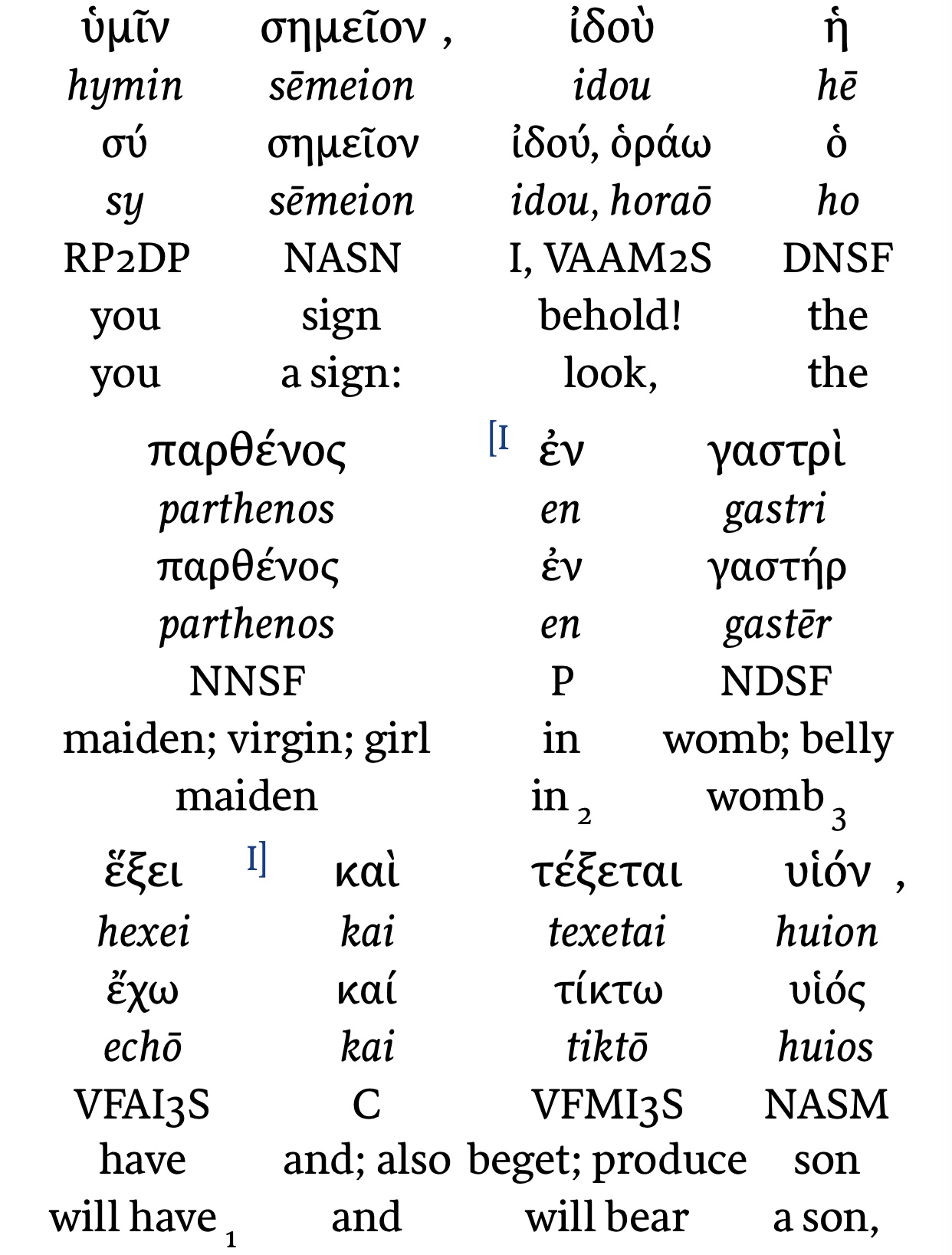
Notwithstanding the subtle controversies surrounding the Septuagint. This is a Greek translation thought to have been in common use around the time of Jesus’ birth. Here is an English translation of the Septuagint for the quotation from Matthew’s Gospel above.

Because of this, the Lord himself will give you a sign: Look, the maiden will become pregnant and will bear a son, and you will call his name Immanuel.

Isaiah 7:14— The Lexham English Septuagint (Bellingham, WA: Lexham Press, 2012)

Here we see the term maiden as it is translated from Hebrew to Greek and then into English. This seems to offer the skeptic some refuge, but does it really?

With a bit of assistance from interlinear tools… We discover something important.

Do you see it?

Parthenos does mean maiden and virgin. This tells us the skeptics are wrong. This could be accepted scholarship for those. I offer it because skeptics seldom take the time to really understand their objections.

Yet somewhere in the back of my mind, I simply prefer to believe what God has said. He moved in such a way as to have Isaiah write of that, using a Hebrew word that includes the meaning of virgin. After that miracle of the birth of the God-Man, He then moved Matthew in a similar fashion to Isaiah. In his Gospel, he used the word parthenos in translating Isaiah 7:14 (Matthew 1:23.)

That is how we know Jesus was born of a virgin. God is not constrained to (or by) time, matter and space. And His Word is true and reliable.

How Is It the Pharisees Knew?

In one of our recent excursions in the text of the Gospel of Matthew, we encountered Jesus preparing His disciples for the near-term future when He would die and rise again. Clearly, in that discussion, the part He spoke of Himself rising again was ignored by His friends, as they were more concerned with ensuring Him of their loyalty.

Later in Matthew’s account, we read this:

The next day, following the Day of Preparation, the chief priests and Pharisees gathered before Pilate, saying, “Sir, we remember that deceiver saying while He was still alive, ‘After three days I will rise.’ Therefore command that the tomb be made secure until the third day, lest His disciples come by night and steal Him away, and tell the people, ‘He has risen from the dead.’ The last deception will be worse than the first.”

Matthew 27:62–64 — Modern English Version (Thinline Edition.; Lake Mary, FL: Passio, 2014)

The chief priests and Pharisees listened keenly to Jesus. They knew He was teaching that He would rise again. It is difficult to read the texts of the four Gospels and find that the disciples actually expected the resurrection. Yet here we see one of those very men setting to pen. Those set against Jesus clearly understood—even expected it to happen.

I know how the skeptics would want us to read the Gospels… Thinking that such were penned to make a new religion. They want you to believe Jesus was just a man and died as just a man. That He was buried and somehow in the middle of the night, His friends took the body away and hid it. Then these men would lie saying He rose again.

I have difficulty even entertaining that farcical point of view. If what the skeptics say were entertainable, why would Matthew abase himself as not understanding the coming resurrection with which they would allegedly attempt to deceive others?

Furthermore… How is it the chief priests and Pharisees did expect what the disciples did not?

It really is the resurrection that sets Christianity miles apart from any other religion. Think about it. God came to His created humans as a human. He died as a Human. He rose again as a human. He did this to defeat the enemy of all of us… Death. We don’t have to die and be separated from the external God. He wants us to be with Him for eternity and made a sure Way for that to be.

The last thought to consider: For almost 2,000 years it’s recorded plainly, the leaders had their alternate story set. “His disciples came by night and stole the body away.” Today that thinking still circles in the fringes. The Pharisees anticipated the resurrection and crafted an alternate explanation. Why do you think that legend of stealing Jesus’ body was recorded by Matthew?

It Wasn’t Really Expected

Then Jesus said to them, “All of you will fall away on account of Me this night, for it is written:
‘I will strike the shepherd, and the sheep of the flock shall be scattered.’

Matthew 26:31 — Modern English Version (Thinline Edition.; Lake Mary, FL: Passio, 2014)

Jesus told the disciples of many insights from the Old Testament. He showed them that even their behavior was prophesied long before it would happen. He shared it with them to prepare them.

As always, people tend to only focus on themselves. Read on as the disciples do that. They would turn their focus on themselves and miss something important.

It’s the proverbial elephant in the room!

But after I have risen, I will go before you to Galilee.”

Matthew 26:32 — Modern English Version (Thinline Edition.; Lake Mary, FL: Passio, 2014)

Jesus isn’t talking about them… Really. I mean, these guys walked with Jesus for around 3 years. They knew Him and loved Him. He relates His impending death, their scattering, and His resurrection and continued shepherding of them.

Peter answered, “Though all men will fall away on account of You, yet I will never fall away.”
Jesus said to him, “Truly I say to you, this night, before the rooster crows, you will deny Me three times.”
Peter said to Him, “Though I should die with You, yet I will not deny You.” And all the disciples spoke in this manner.

Matthew 26:33–35— Modern English Version (Thinline Edition.; Lake Mary, FL: Passio, 2014)

Sometimes we, like the disciples, get so focused on our performance, we miss the bigger picture. Jesus is trying to prepare the disciples for what is going to happen. He would die and rise again. He will again lead them. He gives them the very hope they need to not fear the coming trial.

So focused on proving their loyalty, they missed what He said… After I have risen.

Is it any wonder?

Did they really expect the resurrection, even now?

Think about that. We know the resurrection, as the central tenet of Christianity. Without it, there’s no hope. Skeptics get it. They will pounce on the idea with cockamamie stories on how it is a lie. They will say this dying and rising God was copied from elsewhere. They will allege the disciples stole Jesus’ body and hid it. (I am sure there are even more objections.)

If the resurrection were a lie foisted upon us by these witnesses who penned accounts of it, why would Matthew embarrass himself by recording his own ignoring of it?

In the passage we examined, the fact they would be scattered wasn’t missed. The most important thing wasn’t even acknowledged.

It wasn’t expected, at all.

In your own reading of the Gospels, take note of how many times Jesus spoke of the resurrection. Also, the note how many times it was acknowledged. Deeply consider that.

Encouragement for Some

“To the angel of the church of the Laodiceans write:
“The Amen, the Faithful and True Witness, the Beginning of the creation of God, says these things: I know your works, that you are neither cold nor hot. I wish you were cold or hot. So then, because you are lukewarm, and neither cold nor hot, I will spit you out of My mouth. For you say, ‘I am rich, and have stored up goods, and have need of nothing,’ yet do not realize that you are wretched, miserable, poor, blind, and naked. I counsel you to buy from Me gold refined by fire, that you may be rich, and white garments, that you may be dressed, that the shame of your nakedness may not appear, and anoint your eyes with eye salve, that you may see.
“Those whom I love, I rebuke and discipline. Therefore be zealous and repent. Listen! I stand at the door and knock. If anyone hears My voice and opens the door, I will come in and dine with him, and he with Me.
“To him who overcomes will I grant to sit with Me on My throne, as I also overcame and sat down with My Father on His throne. He who has an ear, let him hear what the Spirit says to the churches.”

Revelation 3:14–22 — Modern English Version (Thinline Edition.; Lake Mary, FL: Passio, 2014)

Please do reread this portion of Scripture when finished reading the entire post.

This is for each of us. Any of us may be of those who are in a church, that for all intents and purposes, appears as the Laodicean one. Our first reaction may be to flee. For some, that may be the best way to handle the situation. But is that what Jesus instructs?

Please pay attention to the admonitions that Jesus gives. The first is to the church itself. He urges the church to repent.

Immediately after, He speaks directly to the individuals in the church. It becomes personal. He encourages us to open the door to Him as His voice is heard. Though Jesus may indeed be standing outside the door of this church and those like it, His entreaty is to anyone who hears. That’s you and I!

For those that hear and respond… The promise to that person is a sweet fellowship with Him. This would be even in the midst of trying circumstances were a believer ‘churches.’

Jesus doesn’t tell us to flee such a situation. Perhaps we are called to stick it out. To be that one person who helps others to hear Jesus’ voice. If enough do, it would change things dramatically.

Listen, the local body of believers may have problems… But the promises are to the individuals in those bodies. It’s you He came to save. It’s you He wants to serve. The promises are to him who overcomes.

Hear what Jesus says to the churches. Listen for His voice and let Him in. Be one who overcomes!