
Humility, Unity and Confidence

The Lord God planted a garden in the east, in Eden, and there He placed the man whom He had formed. Out of the ground the Lord God made to grow every tree that is pleasant to the sight and good for food. The tree of life was also in the midst of the garden, along with the tree of knowledge of good and evil.

Genesis 2:8–9 — Modern English Version (Thinline Edition.; Lake Mary, FL: Passio, 2014)

We start at the beginning from creation forward. We read that the earth was formed, domains made, and inhabitants created to occupy those domains.

Our attention focuses on God planting a garden that included the very thing that would provide a problem. One that would introduce an enemy opposed to God.

We tend to think of time linearly because we experience it that way. An event happens then the next one and so on. Yet, we cannot go back in time or look forward in time.

That movement of time doesn’t happen with God. He doesn’t move backward or forwards in time. He doesn’t look to the future, either. He is in every single moment in every conceivable place concurrently. I know that’s a big concept to grasp. But it helps to try to apprehend that. The psalmist sings of these wonders in Psalm 139.

The existence of that one tree would lead to the downfall of God’s imagers. One that we know He had confidently purposed to rectify.

“Men of Israel, hear these words: Jesus of Nazareth was a man attested to you by God with powerful works and wonders and signs, which God did through Him in your midst, as you yourselves know. You have taken Him, who was handed over to you by the ordained counsel and foreknowledge of God, and by lawless hands have crucified and killed Him, whom God raised up by loosening the pull of death, because it was not possible that He should be held by it.

Acts 2:22–24 — Modern English Version (Thinline Edition.; Lake Mary, FL: Passio, 2014)

It is in the confidence of that already conceived plan that Jesus was crucified. It was set in order long ago before time existed… God, Himself would die for sins. The apostle John drops another bombshell about the “timelessness” of this fact.

All who dwell on the earth will worship him, all whose names have not been written in the Book of Life of the Lamb who was slain from the foundation of the world.

Revelation 13:8 — Modern English Version (Thinline Edition.; Lake Mary, FL: Passio, 2014)

It was determined that Jesus would die for sins. It was also His Blood that atoned for the sin at the foundation of the world exactly when It was needed.

Consider this: It was Jesus Himself (John 1:3) Who planted that tree. He planted the tree of life, along with the tree of knowledge. The latter is that which brought death. Jesus then died on another tree. This is where death was defeated so that humans could have restored access to the tree of life and the garden of God.

In our experience, this is the entire swath of time from creation until the New Jerusalem and beyond. For God, these things don’t happen one after another as spread across time. There is unity in that. Just as there is a unity of purpose within God Himself.

Yet in the moment of the establishment of creation up to planting the garden, the humility of Jesus is a very present reality.

Let this mind be in you all, which was also in Christ Jesus, who, being in the form of God, did not consider equality with God something to be grasped. But He emptied Himself, taking upon Himself the form of a servant, and was made in the likeness of men.
And being found in the form of a man, He humbled Himself and became obedient to death, even death on a cross. Therefore God highly exalted Him and gave Him the name which is above every name, that at the name of Jesus every knee should bow, of those in heaven and on earth and under the earth, and every tongue should confess that Jesus Christ is Lord, to the glory of God the Father.

Philippians 2:5–11 — Modern English Version (Thinline Edition.; Lake Mary, FL: Passio, 2014)

There is a lot of deep stuff to unpack there. I will leave that for another time.

There is humility built into the creation. There is also unity. One which exudes confidence. Confidence that the necessary tasks to be done would be carried out and have the desired outcome. (God is already there.)

That is part of what Paul is saying about each of us having that very mind. Humility, unity, and confidence.

If there is any encouragement in Christ, if any comfort of love, if any fellowship of the Spirit, if any compassion and mercy, then fulfill my joy and be like-minded, having the same love, being in unity with one mind. Let nothing be done out of strife or conceit, but in humility let each esteem the other better than himself. Let each of you look not only to your own interests, but also to the interests of others.

Philippians 2:1–4 — Modern English Version (Thinline Edition.; Lake Mary, FL: Passio, 2014)

Confidence that when we are called to lead, we lead. When called to teach, we teach. When called to love, we love. When called to have compassion, we are compassionate.

All of us are called to share Jesus Christ. We can be confident that we are able to do just that.
Live as Servants of God

Dearly beloved, I implore you as aliens and refugees, abstain from fleshly lusts, which wage war against the soul.

1 Peter 2:11 — Modern English Version (Thinline Edition.; Lake Mary, FL: Passio, 2014)

Now comes the practical application again. This echoes Peter’s introduction to this epistle where he calls his audience pilgrims or refugees. We are taking temporary shelter in this world, its economies, and this fleshly body. Because we are made of the corrupt dust of this earth, and Adam ate of the fruit that corrupted our bodies, this body is only a temporary dwelling.

Therefore, in light of the sojourning, we ought to abstain from those things of the flesh. He outlined them at the beginning of this chapter; wickedness, deceit, hypocrisy, envy, and all evil speaking. These wage war against the soul, the immortal part of us. The fruit of such things leads to destruction and will not last.

If Peter is telling us to abstain from these, we are wholly capable. Though not in and of ourselves, but because of He Who lives in us. There are plenty of admonitions to put this stuff away from us. One of those is from Paul.

Let all bitterness, wrath, anger, outbursts, and blasphemies, with all malice, be taken away from you. And be kind one to another, tenderhearted, forgiving one another, just as God in Christ also forgave you.

Ephesians 4:31–32 — Modern English Version (Thinline Edition.; Lake Mary, FL: Passio, 2014)

He gives us the opposite things to embrace and put on. Note how outwardly focused they are. These behaviors only exist when there is another person for whom we do them. Peter gives us an example, look at how Peter addresses those who He is speaking to as ‘dearly beloved.’

Live your lives honorably among the Gentiles, so that though they speak against you as evildoers, they shall see your good works and thereby glorify God in the day of visitation.

1 Peter 2:12 — Modern English Version (Thinline Edition.; Lake Mary, FL: Passio, 2014)

As royal priests, part of our service to God is praise. It is good to praise God. What better way is there to praise God by not doing the works of the flesh?

This is the idea Peter is addressing. The way we behave makes others take notice. The unbelievers are going to mock and scoff. That is for sure. But they will surely notice the way we comport ourselves.

There is a greater purpose in mind though, by acting rightly. It is to bring glory to God. It does it in real-time, yet there is a future time at the end of the age, where how you act will glorify God. It will be attested to by those who perish.

Response to Established Authority

Submit yourselves to every human authority for the Lord’s sake, whether it be to the king, as supreme, or to governors, as sent by him for the punishment of evildoers and to praise those who do right. For it is the will of God that by doing right you may put to silence the ignorance of foolish men.

1 Peter 2:13–15 — Modern English Version (Thinline Edition.; Lake Mary, FL: Passio, 2014)

Part of the abstention from the lusts of the flesh includes submission to every human authority. It’s not just some. We cannot pick and choose. I didn’t make that up, either.

Peter is going to give us many examples. Here, he begins with those who govern. We are to be law-abiding citizens. It’s not some legalistic idea, either. I think that thought enters the conversation as a coping mechanism. It is an escape from the cognitive dissonance that comes from the warring flesh with the soul. We need to be wary of using such things.

When we look for loopholes and escapes, it isn’t right. It is part of fleshly lusts. It certainly isn’t submission. And it doesn’t glorify God at all.

We do have freedom, but Peter is going to speak on that in a bit.

Peter is speaking of a particular authority here, government. He is saying that the governments are sent by God. That would include some we’d rather deny (for those of us in the US presidents Obama and Trump.) I know, it’s shocking. But we are told to submit to the authorities. It’s not just by Peter.

Remind them to be subject to rulers and authorities, to obey them, to be ready for every good work, to speak evil of no one, not to be contentious, but gentle, showing all humility toward everyone.

Titus 3:1–2 — Modern English Version (Thinline Edition.; Lake Mary, FL: Passio, 2014)

Submission to authority is part of being ready for every good work. If we cannot submit, we cannot do good things. It’s a simple enough concept.

Humility and submission work together. There isn’t one without the other. It can clearly be said to vaunt oneself is not to be in submission. Contention isn’t submission nor humility either. (The idea of contention is more to think in terms of being discourteous.)

The one that gets most of us, though is that speaking evil of no one. How tempting is it to talk unseemly about folks in secret?

Doing the Right Thing has Rewards

First, it can silence accusers.

Jesus did that for us when He chose to submit to God and go to the cross. That is most important. Peter tells us that doing right silences the ignorance of foolish people. When we do right, there are none who can bring a bad report—even one founded in ignorance.

Live Free

As free people, do not use your liberty as a covering for evil, but live as servants of God. Honor all people. Love the brotherhood. Fear God. Honor the king.

1 Peter 2:16–17 — Modern English Version (Thinline Edition.; Lake Mary, FL: Passio, 2014)

We have awesome liberty in Jesus Christ. Paul said it this way.

“All things are lawful for me,” but not all things are helpful. “All things are lawful for me,” but not all things edify

1 Corinthians 10:23 — Modern English Version (Thinline Edition.; Lake Mary, FL: Passio, 2014)

Sometimes in our freedom, we do choose to do something self-serving that is evil or causes evil. We might give an excuse, “God will forgive.” That is clearly wrong. Usually, evil comes as a result of serving self. Such things we do in our freedom cause irreparable harm to those around us. It ought not to be so.

Paul connects our liberty to circumspection. That is, we need to be concerned more so with those around us than our own selves. If we are serving others before ourselves, there is very little chance for those actions to be considered evil.

Let no one seek his own, but each one the other’s well-being.

1 Corinthians 10:24 — Modern English Version (Thinline Edition.; Lake Mary, FL: Passio, 2014)

That is how we are to use our liberty, to serve others. By so doing we serve God. We honor all. We love our brothers and sisters. This brings honor to God and those who govern us.

We can seek our own desires, having that liberty. There is no honor in that. There is no reward. There is no glory to God.

Let us look first to fulfill the needs of those around us. That way, nothing bad can be said about us.

Christmas, Behold the Lord’s Female Slave

Now in the sixth month, the angel Gabriel was sent from God to a town of Galilee named Nazareth, to a virgin legally promised in marriage to a man named Joseph of the house of David. And the name of the virgin was Mary. And he came to her and said, “Greetings, favored one! The Lord is with you.” But she was greatly perplexed at the statement, and was pondering what sort of greeting this might be. And the angel said to her,
“Do not be afraid, Mary, for you have found favor with God. And behold, you will conceive in the womb and will give birth to a son, and you will call his name Jesus. This one will be great, and he will be called the Son of the Most High, and the Lord God will give him the throne of his father David. And he will reign over the house of Jacob forever, and of his kingdom there will be no end.
And Mary said to the angel, “How will this be, since I have not had sexual relations with a man?” And the angel answered and said to her,
“The Holy Spirit will come upon you, and the power of the Most High will overshadow you. Therefore also the one to be born will be called holy, the Son of God.
And behold, your relative Elizabeth—she also has conceived a son in her old age, and this is the sixth month for her who was called barren. For nothing will be impossible with God.”
So Mary said, “Behold, the Lord’s female slave! May it happen to me according to your word.” And the angel departed from her.

Luke 1:26–38 — The Lexham English Bible (Bellingham, WA: Lexham Press, 2012)

Yeah… That title.

It is what Mary said. It wasn’t that she didn’t have a choice in the matter. She could have refused. Yet she didn’t. She called herself the Lord’s slave.

Did God make her do it?

No.

We tend to think about things that happen linearly because that is our only experience in this time-matter-space existence. All of this could have been orchestrated to happen to bring forth the Savior at the right time. It is well within the power of God. Such a concept as that brings to mind a child posing his toys in play, to do as such imagined. God doesn’t do that.

I think people live their lives and make choices just as Mary made. Those choices could be to honor God or more likely not. God didn’t cause Mary’s choice. Nor did He predict it. (I am sure that will cause some to gasp. Relax.) He gave us patterns for which to expect. We refer to this as prophecy.

Prophecy is just ‘truth-telling.’ In this particular situation, Isaiah recorded a truth for Ahaz, which had a dual pattern, like much of these prophecies. That dual pattern found its ultimate completion in the birth of Jesus. He is God in human form. Not appearing as God, but adding humanity to God.

God can tell us the beginning from the end. He is the only One able to do such things. He can do that because of His omniscience and omnipresence. Every moment is a present reality for God. He is present in the moment Isaiah penned ‘a maiden shall conceive.’ Just as He is present in the moment that Mary met the angel, and when Mary conceived. He is even present at that moment with Eve when He told her that her ‘seed’ would bring the redemption of humanity.

I am certain through the noisy bustle of this season, you’re going to hear the skeptical claims of holy rape and mistranslation.

Mary fully participated, yielding herself to what would happen to her. What we do know, is the conception of the Babe wasn’t sexual, and it wasn’t rape. Otherwise, she couldn’t be a virgin when she gave birth.

And that brings us to the second point. The contention over the term virgin. Many will say the Hebrew word almah cannot be translated to virgin, as it only means maiden. Yet, virgin is an acceptable translation from Hebrew just by looking at how it is used elsewhere in the Bible. Regardless, it never refers to a married woman.

Let’s look deeper.

“Behold, the virgin will become pregnant and will give birth to a son, and they will call his name Emmanuel,”

Matthew 1:23 — The Lexham English Bible (Bellingham, WA: Lexham Press, 2012)

Notwithstanding the subtle controversies surrounding the Septuagint. This is a Greek translation thought to have been in common use around the time of Jesus’ birth. Here is an English translation of the Septuagint for the quotation from Matthew’s Gospel above.

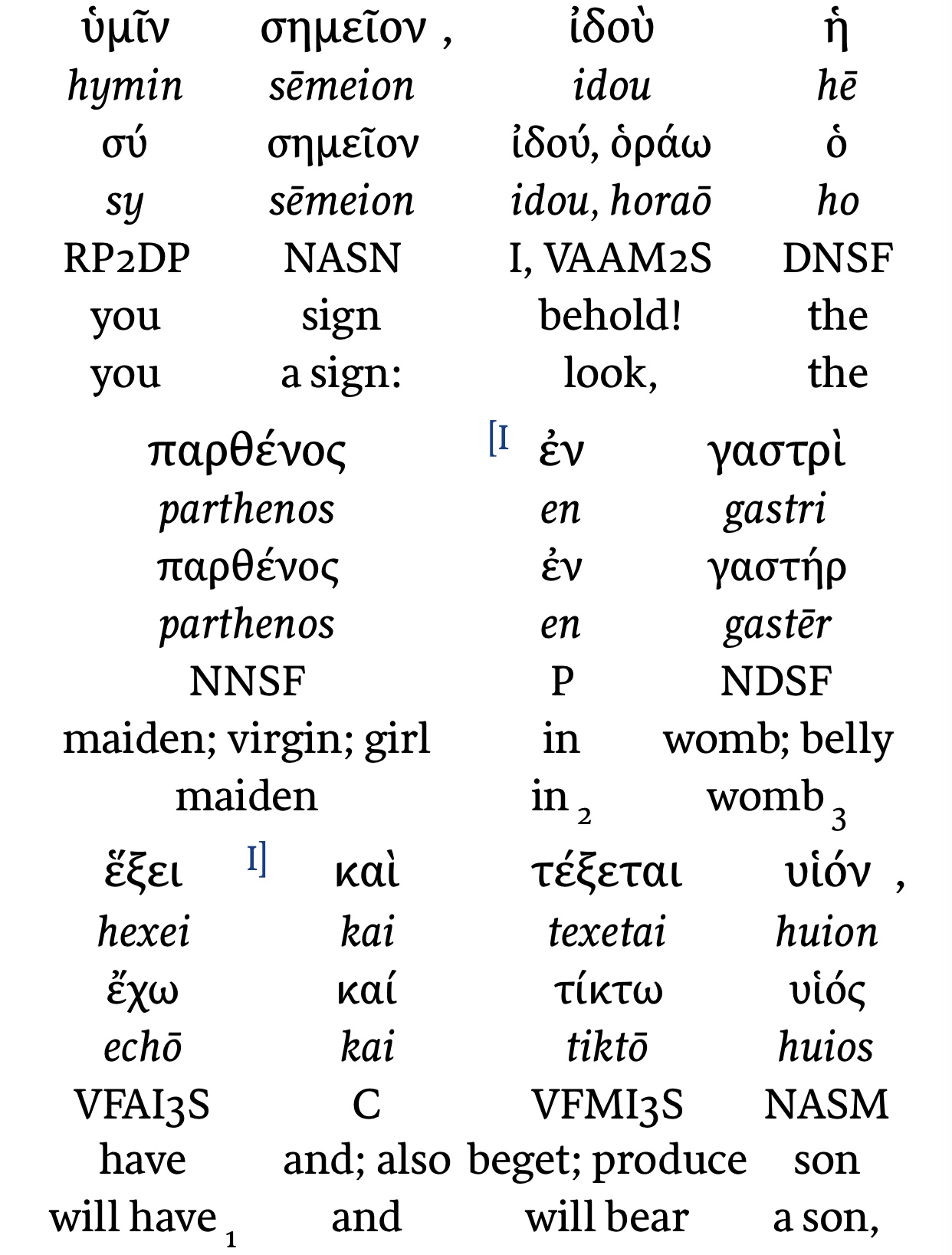
Because of this, the Lord himself will give you a sign: Look, the maiden will become pregnant and will bear a son, and you will call his name Immanuel.

Isaiah 7:14— The Lexham English Septuagint (Bellingham, WA: Lexham Press, 2012)

Here we see the term maiden as it is translated from Hebrew to Greek and then into English. This seems to offer the skeptic some refuge, but does it really?

With a bit of assistance from interlinear tools… We discover something important.

Do you see it?

Parthenos does mean maiden and virgin. This tells us the skeptics are wrong. This could be accepted scholarship for those. I offer it because skeptics seldom take the time to really understand their objections.

Yet somewhere in the back of my mind, I simply prefer to believe what God has said. He moved in such a way as to have Isaiah write of that, using a Hebrew word that includes the meaning of virgin. After that miracle of the birth of the God-Man, He then moved Matthew in a similar fashion to Isaiah. In his Gospel, he used the word parthenos in translating Isaiah 7:14 (Matthew 1:23.)

That is how we know Jesus was born of a virgin. God is not constrained to (or by) time, matter and space. And His Word is true and reliable.