
Much is Said About ‘This Generation’

When He was asked by the Pharisees when the kingdom of God would come, He answered them, “The kingdom of God does not come with observation. Nor will they say, ‘Here it is!’ or ‘There it is!’ For remember, the kingdom of God is within you.”

Luke 17:20–21 — Modern English Version (Thinline Edition.; Lake Mary, FL: Passio, 2014)

As Jesus discussed with the Pharisees, He was answering their question of when the kingdom of God comes. The Pharisees are expecting some great heroic Vanquisher to restore Jerusalem from Roman rule. It’s as if that is the Kingdom Jesus is speaking about. Jesus said the Kingdom comes within people. Meaning your allegiance to the Kingdom is within you and is your responsibility.

The conversation then turns to address the misunderstood idea of the Kingdom of God only being the Valiant King ruling in Jerusalem.

Then He said to the disciples, “The days will come when you will desire to see one of the days of the Son of Man, but you will not see it. They will say to you, ‘Look here,’ or ‘Look there!’ Do not follow after them. For as the lightning flashes and lights up the heavens from one side to the other, so will the Son of Man be in His day. But first He must suffer many things and be rejected by this generation.

Luke 17:22–25 — Modern English Version (Thinline Edition.; Lake Mary, FL: Passio, 2014)

Jesus called that time the days of the Son of Man. What Jesus is teaching here is end times when He conquers the world.

The phrases used by Jesus are emphatic that some would draw disciples’ attention away from Him. It’s hinted at that there are more than just one that would draw believers away, like false Messiahs. The language is similar to that used in another place.

Just as lightning flashes in the sky and lights up everything, these days would not be unmistaken for anything else. They would be, overtly visible. All would know what is happening.

This is connected to the Olivet Discourse where Jesus vividly describes the days of the Son of Man.

“So, if they say to you, ‘Look, He is in the desert,’ do not go there; or, ‘Look, He is in the private chambers,’ do not believe it. For as the lightning comes from the east and flashes to the west, so will be the coming of the Son of Man. Wherever the carcass is, there the eagles will be gathered together.

Matthew 24:26–28 — Modern English Version (Thinline Edition.; Lake Mary, FL: Passio, 2014)

Remember in our introduction texts, Jesus is specific and speaks of this generation as alive then. He speaks that He must suffer from them.

There are other texts that use that phrase like this one:

Truly I say to you, this generation will not pass away until all these things take place.

Matthew 24:34 — Modern English Version (Thinline Edition.; Lake Mary, FL: Passio, 2014)

Many teachers will connect this phrase to the entire data if the Son of Man in the Olivet Discourse (Matthew 24:3-31.) They will use it to disprove futurism. Futurism is the belief that Jesus will come again to rescue His church and set the world right, reigning on David’s throne. The phrase is used to debunk any idea of the rapture, too.

It’s clear in the text. Jesus applies this generation in His Parable of the Fig Tree to a yet future generation that sees the leaves come back. He has shifted His description from the days of the Son of Man to that of what leads up to those days.

That fig tree is used figuratively as Israel. Israel has come back in our generation. We witnessed it. We are those of this generation of the fig tree. It means the days of the Son of Man are very near future.

Rolling back to our text in Luke 17:25, Jesus wasn’t speaking in parables and was addressing what must occur in the short-term future. He would suffer.

He also clearly told those members of this generation listening to Him that day, they would long to see one of the days of the Son of Man. But they would not.

It follows that the days of the Son of Man were much farther into the future than could be perceived. Therefore, for this reason (among countless others,) Amillennialism is not true. Amillennialism is the belief that all of the apocalyptic (considered yet future) Bible passages were fulfilled by the siege of Jerusalem in 70 AD. Some even teach that Jesus already came back at that time.

In Jesus’ own words… Those teachings can’t be. The days of the Son of Man could not occur in the 70 AD siege. Jesus said members of this generation alive then would long to see one of those days, but would not.
The Reward for the Believer

Then those who feared the Lord spoke to one another. The Lord listened and heard them, and a book of remembrance was written before Him for those who fear the Lord and who esteem His name.

Malachi 3:16 — Modern English Version (Thinline Edition.; Lake Mary, FL: Passio, 2014)

In the midst of the apocalyptic portions of the book of Malachi, we find a hidden hint of mystery. As the context speaks of the advent of the Messiah, and who can stand in that day… We know this is of what is called the end days.

There is a some-2,000-year gap in the midst of those end days. I like to think of it as a respite. It has stretched the culmination of them (times of the Gentiles) for millennia, maybe more. But I doubt that.

Our verse above transitions the focus from judgment to the disposition of the believer. Watch as to what is in store for them.

They shall be Mine, says the Lord of Hosts, on the day when I make up My jewels. And I will spare them as a man spares his son who serves him.

Malachi 3:17 — Modern English Version (Thinline Edition.; Lake Mary, FL: Passio, 2014)

He calls those who believed His jewels. Another translation says His treasured possession. If you believe… That’s you. That is who you are. It’s not by anything you have done. It is his He Who considers you thusly.

But wait, there’s more! Just like the unbelievable commercials always promising more to entice. God promises more for the believer (that’s us) in those end days. Those will be spared.

One may ask, “Spared from what?”

To answer that, we must read a bit ahead.

Surely the day is coming, burning like an oven; all the proud, yes, all evildoers will be stubble. The day that is coming will burn them up, says the Lord of Hosts, so that it will leave them neither root nor branch.

Malachi 4:1 — Modern English Version (Thinline Edition.; Lake Mary, FL: Passio, 2014)

It is being spared from what other texts call the indignation, the day of wrath, or Jacob’s Trouble. It is the judgment poured out onto the world because of Israel. Believers are spared this as sons. Which takes us to what is hidden.

Then you will again discern between the righteous and the wicked, between one who serves God and one who does not serve Him.

Malachi 3:18 — Modern English Version (Thinline Edition.; Lake Mary, FL: Passio, 2014)

In the particular translation I use, it’s not really clear. Here’s another.

You will return and see the difference between the righteous and the wicked, between the one who serves God and the one who does not serve him.

Malachi 3:18 — The Lexham English Bible (Bellingham, WA: Lexham Press, 2012)

What is meant by “You will return?”

The Hebrew word that underlies the English return implies physical movement. We will venture a bit ahead in the text yet again. This is to clarify understanding.

But for you who fear My name, the sun of righteousness will rise with healing in its wings. You will go out and grow up like calves from the stall. And you will tread down the wicked, for they will be ashes under the soles of your feet, on the day when I do this, says the Lord of Hosts.

Malachi 4:2–3 — Modern English Version (Thinline Edition.; Lake Mary, FL: Passio, 2014)

“You will go out.” And “you will tread down the wicked.” “You will return.”

Isn’t this clear that believers would be physically removed from the indignation and judgment and would then be the ones returning amidst and after that judgment?

If so… Could this be a hint of rapture?

Read the text for yourselves. Don’t believe me. The context is there. As is the subtle language of escape and return.

They Shall Come Into the Land Restored from the Sword

And the word of the Lord came to me, saying: Son of man, set your face against Gog of the land of Magog, the prince of Rosh, Meshek and Tubal, and prophesy against him, and say: Thus says the Lord God: I am against you, O Gog, the prince of Rosh, Meshek and Tubal.

Ezekiel 38:1–3 — Modern English Version (Thinline Edition.; Lake Mary, FL: Passio, 2014)

Ezekiel is prophesying against the nations around Israel. This particular passage, it comes as a stark contrast to what comes before. That is speaking of the restoration of Israel. I would think that the timeliness of that could also be considered prophetic. That restoration reads specifically as both Judah and Israel being gathered together as one nation. That assembly is happening today.

It comes as the backdrop for the set-up for what most scholars agree is something yet future. I contend that yet future is almost now.

The term Gog refers to an unidentifiable person some think it is even a supernatural entity. The other names in the text are geographical in nature. These places are named in what is referred to as the Table of Nations in genesis 10. Magog refers to part of Asia. Josephus identified Magog as the land of the Scythians. It is said by some the Great Wall of China was called the Ramparts of Magog. This most likely identifies the area around and including Ukraine and Russia.

The entire area is marked by three names, Rosh, Meshek, and Tubal. These would include the area directly north of Israel. This would fit with many of the prophetic warnings to Israel and Judah that were recorded at the same time. The invasion would come from the north (mentioned later in the text.) As it happened with Babylon.

And I will turn you back and put hooks into your jaws, and I will bring you out, and all your army, horses, and horsemen, all of them clothed with all sorts of armor, even a great company with buckler and shield, all of them handling swords.

Ezekiel 38:4 — Modern English Version (Thinline Edition.; Lake Mary, FL: Passio, 2014)

There are words here that are noteworthy. “I will turn you back.” God is saying that to these nations, He will make them turn back. It sounds like a reverse course, at least that is what seems to be said. Perhaps it is an about-face on a peripheral approval of peace accords.

It looks as like something is being used as bait to draw them. That fits with what is spoken of later in this. Some speculate that it is the massive gas deposits Israel has recently discovered. But I will leave that for the reader to discover.

This will be a vast military invasion of Israel. The text states horses will be used. Could that be literal?

What is intriguing to me is what is missing. In the other prophetic warnings of invasion recorded by Ezekiel and other prophets, the machines of warfare are mentioned… Camps and siege works along with a prolonged period of time. These are not mentioned here, which lends itself to happening that are more sophisticated and short-lived.

Persia, Ethiopia, and Put with them, all of them with shield and helmet.

Ezekiel 38:5 — Modern English Version (Thinline Edition.; Lake Mary, FL: Passio, 2014)

Roughly… Iran, Ethiopia, and Libya would help with the invasion.

I will do so to Gomer and all its troops, Beth Togarmah of the north quarters and all its troops, and many peoples with you.

Ezekiel 38:6 — Modern English Version (Thinline Edition.; Lake Mary, FL: Passio, 2014)

This names what is the modern area of Turkey. It will also join the coalition. All of these nations would be allies in an invasion of Israel.

Be prepared and prepare yourself, you and all your companies that are assembled to you, and be a guard to them. After many days you shall be called. In the latter years you shall come into the land that is restored from the sword, whose inhabitants have been gathered out of many peoples, against the mountains of Israel which had been always a waste. But its people were brought out of the nations, and they, all of them, are dwelling safely.

Ezekiel 38:7–8 — Modern English Version (Thinline Edition.; Lake Mary, FL: Passio, 2014)

As God speaks to this confederation of invaders, He establishes some specific markers with a precision that seems to fit the current situation. I mean that they fit right into events of late.

This invasion is prophesied to be in the latter years. That is where we are… In what the Bible calls the last days. It is the latter years of the last days.

They shall come into the land restored from the sword.

This is huge! That is exactly what we are seeing today. Unprecedented peace agreements are being made between Israel and some of her age-old enemies. The land is being restored from the sword… And the centuries of warfare over it.

The modern-day inhabitants of Israel are gathered out of many places. They have returned to Israel and settled. They have restored the mountains of Israel which have always been a waste. The mountainsides are now terraced and homes are built on them.

And all of these people were brought from other lands to the wasteland. They’ve trained it. They’ve made it alive again. It’s happening right before our eyes. And soon, Israel will be dwelling safely.

You shall ascend and come like a storm; you shall be like a cloud to cover the land, you and all your troops, and many peoples with you.

Ezekiel 38:9 — Modern English Version (Thinline Edition.; Lake Mary, FL: Passio, 2014)

It will be a sight to see…

Self-Important Religious Folk

So Amaziah said to Amos, “O seer, go, flee back to the land of Judah. Earn your sustenance there, and prophesy there. But do not prophesy any more at Bethel, for it is the king’s sanctuary and a royal temple.”

Amos 7:12–13 — Modern English Version (Thinline Edition.; Lake Mary, FL: Passio, 2014)

The prophet is never welcome in the homeland. There are people who will always demand he change what is said. They will bully the prophet to move from the land. They will even kill the prophet.

We all seem to love prophecy as some sort of prediction of what is to happen. At it’s simplest, prophecy is just speaking truth. In the Bible, some of that truth is yet to happen.

Regardless, the words of the prophet were always sought, but not always welcome and not always honored. Jesus even told us this…

He said, “Woe to you also, you lawyers! For you load men with burdens difficult to carry, and you yourselves do not touch the burdens with one of your fingers.

“Woe to you! For you build the tombs of the prophets, and your fathers killed them. So you are witnesses and entirely approve the deeds of your fathers, because they killed them, and you build their tombs. Therefore also the wisdom of God said, ‘I will send them prophets and apostles, and some of them they will kill and persecute,’ that the blood of all the prophets, shed since the beginning of the world, may be required from this generation, from the blood of Abel to the blood of Zechariah, who was killed between the altar and the sanctuary. Yes, I tell you, it shall be required from this generation.

“Woe to you, lawyers! For you have taken away the key of knowledge. You did not enter yourselves, and you hindered those who were entering.”

Luke 11:46–52 — Modern English Version (Thinline Edition.; Lake Mary, FL: Passio, 2014)

After Jesus said those things, people began to really conspire against Him. But the ones who tell the truth are always persecuted by the self-important religious folk.

A Child is Born, a Son is Given

Here’s something that has occupied the spare processing cycles in my brain when the screen saver is active. In other words, there is something that I have been considering deeply.

For unto us a child is born,
unto us a son is given, and the government shall be upon his shoulder. And his name shall be called Wonderful Counselor, Mighty God, Eternal Father, Prince of Peace.

Isaiah 9:6 — Modern English Version (Thinline Edition.; Lake Mary, FL: Passio, 2014)

This is one of those memory verses I learned from years of listening to Handel’s Messiah. In that first line is a distinction that is easy to overlook. A child is born and a son is given. It is a prophetic announcement of the birth of Jesus. A child would be born to us humans. Not just any child, but a Son would be given. That Son would be unique. This announcement clearly shows that Jesus is God, not that He came from God.

In a discussion on the Godhead I just perused, I again pondered this idea. This God-Man… This Son, or Word, that was given to us. The interesting part of the conversation prompted me to write my thoughts down and share them.

The discussion was over the Son or Word and whether saying He is begotten by God somehow darkens the idea of His existence from “eternity past.” It’s precisely what derives from the idea of being begotten means, and sort of considers the hypostatic union. That is the union of God and man that is Jesus.

I want to give a foundation from here. This is what God says of Himself in the final chapters of the Old Testament.

For I am the Lord, I do not change; therefore you, O sons of Jacob, are not consumed.

Malachi 3:6 — Modern English Version (Thinline Edition.; Lake Mary, FL: Passio, 2014)

Every good gift and every perfect gift is from above and comes down from the Father of lights, with whom is no change or shadow of turning. Of His own will He brought us forth with the word of truth, that we should be a kind of first fruits of His creatures.

James 1:17–18 — Modern English Version (Thinline Edition.; Lake Mary, FL: Passio, 2014)

From these two witnesses, it is clear that God doesn’t change. The writer of Hebrews adds to this.

Jesus Christ is the same yesterday, and today, and forever.

Hebrews 13:8 — Modern English Version (Thinline Edition.; Lake Mary, FL: Passio, 2014)

How does a God Who doesn’t change incarnate?

It sort of intrigues me that the God Who clearly says He is the same and doesn’t change somehow put on humanity.

It is precisely that idea that I think is too simplistic of an explanation. If He puts on humanity, He changes. Or maybe that doesn’t count as a change.

God has a Unique Relationship with Humans

I think it goes back to something foundational.

Then God said, “Let us make man in our image, after our likeness, and let them have dominion over the fish of the sea, and over the birds of the air, and over the livestock, and over all the earth, and over every creeping thing that creeps on the earth.”
So God created man in His own image; in the image of God He created him; male and female He created them.

Genesis 1:26–27 — Modern English Version (Thinline Edition.; Lake Mary, FL: Passio, 2014)

This idea of God making us in His image. What is that, really?

I know one of my favorite Bible nerds says we are imagers. Meaning we get to make God known to others in unique ways.

What if this image is something profound like it is something that is really a part of God?

No… I am not drifting off into pantheism or panentheism.

I’m not saying we are God. Yet there is something more here. When you read the Bible, you’re going to read some things that you might be tempted to glance over.

Beloved, now are we children of God, and it has not yet been revealed what we shall be. But we know that when He appears, we shall be like Him, for we shall see Him as He is.

1 John 3:2 — Modern English Version (Thinline Edition.; Lake Mary, FL: Passio, 2014)

There is something so spectacular reserved for humanity. It cannot be put into words.

For those whom He foreknew, He predestined to be conformed to the image of His Son, so that He might be the firstborn among many brothers. And those whom He predestined, He also called; and those whom He called, He also justified; and those whom He justified, He also glorified.

Romans 8:29–30 — Modern English Version (Thinline Edition.; Lake Mary, FL: Passio, 2014)

It’s this imager-thing. We are made in His image initially and will be conformed to His image. There are other texts that iterate these ideas like being a joint-heir with Jesus.

Jesus even spoke of this in some of His last words before the crucifixion.

I do not pray for these alone, but also for those who will believe in Me through their word, that they may all be one, as You, Father, are in Me, and I in You. May they also be one in Us, that the world may believe that You have sent Me. I have given them the glory which You gave Me, that they may be one even as We are one: I in them and You in Me, that they may be perfect in unity, and that the world may know that You have sent Me, and have loved them as You have loved Me.

John 17:20–23— Modern English Version (Thinline Edition.; Lake Mary, FL: Passio, 2014)

I don’t think we can even begin to ponder what is in store for each of us who loves Jesus.

Listen! I Stand at the Door and Knock.

Listen! I stand at the door and knock. If anyone hears My voice and opens the door, I will come in and dine with him, and he with Me.

Revelation 3:20 — Modern English Version (Thinline Edition.; Lake Mary, FL: Passio, 2014)

I cannot help but to see how urgent and insistent this declaration is.

Our church gives doctrinal studies for those who want to go a bit deeper into basic doctrine. I love to attend because I always learn something new. I have come to understand that anyone can open the Bible and teach, and I can learn from them. I like that about the Holy Spirit. Enough on that.

We were taking an overview of the epistles Jesus wrote to the seven churches in His Revelation to John. Here is one part of what I learned.

Of the letters to the churches, there can be a loose grouping of them applied. It is done using the simple closing phrase in all epistles. “He who has an ear, let him hear what the Spirit says to the churches.” In each epistle, promises are given to the overcomer. Their placement becomes conspicuous. In the first three epistles, these promises are a postscript to the letter, coming after the close. The latter four, the promises to the overcomer are included in the epistle.

It is believed by some that these messages to the churches encompass the character of the entire age of the church of Jesus Christ, from its foundation to its end. The message to Thyatira represents the character of the medieval church. In a more specific way, it would be the Roman church. A further delineating factor to pay attention to comes in the middle epistle, to the church at Thyatira. Thyatira conveys the meaning of continuing sacrifice.

But I have a few things against you: You permit that woman Jezebel, who calls herself a prophetess, to teach and seduce My servants to commit sexual immorality and eat food sacrificed to idols. I gave her time to repent of her sexual immorality, but she did not repent. Look! I will throw her onto a sickbed, and those who commit adultery with her into great tribulation, unless they repent of their deeds.

Revelation 2:20–22 — Modern English Version (Thinline Edition.; Lake Mary, FL: Passio, 2014)

I want to point out the words great tribulation. Those who don’t repent of idolatry will be judged. These words of Jesus are not to be taken lightly. Perhaps it is to draw our attention to the end of the age. We still have the vestiges of the medieval church age with us. Simply for that reason, the words great tribulation are important.

We move to the next epistle. Just as the message to Thyatira is representative of the character of the Roman medieval church, the epistle to Sardis represents the reformation age. Sardis conveys a meaning of an escaping remnant.

Remember therefore how you have received and heard; hold fast and repent. Therefore if you will not watch, I will come upon you as a thief, and you will not know what hour I will come upon you.

Revelation 3:3 — Modern English Version (Thinline Edition.; Lake Mary, FL: Passio, 2014)

The admonition for this church is to watch. If it truly represents the character of the church of the reformation age, those churches exist contemporary with us. The admonition to them also reveals something yet future. Just as the previous epistle hinted toward great tribulation, this one hints to Jesus coming back as a thief. These will be surprised when He comes.

The next epistle is that to Philadelphia. In representing the character of the church, this is one of the great evangelistic soul-winning-missionary-minded churches. Philadelphia conveys the meaning of brotherly love.

Because you have kept My word of patience, I also will keep you from the hour of temptation which shall come upon the entire world, to test those who dwell on the earth.

Revelation 3:10 — Modern English Version (Thinline Edition.; Lake Mary, FL: Passio, 2014)

The admonition to this church includes the idea of wholly being rescued from the hour of temptation which shall come upon the whole world. This temptation is a test of those who dwell on Earth. These that are kept from this hour are most likely not on Earth. If not, such would necessarily be included in the whole world and would still be dwelling on Earth.

So far, Jesus tells those who don’t repent will have to go through great tribulation. With increased urgency we are told to watch so as we are not surprised. By keeping His word of patience we are kept from the test of those who dwell on Earth.

Look, I am coming quickly. Hold firmly what you have, so that no one may take your crown.

Revelation 3:11 — Modern English Version (Thinline Edition.; Lake Mary, FL: Passio, 2014)

There is an urgency that is increasing and becoming more specific. Time is closing in fast. He is coming quickly.

When we encounter the last epistle to Laodicea, this is the characterization of the church in the last days. Laodicea conveys a meaning of the people judging, or the people are in charge. (That says much about modern churches. Many do surveys to determine how to best meet people’s felt needs. That’s another discussion.)

Listen! I stand at the door and knock. If anyone hears My voice and opens the door, I will come in and dine with him, and he with Me.

Revelation 3:20 — Modern English Version (Thinline Edition.; Lake Mary, FL: Passio, 2014)

If this is the last age of the church, it would also follow that the urgency would increase. That is exactly what we see. Instead, He’s not coming quickly, or as a surprise. He’s right there at the door… Knocking!

There isn’t much time. But you can still open the door to Him.

Men Fainting from Fear and Expectation

“There will be signs in the sun and the moon and the stars; and on the earth distress of nations, with perplexity, the sea and the waves roaring; men fainting from fear and expectation of what is coming on the inhabited earth. For the powers of heaven will be shaken. Then they will see the Son of Man coming in a cloud with power and great glory. When these things begin to happen, look up and lift up your heads, for your redemption is drawing near.”

Luke 21:25–28 — Modern English Version (Thinline Edition.; Lake Mary, FL: Passio, 2014)

These are the words of Jesus to His disciples during a private briefing He gave them in the week before His death. Clearly, we can understand that the events portrayed here will happen around the time closely preceding Jesus’ return to judge the world.

Reading through this, there was something that stood out. Jesus speaks of the signs that seem to be unprecedented at any time heretofore. He then makes an interesting statement, that there will be humans “fainting from fear and expectation of what is coming.”

What is Coming

Perhaps He is speaking to that period of signs and distress He spoke of in the immediately preceding context. But then He could be speaking of the immediately preceding context, as bad as it was, things coming would be more perilous and frightening.

I am thinking the latter is probably a better explanation. Those people faint from fear connect right here:

In those days men will seek death but will not find it. They will desire to die, but death will elude them.

Revelation 9:6 — Modern English Version (Thinline Edition.; Lake Mary, FL: Passio, 2014)

As the revelation unfolds beginning in Revelation 6, seals are opened. As each seal is opened, it reveals an event among other things.

The Seals

As the first is opened, it reveals a horseman given the ability to conquer. This is most likely what will bring a one world leader into power. Yet it will not be without bloodshed. The second reveals peace being taken the earth. Again, this will probably prove fatal to some humans. The next brings massive inflation. How much death would occur during each of these?

The fourth horseman brings death to one-quarter of the Earth’s population. The next seal reveals comfort and encouragement given to the servants of God murdered during this time. They seem to have already been informed that God would avenge them. They ask God, “How long?”

The sixth seal reveals massive earthquakes and signs in the sky. The stars of heaven fall to the Earth. This could be figurative, or it could be the fallen angels coming to Earth as the marshaling of forces to confront Jesus when He comes to Earth to judge at the end of these events.

So far we see that this stuff is so disconcerting, people will go underground and hide in caves. They will hide from what they know is the great day of His (Jesus’) wrath.

A pause ensues, the servants of God on Earth are marked. We also see the saints that were murdered for their testimony during this time of perplexity worshipping Jesus. We see the prayers from those still alive being heard in the heavens and answers to them are prepared.

As the seventh seal is opened, there is a short period of silence. After the silence, angels are revealed, seven of them have trumpets.

The first angel sounds his trumpet, a third of all vegetation burns up. The second sounds and a great rock falls into the sea destroying a third of the living creatures in it and a third of the ships on it. The third blares, a star falls from heaven and makes a third of the freshwater rivers bitter; killing those who drink the water. The fourth angel sounds and a third of the day and a third of the night have no light.

There is yet another pause.

Then I watched, and I heard an angel flying through the midst of heaven, saying with a loud voice, “Woe, woe, woe to the inhabitants of the earth, because of the other trumpet blasts of the three angels, who are yet to sound!”

Revelation 8:13 — Modern English Version (Thinline Edition.; Lake Mary, FL: Passio, 2014)

Now considering all that has been revealed so far from Revelation 6 through 8 and how it is easily and succinctly summed up in Luke 21:25. Think of the reaction you might have to an angel flying over your head saying loudly, “Woe, woe, woe.” Would there be overwhelming fear so bad you would want to die?

God says they will desire to die, but death will elude them.

men fainting from fear and expectation of what is coming on the inhabited earth. For the powers of heaven will be shaken.

Luke 21:26 — Modern English Version (Thinline Edition.; Lake Mary, FL: Passio, 2014)
The Powers of Heaven Will Be Shaken

The fifth angel sounded, and I saw a star fallen from heaven to the earth. The star was given the key to the bottomless pit. He opened the bottomless pit, and smoke ascended from the pit, like the smoke of a great furnace. The sun and the air were darkened by the smoke from the pit. And out of the smoke locusts came upon the earth. Power was given them as the scorpions of the earth have power. They were commanded not to harm the grass of the earth, or any green thing, or any tree, but only those men who did not have the seal of God on their foreheads. They were given authority, not to kill them, but to torment them for five months. Their torment was like the torment of a scorpion when it stings a man. In those days men will seek death but will not find it. They will desire to die, but death will elude them.

Revelation 9:1–6 — Modern English Version (Thinline Edition.; Lake Mary, FL: Passio, 2014)

I cannot even begin to imagine the things that would follow. An angel opens a pit, from which locusts thick as clouds come. These won’t bother anything other than those men who do not have the seal of God. These will have a painful sting and cannot kill either.

That Time Approaches Quickly

Given the greater context of our primary text in Luke 21, this setting is in the period before these things happen. By the parable of the fig tree that comes immediately after, we can surmise we are most likely in that time period.

What is coming is a drastic and systematic reduction of the population of the Earth. It’s going to happen. God didn’t write this to scare anyone, but to warn those who have ears to hear… So they may prepare.

That preparation is to become a servant of God… Not a servant of the needy, the culture, or yourself.

Harmonizing the Tribulation of Those Days

“Immediately after the tribulation of those days, ‘the sun will be darkened, the moon will not give its light; the stars will fall from heaven, and the powers of the heavens will be shaken.’
“Then the sign of the Son of Man will appear in heaven, and then all the tribes of the earth will mourn, and they will see the Son of Man coming on the clouds of heaven with power and great glory. And He will send His angels with a great sound of a trumpet, and they shall gather His elect from the four winds, from one end of the heavens to the other.

Matthew 24:29–31 — Modern English Version (Thinline Edition.; Lake Mary, FL: Passio, 2014)

“But in those days, after that distress, ‘the sun will be darkened, and the moon will not give her light; the stars of heaven will fall, and the powers that are in heaven will be shaken.’
“Then they will see the Son of Man coming in clouds with great power and glory. Then He will send His angels and gather His elect from the four winds, from the farthest part of the earth to the farthest part of heaven.

Mark 13:24–27 — Modern English Version (Thinline Edition.; Lake Mary, FL: Passio, 2014)

“There will be signs in the sun and the moon and the stars; and on the earth distress of nations, with perplexity, the sea and the waves roaring; men fainting from fear and expectation of what is coming on the inhabited earth. For the powers of heaven will be shaken. Then they will see the Son of Man coming in a cloud with power and great glory. When these things begin to happen, look up and lift up your heads, for your redemption is drawing near.”

Luke 21:25–28 — Modern English Version (Thinline Edition.; Lake Mary, FL: Passio, 2014)

In the harmony of these presentations of the special briefing that Jesus gave His disciples at the end of the age, there are similarities that can be harmonized. All three are describing a time of great tumult, with signs in the sun, moon, and stars, and the heavens being shaken. We also see Jesus coming in the clouds.

To understand the coming in the clouds, we must delve into the old testament. We find over the many mentions of clouds associated with God it came in the form of divine intervention for His people. During the exodus, God led the Israelites in a pillar of cloud by day. When the cloud descended on the tent of meeting, it signified the presence of God. God coming in the clouds is a powerful and symbolic way to demonstrate divine intervention, divine judgment, or divine provision for the preservation of His people.

In this ‘sign’ we see ALL three. There is also another truth in the harmony that isn’t discussed. That is, Jesus is referring to Himself as God. If one understands the trial with the high priest, Jesus was asked if He was the Messiah, the Son of God. In His reply, He affirmed the questions the priest asked and claimed He is God. This is understood when we know the identity of Who comes in the clouds. Jesus said it would be Him by the title He chose for Himself. This title is also a direct reference to all of this.

I saw in the night visions, and there was one like a Son of Man coming with the clouds of heaven. He came to the Ancient of Days and was presented before Him. There was given to Him dominion, and glory, and a kingdom, that all peoples, nations, and languages should serve Him. His dominion is an everlasting dominion, which shall not pass away, and His kingdom that which shall not be destroyed.

Daniel 7:13–14 — Modern English Version (Thinline Edition.; Lake Mary, FL: Passio, 2014)

The differences are also important. Let’s poke at some of these.

The first is the introductory phrase to this time. In the Matthew and Mark account, the audiences’ attention is drawn toward the period after these distresses. More things would happen on Earth and in the heavens, and then the Son of Man would appear. The elect would be gathered, and a kingdom established (The latter part is inferred.) Both accounts seem to give a contemporaneous account of events.

Now note how Luke explains it, paying special attention to where he wants the audiences’ attention drawn. From the outset, Luke is asking his reader to understand the time before these events occur. This is clearly understood by this phrase “of what is coming on the inhabited earth.” Luke describes the same events that will happen, not contemporaneously.

Then we encounter the last sentence. “When these things begin to happen, look up and lift up your heads, for your redemption is drawing near.” Luke is a gentile writing to gentiles. He is admonishing them to pay attention to when these things begin to happen. We also have the use of a unique word, ‘redemption.’

Matthew and Mark are drawing attention to the time of God’s intervention, judgment, and preservation of His people. Perhaps it could be redemption. Yet they did not use the word. I think it is because the attention of the reader is being drawn to two different events. Luke is drawing attention to redemption that occurs before the harmonized disasters that are described.

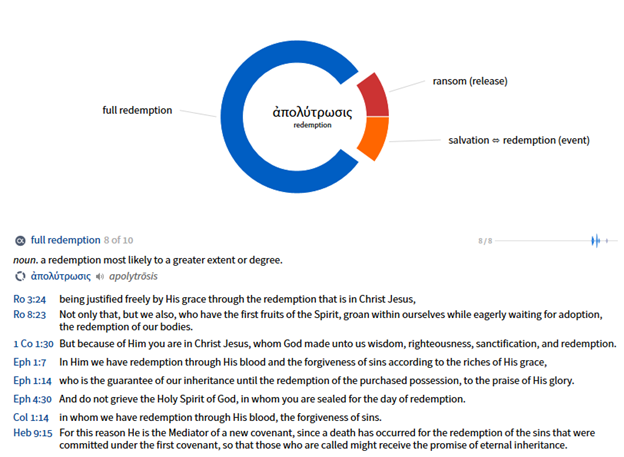
Considering redemption and the way the word is used in the New Testament, we can readily see the references of the majority of forms in the graphic. There are two other uses, one reference meaning ransom/release is cited in Hebrews 11:35 (Red.) The other is referencing an event and is the one word from Luke 21:28 we are discussing, ‘Redemption.’

God’s Bread

In those days a decree went out from Caesar Augustus that the entire inhabited earth should be taxed. This taxation was first made when Quirinius was governor of Syria. And everyone went to his own city to be taxed.
So Joseph also departed from the city of Nazareth in Galilee to the City of David which is called Bethlehem, in Judea, because he was of the house and lineage of David, to be taxed with Mary, his betrothed wife, who was with child. So while they were there, the day came for her to give birth. And she gave birth to her firstborn Son, and wrapped Him in strips of cloth, and laid Him in a manger, because there was no room for them in the inn.

Luke 2:2–7 — Modern English Version (Thinline Edition.; Lake Mary, FL: Passio, 2014)

As we’ve discussed before, God is present in every moment. The fact that Caesar Augustus decreed a tax that would ensure Joseph to be in the city of his lineage was known to God when David called the prophet Samuel.

The Lord said to Samuel, “How long will you mourn for Saul, since I have rejected him from ruling over Israel? Fill your horn with oil and go. I will send you to Jesse the Bethlehemite, for I have chosen a king for Myself from among his sons.”

1 Samuel 16:1 — Modern English Version (Thinline Edition.; Lake Mary, FL: Passio, 2014)

Bethlehem is the birthplace of Kings. It is the birthplace of God’s Chosen. In this way, God’s choosing of David was a pattern for Israel, and by extension the whole world. That’s for us!

David’s anointing would be when Israel already had a king… Saul. In the same way, Jesus’ advent was when Israel already had a king… Caesar.

It is Bethlehem. The word that means house of bread. The Bread of Heaven would be born there.

But you, Bethlehem Ephrathah, although you are small among the tribes of Judah, from you will come forth for Me one who will be ruler over Israel. His origins are from of old, from ancient days.

Micah 5:2 — Modern English Version (Thinline Edition.; Lake Mary, FL: Passio, 2014)

Least among the tribes of Judah.

Everything about His birth doesn’t make us think of kings or rulers. Jesus was born to a regular working-class couple. He was born away from home, in a stall for animals. His first resting place was most likely a trough hewn from stone used for fodder. And Bethlehem… Which was a relative backwater near bustling Jerusalem.

David was born there, too. He was the least of his brothers. He was the shortest in stature. He was a dirty shepherd. Shepherds in those days were the least esteemed of people if they were even considered that. David serves as the pattern.

We were to know that pattern.

God chooses the weak to confound the strong. He chooses the base to offend the intellectual. We choose according to stature, prowess, mental acumen and wealth. These are the things humans esteem. This is not so with God.

A dirty and lowly shepherd boy was chosen to be king over Israel. This David is like a sling stone forging through time to that lands in the midst of that lowly carpenter’s Boy’s circumstance of birth.

It’s that day.

Today (the eve of Christmas,) when you think of Jesus and His birth, it’s not the trappings of silver and gold, the red and the white and the green… Santa Claus or turkey… Or even what skeptics say that really matters.

It’s Who Jesus is that does. God’s desire is that you eat His Bread! Seriously. He wants you to take Jesus into your body by believing He is Emmanuel, God among men… Your King.

How Is It the Pharisees Knew?

In one of our recent excursions in the text of the Gospel of Matthew, we encountered Jesus preparing His disciples for the near-term future when He would die and rise again. Clearly, in that discussion, the part He spoke of Himself rising again was ignored by His friends, as they were more concerned with ensuring Him of their loyalty.

Later in Matthew’s account, we read this:

The next day, following the Day of Preparation, the chief priests and Pharisees gathered before Pilate, saying, “Sir, we remember that deceiver saying while He was still alive, ‘After three days I will rise.’ Therefore command that the tomb be made secure until the third day, lest His disciples come by night and steal Him away, and tell the people, ‘He has risen from the dead.’ The last deception will be worse than the first.”

Matthew 27:62–64 — Modern English Version (Thinline Edition.; Lake Mary, FL: Passio, 2014)

The chief priests and Pharisees listened keenly to Jesus. They knew He was teaching that He would rise again. It is difficult to read the texts of the four Gospels and find that the disciples actually expected the resurrection. Yet here we see one of those very men setting to pen. Those set against Jesus clearly understood—even expected it to happen.

I know how the skeptics would want us to read the Gospels… Thinking that such were penned to make a new religion. They want you to believe Jesus was just a man and died as just a man. That He was buried and somehow in the middle of the night, His friends took the body away and hid it. Then these men would lie saying He rose again.

I have difficulty even entertaining that farcical point of view. If what the skeptics say were entertainable, why would Matthew abase himself as not understanding the coming resurrection with which they would allegedly attempt to deceive others?

Furthermore… How is it the chief priests and Pharisees did expect what the disciples did not?

It really is the resurrection that sets Christianity miles apart from any other religion. Think about it. God came to His created humans as a human. He died as a Human. He rose again as a human. He did this to defeat the enemy of all of us… Death. We don’t have to die and be separated from the external God. He wants us to be with Him for eternity and made a sure Way for that to be.

The last thought to consider: For almost 2,000 years it’s recorded plainly, the leaders had their alternate story set. “His disciples came by night and stole the body away.” Today that thinking still circles in the fringes. The Pharisees anticipated the resurrection and crafted an alternate explanation. Why do you think that legend of stealing Jesus’ body was recorded by Matthew?