
The First Miracle

On the third day there was a wedding in Cana of Galilee. The mother of Jesus was there. Both Jesus and His disciples were invited to the wedding. When the wine ran out, the mother of Jesus said to Him, “They have no wine.”
Jesus said to her, “Woman, what does this have to do with Me? My hour has not yet come.” His mother said to the servants, “Whatever He says to you, do it.” Six water pots made of stone were sitting there, used for ceremonial cleansing by the Jews, containing twenty to thirty gallons each.
Jesus said to them, “Fill the water pots with water.” And they filled them up to the brim.
Then He said to them, “Now draw some out, and take it to the master of the feast.”
And they took it. When the master of the feast tasted the water that had been turned into wine, and did not know where it came from (though the servants who drew the water knew), the master of the feast called the bridegroom, and he said to him, “Every man serves the good wine first, and after men have drunk freely, then the poor wine is served. But you have kept the good wine until now.”

John 2:1–10

I assume that all have read this in their Bible. I also assume many have heard it as part of a sermon or teaching. I post it for you as a quick reference and in case someone has not read it.

In the past, I have not paid any real particular attention to it. At least, not until I started reading Beautiful Outlaw by John Eldredge. This account was used to demonstrate the extravagant generosity of Jesus. I had not even considered that thought in the thinking part of my mind, but I guess it would lurk somewhere in the background. As the Spirit of God would have it, looking deeper into what happened at that wedding He revealed something I had not encountered anywhere else. Come with me and see.

The First Sign

This, the first of His signs, Jesus did in Cana of Galilee, and He revealed His glory, and His disciples believed in Him.

John 2:11

As John recounts in his Gospel what had happened, he closes this punctual account by saying it was the first of Jesus’ signs. This part of the narrative follows the calling of His first disciples. John’s intent is to promote belief in Jesus by telling of His words and the signs He did.

Jesus performed many other signs in the presence of His disciples, which are not written in this book. But these are written that you might believe that Jesus is the Christ, the Son of God, and that believing you may have life in His name.

John 20:30–31

When reading the Gospel of John, pay close attention to the unfolding revelation. He opens with a testimony of Who Jesus is that parallels and expounds on Genesis 1. Later, we encounter John the Baptizer and his ministry of preparing the world for Jesus. Like Elijah speaking truth, John the Baptizer testifies to the ministry of Jesus, just as the apostle John records.

The Lamb of God

The next day John saw Jesus coming toward him and said, “Look, the Lamb of God, who takes away the sin of the world. This is He of whom I said, ‘After me comes a Man who is preferred before me, for He was before me.’ I did not know Him, but for this reason I came baptizing with water: so that He might be revealed to Israel.”

John 1:29–31

The apostle John is unique in recording the words of John the Baptizer. “Behold the Lamb of God” that takes away sin. In a way, he points to this first sign at Cana, which then points to another sign.

Let’s go back to Cana.

On the third day there was a wedding in Cana of Galilee. The mother of Jesus was there. Both Jesus and His disciples were invited to the wedding. When the wine ran out, the mother of Jesus said to Him, “They have no wine.”

John 2:1–3

John recounts the first week of the ministry of Jesus. After being baptized and calling the first disciples, his small troupe is invited to a wedding. Already, we ought to pay attention to the timing mentioned. John is writing in retrospect, recording this decades after the events occurred. He has hindsight of the events in Jesus’ life, it is likely that there is something more to the phrase than just the narrative on the third day. It is something to keep in mind.

As we continue with the account, trouble arises when the open bar runs dry. Mary (Jesus’ mother) says that there is no more wine. There is then nothing left with which to continue the celebration.

A Mother Knows

Jesus said to her, “Woman, what does this have to do with Me? My hour has not yet come.”

John 2:4

This makes me smile. Not just what seems like abrupt language. What did she expect Him to do?

What did she know?

Even more intriguing… How did she know He could help?

I think the Bible helps us to know.

He will be great, and will be called the Son of the Highest. And the Lord God will give Him the throne of His father David, and He will reign over the house of Jacob forever. And of His kingdom there will be no end.”

Luke 1:32–33

Mary had a special briefing given by a messenger from God. She knew her Son. She knew He is the Anointed One, Son of the Most High. She knew He is forever King. I think she even knew Him as God, having command over material things.

Had He done miracles before this?

We are not given any information on that except for John’s telling us this is the first of His signs. It could be a small attestation when as a preteen, He remained behind at the temple and taught. It is something to consider.

What we can determine is that Mary knew Jesus could readily help in this situation. Jesus affirms this by His response to her. We take Jesus’ response to His mother as somewhat sharp. In the language at the time, it was a respectful address. Jesus is telling her that what concerns her doesn’t concern Him. He continues by letting her know to leave Him alone, His time has not yet come.

My Hour

This is the specific phrase used. It refers to a particular time. This is a reference that leads us to the culmination of Jesus’ earthly ministry. It points us to something future.

As John’s narrative unfolds, Jesus uses this word hour to point to a yet future time. He uses it in speaking with the woman at the well in John 4:21; 23. He uses it again to point to a future time period in John 5:25; 28. (The list continues: John 7:30, 8:20, 12:23; 27, 13:1, 16:32, & 17:1.) John explains the hour:

Now before the Passover Feast, Jesus knew that His hour had come to depart from this world to the Father. Having loved His own who were in the world, He loved them to the end.

John 13:1

In my opinion, from reading John’s Gospel, the hour refers to the time period that begins around Jesus’ death and stretches to His return to Earth and the Millennial Kingdom. The hour will be marked with resurrection, I would say multiple resurrections. Yet, I digress.

For the purpose of this sign, my hour refers to the cross as the beginning of it. John is exclusive in his extensive writing of the words and actions of Jesus in the period of time leading to the cross.

That Seeming Reluctance

Did you pick up on the reluctance Jesus demonstrated toward His mother?

Do you think it is significant as a parallel in His hour?

Then Jesus came with them to a place called Gethsemane and said to the disciples, “Sit here while I go and pray close by.” He took with Him Peter and the two sons of Zebedee and began to be sorrowful and troubled. Then He said to them, “My soul is very sorrowful, even to death. Wait here, and keep watch with Me.”
He went a little farther, and falling on His face, He prayed, “O My Father, if it is possible, let this cup pass from Me. Nevertheless, not as I will, but as You will.”

Matthew 26:36–39

It is not necessarily the same way, but I think the reluctance to do His mother’s will belies a very human emotional response. That emotion is amplified many times as demonstrated in His hour. In speaking with His Father, He wanted to find a way out. Nevertheless, as the Man, He honored His father by doing what His father wanted, just as He honored His mother’s will.

His mother said to the servants, “Whatever He says to you, do it.”

John 2:5

It is these few things that leads me to see some things that I think are hidden signs in this sign.

The Specifics

Six water pots made of stone were sitting there, used for ceremonial cleansing by the Jews, containing twenty to thirty gallons each.
Jesus said to them, “Fill the water pots with water.” And they filled them up to the brim.
Then He said to them, “Now draw some out, and take it to the master of the feast.”
And they took it. When the master of the feast tasted the water that had been turned into wine, and did not know where it came from (though the servants who drew the water knew), the master of the feast called the bridegroom, and he said to him, “Every man serves the good wine first, and after men have drunk freely, then the poor wine is served. But you have kept the good wine until now.”

John 2:6–10

Six water pots are filled to the brim. Each can hold a determinate amount of water. I’m not going to go through to the end.

The amount of wine that Jesus made would be the equivalent to 120 to 180 gallons. That is a lot of wine. The master says about the wine, that it is the good stuff and kept until now.

The Sign in the Sign

Consider the specific information given. There are six containers. It is considered by many scholars that six is the number of man. Seven is completion and the number of God, six is just short of that perfection. Humans were made on the sixth day. The number six here points to a human man.

Wine is considered the blood of the grape. Biblically, wine is often a representation of blood. We use the blood of the grape in the Lord’s Supper to remind us of the blood Jesus shed. The wine here ought to also remind us of the shed blood at the cross.

The containers being filled to the brim signify there is no more room for anything else. Think of sufficiency, as the blood of Jesus is sufficient, leaving no room for anything else. More important, had Jesus added something to change the chemical composition of the water, it would easily be detected by overflowing the brim.

Let us consider the quantity mentioned. The amount of wine that Jesus made would be the equivalent of 600 to 900 modern wine bottles. Again, that’s a lot of wine. Especially after the open bar has been emptied out. I don’t think it’s a far stretch to say that the amount of wine Jesus made was far more than sufficient to satisfy all of the guests. Weddings at this time lasted for days, even in the relative austerity the hosts would provide adequate provisions for the length of the celebration.

The wine Jesus made was also considered the best. Like the master of the feast said, the best is usually served first. In this account, the best is saved for last. The best speaks to the efficiency.

The Mediator of the New

This first earthly sign of Jesus was pointing to a future-fulfilling sign. The one when the Lamb of God would have His blood shed for the sins of humanity. It would be a Man. It would be a finite and sufficient amount. None more would be necessary. It would also be an efficient amount to more than satisfy the needs of all. And it would be better than all of the blood of animals shed for sins that came before.

Consider what another writer declares:

Then indeed, the first covenant had ordinances for divine services and an earthly sanctuary. A tabernacle was made. In the first part of the tabernacle, called the Holy Place, were the candlestick, the table, and the showbread. Behind the second veil was the second part of the tabernacle called the Most Holy Place, which contained the golden censer and the ark of the covenant overlaid with gold, containing the golden pot holding the manna, Aaron’s rod that budded, and the tablets of the covenant. Above the ark were the cherubim of glory overshadowing the mercy seat. Concerning these things we cannot now speak in detail.
Now when these things were thus ordained, the priests would regularly go into the first part, conducting the services of God. But only the high priest went into the second part once a year, not without blood, which he offered for himself and for the sins of the people, committed in ignorance. The Holy Spirit was signifying through this that the way into the Most Holy Place was not yet revealed, because the first part of the tabernacle was still standing. This is an illustration for the present time, showing that the gifts and sacrifices offered could not perfect the conscience of those who worshipped, since they are concerned only with foods and drinks, ceremonial cleansings, and fleshly ordinances imposed until the time of reformation. But Christ, when He came as a High Priest of the good things to come, by a greater and more perfect tabernacle, not made with hands, that is to say, not of this creation, neither by the blood of goats and calves, but by His own blood, He entered the Most Holy Place once for all, having obtained eternal redemption. For if the blood of bulls and goats, and the ashes of a heifer, sprinkling the unclean, sanctifies so that the flesh is purified, how much more shall the blood of Christ, who through the eternal Spirit offered Himself without blemish to God, cleanse your conscience from dead works to serve the living God?

Hebrews 9:1–14

There is no room for another.

For this reason He is the Mediator of a new covenant, since a death has occurred for the redemption of the sins that were committed under the first covenant, so that those who are called might receive the promise of eternal inheritance.

Hebrews 9:15

Knowing all of this, one can be assured beyond doubt, that the work of Jesus is sufficient and efficient to cleanse the conscience from sin for any that ask. The way to approach God is no longer veiled to anyone. Jesus’ blood, and only His blood alone, made the Way.

And just like at the wedding, there was no license for the attendees to be drunk. Jesus was not even concerned of that. There was more than enough for each invited guest to enjoy.

Invited Guests

Jesus and His troupe were among the invited guests at the wedding. As with the hosts of the wedding, God invites people to His wedding feast. Where is that invitation?

Jesus spoke to them again by parables, saying, “The kingdom of heaven is like a certain king who arranged a marriage for his son, and sent out his servants to call those who were invited to the wedding, but they would not come.
“Again, he sent out other servants, saying, ‘Tell those who are invited: See, I have prepared my supper. My oxen and fattened calves are killed, and everything is ready. Come to the wedding banquet.’
“But they made light of it and went their ways, one to his farm, another to his business; the rest took his servants, treated them spitefully, and killed them. When the king heard about it, he was angry. He sent in his army and destroyed those murderers and burned up their city.
“Then he said to his servants, ‘The wedding is ready, but those who were invited were not worthy. Go therefore to the streets, and invite to the wedding banquet as many as you find.’ So those servants went out into the streets and gathered together as many as they found, both bad and good. So the wedding hall was filled with guests.
“But when the king came in to see the guests, he saw a man who was not wearing wedding garments. 12 He said to him, ‘Friend, how did you get in here without wedding garments?’ And he was speechless.
“Then the king told the attendants, ‘Bind him hand and foot, take him away, and cast him into outer darkness, where there will be weeping and gnashing of teeth.’
“For many are called, but few are chosen.”

Matthew 22:1–14

I make the case that simply by being born of Adam’s race just as Jesus… You, like I am, are invited to the feast. God wanted you in His creation. It follows He wants you in His presence in heaven.

Being an invited guest, you can enter His presence anywhere at anytime. (Really, you’re already there because of that blood Jesus shed. And there is no place anyone can go to escape Him.) Just talk to Him.

He’s listening.
The Divinity of Jesus

The Revelation of Jesus Christ, which God gave to Him to show to His servants things which must soon take place. He sent and signified it by His angel to His servant John, who bears record of the word of God, and of the testimony of Jesus Christ, and of all things that he saw. Blessed is he who reads and those who hear the words of this prophecy and keep those things which are written in it, for the time is near.

Revelation 1:1–3

I just encountered this recently. In the first line, we are given a glimpse of exactly what it cost Jesus for us. You can see it in that first sentence.

Consider this: I assume that most reading this know that Jesus is God. But have you ever considered the humanity of Jesus?

He is wholly reliant on His Father. Even in glory, He still depends on the Father for everything.

But here it is, God giving a special briefing to Jesus Christ. He then shared it with John. Who then wrote it for us.

He really is like us in every way. He teaches us through His own example of complete reliance on the Father.

Jesus Takes Away the Sins of the World

The next day John saw Jesus coming toward him and said, “Look, the Lamb of God, who takes away the sin of the world. This is He of whom I said, ‘After me comes a Man who is preferred before me, for He was before me.’ I did not know Him, but for this reason I came baptizing with water: so that He might be revealed to Israel.”

John 1:29–31 — Modern English Version (Thinline Edition.; Lake Mary, FL: Passio, 2014)

In his Gospel, John first introduces us to John the Baptist. John the Baptist then introduces us to Jesus.

The words that John uttered to and about Jesus reveal the truth. Jesus takes away the sins of the world.

Jesus does not take away some of the sins of the world, nor does He take away the sins of some of the world.

Jesus takes away the sins of the world… From Adam to the end.

Isaiah 9: The People

The people who walked in darkness have seen a great light; those who dwell in the land of the shadow of death, upon them the light has shined.

Isaiah 9:2 — Modern English Version (Thinline Edition.; Lake Mary, FL: Passio, 2014)

As we have seen in the previous post, it is the people who walk in darkness that see the great light. This is prophetically speaking, and in a literal sense speaks to the people of the nation of Israel. Yet we see that Galilee is to be the focus of the nations, this prophecy is a pattern. The people that walk in darkness apply to everyone. All of our minds are darkened by the corrupting influence of sin. That is why Paul wrote it this way:

The wrath of God is revealed from heaven against all ungodliness and unrighteousness of men, who suppress the truth through unrighteousness.

Romans 1:18 — Modern English Version (Thinline Edition.; Lake Mary, FL: Passio, 2014)

Sin hides the truth. It veils truth. It brings darkness. and because of sin, humanity is in a precarious position that is indicted by impending death. All men dwell in the shadow of death. Hebrews tells us that all men have an inescapable appointment with death.

As it is appointed for men to die once, but after this comes the judgment,

Hebrews 9:27 — Modern English Version (Thinline Edition.; Lake Mary, FL: Passio, 2014)

After that death comes judgment. That’s the doom and darkness. Yet… That verse ends with a comma indicating the thought is not yet complete.

so Christ was offered once to bear the sins of many, and He will appear a second time, not to bear sin but to save those who eagerly wait for Him.

Hebrews 9:28 — Modern English Version (Thinline Edition.; Lake Mary, FL: Passio, 2014)

This is the great Light. It’s Jesus! Isaiah is speaking to Him and His work to save all of humanity, first from the certain swift death justice for sin demands. He brings a stay of execution so that anyone may escape judgment.

It’s not just good news for Israelis, but for all men.

The night of the birth of Jesus… The sky erupted with stars. Yes, countless living stars proclaiming the goodness and goodwill. (Biblically, angels, and stars are treated as the same.) Doubtless, you know what happened.

And in the same area there were shepherds living in the fields keeping watch over their flock by night. And then an angel of the Lord appeared to them, and the glory of the Lord shone around them, and they were very afraid. But the angel said to them, “Listen! Do not fear. For I bring you good news of great joy, which will be to all people. For unto you is born this day in the City of David a Savior, who is Christ the Lord. And this will be a sign to you: You will find the Baby wrapped in strips of cloth, lying in a manger.”
Suddenly there was with the angel a company of the heavenly host praising God and saying, “Glory to God in the highest, and on earth peace, and good will toward men.”

Luke 2:8–14 — Modern English Version (Thinline Edition.; Lake Mary, FL: Passio, 2014)

This is good news! A Child is born unto men. But not just any child, One that would bring blessing to all. He would bring peace showing God’s goodwill toward humanity.

That’s the reality of what some celebrate today. The anticipation loaded in Isaiah’s words. The great Light had come and shined on the people, all of them. Even in Isaiah’s time.

Isaiah 9: Galilee

Nevertheless there shall be no more gloom for her who was in anguish. In the former time He contemptuously treated the land of Zebulun and the land of Naphtali, but in the latter time He shall make it glorious, by the way of the sea, beyond the Jordan, in Galilee of the nations.

Isaiah 9:1 — Modern English Version (Thinline Edition.; Lake Mary, FL: Passio, 2014)

The prophet Isaiah is speaking of a time yet future for his contemporary Israelis. Instead of sending the lands mentioned into captivity, God will restore glory to them. Specifically, Galilee will become the future focal point of the nations of the world. Yet in the time of Isaiah, Galilee was a rather insignificant backwater.

This verse is also the only mention of Galilee in the prophets. In the order of the books in the Old Testament, it is the last reference to the region by the name Galilee.

It was in Galilee where the first sign of Jesus was done. It is considered the moment His Ministry began. That seemingly unnoticed yet long silence demonstrates the insignificance of the region that now commands attention.

Jesus left Galilee and went up to John the Baptist to be baptized. This is where God testified audibly to Who Jesus is. The Spirit testified visually.

As His Ministry grew, those in authority couldn’t help but to take notice. John records this in an interesting way. Those in the authority wanted Jesus arrested.

Then the officers came to the chief priests and Pharisees, who said to them, “Why did you not bring Him?”
The officers answered, “No man has ever spoken like this Man.”
Then the Pharisees answered them, “Are you also deceived? Have any of the rulers or the Pharisees believed in Him? Not at all. This crowd who does not know the law is accursed.”
Nicodemus, being one of them who came to Jesus by night, said to them, “Does our law judge a man before it hears him and knows what he is doing?”
They answered him, “Are you also from Galilee? Search and see that no prophet arises out of Galilee.”

John 7:45–52 — Modern English Version (Thinline Edition.; Lake Mary, FL: Passio, 2014)

At first, it was the religious authorities who didn’t know. One would think that the Pharisees would know their Scriptures, and notice that the attention of the nation is being drawn to Galilee. As Israel is under the rule, that concern would spread to the government of the nations of the world at that time.

When Pilate heard of Galilee, he asked whether the Man was a Galilean.

Luke 23:6 — Modern English Version (Thinline Edition.; Lake Mary, FL: Passio, 2014)

As with all prophecy, it’s a pattern given to be watchful for a match. That match can appear multiple times and in multiple ways. In this example, Jesus begins His Ministry in Galilee and consequently begins to draw the attention of the world to that region.

When Jesus spoke of His impending death to His disciples, take note of the place where they would go to Him.

But after I have risen, I will go before you to Galilee.”

Matthew 26:32 — Modern English Version (Thinline Edition.; Lake Mary, FL: Passio, 2014)

Matthew will continue to witness that Jesus is of Galilee.

Now Peter sat outside in the courtyard. And a girl came to him, saying, “You also were with Jesus of Galilee.”

Matthew 26:69 — Modern English Version (Thinline Edition.; Lake Mary, FL: Passio, 2014)

What I am saying is testified to plainly in the Bible. When Peter preached at Cornelius’ house, it’s clear where Jesus started. (The testimony is so good, I will give most of it.)

Then Peter began to speak, saying, “Truthfully, I perceive that God is no respecter of persons. But in every nation he who fears Him and works righteousness is accepted by Him. The word which He sent to the children of Israel, preaching peace through Jesus Christ, who is Lord of all, the word, which you know, that was proclaimed throughout all Judea, beginning from Galilee after the baptism which John preached: how God anointed Jesus of Nazareth with the Holy Spirit and with power, who went about doing good and healing all who were oppressed by the devil, for God was with Him. “We are witnesses of all that He did both in the land of the Jews and in Jerusalem, whom they killed by hanging on a tree. But God raised Him on the third day and presented Him publicly, not to all the people, but to witnesses previously chosen by God, to us who ate and drank with Him after He rose from the dead. He commanded us to preach to the people and to testify that it is He who was ordained by God to be the Judge of the living and the dead. To Him all the prophets bear witness that whoever believes in Him will receive remission of sins through His name.”

Acts 10:34–43 — Modern English Version (Thinline Edition.; Lake Mary, FL: Passio, 2014)

We see the pattern worked, and it expands. Jesus’ Ministry in a temporal body began in Galilee as Peter testifies. Just as Matthew tells us His Ministry in His Resurrected body began in Galilee.

Note some important details Peter introduced. God is no respecter of persons. That there are believers accepted by God from other nations. The disciples are called to deliver the message, that whoever believes in Him will receive not just forgiveness of sin, but remission of the same.

While Peter was still speaking these words, the Holy Spirit fell on all those who heard the word. All the believers of the circumcision who had come with Peter were astonished, because the gift of the Holy Spirit had been poured out even on the Gentiles. For they heard them speaking in other tongues and magnifying God.
Then Peter continued, “Can anyone forbid water for baptizing these, who have received the Holy Spirit as we have?” So he commanded them to be baptized in the name of the Lord. Then they asked him to stay a few days.

Acts 10:44–48 — Modern English Version (Thinline Edition.; Lake Mary, FL: Passio, 2014)

They watched as the same Holy Spirit that baptized the Israeli disciples gathered on Pentecost (the inauguration of the church) fall on Gentiles. Gentiles could be Spirit-baptized believers, too.

This is yet another pattern we match back to Isaiah 9:1. And like the last mention of Galilee in the Tanakh, Acts 13 is the last reference to it by name in the New Testament.

Now we know that Galilee will be the gateway of the nations who come in peace to worship God. This pattern started with Jesus and will finish with Jesus. It points to yet a future time (for us) when glory is restored to Israel under the rightful King who will have dominion.

Keep all of this in mind as we move forward.

Homeborn Servants and Sons

Jesus answered them, “Truly, truly I say to you, whoever commits sin is a slave of sin. Now a slave does not remain in the house forever, but a son remains forever.

John 8:34–35 — Modern English Version (Thinline Edition.; Lake Mary, FL: Passio, 2014)

Not having a full understanding of the Torah hinders us Gentiles. We want to understand the things Jesus says, and we do in a shallow sense. There are deeper things we need to be diligent in searching out.

It would not occur to me to understand what Jesus is saying in light of the Torah. In this case, Jesus is referring to some of the first things about an elect people God will call His servants and the origins of that.

Therefore she said to Abraham, “Throw out this slave woman and her son, for the son of this slave woman shall not be heir with my son, Isaac.”

Genesis 21:10 — Modern English Version (Thinline Edition.; Lake Mary, FL: Passio, 2014)

We know that Isaac was the chosen heir. But there is an important distinction being made between servants and heirs. There is also an apparent distinction inherent among servants. There are those bought with money and there are those homeborn.

Is Israel a servant? Is he a homeborn slave?
Why has he been plundered?

Jeremiah 2:14 — Modern English Version (Thinline Edition.; Lake Mary, FL: Passio, 2014)

I understand that these texts will have layers of meanings. The first question asked here lends itself to be prophetic in nature as it speaks of Jesus. It also encompasses the entire nation of Israel. While it causes us to remember the son of Isaac, Jacob.

The Homeborn Servant.

But Abram said, “Lord God, what will You give me, seeing I am childless and the heir of my house is Eliezer of Damascus?” Abram said, “Since You have not given me any children, my heir is a servant born in my house.”

Genesis 15:2–3 — Modern English Version (Thinline Edition.; Lake Mary, FL: Passio, 2014)

We get a tiny glimpse into the realities of life in those times. To a childless couple, the first homeborn servant is heir apparent. It was no different for Abram and Sarai.

In their haste to work God’s promises for themselves, Sarai’s servant Hagar was given to Abram. The homeborn son is named Ishmael.

As Ishmael had the distinction of being fathered by Abram with the servant Hagar, he was now heir-apparent. This by the distinction of not being bought, but homeborn. More important is the fact that he is the firstborn son.

When the promise of God came after Abraham and Sarah’s names were changed, Isaac was born. Isaac is not firstborn and not heir-apparent. Therefore, the servant-child had to be driven out. Even though Isaac was a son, he was also a servant.

Though Ishmael benefits of the promise made to Abraham, the promise was on Isaac, not Ishmael. Isaac was the son of promise. God would also establish a covenant with Isaac.

The Lord appeared to him that same night and said, “I am the God of Abraham your father. Do not fear, for I am with you. I will bless you and multiply your descendants for the sake of My servant Abraham.”

Genesis 26:24 — Modern English Version (Thinline Edition.; Lake Mary, FL: Passio, 2014)

It is my contention that Abraham typifies the bought servant, while Isaac, the homeborn. Genetic heritage does not change, and the people descended from Abraham through the homeborn slave-son Ishmael and the son Isaac are innumerable. The son of bondage heir apparent had to be removed.

This hints as to the work of the cross. When Jesus died, the son of bondage was driven out. It made room for the son of promise. In other words, death was removed that life could be received.

Jacob is Born.

Now Isaac pleaded with the Lord for his wife, because she was barren; and the Lord granted his plea, and Rebekah his wife conceived. But the children struggled together within her, and she said, “If all is well, why am I like this?” So she went to inquire of the Lord. Then the Lord said to her,
“Two nations are in your womb,
and two peoples will be separated from your body;
one people will be stronger than the other,
and the older will serve the younger.”

Genesis 25:21–23 — Modern English Version (Thinline Edition.; Lake Mary, FL: Passio, 2014)

Paralleling the plight of his parents, Isaac and Rebekah were also barren. The promises of God entail countless progeny. In these times people waited years for the promises of God to come. It is not that He is slack or slow, but all things happen in due time.

When Isaac and Rebekah conceived, two babies would be born. This provides another important distinction. The older shall serve the younger. The covenant promise will be to the younger.

We follow that covenant promise. Just as Isaac was chosen and the slave driven away. The younger would be chosen as the conveyance of God’s promise.

We know the account of how Jacob bought the birthright with a pot of red lentils. We also know how Rebekah and Jacob connived to obtain the blessing of Isaac. It teaches us another important lesson, a birthright can be bought (I will leave that to you to figure out how that points to Jesus.)

Then the man said, “Your name will no more be called Jacob, but Israel. For you have fought with God and with men, and have prevailed.”

Genesis 32:28 — Modern English Version (Thinline Edition.; Lake Mary, FL: Passio, 2014)

It is this Jacob that serves as a further typification of Jesus in many ways. God’s covenant comes to Jacob, and his name is changed. The way the Bible weaves together the names of Israel, Jacob, and Jesus provide an easily accessible entree to a deeper truth.

Jacob prevailed. I think this to be prophetic in nature as it foreshadows Jesus.

But no one in heaven or on earth or under the earth was able to open the scroll or to look in it. I began to weep loudly, because no one was found worthy to open and read the scroll, or to look in it. Then one of the elders said to me, “Do not weep. Look! The Lion of the tribe of Judah, the Root of David, has triumphed. He is able to open the scroll and to loose its seven seals.”

Revelation 5:3–5 — Modern English Version (Thinline Edition.; Lake Mary, FL: Passio, 2014)

Jesus has prevailed. But what of this fought with God?

The Hebrew word behind the English fought is from the same root of Jacob’s grandmother’s name Sarah. It doesn’t mean physical fighting, but more like persistence and perseverance. As an aside, Sarah had to persist and persevere with Abraham! Yet something else about Jesus comes to mind…

Let us look to Jesus, the author and finisher of our faith, who for the joy that was set before Him endured the cross, despising the shame, and is seated at the right hand of the throne of God. For consider Him who endured such hostility from sinners against Himself, lest you become weary and your hearts give up.

Hebrews 12:2–3 — Modern English Version (Thinline Edition.; Lake Mary, FL: Passio, 2014)

Jacob my Servant.

Here is My servant, whom I uphold,
My chosen one, in whom My soul delights.
I have put My Spirit upon him;
he shall bring forth justice to the nations.

Isaiah 42:1 — Modern English Version (Thinline Edition.; Lake Mary, FL: Passio, 2014)

You are My witnesses, says the Lord,
and My servant whom I have chosen
that you may know and believe Me,
and understand that I am He.
Before Me there was no God formed,
nor shall there be after Me.

Isaiah 43:10 — Modern English Version (Thinline Edition.; Lake Mary, FL: Passio, 2014)

Yet now listen, O Jacob, My servant,
and Israel, whom I have chosen.

Isaiah 44:1 — Modern English Version (Thinline Edition.; Lake Mary, FL: Passio, 2014)

Remember these things, O Jacob,
and Israel, for you are My servant;
I have formed you; you are My servant;
O Israel, you shall not be forgotten by Me.

Isaiah 44:21 — Modern English Version (Thinline Edition.; Lake Mary, FL: Passio, 2014)

There are many witnesses to attest to the fact that Israelis are servants. The texts also have prophetic implications. They show us plainly that the names Jacob, Israel, and my servant all point to Jesus.

A Son is Forever.

In the Tanakh, we see Israel presented as a servant. Since Abraham, these would be the homeborn servants. But as clearly seen, there is a better relationship. That is to be a son (or child of God.) Jesus said a son remains forever.

A physical birthright doesn’t convey salvation. Salvation comes by promise. With all of this, what Paul writes to the Galatians is clear.

Sons by Faith.

You are all sons of God by faith in Christ Jesus. For as many of you as have been baptized into Christ have put on Christ. There is neither Jew nor Greek, there is neither slave nor free, and there is neither male nor female, for you are all one in Christ Jesus. If you are Christ’s, then you are Abraham’s seed, and heirs according to the promise.

Galatians 3:26–29 — Modern English Version (Thinline Edition.; Lake Mary, FL: Passio, 2014)

Homeborn servants are not necessarily sons of promise. Salvation isn’t conferred by election or birthright. It comes by faith.

No Longer a Servant, but a Son and Heir.

Now I say that as long as the heir is a child, he does not differ from a servant though he is lord of all. But he is under tutors and governors until the time appointed by the father. So when we were children, we were in bondage to the elements of the world. But when the fullness of time came, God sent forth His Son, born from a woman, born under the law, to redeem those who were under the law, that we might receive the adoption as sons. And because you are sons, God has sent forth into our hearts the Spirit of His Son, crying, “Abba, Father!” Therefore you are no longer a servant, but a son, and if a son, then an heir of God through Christ

Galatians 4:1–7 — Modern English Version (Thinline Edition.; Lake Mary, FL: Passio, 2014)

Adam sold his birthright for some food just like Esau. Jesus bought that birthright by obedience. He bought it to give it back to you as children of God received by faith.

Some Context for John 6

Your righteousness, O God, reaches to the heights; You have done great deeds; O God, who is like You?
You who have shown me great distresses and troubles will revive me again,
and will bring me up again from the depths of the earth. You will increase my greatness, and You will encircle and comfort me.

Psalm 71:19–21 — Modern English Version (Thinline Edition.; Lake Mary, FL: Passio, 2014)

The psalms are written in poetic language. They are also used to convey truth to the Israelis in an easily memorized way. It is no different here.

The psalms are a carefully curated collection of prophetic poetry. When I say that, I am not saying that they predict the future, only that they convey truth. Sometimes, the truths encountered veil something yet to be revealed in a future time.

Look at the middle verse from the selection above. It says, “You who have shown me great distresses and troubles will revive me again and will bring me up again from the depths of the earth.” That is a truth hinting at a yet future hope. One in which the psalmist rests assured. The You is God. And the psalmist trusted that God would revive him. He would raise him from the depths of the earth. That’s a euphemism for resurrection.

This is teaching that God has the power to raise the dead. There is no way to escape that idea, given the language. It’s certain that some might balk at it being just poetic language, but it still contains solid truth.

Consider that this is the songbook of the Israeli people. They would be familiar with the words in it. I will give you some because of education may have even committed parts of it to memory. This understanding is what I want to connect to something Jesus said.

There was a large group of folks that followed Jesus into the wilderness. He fed them with a young boy’s lunch. The Bible tells us there were 5,000 men in this group. It was probably a much larger crowd.

Jesus fed them. Afterward, He quietly left to go to Capernaum. These same folks, not seeing Him the next day, surmised He crossed the sea and took to boats after Him. When they came to Him, they asked Him how He arrived there. They didn’t see Him get in the boat with the other disciples, and there were no other boats there.

Can you imagine?

Then Jesus spoke to them. He spoke to them in a way that brought their own motivations for seeking Him to light. Of course, they were seeking signs. Nevertheless, they had been drawn to Him and came to find Him. Then… Well, let’s look.

Jesus claims some impressive things about Himself; somehow they seem to scoff in disbelief at His claims. They want more signs as proof. Here is what Jesus said to them.

But I told you that you have seen Me, and yet do not believe. All whom the Father gives Me will come to Me, and he who comes to Me I will never cast out.

John 6:36–37 — Modern English Version (Thinline Edition.; Lake Mary, FL: Passio, 2014)

Read all of John 6, see what is there. Keep in mind that last line above; Jesus never did cast out anyone of that present audience. They were drawn to Him and even came to Him. And the indictment for their condition is not on God. It’s on them.

After some more teaching, He makes an important statement. Important because of its ( at least) double emphasis.

This is the will of the Father who has sent Me, that of all whom He has given Me, I should lose nothing, but should raise it up at the last day. This is the will of Him who sent Me, that everyone who sees the Son and believes in Him may have eternal life, and I will raise him up on the last day.

John 6:39–40 — Modern English Version (Thinline Edition.; Lake Mary, FL: Passio, 2014)

Raise him up on the last day… According to the psalm, Who has the power of resurrection?

What is Jesus saying about Himself?

Leave it to the crowd to tell us exactly what they heard and thought. They started murmuring…

They said, “Is this not Jesus, the son of Joseph, whose father and mother we know? How is it then that He says, ‘I have come down from heaven’?”

John 6:42 — Modern English Version (Thinline Edition.; Lake Mary, FL: Passio, 2014)

Why did they mention who they knew Jesus’ father to be if they didn’t understand His claim to be the very Son of God?

Jesus tells them to stop murmuring. He again affirms what He previously said, even adding to it.

No one can come to Me unless the Father who has sent Me draws him. And I will raise him up on the last day. It is written in the Prophets, ‘They shall all be taught by God.’ Therefore everyone who has heard and has learned of the Father comes to Me. Not that anyone has seen the Father, except He who is from God. He has seen the Father.

John 6:44–46 — Modern English Version (Thinline Edition.; Lake Mary, FL: Passio, 2014)

No one can come to Jesus unless the Father draws them. Yet they did come, proving they were already drawn to Him. By Jesus’ testimony, it is the Father Who drew them.

Jesus raises them up on the last day. He is yet again claiming that ability of God. It is the simple truth: He is claiming to be God, if you’re paying attention.

Everyone who has heard and learned of the Father comes to Him. And they already did, because they had heard and learned of the Father. Jesus was telling them more about Him.

He then claims to have seen the Father. Because He is from (think Offspring of) God.

Truly, truly I say to you, whoever believes in Me has eternal life. I am the bread of life. Your fathers ate manna in the wilderness, and they died. This is the bread which comes down from heaven, that one may eat of it and not die. I am the living bread which came down from heaven. If anyone eats of this bread, he will live forever. The bread which I shall give for the life of the world is My flesh.

John 6:47–51 — Modern English Version (Thinline Edition.; Lake Mary, FL: Passio, 2014)

He offers the simple truth. One either believes, or they do not. There is nothing that prevents anyone from believing the words Jesus says.

It’s clear from the text: if you’re reading this, you’ve heard of the Father, learned of the Father, and are drawn to Jesus. But will you believe the claims of Jesus?

That question alone is the great divide. Those who believe in Him — I repeat, not just believe Him but believe in Him — have eternal life. Those who do not do not have eternal life.

Remember, God won’t cast any out. That is, Jesus Who is God, doesn’t cast out anyone who comes to Him. If you don’t believe that… It’s on you.

I am a Worm

But I am a worm, and not a man;
a reproach of men and despised by the people.

Psalm 22:6 — Modern English Version (Thinline Edition.; Lake Mary, FL: Passio, 2014)

I love the psalms. For many reasons, yes, I love them. There are gems like this verse that give a stark contrast between a fleeting moment and eternity.

It is written by King David, the man after God’s heart. One who was far from perfect yet God favored. This is David’s lament, yet with prophetic significance, as it speaks to the experience Jesus had on Earth.

Yes, Jesus suffered the disapproval of others; He suffered the dismissal of indifference.

Sometimes, circumstance leads some of us right into that lonely place of reproach and despair. It can happen at any moment, even in a crowded room. And if our minds are not focused correctly, we can easily slip further into a circular morass of depression.

The real idea that permeates David’s song is not the singular focus of that verse. There is the steadfast focus on God in the rest of the psalm that gives encouragement. Read it for yourself. David, writing prophetically of Jesus, knew the reproach of men. He also knew the promises of God and in Whom hope is never disappointed.

I‘ve experienced this solitary place more than I would like to admit over my lifetime. I’ve been called more names than I want to remember… Even by adults who supposedly cared for me. I can be alone in my thoughts anywhere, anytime.

Things I know… Knowledge is a firmer foundation than emotion. What I feel is fleeting and can change. What I know can change what I feel.

The man after God’s heart knew that place. Jesus also isn’t unfamiliar with the same. He has suffered despair far worse than David, you, or I could imagine.

The God of the universe has firsthand experience with hate and spite given to Him by the very creatures He made in His likeness and whom He sustains.

That is my God!

He’s the One Who set aside what it is to be God to experience the things I experience… Even death. The Bible says that He even tasted that death for me.

He didn’t deserve to get what I ought to have.

“I am a worm,” Jesus says.

He stooped to serve me. He didn’t hide from it. Yet in that same instant that I remember it comes to mind, He did that so I could have no fear.

For He has not despised nor abhorred
the affliction of the afflicted;
nor has He hid His face from him;
but when he cried to Him, He heard.

Psalm 22:24 — Modern English Version (Thinline Edition.; Lake Mary, FL: Passio, 2014)

I need not fear despair. I need not fear reproach. I need not even fear death. For He has conquered it all. And He does not hide from it.

Behold, the Lion of the tribe of Judah has prevailed. The One that stooped to serve me will have all willingly kneel to Him.

All the prosperous ones of the earth will eat and worship;
all who go down to the dust will bow before Him,
even he who cannot keep his own soul alive.
Posterity will serve Him;
it will be told to generations about the Lord;
they will come and declare His righteousness
to a people yet to be born,
that He has acted.

Psalm 22:29–31 — Modern English Version (Thinline Edition.; Lake Mary, FL: Passio, 2014)

He is alive. He has overcome. Behold, He is risen and coming back for His own.

The Name: Scepter

On the third day, Esther put on her royal apparel and positioned herself in the king’s palace courtyard so that she would be directly in line with the part of the king’s throne room where the king sat facing the entrance of the room on his royal throne in the royal hall. When the king saw Queen Esther standing quietly out in the courtyard, she gained favor in his sight, so the king held out the golden scepter in his hand to Esther. Esther approached and touched the top of the scepter.

Esther 5:1–2 — Modern English Version (Thinline Edition.; Lake Mary, FL: Passio, 2014)

I love the types and shadows that are present in the Scriptures. I think there is one here that, like all, is profound.

For those not familiar with Esther, she is the queen of Persia and Media. The entire account is a fascinating read. In defeating the evil Haman by exposing his plot to destroy her cousin, Mordecai. The king had Haman hung on his own gallows.

There was also a law written in the books created by Haman that, on a certain day, the citizens were permitted and expected to kill all the Jewish folk in the nation. The culture in that nation didn’t allow for the voiding of laws.

How was Esther going to save her people?

The laws didn’t permit anyone to approach the king, even his bride, without an invitation. The penalty was death.

To the Types and Shadows…

It’s that golden scepter… The extension of it toward Esther, granting her favor to enter the presence of the king. It is the extension of favor wherein she may now let the king know her petition without fear in his very presence.

The underlying word in Hebrew makes connections that are astounding. Our English translations also make the connection.

But first I want to point out that scholars think this scepter was a small version of a shepherd’s crook. You are probably familiar with an Egyptian version. It is represented in ancient carvings. Even Disney has an accurate depiction at Epcot in Spaceship Earth.

This scepter, as a representative shepherd’s crook, is a good reminder to us all that the leaders of a nation are appointed by God to be good stewards of the people, just as a shepherd cares for sheep. In that way, they are to be like Jesus. This brings this digression back to the point. In Numbers, there was a prophecy of Jesus given.

“I will see him, but not now; I will behold him, but not near; a star will come out of Jacob, and a scepter will rise out of Israel, and will crush the borderlands of Moab, and destroy all the children of Sheth. Edom will be a possession, and Seir, a possession of its enemies, while Israel does valiantly. One out of Jacob shall have dominion, and destroy the survivors of the city.”

Numbers 24:17–19 — Modern English Version (Thinline Edition.; Lake Mary, FL: Passio, 2014)

Here, Jesus is referred to as “a scepter.” The underlying Hebrew words are related. This one in Numbers is the Hebrew shêbeṭ. Whereas in Esther, it is the derivative sharbı̂yṭ. It is only used four times in the Old Testament, and all of them are in Esther. Our reference word for scepter is specific and exclusive, yet is derived from the same word in the Numbers prophecy.

Furthermore, the phrase “the golden scepter” is used three times in Esther. The Hebrew phrase is ’eṯ sharbı̂yṭ hǎ zāhāḇ. Each time it is used, it is a demonstration of grace and acceptance extended by the king.

That Is Jesus.

He is the Sceptre, the extension of grace and acceptance from God. Jesus told us…

For God so loved the world that He gave His only begotten Son, that whoever believes in Him should not perish, but have eternal life.

John 3:16 — Modern English Version (Thinline Edition.; Lake Mary, FL: Passio, 2014)

In Hebrews, it is explained this way.

Since then we have a great High Priest who has passed into the heavens, Jesus the Son of God, let us hold firmly to our confession. For we do not have a High Priest who cannot sympathize with our weaknesses, but One who was in every sense tempted like we are, yet without sin. Let us then come with confidence to the throne of grace, that we may obtain mercy and find grace to help in time of need.

Hebrews 4:14–16 — Modern English Version (Thinline Edition.; Lake Mary, FL: Passio, 2014)

Saved or unsaved… pagan or Christian… Jew or Gentile… There is only one Way to enter the presence of the King. And that’s via the Sceptre extended to us in favor… Jesus Christ.

Not Convinced? There’s More.

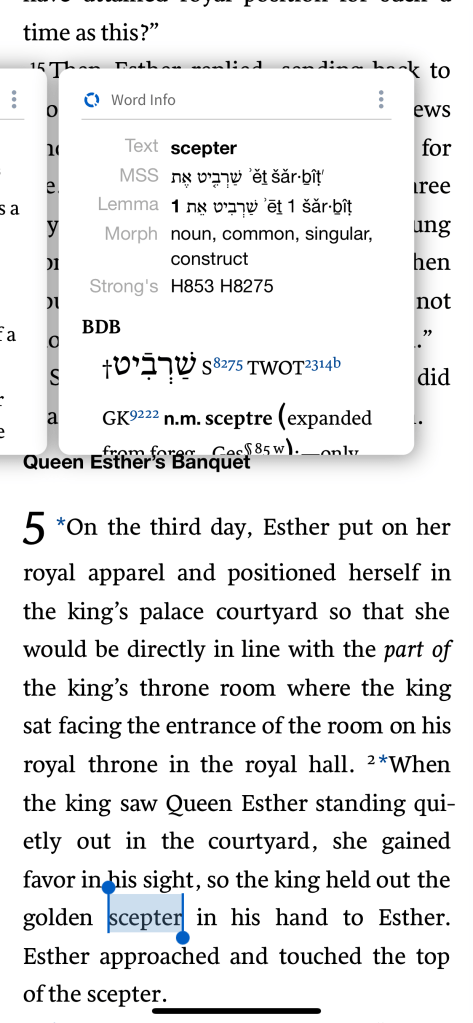
That little two-letter word et may easily be passed over. In my opinion, it is one of those things in Hebrew that point directly to Jesus.

The Hebrew letters that make up the word et are the aleph and the tav. The aleph is the first letter of the Hebrew alphabet, and the tav is the last.

Look at the screenshot included. You can see the Hebrew aleph and tav depicted in the callout box. (In the “Lemma” line next to the number 1.)

These two letters appear (sometimes untranslated) occasionally in the Hebrew Bible. An important one for me to discover was some years back. It is in the first line of the Bible. Genesis 1: In the beginning, God. Right next to the word Elohim are these two Hebrew letters. In the beginning, God: aleph-tav (think Alpha Omega.)

Conclusion.

People say that Esther doesn’t mention God. It certainly doesn’t mention Jesus. But a little digging into the underlying text reveals that He is indeed there. Don’t be afraid to use the vast tools available to you. There are many to allow such digging. If I can find it, you can.

I think I understand why this has been knocking around in my head for some weeks now. God had something important to show. I am also very cognizant of Michael Heiser and his adage. “If it’s weird. It’s important.” I always keep that in mind. Along with those little ideas that arise as God causes them to stick in your mind.

Jesus Sets the Timing

Do not let anyone deceive you in any way. For that Day will not come unless a falling away comes first, and the man of sin is revealed, the son of destruction,

2 Thessalonians 2:3 — Modern English Version (Thinline Edition.; Lake Mary, FL: Passio, 2014)

While I was with them in the world, I kept them in Your name. I have kept those whom You have given Me. And none of them is lost except the son of perdition, that the Scripture might be fulfilled.

John 17:12 — Modern English Version (Thinline Edition.; Lake Mary, FL: Passio, 2014)

It is unmistakable that the coming prince shares the same epithet that Judas shared. It is also unmistakable that this imposter is not in control of timing.

There is some controversy on exactly what falling away entails. It could be the abandonment of orthodox Christianity by some. If so, it’s easy to see the beginnings of that even now. There are some who see it as a removal of people, specifically believers. Regardless, the revealing of the son of perdition cannot occur until after the event.

If Satan is not in control of the timing of things, that means he has to have a man ready at any given time. He knows his time is short but has a specific beginning. He has no idea when the specific time starts.

God knows. In fact, God has shared intelligence with us in His Word. We are given vivid descriptions of exactly what is going to happen. But it won’t start until God gives the go-ahead.

For lots of Christians, we think that is what is called the rapture. That word comes with some baggage, too. But I think of it as a catching away of the believers.

As God would have it come to mind… Jesus also controlled the timing of the previous son of perdition. Sitting down to share a meal with his disciples, this is what happened.

Jesus answered, “It is he to whom I shall give a piece of bread when I have dipped it.” When He had dipped the bread, He gave it to Judas Iscariot, the son of Simon. After receiving the piece of bread, Satan entered him.
Then Jesus said to him, “What you are going to do, do quickly.” But no one at the table knew why He said this to him.

John 13:26–28 — Modern English Version (Thinline Edition.; Lake Mary, FL: Passio, 2014)

It was Jesus who controlled the timing of His crucifixion.

Satan couldn’t move against Jesus at his own discretion and timing. He also can’t move in his short window of time in the end at his own discretion. He must first wait for God.

The very context of 2 Thessalonians tells us the sign…

Do you not remember that when I was still with you, I told you these things? Now you know what restrains him that he might be revealed in his time. For the mystery of lawlessness is already working. Only He who is now restraining him will do so until He is taken out of the way. Then the lawless one will be revealed, whom the Lord will consume with the breath of His mouth, and destroy with the brightness of His presence, even him, whose coming is in accordance with the working of Satan with all power and signs and false wonders, and with all deception of unrighteousness among those who perish, because they did not receive the love for the truth that they might be saved.

2 Thessalonians 2:5–10 — Modern English Version (Thinline Edition.; Lake Mary, FL: Passio, 2014)

He can’t move until that happens. He Who restrains. This time, it’s not Jesus… But the Holy Spirit Who works in the hearts of all believers now.

Time seems short.