
How Shall I Know?

Zechariah said to the angel, “How shall I know this? For I am an old man and my wife well advanced in years.”

Luke 1:18 — Modern English Version (Thinline Edition.; Lake Mary, FL: Passio, 2014)

This is Zechariah’s response to the angel that visited him while he was burning incense in the temple before the Lord. The angel came with good tidings of a promised newborn son. He and his wife were childless and well advanced in years. Yet the angel declared a boy would be born. He named the child and said he would have the power of Elijah.

Zechariah’s response wasn’t to believe what he was told. In fact, his response doesn’t seem quite shocking at all to modern ears. It is the same objection that many of us would offer.

“Prove it to me.”

“I need evidence.”

“Something more than your words is necessary.”

It’s the simple communication of truth from one person to another. In our case, an angel that has true information was tasked to relay it to Zechariah. He needed something more. Paul spoke of the human impediment at work here.

Where is the wise? Where is the scribe? Where is the debater of this age? Has God not made the wisdom of this world foolish? For since, in the wisdom of God, the world through its wisdom did not know God, it pleased God through the foolishness of preaching to save those who believe. For the Jews require a sign, and the Greeks seek after wisdom.

1 Corinthians 1:20–22 — Modern English Version (Thinline Edition.; Lake Mary, FL: Passio, 2014)

In all of the questions Paul asks, he is mocking the wisdom of the world. Technology advances, people compose great written works, wise men debate novel ideas. Yet in none of these is revealed the only truth that matters… To know God and to be saved.

Our friend Zechariah wanted something more. What was told to Him didn’t match what he knew. Older couples were well past the child-bearing years. Zechariah knew this messenger was different than a mere human.

Paul says the Israeli seeks something more… A sign. The Greek needs the wisdom that often arises from the debate of ideas. It’s always something more.

God conveys ideas to us. Without faith, it is impossible to please God. The just shall live by faith.

It pleased God through the foolishness of proclamation (preaching) to save those who believe it. It’s as simple as that. Believe what is said.

Zechariah’s response revealed he didn’t really believe. Yet Zechariah already had his sign.

Then an angel of the Lord appeared to him, standing on the right side of the altar of incense.

Luke 1:11 — Modern English Version (Thinline Edition.; Lake Mary, FL: Passio, 2014)

He was alone, and no other person was permitted to enter the place where he was. We know the angel appeared to him. It wasn’t there when he walked in.

Zechariah didn’t believe the proclamation, it cost him something. He regarded what he was told foolishly. He was a witness to it being all true. His wife conceived. A son was born to him.

If someone were to say to you, “Jesus died for you.” Would your response be to treat the statement with folly or would you want to know more?

The disposition of your soul depends on your response.
Christmas, Behold the Lord’s Female Slave

Now in the sixth month, the angel Gabriel was sent from God to a town of Galilee named Nazareth, to a virgin legally promised in marriage to a man named Joseph of the house of David. And the name of the virgin was Mary. And he came to her and said, “Greetings, favored one! The Lord is with you.” But she was greatly perplexed at the statement, and was pondering what sort of greeting this might be. And the angel said to her,
“Do not be afraid, Mary, for you have found favor with God. And behold, you will conceive in the womb and will give birth to a son, and you will call his name Jesus. This one will be great, and he will be called the Son of the Most High, and the Lord God will give him the throne of his father David. And he will reign over the house of Jacob forever, and of his kingdom there will be no end.
And Mary said to the angel, “How will this be, since I have not had sexual relations with a man?” And the angel answered and said to her,
“The Holy Spirit will come upon you, and the power of the Most High will overshadow you. Therefore also the one to be born will be called holy, the Son of God.
And behold, your relative Elizabeth—she also has conceived a son in her old age, and this is the sixth month for her who was called barren. For nothing will be impossible with God.”
So Mary said, “Behold, the Lord’s female slave! May it happen to me according to your word.” And the angel departed from her.

Luke 1:26–38 — The Lexham English Bible (Bellingham, WA: Lexham Press, 2012)

Yeah… That title.

It is what Mary said. It wasn’t that she didn’t have a choice in the matter. She could have refused. Yet she didn’t. She called herself the Lord’s slave.

Did God make her do it?

No.

We tend to think about things that happen linearly because that is our only experience in this time-matter-space existence. All of this could have been orchestrated to happen to bring forth the Savior at the right time. It is well within the power of God. Such a concept as that brings to mind a child posing his toys in play, to do as such imagined. God doesn’t do that.

I think people live their lives and make choices just as Mary made. Those choices could be to honor God or more likely not. God didn’t cause Mary’s choice. Nor did He predict it. (I am sure that will cause some to gasp. Relax.) He gave us patterns for which to expect. We refer to this as prophecy.

Prophecy is just ‘truth-telling.’ In this particular situation, Isaiah recorded a truth for Ahaz, which had a dual pattern, like much of these prophecies. That dual pattern found its ultimate completion in the birth of Jesus. He is God in human form. Not appearing as God, but adding humanity to God.

God can tell us the beginning from the end. He is the only One able to do such things. He can do that because of His omniscience and omnipresence. Every moment is a present reality for God. He is present in the moment Isaiah penned ‘a maiden shall conceive.’ Just as He is present in the moment that Mary met the angel, and when Mary conceived. He is even present at that moment with Eve when He told her that her ‘seed’ would bring the redemption of humanity.

I am certain through the noisy bustle of this season, you’re going to hear the skeptical claims of holy rape and mistranslation.

Mary fully participated, yielding herself to what would happen to her. What we do know, is the conception of the Babe wasn’t sexual, and it wasn’t rape. Otherwise, she couldn’t be a virgin when she gave birth.

And that brings us to the second point. The contention over the term virgin. Many will say the Hebrew word almah cannot be translated to virgin, as it only means maiden. Yet, virgin is an acceptable translation from Hebrew just by looking at how it is used elsewhere in the Bible. Regardless, it never refers to a married woman.

Let’s look deeper.

“Behold, the virgin will become pregnant and will give birth to a son, and they will call his name Emmanuel,”

Matthew 1:23 — The Lexham English Bible (Bellingham, WA: Lexham Press, 2012)

Notwithstanding the subtle controversies surrounding the Septuagint. This is a Greek translation thought to have been in common use around the time of Jesus’ birth. Here is an English translation of the Septuagint for the quotation from Matthew’s Gospel above.

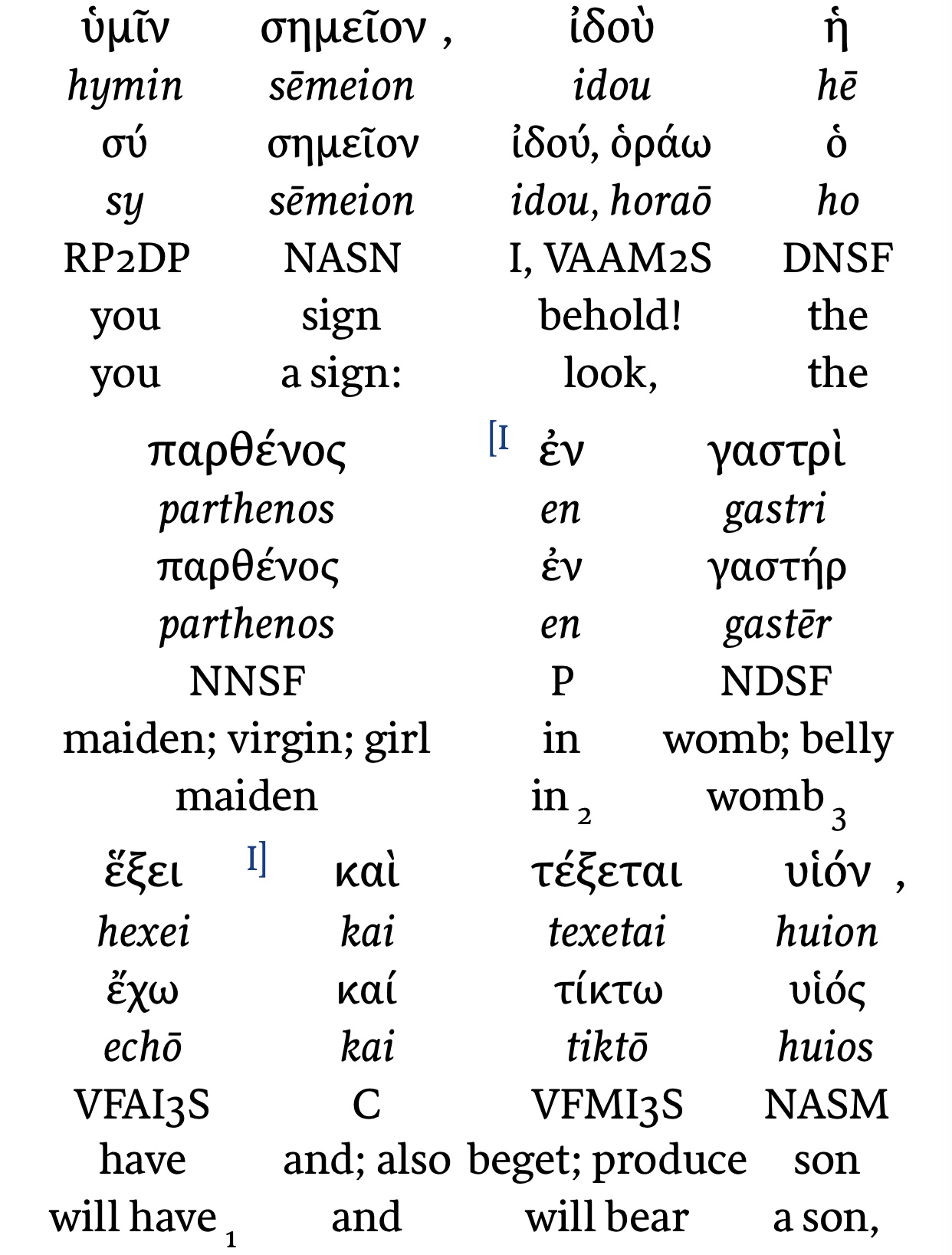
Because of this, the Lord himself will give you a sign: Look, the maiden will become pregnant and will bear a son, and you will call his name Immanuel.

Isaiah 7:14— The Lexham English Septuagint (Bellingham, WA: Lexham Press, 2012)

Here we see the term maiden as it is translated from Hebrew to Greek and then into English. This seems to offer the skeptic some refuge, but does it really?

With a bit of assistance from interlinear tools… We discover something important.

Do you see it?

Parthenos does mean maiden and virgin. This tells us the skeptics are wrong. This could be accepted scholarship for those. I offer it because skeptics seldom take the time to really understand their objections.

Yet somewhere in the back of my mind, I simply prefer to believe what God has said. He moved in such a way as to have Isaiah write of that, using a Hebrew word that includes the meaning of virgin. After that miracle of the birth of the God-Man, He then moved Matthew in a similar fashion to Isaiah. In his Gospel, he used the word parthenos in translating Isaiah 7:14 (Matthew 1:23.)

That is how we know Jesus was born of a virgin. God is not constrained to (or by) time, matter and space. And His Word is true and reliable.