The Virgin Birth

And Joseph, when he woke up from sleep, did as the angel of the Lord commanded him, and he took his wife and did not have sexual relations with her until she gave birth to a son. And he called his name Jesus.

Matthew 1:24–25 — The Lexham English Bible (Bellingham, WA: Lexham Press, 2012)

God had visited Joseph to quell his own fears. It would be such a shame for him to have a betrothed who was pregnant.

Joseph did take his wife, sheltering her and honoring God. In his honor to God, he refrained from sexual relations, that the Baby would be born of a virgin.

This is the miracle. This is the virgin birth. This is Salvation for the world. This is the event that changed time. Even though we don’t use the BC and AD descriptors for years, we continue to mark the years in celebration of His birth.

This Baby changed the world!

Christmas, Behold the Lord’s Female Slave

Now in the sixth month, the angel Gabriel was sent from God to a town of Galilee named Nazareth, to a virgin legally promised in marriage to a man named Joseph of the house of David. And the name of the virgin was Mary. And he came to her and said, “Greetings, favored one! The Lord is with you.” But she was greatly perplexed at the statement, and was pondering what sort of greeting this might be. And the angel said to her,
“Do not be afraid, Mary, for you have found favor with God. And behold, you will conceive in the womb and will give birth to a son, and you will call his name Jesus. This one will be great, and he will be called the Son of the Most High, and the Lord God will give him the throne of his father David. And he will reign over the house of Jacob forever, and of his kingdom there will be no end.
And Mary said to the angel, “How will this be, since I have not had sexual relations with a man?” And the angel answered and said to her,
“The Holy Spirit will come upon you, and the power of the Most High will overshadow you. Therefore also the one to be born will be called holy, the Son of God.
And behold, your relative Elizabeth—she also has conceived a son in her old age, and this is the sixth month for her who was called barren. For nothing will be impossible with God.”
So Mary said, “Behold, the Lord’s female slave! May it happen to me according to your word.” And the angel departed from her.

Luke 1:26–38 — The Lexham English Bible (Bellingham, WA: Lexham Press, 2012)

Yeah… That title.

It is what Mary said. It wasn’t that she didn’t have a choice in the matter. She could have refused. Yet she didn’t. She called herself the Lord’s slave.

Did God make her do it?

No.

We tend to think about things that happen linearly because that is our only experience in this time-matter-space existence. All of this could have been orchestrated to happen to bring forth the Savior at the right time. It is well within the power of God. Such a concept as that brings to mind a child posing his toys in play, to do as such imagined. God doesn’t do that.

I think people live their lives and make choices just as Mary made. Those choices could be to honor God or more likely not. God didn’t cause Mary’s choice. Nor did He predict it. (I am sure that will cause some to gasp. Relax.) He gave us patterns for which to expect. We refer to this as prophecy.

Prophecy is just ‘truth-telling.’ In this particular situation, Isaiah recorded a truth for Ahaz, which had a dual pattern, like much of these prophecies. That dual pattern found its ultimate completion in the birth of Jesus. He is God in human form. Not appearing as God, but adding humanity to God.

God can tell us the beginning from the end. He is the only One able to do such things. He can do that because of His omniscience and omnipresence. Every moment is a present reality for God. He is present in the moment Isaiah penned ‘a maiden shall conceive.’ Just as He is present in the moment that Mary met the angel, and when Mary conceived. He is even present at that moment with Eve when He told her that her ‘seed’ would bring the redemption of humanity.

I am certain through the noisy bustle of this season, you’re going to hear the skeptical claims of holy rape and mistranslation.

Mary fully participated, yielding herself to what would happen to her. What we do know, is the conception of the Babe wasn’t sexual, and it wasn’t rape. Otherwise, she couldn’t be a virgin when she gave birth.

And that brings us to the second point. The contention over the term virgin. Many will say the Hebrew word almah cannot be translated to virgin, as it only means maiden. Yet, virgin is an acceptable translation from Hebrew just by looking at how it is used elsewhere in the Bible. Regardless, it never refers to a married woman.

Let’s look deeper.

“Behold, the virgin will become pregnant and will give birth to a son, and they will call his name Emmanuel,”

Matthew 1:23 — The Lexham English Bible (Bellingham, WA: Lexham Press, 2012)

Notwithstanding the subtle controversies surrounding the Septuagint. This is a Greek translation thought to have been in common use around the time of Jesus’ birth. Here is an English translation of the Septuagint for the quotation from Matthew’s Gospel above.

Because of this, the Lord himself will give you a sign: Look, the maiden will become pregnant and will bear a son, and you will call his name Immanuel.

Isaiah 7:14— The Lexham English Septuagint (Bellingham, WA: Lexham Press, 2012)

Here we see the term maiden as it is translated from Hebrew to Greek and then into English. This seems to offer the skeptic some refuge, but does it really?

With a bit of assistance from interlinear tools… We discover something important.
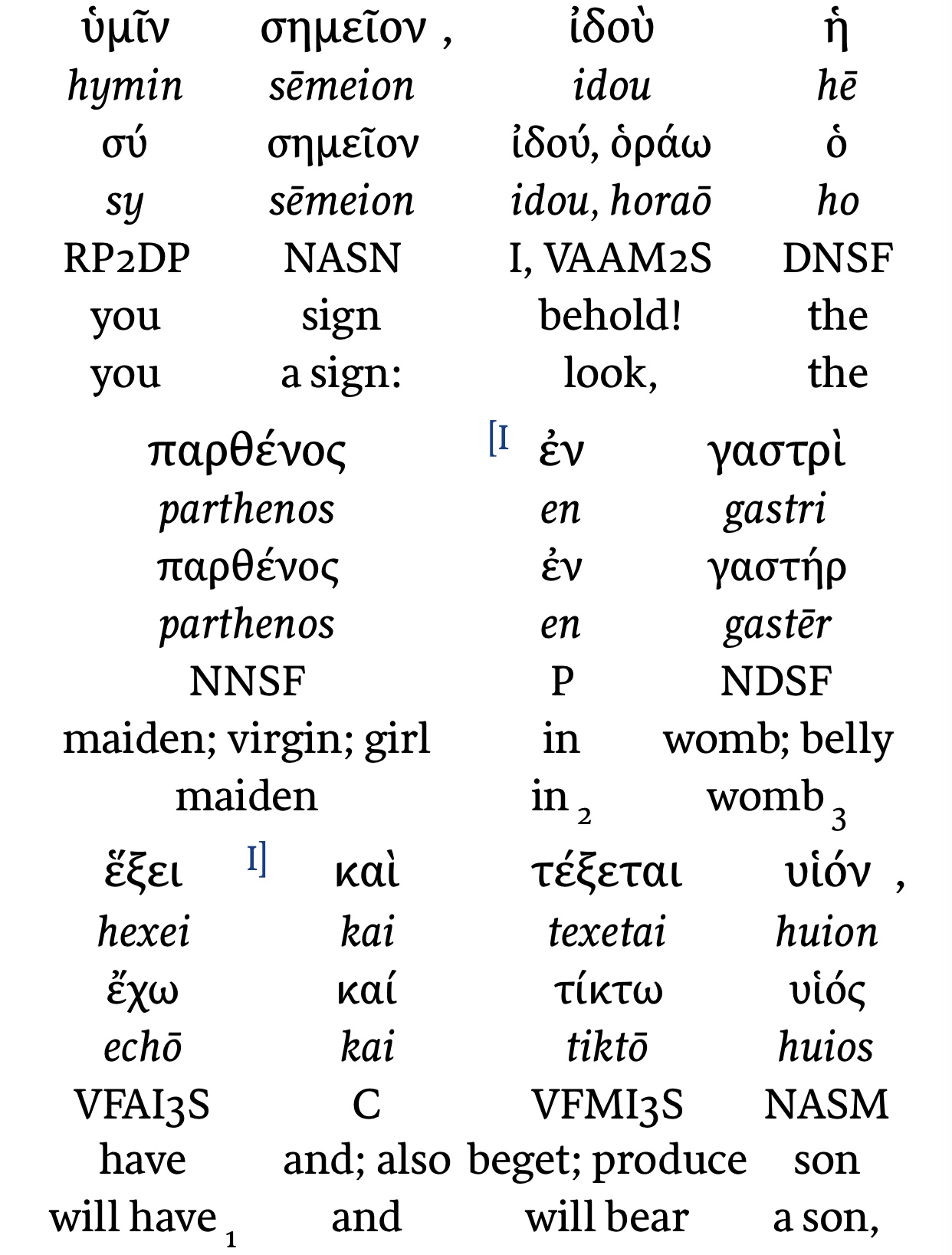
Do you see it?

Parthenos does mean maiden and virgin. This tells us the skeptics are wrong. This could be accepted scholarship for those. I offer it because skeptics seldom take the time to really understand their objections.

Yet somewhere in the back of my mind, I simply prefer to believe what God has said. He moved in such a way as to have Isaiah write of that, using a Hebrew word that includes the meaning of virgin. After that miracle of the birth of the God-Man, He then moved Matthew in a similar fashion to Isaiah. In his Gospel, he used the word parthenos in translating Isaiah 7:14 (Matthew 1:23.)

That is how we know Jesus was born of a virgin. God is not constrained to (or by) time, matter and space. And His Word is true and reliable.


How Is It the Pharisees Knew?

In one of our recent excursions in the text of the Gospel of Matthew, we encountered Jesus preparing His disciples for the near-term future when He would die and rise again. Clearly, in that discussion, the part He spoke of Himself rising again was ignored by His friends, as they were more concerned with ensuring Him of their loyalty.

Later in Matthew’s account, we read this:

The next day, following the Day of Preparation, the chief priests and Pharisees gathered before Pilate, saying, “Sir, we remember that deceiver saying while He was still alive, ‘After three days I will rise.’ Therefore command that the tomb be made secure until the third day, lest His disciples come by night and steal Him away, and tell the people, ‘He has risen from the dead.’ The last deception will be worse than the first.”

Matthew 27:62–64 — Modern English Version (Thinline Edition.; Lake Mary, FL: Passio, 2014)

The chief priests and Pharisees listened keenly to Jesus. They knew He was teaching that He would rise again. It is difficult to read the texts of the four Gospels and find that the disciples actually expected the resurrection. Yet here we see one of those very men setting to pen. Those set against Jesus clearly understood—even expected it to happen.

I know how the skeptics would want us to read the Gospels… Thinking that such were penned to make a new religion. They want you to believe Jesus was just a man and died as just a man. That He was buried and somehow in the middle of the night, His friends took the body away and hid it. Then these men would lie saying He rose again.

I have difficulty even entertaining that farcical point of view. If what the skeptics say were entertainable, why would Matthew abase himself as not understanding the coming resurrection with which they would allegedly attempt to deceive others?

Furthermore… How is it the chief priests and Pharisees did expect what the disciples did not?

It really is the resurrection that sets Christianity miles apart from any other religion. Think about it. God came to His created humans as a human. He died as a Human. He rose again as a human. He did this to defeat the enemy of all of us… Death. We don’t have to die and be separated from the external God. He wants us to be with Him for eternity and made a sure Way for that to be.

The last thought to consider: For almost 2,000 years it’s recorded plainly, the leaders had their alternate story set. “His disciples came by night and stole the body away.” Today that thinking still circles in the fringes. The Pharisees anticipated the resurrection and crafted an alternate explanation. Why do you think that legend of stealing Jesus’ body was recorded by Matthew?

It Wasn’t Really Expected

Then Jesus said to them, “All of you will fall away on account of Me this night, for it is written:
‘I will strike the shepherd, and the sheep of the flock shall be scattered.’

Matthew 26:31 — Modern English Version (Thinline Edition.; Lake Mary, FL: Passio, 2014)

Jesus told the disciples of many insights from the Old Testament. He showed them that even their behavior was prophesied long before it would happen. He shared it with them to prepare them.

As always, people tend to only focus on themselves. Read on as the disciples do that. They would turn their focus on themselves and miss something important.

It’s the proverbial elephant in the room!

But after I have risen, I will go before you to Galilee.”

Matthew 26:32 — Modern English Version (Thinline Edition.; Lake Mary, FL: Passio, 2014)

Jesus isn’t talking about them… Really. I mean, these guys walked with Jesus for around 3 years. They knew Him and loved Him. He relates His impending death, their scattering, and His resurrection and continued shepherding of them.

Peter answered, “Though all men will fall away on account of You, yet I will never fall away.”
Jesus said to him, “Truly I say to you, this night, before the rooster crows, you will deny Me three times.”
Peter said to Him, “Though I should die with You, yet I will not deny You.” And all the disciples spoke in this manner.

Matthew 26:33–35— Modern English Version (Thinline Edition.; Lake Mary, FL: Passio, 2014)

Sometimes we, like the disciples, get so focused on our performance, we miss the bigger picture. Jesus is trying to prepare the disciples for what is going to happen. He would die and rise again. He will again lead them. He gives them the very hope they need to not fear the coming trial.

So focused on proving their loyalty, they missed what He said… After I have risen.

Is it any wonder?

Did they really expect the resurrection, even now?

Think about that. We know the resurrection, as the central tenet of Christianity. Without it, there’s no hope. Skeptics get it. They will pounce on the idea with cockamamie stories on how it is a lie. They will say this dying and rising God was copied from elsewhere. They will allege the disciples stole Jesus’ body and hid it. (I am sure there are even more objections.)

If the resurrection were a lie foisted upon us by these witnesses who penned accounts of it, why would Matthew embarrass himself by recording his own ignoring of it?

In the passage we examined, the fact they would be scattered wasn’t missed. The most important thing wasn’t even acknowledged.

It wasn’t expected, at all.

In your own reading of the Gospels, take note of how many times Jesus spoke of the resurrection. Also, the note how many times it was acknowledged. Deeply consider that.

A Parable for You Today

“Then the kingdom of heaven shall be like ten virgins, who took their lamps and went out to meet the bridegroom. Five of them were wise and five were foolish. Those who were foolish took their lamps, but took no oil with them. But the wise took jars of oil with their lamps. While the bridegroom delayed, they all rested and slept.
“But at midnight there was a cry, ‘Look, the bridegroom is coming! Come out to meet him!’
“Then all those virgins rose and trimmed their lamps. But the foolish said to the wise, ‘Give us some of your oil, for our lamps have gone out.’
“The wise answered, ‘No, lest there not be enough for us and you. Go rather to those who sell it, and buy some for yourselves.’
“But while they went to buy some, the bridegroom came, and those who were ready went in with him to the wedding banquet. And the door was shut.
“Afterward, the other virgins came also, saying, ‘Lord, Lord, open the door for us.’
“But he answered, ‘Truly I say to you, I do not know you.’
“Watch therefore, for you know neither the day nor the hour in which the Son of Man is coming.

Matthew 25:1–13 — Modern English Version (Thinline Edition.; Lake Mary, FL: Passio, 2014)

Sometimes these parables can be hard to understand. People will apply this for those to be ready when Jesus comes again. That is true, but it is specifically regarding His coming in the clouds for believers. It is addressing salvation. Given the signs of the times… It is a message for today.

Perhaps this is for you. You’ve gone to church, heard the preaching and know your Bible. But you’ve never made the decision for yourself to believe that Jesus is God and that He died personally for you and your sins. And that He rose again.

Listen to the promise explained in a similar fashion, near the time Jesus spoke that parable.

“If you love Me, keep My commandments. I will pray the Father, and He will give you another Counselor, that He may be with you forever: the Spirit of truth, whom the world cannot receive, for it does not see Him, neither does it know Him. But you know Him, for He lives with you, and will be in you. I will not leave you fatherless. I will come to you. Yet a little while and the world will see Me no more. But you will see Me. Because I live, you will live also.

John 14:15–19 — Modern English Version (Thinline Edition.; Lake Mary, FL: Passio, 2014)

Interestingly, He says He won’t leave us Fatherless. It’s a hint to a greater truth. That’s a different discussion.

There is another. It is this Counselor, or better, Comforter. He is for believers only. The world can’t receive Him. Jesus did use a personal pronoun… Him. Jesus promises to come to those who receive this Person.

How does this work with the other you ask?

The wise virgins in Jesus’ story had oil for their lamps. They had the Spirit of the Living God to light their testimony. Oil is a typification of the Holy Spirit. The five wise virgins were saved. They had received the gift of the Comforter.

The foolish virgins had a testimony, but no oil for it. That is, they weren’t saved. They attend church and participate in all the things, but never receive the Gift because they don’t really believe it for themselves. They’re Christians because their parents were.

Being a Christian isn’t something that’s inherited or conferred by birthright. It’s something you must decide for yourself. You must count the cost. Believing Jesus is God.

Read that passage from John again. Jesus explicitly states He wasn’t leaving the disciples fatherless.

Jesus is going to come. Next… It will be in the twinkling of an eye. When He keeps His promise to retrieve His bride, there won’t be time to decide for salvation for yourself. You will be left behind. The door to the feast will be shut.

Don’t wait. Don’t be foolish. There won’t be time. But you have time now.

Encouragement for Some

“To the angel of the church of the Laodiceans write:
“The Amen, the Faithful and True Witness, the Beginning of the creation of God, says these things: I know your works, that you are neither cold nor hot. I wish you were cold or hot. So then, because you are lukewarm, and neither cold nor hot, I will spit you out of My mouth. For you say, ‘I am rich, and have stored up goods, and have need of nothing,’ yet do not realize that you are wretched, miserable, poor, blind, and naked. I counsel you to buy from Me gold refined by fire, that you may be rich, and white garments, that you may be dressed, that the shame of your nakedness may not appear, and anoint your eyes with eye salve, that you may see.
“Those whom I love, I rebuke and discipline. Therefore be zealous and repent. Listen! I stand at the door and knock. If anyone hears My voice and opens the door, I will come in and dine with him, and he with Me.
“To him who overcomes will I grant to sit with Me on My throne, as I also overcame and sat down with My Father on His throne. He who has an ear, let him hear what the Spirit says to the churches.”

Revelation 3:14–22 — Modern English Version (Thinline Edition.; Lake Mary, FL: Passio, 2014)

Please do reread this portion of Scripture when finished reading the entire post.

This is for each of us. Any of us may be of those who are in a church, that for all intents and purposes, appears as the Laodicean one. Our first reaction may be to flee. For some, that may be the best way to handle the situation. But is that what Jesus instructs?

Please pay attention to the admonitions that Jesus gives. The first is to the church itself. He urges the church to repent.

Immediately after, He speaks directly to the individuals in the church. It becomes personal. He encourages us to open the door to Him as His voice is heard. Though Jesus may indeed be standing outside the door of this church and those like it, His entreaty is to anyone who hears. That’s you and I!

For those that hear and respond… The promise to that person is a sweet fellowship with Him. This would be even in the midst of trying circumstances were a believer ‘churches.’

Jesus doesn’t tell us to flee such a situation. Perhaps we are called to stick it out. To be that one person who helps others to hear Jesus’ voice. If enough do, it would change things dramatically.

Listen, the local body of believers may have problems… But the promises are to the individuals in those bodies. It’s you He came to save. It’s you He wants to serve. The promises are to him who overcomes.

Hear what Jesus says to the churches. Listen for His voice and let Him in. Be one who overcomes!

He Shall Send Them

Rejoice greatly, O daughter of Zion! And cry aloud, O daughter of Jerusalem! See, your king is coming to you; he is righteous and able to deliver, he is humble and riding on a donkey, a colt, the offspring of a donkey.

Zechariah 9:9 — Modern English Version (Thinline Edition.; Lake Mary, FL: Passio, 2014)

I know. This is more of an appropriate post for springtime. It works for this season simply for the fact that we ought to know Who it is Whose birth we celebrate.

This is a familiar prophecy to lag of us. I’m reading in Matthew of the Messiah’s Triumphal Entry into Jerusalem just before He was crucified.

When they drew near to Jerusalem and came to Bethphage, on the Mount of Olives, then Jesus sent two disciples, saying to them, “Go over into the village opposite you, and immediately you will find a donkey tied, and a colt with her. Untie them and bring them to Me. If anyone says anything to you, you shall say, ‘The Lord has need of them.’ And he will send them immediately.”
All this was done to fulfill what was spoken by the prophet, saying: “Tell the daughter of Zion, ‘Look, your King is coming to you, humble, and sitting on a donkey, and on a colt, the foal of a donkey.’”

Matthew 21:1–5 — Modern English Version (Thinline Edition.; Lake Mary, FL: Passio, 2014)

I couldn’t help but to notice, “he will send them immediately.”

Them… That word. There was more than one animal that was sent. It says a donkey and a colt.

When I read Scripture, I like to pay attention to the precision of the text. Oft times, it has caused me to rethink what I thought I knew Scripture teaches. What is God trying to convey here?

I am going to say something about the translations. I use the MEV for reading. It is sufficient for that task. I will use others to grasp the nuances in meaning or to be aware of the biases of the translators.

When comparing the translation of Matthew’s quotation of the Zechariah passage with how the translators actually rendered Zechariah 9:9… There are some differences. Notably, the Zechariah passage could be vaguely referring to one or two animals in the MEV. As rendered it isn’t clear. In other translations, we see the conjunction. The donkey would be joined with the colt. What is literally written in Zechariah is this: “and riding on an ass, And on a colt — a son of she-asses.” The literal rendering says Jesus is riding on two donkeys.

Think about that.

No earthly king would present himself on a donkey if the more majestic horse was available. Jesus riding on a donkey would immediately bring to mind lowliness and humility. It would be without comeliness, that is it wouldn’t be attractive.

I know the picture we have conjured in our mind’s eye of this event. Consider this: Jesus did ride into Jerusalem. He did it on a date precisely foretold almost 500 years earlier by a prophecy shown to and recorded by Daniel. Jesus expected the Israelis than to know of their visitation.

The disciples went and did as Jesus commanded them. They brought the donkey and the colt, laid their garments on them, and He sat on them.

Matthew 21:6–7 — Modern English Version (Thinline Edition.; Lake Mary, FL: Passio, 2014)

He sat on them.

This is as precise a picture of the presentation of the Messiah as Daniel’s dating. The King would be riding on an ass and a colt of she-asses. This was foretold by Zechariah. We see it fulfilled precisely in Matthew.

The presentation of the lowly Servant-King riding on the back of a wobbly donkey barely able to support Him. A colt who needed help from his own mother.

Now… How many kings are presented on two donkeys like that?

Stumbling Stones: Not Speaking Truthfully

But whoever misleads one of these little ones who believe in Me, it would be better for him to have a millstone hung about his neck and to be drowned in the depth of the sea. Woe to the world because of temptations! For it must be that temptations come, but woe to that man by whom the temptation comes!

Matthew 18:6–7 — Modern English Version (Thinline Edition.; Lake Mary, FL: Passio, 2014)

It goes without saying, Jesus is being firm. He is conveying the seriousness with which we as believers must comport ourselves.

It seems to be for our own good, yet Jesus explains the greater concept. It’s for the good of the “little ones,” that is our younger siblings in Christ.

We ought to act circumspectly, minding closely how we affect others not only by our actions but what we say about our faith. Not just ‘others’ outside the circle of faith, but to the younger in the faith.

In recent days, there is a bit of controversy over remarks made by a popular contemporary vocal artist who has made public appearances. It’s a great thing, though the name of Jesus is being proclaimed in novel ways. (Novel to today’s culture.) The publicity eventually strayed into one issue of contention. Whether fairly or not, she was blind-sided by a direct question.

As mature believers, the citation of Jesus above may clearly show how what Jesus is saying applies to this controversy. For those who need a bit of help, let me say the struggle is real. There are some Christians who struggle with sexual sin. For those who struggle with exactly the essence of this controversy, the wishy-washiness of the response may be taken as permission or endorsement. This can lead to dire consequences.

When we are asked matter-of-fact questions by those who hold sway over the culture, we ought not to be caught unawares. Let us all have proper answers from studying and understanding issues. Let us ask our Lord for appropriate answers that are truthful. Because if you speak the truth, it is the only way to love the culture.

Christianity is offensive. It begins with the truth that none of us measure up to the standard God gives. In fact, the moment we can understand that, we realize we’ve already fatally failed. God stepped in. He sent His Son to stand in that gap, reconciling the world to Himself. Those that trust in Him has been redeemed of the mortal debt owed. Our job transitions to an ambassador of reconciliation.

Just as Jesus died for you, He also died for those whose struggle is not like yours. Let’s love them by being truthful. Soft-pedaling sin is really an endorsement of it.

The cultural divide will only continue to grow exponentially. We have the Book that tells us this. We can try to go along to get along, what does that win us?

Let us urge others to be reconciled to God, and let Him clean them up. I know He is still trying to clean me up. I have His promises to see that through.

Testimony: Be Intentional

It’s an odd feeling when you’re whole life you’ve relished “alone time.”

But then God steps in and starts changing things. Now “alone time” becomes an opportunity for loneliness. Not in a bad way, just oddness that is hard to explain in other words… That I really do miss being around other people.

In the world of introvert/extrovert… I found myself at once relishing introversion. Oftentimes that memory seems distant now. Something happened.

I’m not a people person, really. But somewhere in that, I know that idea is now fluid, too. Because I want to be around others intentionally. I even want to be purposeful toward them.

Like… Wut is THAT?

I can recall asking God to let me see people like He does. I asked to love them like He does. I deeply understood the flippancy in uttering these words to God. I even asked Him to not let that request be lip service. The memory is that vivid.

John teaches us in his second epistle that we ought to love each other. He says this is a command of God. I would tell you, a command given by God to us is both intentional and purposeful. It is He demonstrating that same intention and purpose toward us.

Additionally, we know that love is purposeful and intentional. (It would make sense because God is love.) Love isn’t something that just happens to us. It’s not something we fall into. It is not something that just goes away. Love is so much more than just an emotional feeling or ethereal concept. Love is action. Love is an act of will.

Love suffers long and is kind; love envies not; love flaunts not itself and is not puffed up, does not behave itself improperly, seeks not its own, is not easily provoked, thinks no evil; rejoices not in iniquity, but rejoices in the truth; bears all things, believes all things, hopes all things, and endures all things.

1 Corinthians 13:4–7 — Modern English Version (Thinline Edition.; Lake Mary, FL: Passio, 2014)

The words that follow that are “Love never fails.” God’s love toward us is all of those things. He never fails us.

We ought to have that same love toward others, even if they fail us. The love we have for them is not about us.

If what we had toward them fails, is it really love?

If John says that we ought to love each other (2 John 5,) then wouldn’t it follow this is the character of a mature believer?

If that is the character of a mature believer, then intentionality and purposefulness are also the character traits of a mature believer. It then follows that a mature believer is going to be to some extent… Extroverted. So being alone now is different for me. It’s energy-depleting. (I did italicize that. Some will know why.)

You cannot out-give God. Ask Him to do things, He’ll do more than you can comprehend. Be intentional. Find someone new and introduce yourself. Be purposeful, learn their name, and something about them.

I am still learning. And I fail often. But…

To live for Jesus is the greatest adventure!

Some Old Testament Evidence for a Multi-person Godhead

Sing and rejoice, O daughter of Zion, for I am coming and will dwell in your midst, says the Lord. And many nations will join themselves with the Lord in that day, and they will be My people. And I will reside in your midst, and you will know that the Lord of Hosts has sent Me to you.

Zechariah 2:10–11 — Modern English Version (Thinline Edition.; Lake Mary, FL: Passio, 2014)

Consider this passage from Zechariah. When reading it, pay close attention to Who is speaking, and Who they are talking about. The Person speaking promises to come and dwell in the midst of the Israelis. He calls Himself “the Lord.”

Therefore the Lord Himself shall give you a sign: The virgin shall conceive, and bear a son, and shall call his name Immanuel.

Isaiah 7:14 — Modern English Version (Thinline Edition.; Lake Mary, FL: Passio, 2014)

Emmanuel, that is literally God with us. He is the promised Anointed One. He is the One Who would dwell in the midst of the people. He is the one to Whom many nations.

Look closely… The One Who comes and dwells in the midst of the people is sent by “the Lord of Hosts.” We have at least two Persons, here, One speaking Who is sent and One Who sends. It’s there for a reason.

The word translated into the English Lord in this selection is the Tetragrammaton. It is that Holy name of God. That’s kind of near, isn’t it?

There’s more. God back and count how many times the word YHWH (Lord) is used. Two of them we know refer to One Person. Perhaps it is to acknowledge a double honor. The other is to the Lord of Hosts, the Father. Of course, the third Person is also present, but by inference. He does the drawing. (It is my conjecture.)

It is Jesus Who is sent by God, and the Holy Spirit draws people to Him.