
Asked For

And all the elders of Israel gathered together and they came to Samuel at Ramah. They said to him, “You are old and your sons do not walk in your ways. Now, install for us a king to govern us like all the nations.” 1 Samuel 8:4–5

Saul was anointed king over Israel. He was the asked for king. Imagine being led to find the meaning of the name Saul. But it came one night… Unexpectedly. It was from this portion, from which I previously posted.

Mephibosheth the son of Jonathan the son of Saul came to David and fell upon his face and bowed down. Then David said, “Mephibosheth,” and he responded, “I am your servant.”
David said to him, “Do not be afraid, for I will certainly show you kindness on account of Jonathan, your father. I will return to you every field of Saul, your father, and you will eat at my table perpetually.” 2 Samuel 9:6–7

I still contemplate what is veiled in this portion of the Bible. It is almost embedded in menory.

When Saul died and David became king, it would be customary to dispatch all of the male descendants of the previous king preventing any inclination to the throne. So when David summoned Mephibosheth, reluctance to comply would be very real. But he goes anyway.

David says do not be afraid, he is addressing this tension. He then gives Mephibosheth a perpetual place at the king’s table. He would be treated as a son of the king, as the text says perpetually.

Ziba said to the king, “Everything that my lord the king has commanded his servant, your servant will do.” So Mephibosheth ate at the table of David like one of the sons of the king. 2 Samuel 9:11

When I made that earlier post, the revelation of the meaning of Saul’s name drew my instant attention. The impression that came with it connected to the fall in the Garden of Eden. I could not quite understand how Adam asked for a new king. I equated Saul as a typification of Satan.

Adam and Eve both chose disobedience and to give themselves over to certain death. From that the death reigned, until the new King was anointed.

David was anointed long before his ascension to the throne. Jesus has yet to take His.

The Lord said to Samuel, “How long will you mourn for Saul, since I have rejected him from ruling over Israel? Fill your horn with oil and go. I will send you to Jesse the Bethlehemite, for I have chosen a king for Myself from among his sons.” 1 Samuel 16:1

God anointed a King for Himself. The typification was to be a macro-level view played out by two kings. It would be from the fall to the Triumphal Entry when the King is anointed. Then the cross and resurrection showing death has already been defeated. The culmination is when the King takes His throne in the Millennial Reign of Jesus Christ.

It was not until a few nights ago, that it was understood better. Saul is not a typification of Satan. He embodies death. Death that pursued the new King.

Samuel said, “How can I go? If Saul hears it, he will kill me.” 1 Samuel 16:2a

Saul embodies disobedience and death. The tension of the two kings shows that death never had a claim on David from the time he was anointed until he took his throne.

Saul’s life served a purpose to the people. He was to point to God’s chosen king who gives people rest. Just as death was appointed, it serves a purpose.

Therefore as sin came into the world through one man and death through sin, so death has spread to all men, because all have sinned. Romans 5:12

God gave the people what they asked for. Then he exploited death, inserting a window of time to show the people mercy.

For God has imprisoned them all in disobedience, so that He might be merciful to all. Romans 11:32

That death is on all, likewise mercy is on all, as they live to breathe after they sin. Just as David escaped. Without the mercy of God, there would be no time for anyone to exercise faith.

But the Scripture has confined all things under sin, that the promise through faith in Jesus Christ might be given to those who believe. Galatians 3:22

The last enemy to be defeated is death. David honored God and waited patiently for His timing. Just as Jesus awaits His Father’s timing.

For since death came by man, by man came also the resurrection of the dead. For as in Adam all die, even so in Christ shall all be made alive. But every man in his own order: Christ the first fruits; afterward, those who are Christ’s at His coming. Then comes the end when He will deliver up the kingdom to God the Father, when He puts an end to all rule and all authority and power. For He will reign until He has put all enemies under His feet. The last enemy that will be destroyed is death. For He “has put all things under His feet.” But when He says, “all things are put under Him,” it is revealed that He, who has put all things under Him, is the exception. When all things are subjected to Him, then the Son Himself will also be subject to Him who put all things under Him, that God may be all in all. 1 Corinthians 15:21–28
From Shame to the King’s Table

Now there was a servant from the house of Saul whose name was Ziba. So they summoned him to David. The king said to him, “Are you Ziba?”
He replied, “I am your servant.”
The king said, “Is there no one else from the house of Saul to whom I may show the kindness of God?”

2 Samuel 9:2–3a

I set out last night to dutifully read the next daily portion of the chronological reading plan. I am about a year behind. I was basically just reading to mark the checkbox. I read through all of 2 Samuel 8 and how David is blessed by God, and everything he sets out to do happens favorably for him.

Reading of David’s derring-do is epic. But chapter 8 was just a synopsis of things with little detail. Then I start chapter 9.

David remembers his friend Jonathan and desires to do right to his remaining family, if any exist. One is found… Mephibosheth.

This intruding thought enters my mind: “What do you think those names mean?”

It was followed by another; you could just ask AI to rewrite it with the meanings of the proper nouns replacing the names.

I did that. I used Perplexity. Usually there is a few-second delay as Perplexity collects consensus. When I put in the six to seven verses, the response was immediate.

“Statue responded to the king, ‘There is still a son of Yahweh Has Given who is crippled in both feet.’
The king said to him, ‘Where is he?’
Statue told the king, ‘He is at the house of Sold son of My Kinsman Is God, at No Pasture.’
So King Beloved sent for him and brought him from the house of Sold son of My Kinsman Is God, from No Pasture.
From the Mouth of Shame—the son of Yahweh Has Given, the son of Asked For—came to Beloved, fell facedown, and bowed. Then Beloved said, ‘From the Mouth of Shame,’ and he replied, ‘Here is your servant.’”

The first thing to catch my attention was the meaning of Saul’s name… Asked for. Saul was the king that Israel asked for. David’s name is beloved. It goes far deeper than Israel, and I have to sort out what is here.

Saul is a typification of the adversary, or Satan as we think. God had given dominion of creation to Adam and Eve. By disobedience and taking what was not theirs, they asked for a new king. Because of the disobedience of this king, God anointed another Beloved One.

Just as David’s life goes, shortly after being anointed, he is sent to his brothers in the presence of Saul. He encounters the blasphemy of Goliath. We know the tale: he subdues the enemy of the people and the king and takes his head.

But it would be a long time before Saul is actually deposed and David takes his rightful throne. And that comes with civil war in Israel.

Think about how God had selected another King for the people of the world. He was sent at just the right time to defeat the enemy of the people and God. That enemy was death. Jesus did that at Calvary.

Calvary, from Latin, meaning skull. Jesus was crucified at the place of the skull… Golgotha. Say it out loud. Could it be Goliath of Gath, the place of the skull?

When David slew Goliath, he brought the giant’s head back to Jerusalem. Dead bodies made one unclean; therefore, the skull would remain outside the camp… Even though Jerusalem was a Jebusite city at the time. There are some who think that David set up Goliath’s skull as a trophy and warning to the Jebusites occupying Jerusalem. The place of that skull is thought to be the very same place where Jesus was crucified.

There is another typification of Jesus in what David did. Remember Genesis 3:15: the seed of the woman bruises the head of the serpent. David beheaded the giant, thought to be the seed of fallen angels. I will let that sit with you to ponder.

That is like a high-level concise view of Earth, and a partial view into the Gospel.

Ziba responded to the king, “There is still a son of Jonathan who is crippled in both feet.”

2 Samuel 9:3b

There is one son of Jonathan found. His name is Mephibosheth. He was crippled. He would have difficulty standing.

Think about that. Is not that our position before a Holy God… Being unable to stand?

The king said to him, “Where is he?”
Ziba told the king, “He is at the house of Makir the son of Ammiel at Lo Debar.”

2 Samuel 9:4

Mephibosheth is in the house of Makir at Lo Debar. Mephibosheth means from the mouth of shame. Makir means sold. And Lo Debar means no place. What does David do?

So King David sent for and brought him from the house of Makir the son of Ammiel, from Lo Debar.

2 Samuel 9:5

Beloved sent for him from the mouth of shame. He was crippled and had difficulty standing. He was summoned to the house of Sold, which had no place.

Mephibosheth the son of Jonathan the son of Saul came to David and fell upon his face and bowed down. Then David said, “Mephibosheth,” and he responded, “I am your servant.”
David said to him, “Do not be afraid, for I will certainly show you kindness on account of Jonathan, your father. I will return to you every field of Saul, your father, and you will eat at my table perpetually.”

2 Samuel 9:6–7

This destitute person is restored and has a perpetual seat at the table of the king.

He bowed low and said, “What is your servant that you should be concerned for a dead dog like me?”

2 Samuel 9:8

What is it that the God of the universe should be concerned with a dead dog like me?

The king summoned Ziba the servant of Saul, and he said to him, “All that belonged to Saul and to all his house, I have given to the son of your master. You will work the ground for him—you, your sons, and your servants. You will bring in the produce so that the son of your master will have food to eat; but Mephibosheth, the son of your master, will always eat at my table.” Now Ziba had fifteen sons and twenty servants.
Ziba said to the king, “Everything that my lord the king has commanded his servant, your servant will do.” So Mephibosheth ate at the table of David like one of the sons of the king.

2 Samuel 9:9–11

The one from shame, sold, and no place was summoned by the king. He had one obligation… To respond to the summons or not.

Listen, in those times, it would be acceptable for the new king to kill all of the household of the deposed king. I can imagine hesitation to respond. But either way, in that mindset, Mephibosheth was as good as dead. He came to David and humbled himself.

David raised him up; he was treated as a son of the king.

If you see Jesus here… That is exactly the point. He summons all of the ashamed to His presence… Not for condemnation that we may be afraid to approach Him. He calls us to lift our heads and gives us a place at the table to be treated like children of God.

That is the Gospel.

The true Light, which enlightens everyone, was coming into the world. He was in the world, and the world was created through Him, yet the world did not know Him. He came to His own, and His own people did not receive Him. Yet to all who received Him, He gave the power to become sons of God, to those who believed in His name, who were born not of blood, nor of the will of the flesh, nor of the will of man, but of God.

John 1:9–13

Like Mephibosheth, you and I have to respond to the summoning of the King to have a perpetual place at His table.

Must the Sword Consume Forever?

Abner called to Joab, “Must the sword consume forever? Do you not understand that a bitter taste will result in the end? How long will you refuse to command the people to withdraw from chasing their brothers?” 2 Samuel 2:26

Saul had perished, and Ish-Bosheth his son arose to the throne to rule Israel. Hod had already chosen the line of David to replace Saul. This would be forever.

The two factions went to war. Abner installed Ish-Bosheth as king and led the Benjamites, and Joab led David’s valiant men. The bloodshed was real. The fighting intense among Israelis… Brothers.

Joab pursued Abner. Abner stopped and his men assembled on a hilltop. This would be the last stand. Abner asks three seeming normal questions.

Must the sword consume forever?

No. The point was that this fighting would destroy all until it was gone. This question also has a practical application. Jesus came just to ensure that the aword, that is death, would not consume forever.

For since death came by man, by man came also the resurrection of the dead. For as in Adam all die, even so in Christ shall all be made alive. But every man in his own order: Christ the first fruits; afterward, those who are Christ’s at His coming. Then comes the end when He will deliver up the kingdom to God the Father, when He puts an end to all rule and all authority and power. For He will reign until He has put all enemies under His feet. The last enemy that will be destroyed is death. 1 Corinthians 15:21–26

Death is the last enemy to be defeated.

Abner continued… Do you not understand that a bitter taste will result in the end?

Yes. There would be bitterness for the families who lost loved ones. Abner would end up with 18 times more casualties more than David. This has echoes back to the previous account where all of Israel pursued and almost wiped out the tribe of Benjamin. All of the tribe of Benjamin would understand the bitterness of the devastating casualties.

Yet as before, this question has a broader scope of application in the answer. Death would consume the entirety of Adam’s race. Death would bring judgment, and all condemned in it.

Jesus has defeated death by giving the gift of eternal life to anyone who wants it. For those who have not availed themselves of this free gift, that bitter taste will come when standing before the judgement of Jesus as an infidel. Knowing He is King and this is regrettably the consequences of your own choice.

As it is appointed for men to die once, but after this comes the judgment, so Christ was offered once to bear the sins of many, and He will appear a second time, not to bear sin but to save those who eagerly wait for Him. Hebrews 9:27–28

It does not have to be that way.

Abner finally asked… How long will you refuse to command the people to withdraw from chasing their brothers?

The questions caused Joab to call off the not-so-civil war.

Abner had just as much culpability in the fight as Joab and his brothers. But Joab was hotly pursuing Abner to avenge the brutal death of Asahel. Joab would not have stopped pursuit of judgment.

Again, the answer has a practicality that transcends the time and place. Joab could have rightly pursued judgment, but to what end?

It could not replace what was already lost. That is the same futility every human has when they understand the perfection required to gain eternal life with God. No amount of obedience can rectify past disobedience.

If you fulfill the royal law according to the Scripture, “You shall love your neighbor as yourself,” you are doing well. But if you show partiality, you are committing sin and are convicted by the law as sinners. For whoever shall keep the whole law and yet offend in one point is guilty of breaking the whole law. For He who said, “Do not commit adultery,” also said, “Do not kill.” Now if you do not commit adultery, yet you kill, you have become a lawbreaker. James 2: 8–11

Abner sought mercy from certain death. Joab relented. Just as is necessary for any human to seek mercy from the justice due for sins… Death. Sin pursues, bringing the bitterness of death. God offers mercy from that judgment.

Just as the brother of Jesus wrote… There is another way.

So speak and so do as those who will be judged by the law of liberty. For he who has shown no mercy will have judgment without mercy, for mercy triumphs over judgment. James 2:12–13

Just as we have been granted mercy, we should freely give it to others.

Be like Abner, seek mercy.

Be like Joab, freely give mercy.

Does the Church Fulfill the Promises to Israel?

O offspring of Abraham, His servant,
O children of Jacob, His chosen ones.

Psalm 105:6

Supersessionism cannot be true. I know that is going to irk some. Yes… The New Testament does call believers as the seed of Abraham… And the seed of Isaac. But it never calls all believers the seed of Jacob it Israel.

It is not as though the word of God has failed. For they are not all Israel who are descended from Israel, nor are they all children because they are descendants of Abraham, but “In Isaac shall your descendants be called.” So those who are the children of the flesh are not the children of God, but the children of the promise are counted as descendants. For this is the word of promise, “At this time I will come, and Sarah shall have a son.”  Romans 9:6–9

Psalm 105:6

Descendants of Jacob also descend from Isaac and Abraham. But not all who call Abraham and Isaac as fathers can call Jacob the same. Just as Jewish folk descend from Judah who came from Jacob.

Gentiles are not the children of Jacob, physically nor spiritually. This is important to grasp. Jacob is called Israel by God… Abraham is not Israel, nor is Isaac.

I am going to split hairs even further… The term Jewish derives from Judah and is not synonymous with Israel. Judah is a son of Israel, and Jewish people are a subset of Israelis. Not all Israelis are Jewish.

The Psalmist helps us to grasp this very important point.

He remembers His covenant forever,
the word that He commanded, to a thousand generations,
that covenant He made with Abraham,
and His oath to Isaac,
and confirmed to Jacob as a decree,
and to Israel for an everlasting covenant,
saying, “To you I will give the land of Canaan
as the portion of your inheritance.” Psalm 105:8–11

Psalm 105:6

The promise was made to Abraham. But not all of his descendants inherited Canaan. The promise was extended to Isaac. But not all of the descendants of Isaac inherit the Land. The promise was confirmed to Jacob. Only those from Jacob inherit the Land.

Again, this means that not all of the descendants of Abraham are Israeli. Nor are all of the progeny of Isaac. Only Israelis are descended from Jacob.

What does that mean?

Well… There is yet a future for Israel. Because the promises to Jacob have not yet been fulfilled. And the universal church does not qualify to fulfill them. As the Psalm rightly declares, the inheritance of Israel is the land.

Understand, Christians are heirs of God, too. We are co-heirs with Jesus Christ. God’s inheritance is His people Israel. (See Deuteronomy 32:8–9.) A Christian’s inheritance is not earthly., either.

Blessed be the God and Father of our Lord Jesus Christ, who according to His abundant mercy has given us a new birth into a living hope through the resurrection of Jesus Christ from the dead, to an incorruptible and undefiled inheritance that does not fade away, kept in heaven for you, who are protected by the power of God through faith for a salvation ready to be revealed in the last time. 1 Peter 1:3–5

Psalm 105:6

There is a distinct purpose for the church, to prevail against the gates of Hell. Tuis is an offensive posture, meaning the enemy is defeated and we work to reclaim creation for God. If you are a Christian, rejoice that God wants you to work with Him in reaching the world.

The universal church does not supersede Israel. It does not replace Israel. The church is not “spiritual Israel.” It is not the fulfillment of Israel or their purpose. Even though no distinction exists between Jews and Greeks. Any can be saved and be a part of the Church, but that does not make one Jewish or Israeli.

The distinct purpose for the church is to go into the world and make disciples. There will be a time when that mission is complete. There will no longer be a need for the Gentile church. What happens then?

The time of grace through mercy is gone… And grace through judgment comes upon the whole world. Do not wait to get right with God, mercy is available now. Judgment comes swiftly… And there may be no respite from it as there is now.

His Anger Kindles in a Flash

Now then, you kings, be wise;
be admonished, you judges of the earth.
Serve the Lord with fear;
tremble with trepidation!
Kiss the son, lest He become angry,
and you perish in the way,
for His wrath kindles in a flash.
Blessed are all who seek refuge in Him.

Psalm 2:10–12

I am often fascinated by the idea that the God of the Old Testament is somehow different than Jesus. They are the same God, Jesus testified to the fact that had one known the Father they would have known Him. Here, Psalm 2 provides an interesting glimpse into an intimate conversation between two Persons as God.

I draw your attention to the closing stanza. Specifically to the idea that Jesus’ wrath kindles in a flash. How does that comport to the loving Jesus you know when His anger explodes instantly?

The more important point to weigh… Why would His anger kindle at all?

Could it be that when leaders don’t lead properly, that is pointing people to Jesus, there is trouble afoot?

Clearly, the stanza is addressed to kings and judges, generally the leaders of the people. These are instructed to worship Jesus before He becomes angry. These Psalm implies that there is a limit to the time available. Perhaps it points to when Jesus returns to vanquish His enemies. It is going to be a swift and rather brutal thing. Or it is just a general exhortation that God will not let you ignore Him forever. Nevertheless, it informs us that there is a time limit to His mercy.

Personally, I think there may be a bit more in view. Especially when considering that part of this is quoted in Hebrews.

For to which of the angels did He at any time say:
“You are My Son;
today I have become Your Father”?
Or again,
“I will be a Father to Him,
and He shall be a Son to Me”?

Hebrews 1:5

The Son is Jesus. The text is also speaking of the angels not being like Jesus. When looking back at Psalm 2, those kings and judges may very well include spiritual beings. The next verse in Hebrews 1 seems to point to an indicator of that.

And again, when He brings the firstborn into the world, He says:
“Let all the angels of God worship Him.”

Hebrews 1:6

The desire of God is that all angels worship Him. We know there are some that fell away. The Hebrews passage also cites another Psalm…

All who serve graven images are ashamed,
who boast in worthless idols;
worship Him, all you gods.

Psalm 97:7

In that last line, seeing the word gods, one can assume it is the Hebrew word elohim. Reading it for understanding, “worship Him, all you elohim.”

For some, this may be an introduction to something not considered. That is, the word elohim is not necessarily a name for God. It describes a class of being much like the English word god. When God is capitalized, we know it is the Most High. When not, it is any of the lesser gods. I want you to think elohim are spiritual beings.

There are plenty of resources available on this site and can be found by exploring the tags and categories. But for a deeper explanation, this article serves well enough.

It kind of makes sense that spiritual beings are included and encouraged to remain loyal to the Son. His anger would be kindled to those who do not, and consequently they cannot seek refuge in the Son having no kin relationship to Him.

But, the greater point is that we humans can take refuge in Him. As long as we are breathing, He is a place of safety and comfort no matter what you’ve done and where you are. If you’re running away, the way back to Jesus is easy. Just turn around!

And if you’ve never taken that step to worship Jesus, start now.

The offer will expire.

God Asks Questions

Genesis 16:7–8 (MEV): The angel of the Lord found her by a spring of water in the wilderness. It was the spring on the way to Shur. And he said, “Hagar, Sarai’s maid, where have you come from and where are you going?”
And she said, “I am fleeing from the presence of my mistress Sarai.”

I love the patterns established in Genesis. This particular exchange leads us back to God seeking Adam and Eve after they sinned.

Genesis 3:8–13 (MEV): Then they heard the sound of the Lord God walking in the garden in the cool of the day, and the man and his wife hid themselves from the presence of the Lord God among the trees of the garden. The Lord God called to the man and said to him, “Where are you?”
He said, “ I heard Your voice in the garden and was afraid because I was naked, so I hid myself.”
And He said, “Who told you that you were naked? Have you eaten from the tree of which I commanded you not to eat?”
The man said, “The woman whom You gave to be with me, she gave me fruit of the tree, and I ate.”
Then the Lord God said to the woman, “What have you done?”
And the woman said, “The serpent deceived me, and I ate.”

There is a simplicity here that is often overlooked. When God seeks a lost one, one that has sinned, He seeks them out. Let’s remember that all of this happens before the law was given and before Jesus came. God seeks the sinner in order to restore the broken relationship.

When He finds the one, He gently leads to the problem by asking a question. He’s not asking for information, there is another purpose to His questions.

In each of these examples, God asks a question and it is followed by a confession of sin.

Oh, I know some of you are going to scoff. You’re going to say that there is no contrition or sorrow in the responses… As if feelings have anything to do with a confession of truth.

Sometimes just a simple acknowledgement of our foibles in the presence of a Holy yet loving God is all that is needed. We don’t have to pound our chests, or cry rivers of tears. A simple confession saying this is the problem is the first step to conquering the problem together.

When you sin, don’t wait until you actually feel sorrow or remorse for what you did. Go to your Heavenly Father and confess it. He’s waiting.

Sarah Laughs to Herself

They said to him, “Where is Sarah your wife?”
And he said, “There, in the tent.”
One of them said, “I will certainly return to you about this time next year, and Sarah your wife will have a son.”
And Sarah heard it in the tent door, which was behind him.

Genesis 18:9–10 — Modern English Version (Thinline Edition.; Lake Mary, FL: Passio, 2014)

I assume some of you may be familiar with this account of God visiting Abraham. Three men (the they) come to Abraham where he had pitched his tent near the Oaks of Mamre. He makes them a meal and they eat. It is at this point that we get an indicator as to the identity of One of those.

The group asked after Sarah. But One of those made a promise to come a year later with the intent to fulfill the promise of God. God Himself made a promise to Abraham and Sarah they would have a child. And by the personal pronouns, we now know that One of these me is God.

As was the custom of the time, women remained unseen and Sarah was in the tent. She overheard the conversation.

Now Abraham and Sarah were old and very advanced in age, and Sarah was well past childbearing. Therefore Sarah laughed to herself, saying, “After I am so old and my lord is old also, shall I have pleasure?”

Genesis 18:11–12 — Modern English Version (Thinline Edition.; Lake Mary, FL: Passio, 2014)

Sarah has a moment of surprise, she laughs at what God said to Abraham. This is similar to Abraham’s reaction upon hearing the same promise from God that he and Sarah would have a son.

As Abraham was challenged to stretch his faith, the promise came as God changed Sarah’s name. God was showing Abraham her importance in that promise.

Now Sarah had the same surprise. She too now heard the promise from God Himself. Sequestered away from the men, she heard for herself that she is an important part of God’s plan. Yet there is an intriguing difference in the responses each gave. Can you discern what it is?

Then Abraham fell on his face and laughed and said in his heart, “Shall a child be born to a man that is a hundred years old? Shall Sarah, who is ninety years old, bear a child?”

Genesis 17:17 — Modern English Version (Thinline Edition.; Lake Mary, FL: Passio, 2014)

Abraham laughed out loud but spoke his surprise silently. Sarah laughed to herself, saying, “After I am so old and my lord is old also, shall I have pleasure?”

The different reactions teach us about God.

Then the Lord said to Abraham, “Why did Sarah laugh and say, ‘Shall I surely bear a child when I am old?’ Is anything too difficult for the Lord? At the appointed time I will return to you, at this time next year, and Sarah will have a son.”

Genesis 18:13–14 — Modern English Version (Thinline Edition.; Lake Mary, FL: Passio, 2014)

God heard her secret laughter. Could there have been a bit of disbelief?

Perhaps, but God asks Abraham why she laughed. God then says is anything too difficult for Him?

It was her turn to exercise her faith. Now, the account turns a bit.

Then Sarah denied it, saying, “I did not laugh,” because she was afraid.
But He said, “Yes, you did laugh.”

Genesis 18:15 — Modern English Version (Thinline Edition.; Lake Mary, FL: Passio, 2014)

Sarah denied the truth and spoke a lie right back to God. Who could do such a thing and live?

Sarah did. God corrected her.

It is an awkward turn, Sarah sins before God and lives to tell about it. God does correct her. But what is not recorded here is any confession of Sarah for the wrongdoing.

This is an important concept. Eve confessed her sin to God. Adam confessed his. Even Hagar confessed hers as she was met by God.

I think the grace of God is pictured here. The very grace that Jesus extends to all. I mean all humans by His death on the cross. It’s the fact that the penalty for sin has just satisfaction.

It’s like God silently says to Sarah, I know what you did. You are free to go.

It is in that exchange that points straight to Jesus. This is the same loving God we k ow from the New Testament. He has not ever changed. Jesus is not God 2.0.

The Name: Scepter

On the third day, Esther put on her royal apparel and positioned herself in the king’s palace courtyard so that she would be directly in line with the part of the king’s throne room where the king sat facing the entrance of the room on his royal throne in the royal hall. When the king saw Queen Esther standing quietly out in the courtyard, she gained favor in his sight, so the king held out the golden scepter in his hand to Esther. Esther approached and touched the top of the scepter.

Esther 5:1–2 — Modern English Version (Thinline Edition.; Lake Mary, FL: Passio, 2014)

I love the types and shadows that are present in the Scriptures. I think there is one here that, like all, is profound.

For those not familiar with Esther, she is the queen of Persia and Media. The entire account is a fascinating read. In defeating the evil Haman by exposing his plot to destroy her cousin, Mordecai. The king had Haman hung on his own gallows.

There was also a law written in the books created by Haman that, on a certain day, the citizens were permitted and expected to kill all the Jewish folk in the nation. The culture in that nation didn’t allow for the voiding of laws.

How was Esther going to save her people?

The laws didn’t permit anyone to approach the king, even his bride, without an invitation. The penalty was death.

To the Types and Shadows…

It’s that golden scepter… The extension of it toward Esther, granting her favor to enter the presence of the king. It is the extension of favor wherein she may now let the king know her petition without fear in his very presence.

The underlying word in Hebrew makes connections that are astounding. Our English translations also make the connection.

But first I want to point out that scholars think this scepter was a small version of a shepherd’s crook. You are probably familiar with an Egyptian version. It is represented in ancient carvings. Even Disney has an accurate depiction at Epcot in Spaceship Earth.

This scepter, as a representative shepherd’s crook, is a good reminder to us all that the leaders of a nation are appointed by God to be good stewards of the people, just as a shepherd cares for sheep. In that way, they are to be like Jesus. This brings this digression back to the point. In Numbers, there was a prophecy of Jesus given.

“I will see him, but not now; I will behold him, but not near; a star will come out of Jacob, and a scepter will rise out of Israel, and will crush the borderlands of Moab, and destroy all the children of Sheth. Edom will be a possession, and Seir, a possession of its enemies, while Israel does valiantly. One out of Jacob shall have dominion, and destroy the survivors of the city.”

Numbers 24:17–19 — Modern English Version (Thinline Edition.; Lake Mary, FL: Passio, 2014)

Here, Jesus is referred to as “a scepter.” The underlying Hebrew words are related. This one in Numbers is the Hebrew shêbeṭ. Whereas in Esther, it is the derivative sharbı̂yṭ. It is only used four times in the Old Testament, and all of them are in Esther. Our reference word for scepter is specific and exclusive, yet is derived from the same word in the Numbers prophecy.

Furthermore, the phrase “the golden scepter” is used three times in Esther. The Hebrew phrase is ’eṯ sharbı̂yṭ hǎ zāhāḇ. Each time it is used, it is a demonstration of grace and acceptance extended by the king.

That Is Jesus.

He is the Sceptre, the extension of grace and acceptance from God. Jesus told us…

For God so loved the world that He gave His only begotten Son, that whoever believes in Him should not perish, but have eternal life.

John 3:16 — Modern English Version (Thinline Edition.; Lake Mary, FL: Passio, 2014)

In Hebrews, it is explained this way.

Since then we have a great High Priest who has passed into the heavens, Jesus the Son of God, let us hold firmly to our confession. For we do not have a High Priest who cannot sympathize with our weaknesses, but One who was in every sense tempted like we are, yet without sin. Let us then come with confidence to the throne of grace, that we may obtain mercy and find grace to help in time of need.

Hebrews 4:14–16 — Modern English Version (Thinline Edition.; Lake Mary, FL: Passio, 2014)

Saved or unsaved… pagan or Christian… Jew or Gentile… There is only one Way to enter the presence of the King. And that’s via the Sceptre extended to us in favor… Jesus Christ.

Not Convinced? There’s More.

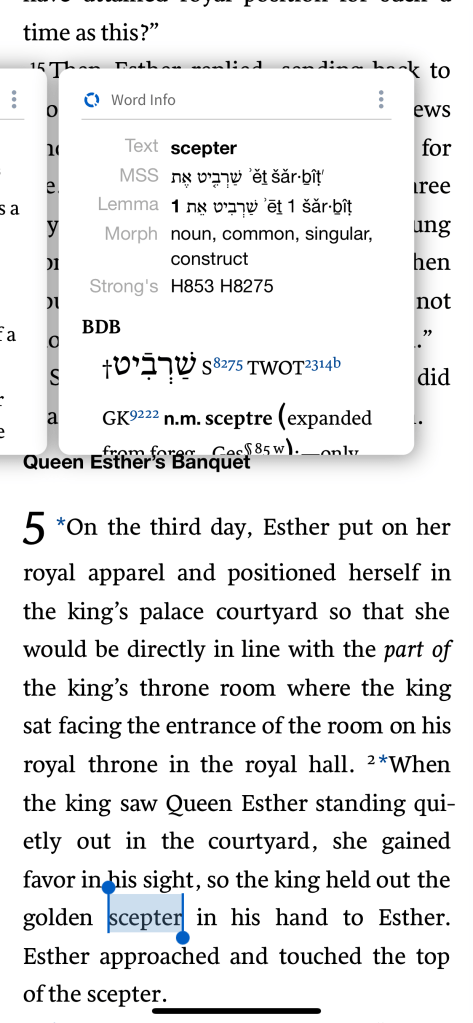
That little two-letter word et may easily be passed over. In my opinion, it is one of those things in Hebrew that point directly to Jesus.

The Hebrew letters that make up the word et are the aleph and the tav. The aleph is the first letter of the Hebrew alphabet, and the tav is the last.

Look at the screenshot included. You can see the Hebrew aleph and tav depicted in the callout box. (In the “Lemma” line next to the number 1.)

These two letters appear (sometimes untranslated) occasionally in the Hebrew Bible. An important one for me to discover was some years back. It is in the first line of the Bible. Genesis 1: In the beginning, God. Right next to the word Elohim are these two Hebrew letters. In the beginning, God: aleph-tav (think Alpha Omega.)

Conclusion.

People say that Esther doesn’t mention God. It certainly doesn’t mention Jesus. But a little digging into the underlying text reveals that He is indeed there. Don’t be afraid to use the vast tools available to you. There are many to allow such digging. If I can find it, you can.

I think I understand why this has been knocking around in my head for some weeks now. God had something important to show. I am also very cognizant of Michael Heiser and his adage. “If it’s weird. It’s important.” I always keep that in mind. Along with those little ideas that arise as God causes them to stick in your mind.

He is Just

This righteousness of God comes through faith in Jesus Christ to all and upon all who believe, for there is no distinction. For all have sinned and come short of the glory of God, being justified freely by His grace through the redemption that is in Christ Jesus, whom God has set forth to be a propitiation through faith, in His blood, for a demonstration of His righteousness, because in His forbearance God had passed over the sins previously committed, to prove His righteousness at this present time so that He might be just and be the justifier of him who has faith in Jesus.

Romans 3:22–26 — Modern English Version (Thinline Edition.; Lake Mary, FL: Passio, 2014)

I am certain all of us are familiar with this passage. In a bit of insomniac tossing and turning last night, I had a half-hearted discussion with God, and He brought this to my mind.

It was after a challenging evening where past lies were dredged up, and the one doing it reported those as my legacy. Of course, the other person was a bit short on facts. Nevertheless, those old scars can hurt.

The person who brought the stuff up is rather lonely, abusive, and very embittered. That one is certainly not a believer, but an avowed atheist. The bitterness has cost lots of people time, aggravation, and real money. Some have had to endure abusive (really demonic) behavior.

I would ask God why someone like that gets to breathe His air for so long.

He gently reminded me of how longsuffering He is with me. He also gently asked why He ought not to be as longsuffering with that person. And as He always does, there was that verse gently impressed into my mind… He might be Just and Justifier.

You see, when we stand before God to give account, us believers have already been judged for our sins; that list of ordinances against us are nailed to the cross.

But there are those unbelievers and God-haters who will stand before Him at the Great White Throne. Those will be gently reminded of all they’ve done to rail against God. Why will be painstakingly obvious to all who watch will be the longsuffering of God.

It’s a simple fact that His mercies are new, and He suffers long that makes Him just.

How often do we seek immediate justice for wrongs done to us?

Seriously, really give that some long consideration. Swift justice is indeed just. Yet something else comes to mind.

He has told you, O man, what is good—and what does the Lord require of you, but to do justice and to love kindness, and to walk humbly with your God?

Micah 6:8 — Modern English Version (Thinline Edition.; Lake Mary, FL: Passio, 2014)

There is so much talk around about justice. It is hard to find where the Bible instructs is to seek justice. I don’t think it does, because God does. We are told to do justice, in other words, to act justly. It is our behavior we ought to control. And by the example given to us by Paul about God.

He says in another place that mercy triumphs over judgment. It is this mercy for all of us, that is supposed to gently lead us to repentance.

Think about that the next time someone disrespects you for something; I don’t care why it is or if it is for the ten-thousandth time. Your God suffers long for you, why would He not suffer just as long for your adversaries?

Why Stay in Exile?

We will surely die and are like water spilled on the ground, which cannot be gathered up again. Yet God does not take away a life; He devises plans so that His banished ones will not be cast out from Him.

2 Samuel 14:14 — Modern English Version (Thinline Edition.; Lake Mary, FL: Passio, 2014)

This is from a woman speaking to King David. The context is an account of David bringing back his son Absalom for blood-guilt over the killing of his brother. This is a sin that demanded an avenger of blood; that is, the death of Absalom.

This account is a typification of the penalty of sin… All sin… Even the little lies we use. Sin brings death.

The woman speaks the truth to David succinctly. The corruption that Adam brought to humanity is death. We all die. Death cannot be undone; its water spilled on the ground and cannot be gathered up again.

Yet, she is also speaking of the mercy of God. In that, though the justice needed for sin is death, justice delayed is not just. God is indeed merciful. Remember, in the garden, He said in the day you do it, you shall die. Yet this woman knows the mercy available to all; God does not take a life.

She goes on to say He devises plans. This is a veiled inference to Jesus and the mercy He worked at the cross. The Bible says Jesus tasted death for every man. His banished ones… Those with a blood-guilt upon them, waiting for the avenger of blood, are free to go. That’s you and me with our sin… We are not yet cast out from Him.

If we were cast out, we would have no hope at all.

Yet we’re not. We’re still alive. We can still be reconciled. While we draw breath, we can still approach God to seek remission of sins.

In the account, David doesn’t permit Absalom in his presence. Eventually, Absalom does insist and enters the presence to be reconciled.

The latter is more a representation of the exile we place on ourselves. When we sin, our sin keeps us separated from God. As it was for Absalom, it is like we are in exile.

Don’t ever be tricked into thinking your own sin is so bad or shameful that you cannot go to God about it. Jesus died for each of us to make that way clear.

You can fix it now.