Housekeeping Caveats and Notes

Every attempt is made to provide citations to proper sources. Some ideas I will leave for your own edification in research.

I use the Modern English Version of the Bible. Scripture quotes with no cited source will be from the Logos edition of the Modern English Version (Thinline Edition.; Lake Mary, FL: Passio, 2014.)

Paneas and Peter’s Rebuke of Jesus

Then Peter took Him and began rebuking Him, saying, “Far be it from You, Lord! This shall not happen to You.”

Matthew 16:22

Peter attempts to teach the Teacher. He criticizes Jesus assuming he knows better. Peter is primed with (to him) contemporary thinking that the Messiah came to vanquish enemies. Jesus couldn’t do that if He died, right?

The Conquering Messiah

In the political climate of the time, there was a short list of agreement among Jewish sects. This included important differences on the expectation of the Messiah. The Essenes were expecting a military hero that would reform temple worship. The Sadducees had no messianic expectations, denied resurrection, and therefore had limited expectations of a future Davidic Kingdom. The Idumaeans (Herodians) would also not be interested in a competing leader. The Pharisees however, expected a Messiah.

One particular agreement amongst the sects was a longing for freedom from Roman rule. This idea had roots in the earlier Maccabean revolt and eventually culminated in AD70. There are important Jewish writings that many are unfamiliar with, and this would include an apocryphal work called the Psalms of Solomon. This book has ties to the Maccabean revolt and is considered non-canonical, yet it was part of the Septuagint. Some of these psalms demonstrate an awareness of the Roman conquest of Jerusalem. Others are clearly Messianic. One in particular Psalms of Solomon 17 is similar to Psalm 72 (also attributed to Solomon.)

It was this Psalms of Solomon 17 that seems to have formed much of the political expectations that the Pharisees had of the Messiah. This idea would also be known among the citizenry of Israel. This particular Psalm is messianic. I will cite a part of it from the Septuagint that demonstrates the expectation.

See, O Lord, and raise up their king for them, a son of David, for the proper time that you see, God, to rule over Israel your servant. And undergird him with strength to shatter unrighteous rulers. Cleanse Jerusalem from the nations that trample it in destruction, to expel sinners from the inheritance in wisdom, in righteousness, to rub out the arrogance of the sinner like a potter’s vessel, to crush all their support with an iron rod; to destroy lawless nations by the word of his mouth, for Gentiles to flee from his face at his threat, and to reprove sinners by the word of their heart.

Psalms of Solomon 17:23–27 — The Lexham English Septuagint (Bellingham, WA: Lexham Press, 2012)

The Servant

It is a line in that Psalm above that takes us to the next point, the identity of the servant. Second Temple era Judaism interpreted much of the texts speaking of the suffering servant as an identification of the nation Israel. Just as it is above.

But what does the Bible show us?

Here is My servant, whom I uphold, My chosen one, in whom My soul delights. I have put My Spirit upon him;
he shall bring forth justice to the nations.

Isaiah 42:1

You are My witnesses, says the Lord, and My servant whom I have chosen that you may know and believe Me, and understand that I am He. Before Me there was no God formed, nor shall there be after Me.

Isaiah 43:10

He said to me, “You are My servant, Israel, in whom I will be glorified.”

Isaiah 49:3

See, My servant shall deal prudently; he shall be exalted and extolled, and be very high.

Isaiah 52:13

Hear this, O Joshua the high priest, you and your friends sitting before you, for these men are a sign. I am bringing My servant, the Branch. The stone that I have set before Joshua, on that single stone is seven eyes. And I will engrave an inscription, says the Lord of Hosts, and I will remove the iniquity of this land in one day.

Zechariah 3:8–9

I offer a few of the texts to demonstrate that this servant idea applies to both Israel as a nation and to the Messiah. It might be clear to us modern thinkers, but not so much for any Israeli at that time.

Being that an Israeli would consider the servant to be the nation of Israel, writings such as Psalm 22 would be taken as a cry from the nation as a servant. Isaiah 53 would also be understood as not messianic in nature.

Who has believed our report?
And to whom has the arm of the Lord been revealed?
For he grew up before Him as a tender plant and as a root out of a dry ground. He has no form or majesty that we should look upon him nor appearance that we should desire him. He was despised and rejected of men,
a man of sorrows and acquainted with grief.
And we hid, as it were, our faces from him;
he was despised, and we did not esteem him.
Surely he has borne our grief and carried our sorrows; Yet we esteemed him stricken, smitten of God, and afflicted. But he was wounded for our transgressions,
he was bruised for our iniquities;
the chastisement of our peace was upon him, and by his stripes we are healed.
All of us like sheep have gone astray; each of us has turned to his own way, but the Lord has laid on him the iniquity of us all. He was oppressed, and he was afflicted,
yet he opened not his mouth;
he was brought as a lamb to the slaughter,
and as a sheep before its shearers is silent,
so he opened not his mouth.
By oppression and judgment he was taken away, and who shall declare his generation? For he was cut off out of the land of the living; for the transgression of my people he was struck. His grave was assigned with the wicked, yet with the rich in his death,
because he had done no violence,
nor was any deceit in his mouth.
Yet it pleased the Lord to bruise him; He has put him to grief. If he made himself as an offering for sin, he shall see his offspring, he shall prolong his days, and the good pleasure of the Lord shall prosper in his hand. He shall see of the anguish of his soul and be satisfied.
By his knowledge My righteous servant shall justify the many, for he shall bear their iniquities.
Therefore, I will divide him a portion with the great, and he shall divide the spoil with the strong, because he poured out his soul to death, and he was numbered with the transgressors, thus he bore the sin of many
and made intercession for the transgressors.

Isaiah 53:1–12

This portion of Isaiah is not known by many Jewish folk today. It is called the forbidden chapter. It is excluded from haftara portions that are read openly in synagogues.

In hindsight, this particular chapter outlines the mission of the Messiah as told beforehand in excruciating detail. He would necessarily suffer and die for sins.

Perhaps it was overlooked that if Messiah made Himself an offering for sins, it also says “(H)e shall see his offspring, he shall prolong his days, and the good pleasure of the Lord shall prosper in his hand.” Th were is no other way to describe that but as resurrection. No other explanation can be made as to how someone can prolong Their days after One dies.

With all that in mind, it seems apropos that Jesus would begin to speak about resurrection.

The Rock

Zechariah told us the servant is the Rock. The Bible talks about Jesus being the precious cornerstone that to some, specifically Israelis, would be a rock of offense. One to stumble over, just as Peter did.

Why not? Because they did not seek it by faith, but by the works of the law. For they stumbled over the stumbling stone. As it is written:
“Look! I lay in Zion a stumbling stone
and rock of offense, and whoever believes in Him will not be ashamed.”

Romans 9:32–33

Peter is expecting the Conquering King. He is expecting a Righteous Ruler. A suffering Servant was not expected. The talk of resurrection would also be unexpected and go right over his head.

As Jesus had stated before this rebuke of Peter, He would suffer many things from the elders, chief priests, and scribes. All of which would lead to His death. Yet He boldly said He would prolong His days and be raised on the third day.

Peter’s response to it is disbelief. To his credit, I might be able to understand that thinking. It raises a question in my mind.

Why would a Conquering King need to die before taking His rightful place on the throne?

There are other messianic texts that fill in details. The prophecies were clear.

“Know therefore and understand that from the going forth of the command to restore and to rebuild Jerusalem until the Prince Messiah shall be seven weeks, and sixty-two weeks. It shall be built again, with plaza and moat, even in times of trouble. After the sixty-two weeks Messiah shall be cut off and shall have nothing. And the troops of the prince who shall come shall destroy the city and the sanctuary.

Daniel 9:25–26

Messiah will be cut off and have nothing. The euphemism cut off is a reference to sudden death. Peter has no excuse not to know this as the penalty for sin that is ascribed in the law. Yet plainly, the mission of the Messiah is clearly outlined in the Tanakh. Peter is taking an emotionally humanistic view, not quite understanding the precise timing.

Seventy weeks have been determined for your people and upon your holy city, to finish the transgression, and to make an end of sins, and to make atonement for iniquity, and to bring in everlasting righteousness, and to seal up the vision and prophecy, and to anoint the Most Holy Place.

Daniel 9:24

That text comes before the prophecy of the Messiah being cut off. It lays out the planned timing. 70 weeks are given (that’s a figure of speech meaning 490 years.) Messiah is cut off after 69 weeks.

It follows that if Messiah is to put an end to all of that, one week is left after being cut off. He would need to prolong His days to accomplish the task. He would have to be alive after dying.

To this day, controversy is afoot concerning these passages in Daniel. Some say the prophecies are done. Others say seven more years remain for Israel. One must also consider why a nation was destroyed and its people scattered, survived as a people for millennia. They are now being gathered into a nation called Israel born in a day. A student of prophecy knows that the nation as a whole has not been regathered in history. We are witnesses to God keeping His Word.

End Thoughts

Daniel 9:24 speaks to a finish of transgression, end of sins, atonement and to bring in everlasting righteousness. Our experience demonstrates these things are yet (very near) future. As the scattered Israelis are continually being called home.

To the first century Jewish mind, it would be murky at best. Especially when the nation is under brutal Roman occupation. Read that as being lorded over by Gentile mutts. Peter wanted a King. He did not want what seemed a suicide mission.

ImOur attention must be brought into focus. Jesus spoke of His death and His resurrection. Both are an integral part of His mission. And each accomplish different tasks. One a Satisfaction off the justice due for sins. The other as complete removal of sins.

This two-fold mission of the Rock is also the very thing that presents itself as a stumbling block. It is that sense, this same Rock is the Cornerstone Jesus is going to build His church on. Some are going to stumble over that. The mensch Peter didn’t get the death part because he didn’t expect the victory in resurrection.


Paneas and Resurrection

From that time on, Jesus began to show His disciples that He must go to Jerusalem and suffer many things from the elders and chief priests and scribes, and be killed, and be raised on the third day.

Matthew 16:21

This is the beginning of a marked change in Jesus’ ministry. His ministerial focus moves from primarily around the area of Galilee toward Jerusalem. He must go to Jerusalem. This is where the elders, scribes, and priests are. It is also home to Herod’s Temple containing the Holy Place where the presence of God is. The very place the chief priest ministered in the presence of God once a year.

For Israelis, Jerusalem is the entire center of the religious world. It is there that the maturest and most venerated leaders of the religious world were. The chief priests were those who presided over the 24 courses established by Daniel. These had charge of the temple. And finally, there are the scribes. At that time, these worked as if in the position of prophets.

There are many hints as to what Jesus is going to face in Jerusalem written of long ago. David sang of them in the Psalms. A few come to mind, Psalms 22, 27, and 35. That is far from a complete list, but as the Pesach (Passover) Lamb, He must be presented to the household of Israel, where He must be inspected as perfect.

The importance of this moment is reflected in the way Matthew thinks of this moment. He writes “(f)rom that time on.” Signifying the paradigm shift in reality. Jesus was going to die. His resurrection, though, would remain mysterious in the minds of the disciples. For the disciples, the resurrection was unexpected until it happened. (This is one of my favorite ideas that shows the four Gospels to be authentic, you can read it here, It Was Unexpected.)

Passover

Many typologies in the Torah point to Jesus. An important one is Passover (Pesach.) In the Exodus, it was the perfect Passover lamb slain, and its blood splashed on the lintel and doorposts of the house. The significance of this sign spared the firstborn of the house from death.

Romans 3:23–26 (MEV): For all have sinned and come short of the glory of God, being justified freely by His grace through the redemption that is in Christ Jesus, whom God has set forth to be a propitiation through faith, in His blood, for a demonstration of His righteousness, because in His forbearance God had passed over the sins previously committed, to prove His righteousness at this present time so that He might be just and be the justifier of him who has faith in Jesus.

From my understanding, the blood of Jesus already abides on every person sparing the firstborn in that house from death. 2 Corinthians 5:1 teaches us that our body is a house. Because we are spared death when we sin, the blood of Jesus applies. The book of Revelation also tells us that the work of the Lamb slain from the foundation of the world is not confined to one moment in time.

Good or bad, believer or not… It is the blood of Jesus that stops the angel of death when you sin. That is one typology.

Blood Atonement

There is another typology presented in Leviticus 16. That is the command for Yom Kippur (the Day of Atonement.)

Aaron shall cast lots for the two goats: one lot for the Lord and the other lot for the scapegoat. Aaron shall bring the goat on which the lot of the Lord falls and offer him for a sin offering. But the goat on which the lot falls to be the scapegoat shall be presented alive before the Lord to make atonement with it, that it may be sent away as a scapegoat into the wilderness.

Leviticus 16:8–10

Already there is a distinction in the text. Two offerings, one dead and one alive. This points to the death of Jesus and His Resurrection.

Then he shall kill the goat of the sin offering, which is for the people, and bring its blood within the veil, and do with that blood as he did with the blood of the bull, and sprinkle it over and in front of the mercy seat. And he shall make atonement for the Holy Place, because of the uncleanness of the children of Israel and because of their transgressions in all their sins, and so he shall do for the tent of meeting that remains among them in the midst of their uncleanness.

Leviticus 16:15–16

The blood of the slain goat was sprinkled in the presence of God, for the people, for all of their sins. This is done even while they were yet sinners!

Remember when Jesus died, the veil separating the presence of God was torn in two. There is no more separation because the blood of Jesus is sprinkled in the presence of God for the people and all of their sins.

But only the high priest went into the second part once a year, not without blood, which he offered for himself and for the sins of the people, committed in ignorance. The Holy Spirit was signifying through this that the way into the Most Holy Place was not yet revealed, because the first part of the tabernacle was still standing.

Hebrews 9:7–8

But Christ, when He came as a High Priest of the good things to come, by a greater and more perfect tabernacle, not made with hands, that is to say, not of this creation, neither by the blood of goats and calves, but by His own blood, He entered the Most Holy Place once for all, having obtained eternal redemption. For if the blood of bulls and goats, and the ashes of a heifer, sprinkling the unclean, sanctifies so that the flesh is purified, how much more shall the blood of Christ, who through the eternal Spirit offered Himself without blemish to God, cleanse your conscience from dead works to serve the living God?

Hebrews 9:11–14

It is essential to understand these things as the Bible presents them. The presence of God is no longer reserved for a privileged few.

Therefore, brothers, we have confidence to enter the Most Holy Place by the blood of Jesus, by a new and living way that He has opened for us through the veil, that is to say, His flesh, and since we have a High Priest over the house of God, let us draw near with a true heart in full assurance of faith, having our hearts sprinkled to cleanse them from an evil conscience, and our bodies washed with pure water.

Hebrews 10:19–22

Understand that it is only by the blood of Jesus that you are sanctified. Sanctified means to be set aside. That is true for all, believer or not. Everyone has respite from the wages of sin. I repeat it, everyone.

That’s the first part of the atonement. And it is unconditional for all people. The second part is also for all people with a condition.

Removal of Sin

When he has made an end of atonement for the Holy Place, and the tent of meeting, and the altar, then he shall bring the live goat.

Leviticus 16:20–22

As we have gone back to the typologies, the high priest leaves the presence of God. This is important, as it proves the offering of blood is accepted as the priest walks out alive. That is the work of the cross, Jesus is declaring to everyone they are free.

Watch how the priest uses that freedom. He makes his way to the living offering. He presses onto the head confessing sins, in a sense transferring them to the goat. The goat is sent away, carrying the sins confessed on it into the wilderness never to return.

That is what the writer of Hebrews is saying… There is a new and living Way opened through the veil of separation. It was done by the blood that any may approach the live offering to confess our sins and have them removed forever. Jesus is the live offering, and He has taken a seat at the right hand of the Father.

We just confess our sins to have them removed. For that, we need a living offering. Jesus rose again.

Conclusion

For by one offering He has forever perfected those who are sanctified.

Hebrews 10:14

You and I cannot add to what Jesus did. It abides on us, and we acknowledge and celebrate that. Furthermore, it is a call to action. If we are forever perfected, and we are… What is there to really fear?

If we mess up and sin, we have an Advocate. A Living Offering Who takes away sin forever.

Paneas and the Church

He said to them, “But who do you say that I am?”
Simon Peter replied, “You are the Christ, the Son of the living God.”
Jesus answered him, “Blessed are you, Simon son of Jonah, for flesh and blood has not revealed this to you, but My Father who is in heaven. And I tell you that you are Peter, and on this rock I will build My church, and the gates of Hades shall not prevail against it.

Matthew 16:15–18

Peter’s declaration is the truth. It is a truth that is revealed to people by the Father. It is the truth that changes the world. It is the truth that changes people.

Blessed are you Simon… I tell you that you are Peter. Putting these two phrases together helps to see the significance. It is here that Jesus gives a new name to Simon. By this very thing, Jesus is once again demonstrating that He is God. We have to refer back to Genesis for the first occurrence.

No longer will your name be called Abram, but your name will be Abraham, for I have made you the father of a multitude of nations.

Genesis 17:5

God changed Abram’s name to Abraham. It signifies a few things. In Abram’s situation, the Hebrew letter heh, was added. Because the Hebrew letters connote significant meaning, heh conveys the idea of spirit of breath. Abram had that inserted into his name. It becomes a sort of prophecy to God putting His Spirit in believers. In the same way, Sarai’s name was changed.

We also know that there are other places where people’s names have been changed. Daniel has his name changed, as well as his friends’ names when they were assimilated into Babylon.

When Jesus changes Peter’s name, we must think back to these things. That God changes names, Jesus is showing that He is God. The name change show Peter to be assimilated into a new culture. Peter is connected to the promises of God, and like Abraham, he serves God by making Him known to the world. Abraham was an integral part of the promise of God, as was Sarah. And now we see Peter, too in the same way. In that moment, Peter overcame.

He who has an ear, let him hear what the Spirit says to the churches. To him who overcomes I will give the hidden manna to eat. And I will give him a white stone, and on the stone a new name written, which no one knows except he who receives it.

Revelation 2:17

The believer is granted a new name. One that shows such has been assimilated into a new culture. One that says this one is an integral part of the promises of God.

Of course, Revelation is speaking of a future time. In the present, the moment we believe, each of us is given a new name. We are called Christian. The new name also includes a new identity as a child of God, and joint-heir with Jesus Himself. We are part of a new culture.

You Are Petros

When Jesus gives that name to Peter, and then declares He will build His church, there is a play on words. In the underlying Greek, Peter (Petros) is a name that means stone or pebble.

When Jesus says “on this rock” (ho petra) He is NOT speaking about Peter. Though the words are almost the same, there are differences. One is masculine and the other feminine. In English, this distinction is insignificant at best. But in other languages, the genders of the nouns and the verbs associated with them must match. Peter (stone; Petros; masculine) is not the same as rock (petra; feminine.)

“On this rock” is a reference to bedrock or massive rock formations like the mountain that towered by them. This isn’t a declaration that Peter is the first pope. Nor is it a declaration that Peter is the stand-in for Jesus on Earth.

No. It is on the bedrock truth, that Jesus is the living Son of God and that is the foundation of the church He will build. This Son of God is living as opposed to the disembodied spirits and others remanded to the netherworld.

The Gates of Hell

The Gates of Hell will not withstand the onslaught of the truth.

In all practical purposes, Jesus is saying the church is not defensive… Waiting for the enemy’s attack. We have the upper hand. Jesus has prevailed. We are the conquerors who take enemy territory. That means we reclaim real ground and help rescue people from fires of perdition.

But you, beloved, build yourselves up in your most holy faith. Pray in the Holy Spirit. Keep yourselves in the love of God while you are waiting for the mercy of our Lord Jesus Christ, which leads to eternal life.

Jude 20–23

Jesus is calling each of us into battle. The idea is to grow to maturity in the faith. The moment you became a believer is when you entered real spiritual warfare. Your testimony in Jesus reminds the fallen of their shame.

Fallen angels and demons have no blood, no life in a body, and no Kinsman Redeemer. Therefore, angels and demons have part in resurrection.

Binding and Loosing

I will give you the keys of the kingdom of heaven, and whatever you bind on earth shall be bound in heaven, and whatever you loose on earth shall be loosed in heaven.”

Matthew 16:19

The previous citation in Jude introduced us to the authority and responsibility we have. You’ve probably been taught that these things are only given to leaders. That would be a mistake to continue to think that. I am going to cite another portion of Jesus’ last words before His assumption.

When He had said this, He breathed on them and said to them, “Receive the Holy Spirit. If you forgive the sins of anyone, they are forgiven them. If you retain the sins of anyone, they are retained.”

John 20:22–23

When Jesus breathed the Spirit on the apostles, it came with great responsibility. A pattern develops, that a believer does exercise the power of binding and loosing. (My stomach just bunches at that thought, I have explored a very similar idea.)

We believers have the authority and ability to save souls!

That means how we treat others for what they do or don’t do to us is heavy with meaning. We can hold anger over a person and bind them. That unforgiving anger can fester. When it does, it means that was given rights. The end result binds the heart that holds resentment. It lives rent-free in the mind.

This idea is sobering. We easily become aware of the striking reality. Each believer can bind or loose. That means whatever we permit will have rights. What we loose, won’t gain foothold. (Tuck that into your mind.)

Then He commanded His disciples to tell no one that He was Jesus the Christ.

Matthew 16:20

It may seem odd to us for Jesus to want some secrecy. This is yet another subtle hint that He is indeed God. He is controlling the timing of what must happen. He was not keeping truth or salvation away from anyone, but that the time was not yet right.

Surprisingly, this is not done. Your bibles may have a topical division that seems to end this encounter with that statement. Jesus has more to say on this subject, and we will continue to examine it.

Tartarus is the Netherworld

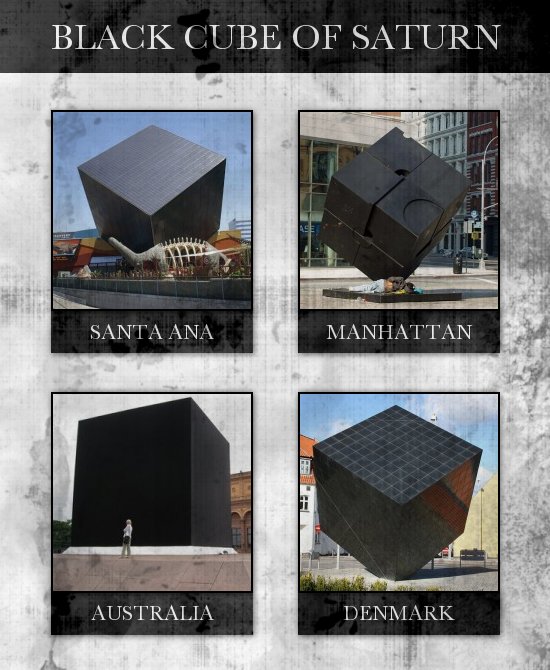
This is the black cube. It conveys an idea you probably have not considered. It represents one of the oldest secret religions. It is a symbol of the worship of Saturn. Saturn is just another name for the deity El. He is the bull-god of the ancients.

The black cube does represent Saturn himself. As such, the black cube represents the dark netherworld where Saturn is now incarcerated.

The Bible says entities like these are chained up in a pit. The ancients called that pit Tartarus. The Bible uses that word Tartarus one time… As the place for fallen angels.

For if God did not spare the angels that sinned, but cast them down to hell and delivered them into chains of darkness to be kept for judgment; and if He did not spare the ancient world, but saved Noah, a preacher of righteousness, with seven others, when He brought a flood upon the world of the ungodly; and if He condemned the cities of Sodom and Gomorrah to destruction by reducing them to ashes, making them an example to those afterward who would live ungodly lives;

2 Peter 2:4–6

In case you thought I was making it up, those gods of old are real and are currently sequestered away… It’s right there. This part of the Scriptures helps us to understand the importance of Paneas and what Jesus was saying.

Cube Imagery

The cube is represented in two dimensions by a hexagon with three lines connecting the opposite points. All of these are various two-dimensional representations of a three-dimensional cube.

Surprisingly, the hexagon also appears on the planet Saturn itself. Modern space exploration has given us images of this anomaly. (For those who do not believe in space flight… It wouldn’t be a coincidence, either.)

Symbology

As employed, the cube is an overt sign of wherever this god of old has influence. How can that god have influence if he’s locked up?

History teaches is that crime bosses continued their operations even while incarcerated.

The hexagon can be divided and unfolded out into a six-point star called a hexagram (which still has a hexagon in the center.)

In like manner, the cube can be unfolded to become a cross.

This is where it can be confusing, because things become blurry. Adherents can embrace a cross and the Star of David albeit it with esoteric meanings and usefulness.

Saturn and his cube are associated with evil and darkness. Those who worship in secret do so to obtain necessary illumination.

This post is a slight deviation but fits well in the current series. It provides necessary information that can help us to be wise in discerning the times. On the surface, things can appear orthodox. But a closer examination is always required.

Examine all things. Firmly hold onto what is good. Abstain from all appearances of evil.

1 Thessalonians 5:21–22

I will leave on last thought… Be of good cheer!

We know that whoever is born of God does not keep on sinning. But whoever has been born of God guards himself, and the wicked one cannot touch him. We know that we are of God, and the whole world lies in wickedness. And we know that the Son of God has come and has given us understanding, so that we may know Him who is true, and we are in Him who is true—His Son Jesus Christ. He is the true God and eternal life.

1 John 5:18–20