Lukewarm Christian?

I know your works, that you are neither cold nor hot. I wish you were cold or hot. So then, because you are lukewarm, and neither cold nor hot, I will spit you out of My mouth.

Revelation 3:15–16 — Modern English Version (Thinline Edition.; Lake Mary, FL: Passio, 2014)

Jesus is speaking to the church at Laodicea. His indictment of their works as a body is lukewarm. And if that is continued, the church would wither away.

This is not an indictment or a judgment on any Christian. It doesn’t mean that any of those Christians in the church lost their salvation. In fact, it has nothing to do with salvation. Nor does it have anything to do with individual behavior, even though the church as a body is made up of individuals.

It is a judgment on a church body.

A Christian doesn’t lose his salvation, neither do his works have anything to do with his salvation, whether helping it or not. In fact, good behavior isn’t fruit-bearing that Jesus looks for in a person. It can lead to it, and make it more bountiful, but bearing fruit is not the same as obeying the law.

Be Like the God You Worship

Those who make them are like them; so is everyone who trusts in them.

Psalm 115:8 — Modern English Version (Thinline Edition.; Lake Mary, FL: Passio, 2014)

In the previous discussion, we learned about those who make idols for adoration and worship. They eventually become like them. Their idols can’t see, hear or talk… They have no way to get around. It will be interesting to find how this idea will be repeated.

O Israel, trust in the Lord; He is their help and their shield. O house of Aaron, trust in the Lord; He is their help and their shield. You who fear the Lord, trust in the Lord; He is their help and their shield.

Psalm 115:9–11 — Modern English Version (Thinline Edition.; Lake Mary, FL: Passio, 2014)

The psalmist’s admonition to us is to trust the Lord. He is a real help and a shelter in times of trouble. This is also how we become like Him, we shelter those who trust us. We do not betray their trust.

That’s a hard one. It’s hard for me, but it used to be said in the U.S. a man’s word was his bond. It isn’t much like that today. People go back on their words. Let it not be so with us. Let those who trust us not be hurt by our frivolities.

The Lord has been mindful of us; He will bless us; He will bless the house of Israel; He will bless the house of Aaron. He will bless those who fear the Lord, both the small and great ones.

Psalm 115:12–13 — Modern English Version (Thinline Edition.; Lake Mary, FL: Passio, 2014)

God is mindful of believers. Sure these promises are to the Israelis and the house of Aaron, but we share in those promises because of our position in Jesus. We are grafted-in to them to bear fruit for God.

To be like our God means to be mindful of others. It also means to bless them. That is hard! We ought to be willing to bless others… Those that are meek and those not so much, alike.

The Lord shall increase you more and more, you and your children. You are blessed of the Lord, who made heaven and earth.

Psalm 115:14–15 — Modern English Version (Thinline Edition.; Lake Mary, FL: Passio, 2014)

The more you become like God, the more you want to serve Him, and by extension His people. His people could be the unbelieving Israelis we meet every day. His people are also other Christians, whether we fellowship locally with them or not.

His blessing is on these. And He calls them blessed. If you are a believer, He calls you blessed, too. Imagine that, the One Who made the heaven and the earth increases your reach and takes the time to call you blessed.

The choice is yours, you can try to increase your own reach and blessing by your own hard work, or you can present yourself to God and let Him work through you. Trust me, the latter is far better and healthier. It is also easier, though it may seem daunting now. Remember, trust in the Lord, He is a shield.

The heavens belong to the Lord, but the earth He has given to the children of men.

Psalm 115:16 — Modern English Version (Thinline Edition.; Lake Mary, FL: Passio, 2014)

God has given the earth to humans. The usurpers have stepped in by insurrection and hijacked it. Yet here is the psalmist singing the truth. In so doing, it’s a hint to the coming second Adam who put those entities to shame. He is the One worthy to take possession of it. We also know the New Testament calls the believer (you and I) joint-heirs. Let that thought sit in your mind for a moment.

Remember when Jesus said the meek shall inherit the earth?

That’s Jesus, and us joint-heirs with Him.

Praise God!

The dead do not praise the Lord, nor do any who go down into silence.

Psalm 115:17 — Modern English Version (Thinline Edition.; Lake Mary, FL: Passio, 2014)

This is the future for those who die in their sins. Those who do not have Jesus and His gift of eternal life—they perish into silence. It’s not annihilation or ceasing to exist. It is a conscious descent into silence where there is no escape. Is that similar to not having limbs that work, hearing, or speaking just like their idols?

My hope and prayer are that none of you reading this are like those.

But we will bless the Lord
from this time and for evermore.
Praise the Lord!

Psalm 115:18 — Modern English Version (Thinline Edition.; Lake Mary, FL: Passio, 2014)

We believers are not mute… Or deaf… Or not-seeing. We can stand and raise our arms and shout…

Praise God!

One Becomes Like the God One Worships

Not unto us, O Lord, not unto us, but unto Your name give glory, for the sake of Your mercy, and for the sake of Your truth.

Psalm 115:1 — Modern English Version (Thinline Edition.; Lake Mary, FL: Passio, 2014)

The opening of the psalm is a chorus of worship. The Lord is worthy of it just for His mercy and truth. These aren’t just attributes of God, but they are part of Who He is. You don’t think of God without thinking of Mercy or Truth among other immutable things.

Why should the nations say, “Where now is their God?” But our God is in the heavens; He does whatever He pleases.

Psalm 115:2–3 — Modern English Version (Thinline Edition.; Lake Mary, FL: Passio, 2014)

It’s those mocking and scorning questions. They are designed to make one question God. As Christian, people may ask each of us this or similar at times.

Our answer, like the psalmist’s, God is in the heavens. We never have to wonder. He doesn’t leave. He doesn’t go on vacation. I would offer that the heavens include creation itself. It is in some way an immutable part of Him, meaning it cannot exist without Him.

There is another important point that is presupposed by the question. It asks, where?

God is in a place. The place is called the heavens. If we remember the creation account there are multiple heavens, including the expanse encompassing our planet. God is here, too.

For thus says the High and Lofty One who inhabits eternity, whose name is Holy: I dwell in the high and holy place and also with him who is of a contrite and humble spirit, to revive the spirit of the humble,
and to revive the heart of the contrite ones.

Isaiah 57:15 — Modern English Version (Thinline Edition.; Lake Mary, FL: Passio, 2014)

We have a clear answer to the question of where. God inhabits eternity. There’s not a place to go where (and when) He isn’t. Yet, He also says He dwells with the contrite and humble spirit.

We also have a hint to the things that He pleases to do. it’s to revive the spirit of the humble and the heart of the contrite ones He dwells with. That is who believes in Him. (To understand more, continue reading around that citation in Isaiah 15, it gives a glimpse into the character of God.)

Their idols are silver and gold, the work of men’s hands.
They have mouths, but they cannot speak;
eyes, but they cannot see; they have ears, but they cannot hear; noses, but they cannot smell; they have hands, but they cannot feel; feet, but they cannot walk; neither can they speak with their throat.

Psalm 115:4–7 — Modern English Version (Thinline Edition.; Lake Mary, FL: Passio, 2014)

The psalmist turns the mockery back to where it squarely belongs. Those that mock make for themselves their own gods. They give them the appearances of the attributes of a human (or even possibly an animal.) But those things cannot do what a living being can do.

Think of the juxtapositions in the text. One God inhabits eternity and dwells with others. Idols can only remain in one place at a time. The idols have no senses, or motor skills and cannot talk. But our God does.

Those who make them are like them; so is everyone who trusts in them.

Psalm 115:8 — Modern English Version (Thinline Edition.; Lake Mary, FL: Passio, 2014)

The indictment from the psalmist is clear. One becomes like the God He worships. This is an important biblical principle that is plainly evident in our world. It’s not just limited to religion. Look around and see how that can be identified. I think you might be surprised and maybe shocked.

There is an application for us. As we examine ourselves against what we know of our God, are we like Him?

In this passage, God dwells with the contrite and humble to revive them. The psalmist also says our God has mercy and is truthful.

I’m not intending this to be condemning, a downer, or something that brings conviction. But if it does become a downer, I hope you see clearly the difference in the two other points. Each experience can lower our feelings, but discern what it is.

Condemnation always brings shame. It comes from the pit of hell.

Conviction is gentle and always comes with the prodding to do better. Being convicted by God means there is hope! We can change.

I encourage you to read the Bible, even the Old Testament. Ask God to show you Who He is, you will also learn about what He likes to do. Then set out to ask Him to change you from the inside to be more like Him. This is you to yield yourself to Him. Sometimes it is going to feel a bit awkward, or even like you don’t really mean it. There’s an answer for that, too.

A man brought his son to Jesus in desperation. This boy is terrorized by a foul entity. It endangers and even harms the boy. When brought to Jesus, the demon seizes the boy and makes him crash to the ground and foam at the mouth uncontrollably.

The father knows he can do nothing. He aches and fears for his boy. And brings his son to Jesus.

Jesus said, “If you can believe, all things are possible to him who believes.”
Immediately the father of the child cried out with tears, “Lord, I believe. Help my unbelief!”

Mark 9:23–24 — Modern English Version (Thinline Edition.; Lake Mary, FL: Passio, 2014)

This is a poignant exchange. Jesus encourages the father to believe. The father wants to believe but knows there is some hesitation, or as I see it, like lip service. When we believe something with a bit of skepticism.

Jesus is okay with that. He healed that boy. (Read the encounter for yourself, it will bless you.)

And in the same way, when you come to God skeptical of your own motivations, He understands. He can even change those motivations if you let Him.

I challenge you to get to know Him. Let Him change you. You will never regret it.

Psalm 69

Save me, O God!
For the waters have come up to my throat. I sink in deep mire; there is no standing place; I have come into the watery depths, and a stream overflows me. I am weary of my crying; my throat is parched; my eyes fail while I wait for my God. Those who hate me without cause are more than the hairs of my head; they are mighty who would destroy me, being my wrongful enemies, so that I must pay back what I did not steal.

Psalm 69:1–4 — Modern English Version (Thinline Edition.; Lake Mary, FL: Passio, 2014)

Immediately we understand that David is weary. He is in the midst of trials and is crying out to God for salvation. As is often the case, the Psalms contain prophetic statements of Jesus and His earthly ministry. This one psalm is no different.

David laments the waters come up to my throat. Waters signify chaos, uncontrollable situations. The deep mire prevents good footing. He is sinking into uncontrollable chaos. He is tired and his throat is dry. Death is coming quickly while he waits for God. His wrongful enemies would destroy him, but they are not his enemies as he has their interests at heart. He must atone for things he did not do.

Now, apply this to Jesus as He is on the cross, the sky is darkened and His Father has forsaken Him. This is exactly what this psalm is pointing at. Jesus even said it plainly.

But that the word which is written in their law might be fulfilled, ‘They hated Me without a cause.’

John 15:25 — Modern English Version (Thinline Edition.; Lake Mary, FL: Passio, 2014)

The pressure on breathing that crucifixion brings seems to be much like drowning (not that I’ve experienced either.) The waters come up to my throat. The psalmist also foresees a lack of a firm footing. How hard to get a good stance with feet nailed to a cross.

Jesus would also have wrongful enemies, as these doing the things to Jesus didn’t quite know He was doing it for them. He paid back what He didn’t owe.

O God, You know my folly, and my sins are not hidden from You.

Psalm 69:5 — Modern English Version (Thinline Edition.; Lake Mary, FL: Passio, 2014)

David knows God. He knows nothing is hidden from Him. It’s a simple truth. We try to run and hide from God. But there’s no escape from Him.

It is the enemies’ accusations that are false. Just as they were with Jesus. David, like Jesus, appears to God Who knows all.

May those who wait on You, O Lord God of Hosts, not be ashamed because of me; may those who seek You not be humiliated because of me, O God of Israel.

Psalm 69:6 — Modern English Version (Thinline Edition.; Lake Mary, FL: Passio, 2014)

Lord of Hosts is a military title for God. It could even be a specific reference to Jesus Himself. The heart of David doesn’t want God to be tarnished in any way by his actions. There is also another aspect given the words David used, that he didn’t want the judgment he suffered to be on them.I

In that way, it is just another foreshadowing of what Jesus will say, “Father forgive them.”

Because for Your sake I have endured insult; humiliation has covered my face. I have become estranged to my relatives, and a foreigner to my mother’s children; for the zeal of Your house has consumed me, and the insults of those who insulted You fell on me.

Psalm 69:7–9 — Modern English Version (Thinline Edition.; Lake Mary, FL: Passio, 2014)

Jesus was mocked with a crown of thorns. He was mocked by the Roman soldiers. They even plucked out His beard.

For even His brothers did not believe in Him.

John 7:5 — Modern English Version (Thinline Edition.; Lake Mary, FL: Passio, 2014)

The Passover of the Jews was at hand, and Jesus went up to Jerusalem. In the temple He found those who were selling oxen and sheep and doves, and the moneychangers sitting there. When He had made a whip of cords, He drove them all out of the temple, with the sheep and oxen. He poured out the changers’ money and overturned the tables. He said to those who sold doves, “Take these things away! Do not make My Father’s house a house of merchandise!” His disciples remembered that it was written, “Zeal for Your house will consume Me.”

John 2:13–17 — Modern English Version (Thinline Edition.; Lake Mary, FL: Passio, 2014)

This psalm seems to be written to lead us to Jesus. Jesus cited the law being fulfilled (Jn 15:25.) The Psalms are not technically The Books of the Law. But remember, the Law is a schoolmaster designed to bring one to Jesus. This psalm serves that purpose well.

When I wept with fasting for my soul, it became an insult to me. I also made sackcloth my garment, and I became a byword to them. Those who sit in the gate speak against me,
and I am the song of the drunkards.

Psalm 69:10–12 — Modern English Version (Thinline Edition.; Lake Mary, FL: Passio, 2014)

Think of the night before Calvary in the garden of Gethsemane. Even His best friends could not stay awake to pray with Him. People spat at Him. The political leaders railed at Him. Job speaks the same prophetic words and more (Job 30:9ff.)

But as for me, my prayer is to You, O Lord; in an acceptable time, O God, in the abundance of Your mercy, answer me in the truth of Your salvation. Deliver me out of the mire
that I may not sink; may I be delivered from those who hate me, and out of the watery depths. May the stream not overflow me; neither may the deep swallow me up, nor the pit close its mouth on me.

Psalm 69:13–15 — Modern English Version (Thinline Edition.; Lake Mary, FL: Passio, 2014)

David now sends his petition to God. In it, he echoes some of the laments that opened the song. He wants to be delivered from the mire and chaos. He wants to be delivered from those who hate him. He wants to be rescued from the depths.

It was Jesus Who offered Himself to God for safekeeping. He said to the Father that He placed His Spirit into His hands.

Answer me, O Lord, for Your lovingkindness is good; turn Your face to me according to the abundance of Your tender mercies. Do not hide Your face from Your servant, for I am in trouble; answer me quickly. Draw near to my soul, and redeem it; deliver me because of my enemies. You have known how I am insulted, and my shame and my dishonor; my adversaries are all before You. Insults have broken my heart, and I am sick; and I looked for some to take pity, but there was none; and for comforters, but I found none. They also gave me poison for my food, and in my thirst they gave me vinegar to drink.

Psalm 69:16–21 — Modern English Version (Thinline Edition.; Lake Mary, FL: Passio, 2014)

There are more types and shadows in David’s continued prayer. He asks for an answer. He pleads for a quick answer in his trouble.

Like Jesus, nobody but God came to David’s rescue. There were none at the cross to help.

May their table become a snare before them, and may security become a trap. May their eyes be darkened so they do not see, and make their sides shake continually. Pour out Your indignation on them, and may Your wrathful anger overtake them. May their habitation be desolate, and may no one dwell in their tents. For they persecute him whom You have struck down, and they recount the pain of those You have wounded. Add punishment to their iniquity, and do not let them come into Your righteousness. Let them be blotted out of the book of the living, and not be written along with the righteous.

Psalm 69:22–28 — Modern English Version (Thinline Edition.; Lake Mary, FL: Passio, 2014)

David starts the imprecatory part of his petition. He is asking for judgment to come.

And there are some important lessons, security in providing for ourselves can become a snare. We know from Romans 1 that sin suppresses the knowledge of God. It darkens our vision and He becomes more difficult to perceive. It’s not a good place to be on the judgment side of God.

It doesn’t have to be that way. But rest assured, those who perish without Jesus will have punishment added to the sins they die in. And their names will be removed from the book of life and not written in the Lamb’s Book of the righteous. (There is a Book of Life thy records all who live… Those dying in their sins have their names blotted out. There is the Lamb’s Book of Life where the names of the righteous are recorded.)

But I am poor and in pain; may Your salvation, O God, set me secure on high.

Psalm 69:29 — Modern English Version (Thinline Edition.; Lake Mary, FL: Passio, 2014)

David acknowledges his station in life, but his Hope is elsewhere and that is where he will choose to focus.

I will praise the name of God with a song, and will magnify Him with thanksgiving. This also will please the Lord more than an ox or bull with horns and hoofs. The humble will see this and be glad; and you who seek God, may your heart live. For the Lord hears the poor, and does not despise His prisoners. Let heaven and earth praise Him, the seas and everything that moves in them. For God will save Zion, and will build the cities of Judah; that they may dwell there, and take possession of it. The descendants of His servants will inherit it; and those who love His name will dwell in it.

Psalm 69:30–36 — Modern English Version (Thinline Edition.; Lake Mary, FL: Passio, 2014)

Finally, we get the application. It is that in whatever situation we are in, we can focus on our circumstances and mire in sorrow. We are free to do that.

But it is always better to focus on the Hope we have in Jesus. It is always better to identify with that now. The promises He made to Israel and David are ours by the relationship the body of Christ has with Israel. These were given by the blood of Jesus Christ and His resurrection. That is, to share in the rich promises of God made to them and fulfilled in Jesus.

You get to choose where your mind focuses.

We Have Escaped

Blessed be the Lord, who has not given us for a prey to their teeth. We have escaped as a bird out of the snare of the hunters; the snare is broken, and we have escaped. Our help is in the name of the Lord, who made heaven and earth.

Psalm 124:6–8 — Modern English Version (Thinline Edition.; Lake Mary, FL: Passio, 2014)

Could this be another hint of the Rapture?

Chuck Missler was fond of finding the somewhat veiled things in Scripture. I don’t recall exactly where he spoke of these things. But he said he suspected there would be seven. (I don’t think he found but four or five.)

This one is intriguing. First, it is included in a Song of Ascents by David. The Songs of Ascents are also known as the Songs of Pilgrims. Tradition has it these were sung on the three feast days (moedim, literally appointed times) that required assembly at Jerusalem. These three days are repeated every year. Pilgrims went up to Jerusalem singing these songs. They ascended the Temple Mount and finally ascended a staircase to meet with the Lord. The Songs of Ascents are a collection of 15 Psalms for going up.

Second, think of how a bird escapes a snare. They would fly up out of it. I wonder if the idea of a bird escaping a snare was intentional to paint that word picture. Other animals are hunted with snares.

Of course, the use of a bird escaping is intentional. God is intentional in His communication with us.

I was hoping to discover some kind of evidence in Hebrew. Perhaps there is something that requires more diligence. Perhaps that is for another post.

Regardless, it is something to take comfort in.

The Name: Scepter

On the third day, Esther put on her royal apparel and positioned herself in the king’s palace courtyard so that she would be directly in line with the part of the king’s throne room where the king sat facing the entrance of the room on his royal throne in the royal hall. When the king saw Queen Esther standing quietly out in the courtyard, she gained favor in his sight, so the king held out the golden scepter in his hand to Esther. Esther approached and touched the top of the scepter.

Esther 5:1–2 — Modern English Version (Thinline Edition.; Lake Mary, FL: Passio, 2014)

I love the types and shadows that are present in the Scriptures. I think there is one here that, like all, is profound.

For those not familiar with Esther, she is the queen of Persia and Media. The entire account is a fascinating read. In defeating the evil Haman by exposing his plot to destroy her cousin Mordecai. The king had Haman hung on his own gallows.

There was also a law written in the books created by this Haman, that on a certain day the citizens were permitted and expected to kill all the Jewish folk in the nation. The culture in that nation didn’t allow for the voiding of laws.

How was Esther going to save her people?

The laws didn’t permit anyone to approach the king, even his bride, without an invitation. The penalty was death.

To the types and shadows…

It’s that golden scepter… The extension of it toward Esther granting her favor to enter the presence of the king. It is the extension of favor wherein she may now let the king know her petition without fear in his very presence.

The underlying word in Hebrew makes connections that are astounding. Our English translations also make the connection.

But first I want to point out that scholars think this scepter was a small version of a shepherd’s crook. You are probably familiar with an Egyptian version. It is represented in ancient carvings. Even Disney has an accurate depiction at Epcot in Spaceship Earth.

This scepter as a representative shepherd’s crook is a good reminder to us all, that the leaders of a nation are appointed by God to be good stewards of the people, just as a shepherd cares for sheep. In that way, they are to be like Jesus. This brings this digression back to the point. In Numbers, there was a prophecy of Jesus given.

“I will see him, but not now; I will behold him, but not near; a star will come out of Jacob, and a scepter will rise out of Israel, and will crush the borderlands of Moab, and destroy all the children of Sheth. Edom will be a possession, and Seir, a possession of its enemies, while Israel does valiantly. One out of Jacob shall have dominion, and destroy the survivors of the city.”

Numbers 24:17–19 — Modern English Version (Thinline Edition.; Lake Mary, FL: Passio, 2014)

Here, Jesus is referred to as “a scepter.” The underlying Hebrew words are related. This one Numbers is the Hebrew shêbeṭ. Whereas in Esther, it is the derivative sharbı̂yṭ. It is only used four times in the Old Testament and all of them are in Esther. Our reference word for scepter is specific and exclusive, yet is derived from the same word in the Numbers prophecy.

Furthermore, the phrase “the golden scepter” is used three times in Esther. The Hebrew phrase is ’eṯ sharbı̂yṭ hǎ zāhāḇ. Each time it is used it is a demonstration of grace and acceptance extended by the king.

That is Jesus.

He is the Sceptre, the extension of grace and acceptance from God. Jesus told us…

For God so loved the world that He gave His only begotten Son, that whoever believes in Him should not perish, but have eternal life.

John 3:16 — Modern English Version (Thinline Edition.; Lake Mary, FL: Passio, 2014)

In Hebrews, it is explained this way.

Since then we have a great High Priest who has passed into the heavens, Jesus the Son of God, let us hold firmly to our confession. For we do not have a High Priest who cannot sympathize with our weaknesses, but One who was in every sense tempted like we are, yet without sin. Let us then come with confidence to the throne of grace, that we may obtain mercy and find grace to help in time of need.

Hebrews 4:14–16 — Modern English Version (Thinline Edition.; Lake Mary, FL: Passio, 2014)

Saved or unsaved… pagan or Christian… Jew or Gentile… There is only one Way to enter the presence of the King. And that’s via the Sceptre extended to us in favor… Jesus Christ.

Not convinced? There’s more.

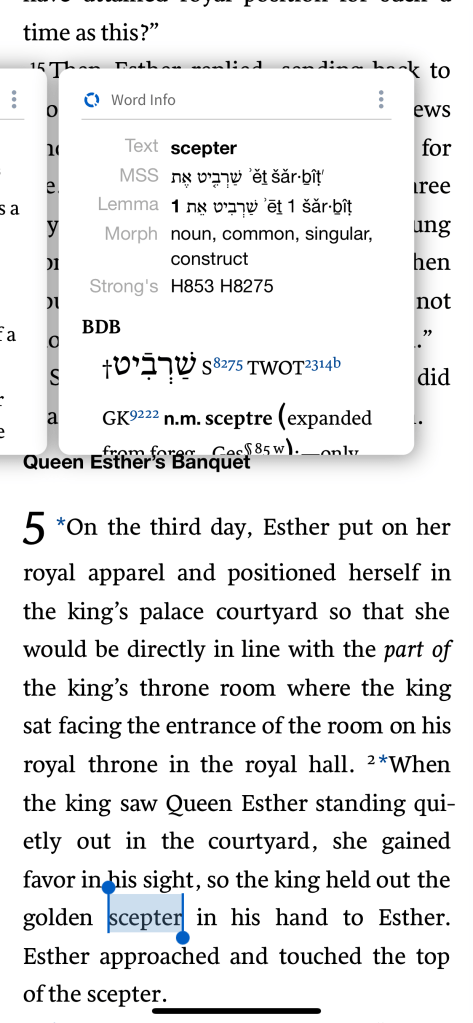
That little two-letter word et may easily be passed over. In my opinion, it is one of those things in Hebrew that point directly to Jesus.

The Hebrew letters that make up the word et are the aleph and the tav. The aleph is the first letter of the Hebrew alphabet, and the tav is the last.

Look at the screenshot included. You can see the Hebrew aleph and tav depicted in the callout box. (In the “Lemma” line next to the number 1.)

These two letters appear (sometimes untranslated) occasionally in the Hebrew Bible. An important one for me to discover was some years back. It is in the first line of the Bible. Genesis 1, in the beginning, God. Right next to the word elohim is these two Hebrew letters. In the beginning God aleph-tav (think Alpha Omega.)

Conclusion.

People say that Esther doesn’t mention God. It certainly doesn’t mention Jesus. But, a little digging into the underlying text reveals that He is indeed there. Don’t be afraid to use the vast tools available to you. There are many to allow such digging. If I can find it, you can.

I think I understand why this has been knocking around in my head for some weeks now. God had something important to show. I am also very cognizant of Michael Heiser and his adage. “If it’s weird. It’s important.” I always keep that in mind. Along with those little ideas that arise as God causes them to be stuck in your mind.