
A Child is Born, a Son is Given

Here’s something that has occupied the spare processing cycles in my brain when the screen saver is active. In other words, there is something that I have been considering deeply.

For unto us a child is born,
unto us a son is given, and the government shall be upon his shoulder. And his name shall be called Wonderful Counselor, Mighty God, Eternal Father, Prince of Peace.

Isaiah 9:6 — Modern English Version (Thinline Edition.; Lake Mary, FL: Passio, 2014)

This is one of those memory verses I learned from years of listening to Handel’s Messiah. In that first line is a distinction that is easy to overlook. A child is born and a son is given. It is a prophetic announcement of the birth of Jesus. A child would be born to us humans. Not just any child, but a Son would be given. That Son would be unique. This announcement clearly shows that Jesus is God, not that He came from God.

In a discussion on the Godhead I just perused, I again pondered this idea. This God-Man… This Son, or Word, that was given to us. The interesting part of the conversation prompted me to write my thoughts down and share them.

The discussion was over the Son or Word and whether saying He is begotten by God somehow darkens the idea of His existence from “eternity past.” It’s precisely what derives from the idea of being begotten means, and sort of considers the hypostatic union. That is the union of God and man that is Jesus.

I want to give a foundation from here. This is what God says of Himself in the final chapters of the Old Testament.

For I am the Lord, I do not change; therefore you, O sons of Jacob, are not consumed.

Malachi 3:6 — Modern English Version (Thinline Edition.; Lake Mary, FL: Passio, 2014)

Every good gift and every perfect gift is from above and comes down from the Father of lights, with whom is no change or shadow of turning. Of His own will He brought us forth with the word of truth, that we should be a kind of first fruits of His creatures.

James 1:17–18 — Modern English Version (Thinline Edition.; Lake Mary, FL: Passio, 2014)

From these two witnesses, it is clear that God doesn’t change. The writer of Hebrews adds to this.

Jesus Christ is the same yesterday, and today, and forever.

Hebrews 13:8 — Modern English Version (Thinline Edition.; Lake Mary, FL: Passio, 2014)

How does a God Who doesn’t change incarnate?

It sort of intrigues me that the God Who clearly says He is the same and doesn’t change somehow put on humanity.

It is precisely that idea that I think is too simplistic of an explanation. If He puts on humanity, He changes. Or maybe that doesn’t count as a change.

God has a Unique Relationship with Humans

I think it goes back to something foundational.

Then God said, “Let us make man in our image, after our likeness, and let them have dominion over the fish of the sea, and over the birds of the air, and over the livestock, and over all the earth, and over every creeping thing that creeps on the earth.”
So God created man in His own image; in the image of God He created him; male and female He created them.

Genesis 1:26–27 — Modern English Version (Thinline Edition.; Lake Mary, FL: Passio, 2014)

This idea of God making us in His image. What is that, really?

I know one of my favorite Bible nerds says we are imagers. Meaning we get to make God known to others in unique ways.

What if this image is something profound like it is something that is really a part of God?

No… I am not drifting off into pantheism or panentheism.

I’m not saying we are God. Yet there is something more here. When you read the Bible, you’re going to read some things that you might be tempted to glance over.

Beloved, now are we children of God, and it has not yet been revealed what we shall be. But we know that when He appears, we shall be like Him, for we shall see Him as He is.

1 John 3:2 — Modern English Version (Thinline Edition.; Lake Mary, FL: Passio, 2014)

There is something so spectacular reserved for humanity. It cannot be put into words.

For those whom He foreknew, He predestined to be conformed to the image of His Son, so that He might be the firstborn among many brothers. And those whom He predestined, He also called; and those whom He called, He also justified; and those whom He justified, He also glorified.

Romans 8:29–30 — Modern English Version (Thinline Edition.; Lake Mary, FL: Passio, 2014)

It’s this imager-thing. We are made in His image initially and will be conformed to His image. There are other texts that iterate these ideas like being a joint-heir with Jesus.

Jesus even spoke of this in some of His last words before the crucifixion.

I do not pray for these alone, but also for those who will believe in Me through their word, that they may all be one, as You, Father, are in Me, and I in You. May they also be one in Us, that the world may believe that You have sent Me. I have given them the glory which You gave Me, that they may be one even as We are one: I in them and You in Me, that they may be perfect in unity, and that the world may know that You have sent Me, and have loved them as You have loved Me.

John 17:20–23— Modern English Version (Thinline Edition.; Lake Mary, FL: Passio, 2014)

I don’t think we can even begin to ponder what is in store for each of us who loves Jesus.
And Many Animals

Sometimes I cannot read the Bible without other ideas swirling in my brain. Most of those ideas are just vapidity. Yet every once in a while, an idea coalesces with the Scriptures that is intriguing. It happened this morning.

In reading Jonah, this stood out.

Then he made a proclamation in Nineveh:
“By decree of the king and his nobles:
No man or animal, no herd or flock, shall taste anything. They shall not eat or drink water. Both man and animals shall cover themselves with sackcloth and cry mightily to God. All shall turn from their evil ways and from the violence that is in their hands. Who knows? God may relent and change His mind. He may turn from His fierce anger, so that we will not perish.”

Jonah 3:7–9 — Modern English Version (Thinline Edition.; Lake Mary, FL: Passio, 2014)

To give some context, Jonah was sent to Nineveh because of the wickedness practiced in the city. It is said that the wickedness itself came up before God.

Of course, Jonah didn’t heed God’s command to go and purposed to go to sea traveling in the opposite direction away from Nineveh. God sent a storm on the ship, Jonah persuaded the shipmates to throw him overboard. God appointed a fish to swallow Jonah. In that fish, Jonah came to his senses and was spit out on dry land.

The fish must have brought Jonah very near Nineveh as God commanded Jonah yet again to go and give them His message.

Upon this second command, Jonah complied and did as God said. He preached the coming destruction of Nineveh to the inhabitants of the vast city. The message was heard, even by the leaders of the city. That takes us to the passage above.

Aside from the repentance and crying to God for mercy, there is a tacit confession of sin in the decree. Not only that, all people and animals were to participate in this plea for mercy.

That is where ideas collide. Sometimes, I read scriptures with the objections of skeptics in mind. In this instance, clearly the animals are involved in the plea for mercy. That says to my way of thinking, that the animals are also complicit in the evil of the city, most likely not of their own volition.

The objections skeptics raise are sometimes centered around the genocidal portions of the Old Testament where God wiped out entire nations that included men, women, children and animals. Why “innocent” animals is what some ask.

Implicit in this king’s decree is that animals are used in ways perhaps to perpetrate calamity on others.

It was a passing thought on encountering that, and I pushed on thinking that was probably a fancy imagination.

There is a biblical principle, on the testimony of two or three witnesses, a thing is established. I tend to apply this to what the Scriptures say. But God wants to make sure we understand.

After God relents in bringing judgment to Nineveh because of their confession, Jonah disdains the compassion of God. God gives Jonah a practical lesson in compassion. He uses a plant to comfort Jonah in his angry grief.

God concludes that lesson in a succinct summary.

The Lord said, “You are troubled about the plant for which you did not labor and did not grow. It came up in a night and perished in a night. Should I not, therefore, be concerned about Nineveh, that great city, in which there are more than a hundred and twenty thousand people, who do not know their right hand from their left, and also many animals?”

Jonah 4:10–11 — Modern English Version (Thinline Edition.; Lake Mary, FL: Passio, 2014)

It was this last interaction recorded between God and Jonah. The very last phrase is a second witness to that what I thought was my fancy imagination.

Somehow animals are involved in perpetrating evil.

Some commentators think that herds would be destroyed as collateral damage. That is why they are mentioned. I don’t think that is why.

Suffice it to say, cattle… Especially bulls were venerated in the pagan cults. The motif is clear in the Bible, even when Aaron says “these be your gods” for the Israelites. Baal is depicted as a mating bull.

Much of these ancient cults (religious systems) used practices that would upset or modern sensibilities. These cult practices involved sex with animals as well as burning their own children.

It’s easy for a skeptic to reject the Bible on a sophomoric surface level not understanding the contexts in which it is written.

I get this is a bit controversial. But I think that the ideas included in Jonah’s text demonstrate clearly that God is just.

Where I Am Going, You Cannot Come

Again, Jesus said to them, “I am going away, and you will seek Me, and you will die in your sins. Where I am going, you cannot come.”

John 8:21 — Modern English Version (Thinline Edition.; Lake Mary, FL: Passio, 2014)

That simple truth is a stumbling block for many. Jesus said it to the very leaders of His chosen people, Israel. Their leaders were told that where Jesus is going they cannot come.

It wasn’t an outright prohibition to them, nor were these born condemned for that destiny. Quite the contrary, they were born Jewish, with all of the privileges that entail. (Paul outlines these in the first few verses of Romans 9.) Jesus was really saying… Where they could not go is heaven.

In this verse are some important things we can glean about salvation and election. Most importantly, they aren’t the same. Election doesn’t guarantee salvation.

Israelites are elect. They are God’s people. But clearly, being chosen isn’t enough to get one into heaven.

In the conversation preceding Jesus’ statement we’re considering, He is telling these Pharisees that they do not know the Father. Nor do they know Him. Consider that. The Father’s (and the Son’s) chosen didn’t know Him.

Furthermore, because they did not know Him they cannot know where He is going. He is going to heaven. They wouldn’t know where.

It’s not that Jesus condemned them to such a fate either. Jesus explained that succinctly to Nicodemus.

For God did not send His Son into the world to condemn the world, but that the world through Him might be saved. He who believes in Him is not condemned. But he who does not believe is condemned already, because he has not believed in the name of the only begotten Son of God.

John 3:17–18 — Modern English Version (Thinline Edition.; Lake Mary, FL: Passio, 2014)

The apparent condemnation Jesus proclaimed over these Pharisees wasn’t from Him. It was because they didn’t know Him. Not knowing Him means they would not know the Father. Jesus said so (John 8:19.)

Jesus told them He would go away. After He left, these Pharisees would seek Him but not find Him. They would die in their sins.

Many today are in that same condition… In danger of dying in their sins because they refused to believe Jesus. Many still seek Him. Some do it in vain, they never believe. Others believe and are saved.

Of which are you?

The ones who seek Jesus and never find Him, because one doesn’t believe they themselves have fallen short and are in need of rescue.

Or…

Of the redeemed, who know Jesus and the Father. They know where Jesus was going. Therefore they are going there, too.

Harmonizing the Tribulation of Those Days

“Immediately after the tribulation of those days, ‘the sun will be darkened, the moon will not give its light; the stars will fall from heaven, and the powers of the heavens will be shaken.’
“Then the sign of the Son of Man will appear in heaven, and then all the tribes of the earth will mourn, and they will see the Son of Man coming on the clouds of heaven with power and great glory. And He will send His angels with a great sound of a trumpet, and they shall gather His elect from the four winds, from one end of the heavens to the other.

Matthew 24:29–31 — Modern English Version (Thinline Edition.; Lake Mary, FL: Passio, 2014)

“But in those days, after that distress, ‘the sun will be darkened, and the moon will not give her light; the stars of heaven will fall, and the powers that are in heaven will be shaken.’
“Then they will see the Son of Man coming in clouds with great power and glory. Then He will send His angels and gather His elect from the four winds, from the farthest part of the earth to the farthest part of heaven.

Mark 13:24–27 — Modern English Version (Thinline Edition.; Lake Mary, FL: Passio, 2014)

“There will be signs in the sun and the moon and the stars; and on the earth distress of nations, with perplexity, the sea and the waves roaring; men fainting from fear and expectation of what is coming on the inhabited earth. For the powers of heaven will be shaken. Then they will see the Son of Man coming in a cloud with power and great glory. When these things begin to happen, look up and lift up your heads, for your redemption is drawing near.”

Luke 21:25–28 — Modern English Version (Thinline Edition.; Lake Mary, FL: Passio, 2014)

In the harmony of these presentations of the special briefing that Jesus gave His disciples at the end of the age, there are similarities that can be harmonized. All three are describing a time of great tumult, with signs in the sun, moon, and stars, and the heavens being shaken. We also see Jesus coming in the clouds.

To understand the coming in the clouds, we must delve into the old testament. We find over the many mentions of clouds associated with God it came in the form of divine intervention for His people. During the exodus, God led the Israelites in a pillar of cloud by day. When the cloud descended on the tent of meeting, it signified the presence of God. God coming in the clouds is a powerful and symbolic way to demonstrate divine intervention, divine judgment, or divine provision for the preservation of His people.

In this ‘sign’ we see ALL three. There is also another truth in the harmony that isn’t discussed. That is, Jesus is referring to Himself as God. If one understands the trial with the high priest, Jesus was asked if He was the Messiah, the Son of God. In His reply, He affirmed the questions the priest asked and claimed He is God. This is understood when we know the identity of Who comes in the clouds. Jesus said it would be Him by the title He chose for Himself. This title is also a direct reference to all of this.

I saw in the night visions, and there was one like a Son of Man coming with the clouds of heaven. He came to the Ancient of Days and was presented before Him. There was given to Him dominion, and glory, and a kingdom, that all peoples, nations, and languages should serve Him. His dominion is an everlasting dominion, which shall not pass away, and His kingdom that which shall not be destroyed.

Daniel 7:13–14 — Modern English Version (Thinline Edition.; Lake Mary, FL: Passio, 2014)

The differences are also important. Let’s poke at some of these.

The first is the introductory phrase to this time. In the Matthew and Mark account, the audiences’ attention is drawn toward the period after these distresses. More things would happen on Earth and in the heavens, and then the Son of Man would appear. The elect would be gathered, and a kingdom established (The latter part is inferred.) Both accounts seem to give a contemporaneous account of events.

Now note how Luke explains it, paying special attention to where he wants the audiences’ attention drawn. From the outset, Luke is asking his reader to understand the time before these events occur. This is clearly understood by this phrase “of what is coming on the inhabited earth.” Luke describes the same events that will happen, not contemporaneously.

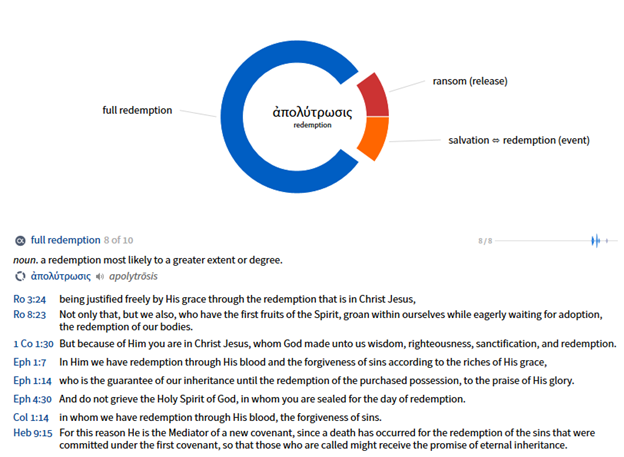
Then we encounter the last sentence. “When these things begin to happen, look up and lift up your heads, for your redemption is drawing near.” Luke is a gentile writing to gentiles. He is admonishing them to pay attention to when these things begin to happen. We also have the use of a unique word, ‘redemption.’

Matthew and Mark are drawing attention to the time of God’s intervention, judgment, and preservation of His people. Perhaps it could be redemption. Yet they did not use the word. I think it is because the attention of the reader is being drawn to two different events. Luke is drawing attention to redemption that occurs before the harmonized disasters that are described.

Considering redemption and the way the word is used in the New Testament, we can readily see the references of the majority of forms in the graphic. There are two other uses, one reference meaning ransom/release is cited in Hebrews 11:35 (Red.) The other is referencing an event and is the one word from Luke 21:28 we are discussing, ‘Redemption.’

A Child is Born

And in the same area there were shepherds living in the fields, keeping watch over their flock by night. And then an angel of the Lord appeared to them, and the glory of the Lord shone around them, and they were very afraid.

Luke 2:8–9 — Modern English Version (Thinline Edition.; Lake Mary, FL: Passio, 2014)

It was a night like any other for those shepherds. They were keeping watch over the clocks that would be used for the daily sacrifice in the temple in Jerusalem. From our perspective, shepherding is quaint and bucolic. Being a shepherd in that day was among the lowest of the rungs of that society. Meekly, they attended to their flocks with great care.

It was God (in Theophany) Who appeared to them suddenly. He came without notice of fanfare. His glory encompassed them in a flash. From darkness, it was suddenly brighter than daylight. It made them very afraid — as it would any of us.

But the angel said to them, “Listen! Do not fear. For I bring you good news of great joy, which will be to all people. For unto you is born this day in the City of David a Savior, who is Christ the Lord. And this will be a sign to you: You will find the Baby wrapped in strips of cloth, lying in a manger.”

Luke 2:10–12 — Modern English Version (Thinline Edition.; Lake Mary, FL: Passio, 2014)

Fear not! It wasn’t a command to them. They are intended as words of comfort. God was announcing favor to those most undesirable. A shepherd’s testimony in that society trusted or even sought out. The favor announced to them wouldn’t be for them alone but to all people. Who could believe them?

Yet… This is Christmas!

God announces His favor to even you. I don’t know anything about you. If you’re like me, you couldn’t think God would be favorable in your direction. Yet He is. Christmas demonstrates it. For God has caused it to be written:

For unto us a child is born, unto us a son is given, and the government shall be upon his shoulder. And his name shall be called Wonderful Counselor, Mighty God, Eternal Father, Prince of Peace.

Isaiah 9:6 — Modern English Version (Thinline Edition.; Lake Mary, FL: Passio, 2014)

Unto us, a child is born. That is for you and me, too. He is born just a wee human Babe from our perspective. God gave dearly… A Son. He didn’t give just any Son, but His unique Son. There’s not another like Him anywhere.

This Babe would eventually rule the world. He would be wise beyond His years. He is God, the One Who brings peace.

These are the good tidings to all people. God has set aside His anger toward people. Glory goes to God. Yet in the transaction, we get goodwill and peace from Him.

Suddenly there was with the angel a company of the heavenly host praising God and saying, “Glory to God in the highest, and on earth peace, and good will toward men.”

Luke 2:13–14 — Modern English Version (Thinline Edition.; Lake Mary, FL: Passio, 2014)

Take His Gift to you.