His Anger Kindles in a Flash

Now then, you kings, be wise;
be admonished, you judges of the earth.
Serve the Lord with fear;
tremble with trepidation!
Kiss the son, lest He become angry,
and you perish in the way,
for His wrath kindles in a flash.
Blessed are all who seek refuge in Him.

Psalm 2:10–12

I am often fascinated by the idea that the God of the Old Testament is somehow different than Jesus. They are the same God, Jesus testified to the fact that had one known the Father they would have known Him. Here, Psalm 2 provides an interesting glimpse into an intimate conversation between two Persons as God.

I draw your attention to the closing stanza. Specifically to the idea that Jesus’ wrath kindles in a flash. How does that comport to the loving Jesus you know when His anger explodes instantly?

The more important point to weigh… Why would His anger kindle at all?

Could it be that when leaders don’t lead properly, that is pointing people to Jesus, there is trouble afoot?

Clearly, the stanza is addressed to kings and judges, generally the leaders of the people. These are instructed to worship Jesus before He becomes angry. These Psalm implies that there is a limit to the time available. Perhaps it points to when Jesus returns to vanquish His enemies. It is going to be a swift and rather brutal thing. Or it is just a general exhortation that God will not let you ignore Him forever. Nevertheless, it informs us that there is a time limit to His mercy.

Personally, I think there may be a bit more in view. Especially when considering that part of this is quoted in Hebrews.

For to which of the angels did He at any time say:
“You are My Son;
today I have become Your Father”?
Or again,
“I will be a Father to Him,
and He shall be a Son to Me”?

Hebrews 1:5

The Son is Jesus. The text is also speaking of the angels not being like Jesus. When looking back at Psalm 2, those kings and judges may very well include spiritual beings. The next verse in Hebrews 1 seems to point to an indicator of that.

And again, when He brings the firstborn into the world, He says:
“Let all the angels of God worship Him.”

Hebrews 1:6

The desire of God is that all angels worship Him. We know there are some that fell away. The Hebrews passage also cites another Psalm…

All who serve graven images are ashamed,
who boast in worthless idols;
worship Him, all you gods.

Psalm 97:7

In that last line, seeing the word gods, one can assume it is the Hebrew word elohim. Reading it for understanding, “worship Him, all you elohim.”

For some, this may be an introduction to something not considered. That is, the word elohim is not necessarily a name for God. It describes a class of being much like the English word god. When God is capitalized, we know it is the Most High. When not, it is any of the lesser gods. I want you to think elohim are spiritual beings.

There are plenty of resources available on this site and can be found by exploring the tags and categories. But for a deeper explanation, this article serves well enough.

It kind of makes sense that spiritual beings are included and encouraged to remain loyal to the Son. His anger would be kindled to those who do not, and consequently they cannot seek refuge in the Son having no kin relationship to Him.

But, the greater point is that we humans can take refuge in Him. As long as we are breathing, He is a place of safety and comfort no matter what you’ve done and where you are. If you’re running away, the way back to Jesus is easy. Just turn around!

And if you’ve never taken that step to worship Jesus, start now.

The offer will expire.

God Asks Questions

Genesis 16:7–8 (MEV): The angel of the Lord found her by a spring of water in the wilderness. It was the spring on the way to Shur. And he said, “Hagar, Sarai’s maid, where have you come from and where are you going?”
And she said, “I am fleeing from the presence of my mistress Sarai.”

I love the patterns established in Genesis. This particular exchange leads us back to God seeking Adam and Eve after they sinned.

Genesis 3:8–13 (MEV): Then they heard the sound of the Lord God walking in the garden in the cool of the day, and the man and his wife hid themselves from the presence of the Lord God among the trees of the garden. The Lord God called to the man and said to him, “Where are you?”
He said, “ I heard Your voice in the garden and was afraid because I was naked, so I hid myself.”
And He said, “Who told you that you were naked? Have you eaten from the tree of which I commanded you not to eat?”
The man said, “The woman whom You gave to be with me, she gave me fruit of the tree, and I ate.”
Then the Lord God said to the woman, “What have you done?”
And the woman said, “The serpent deceived me, and I ate.”

There is a simplicity here that is often overlooked. When God seeks a lost one, one that has sinned, He seeks them out. Let’s remember that all of this happens before the law was given and before Jesus came. God seeks the sinner in order to restore the broken relationship.

When He finds the one, He gently leads to the problem by asking a question. He’s not asking for information, there is another purpose to His questions.

In each of these examples, God asks a question and it is followed by a confession of sin.

Oh, I know some of you are going to scoff. You’re going to say that there is no contrition or sorrow in the responses… As if feelings have anything to do with a confession of truth.

Sometimes just a simple acknowledgement of our foibles in the presence of a Holy yet loving God is all that is needed. We don’t have to pound our chests, or cry rivers of tears. A simple confession saying this is the problem is the first step to conquering the problem together.

When you sin, don’t wait until you actually feel sorrow or remorse for what you did. Go to your Heavenly Father and confess it. He’s waiting.

Sarah Laughs to Herself

They said to him, “Where is Sarah your wife?”
And he said, “There, in the tent.”
One of them said, “I will certainly return to you about this time next year, and Sarah your wife will have a son.”
And Sarah heard it in the tent door, which was behind him.

Genesis 18:9–10 — Modern English Version (Thinline Edition.; Lake Mary, FL: Passio, 2014)

I assume some of you may be familiar with this account of God visiting Abraham. Three men (the they) come to Abraham where he had pitched his tent near the Oaks of Mamre. He makes them a meal and they eat. It is at this point that we get an indicator as to the identity of One of those.

The group asked after Sarah. But One of those made a promise to come a year later with the intent to fulfill the promise of God. God Himself made a promise to Abraham and Sarah they would have a child. And by the personal pronouns, we now know that One of these me is God.

As was the custom of the time, women remained unseen and Sarah was in the tent. She overheard the conversation.

Now Abraham and Sarah were old and very advanced in age, and Sarah was well past childbearing. Therefore Sarah laughed to herself, saying, “After I am so old and my lord is old also, shall I have pleasure?”

Genesis 18:11–12 — Modern English Version (Thinline Edition.; Lake Mary, FL: Passio, 2014)

Sarah has a moment of surprise, she laughs at what God said to Abraham. This is similar to Abraham’s reaction upon hearing the same promise from God that he and Sarah would have a son.

As Abraham was challenged to stretch his faith, the promise came as God changed Sarah’s name. God was showing Abraham her importance in that promise.

Now Sarah had the same surprise. She too now heard the promise from God Himself. Sequestered away from the men, she heard for herself that she is an important part of God’s plan. Yet there is an intriguing difference in the responses each gave. Can you discern what it is?

Then Abraham fell on his face and laughed and said in his heart, “Shall a child be born to a man that is a hundred years old? Shall Sarah, who is ninety years old, bear a child?”

Genesis 17:17 — Modern English Version (Thinline Edition.; Lake Mary, FL: Passio, 2014)

Abraham laughed out loud but spoke his surprise silently. Sarah laughed to herself, saying, “After I am so old and my lord is old also, shall I have pleasure?”

The different reactions teach us about God.

Then the Lord said to Abraham, “Why did Sarah laugh and say, ‘Shall I surely bear a child when I am old?’ Is anything too difficult for the Lord? At the appointed time I will return to you, at this time next year, and Sarah will have a son.”

Genesis 18:13–14 — Modern English Version (Thinline Edition.; Lake Mary, FL: Passio, 2014)

God heard her secret laughter. Could there have been a bit of disbelief?

Perhaps, but God asks Abraham why she laughed. God then says is anything too difficult for Him?

It was her turn to exercise her faith. Now, the account turns a bit.

Then Sarah denied it, saying, “I did not laugh,” because she was afraid.
But He said, “Yes, you did laugh.”

Genesis 18:15 — Modern English Version (Thinline Edition.; Lake Mary, FL: Passio, 2014)

Sarah denied the truth and spoke a lie right back to God. Who could do such a thing and live?

Sarah did. God corrected her.

It is an awkward turn, Sarah sins before God and lives to tell about it. God does correct her. But what is not recorded here is any confession of Sarah for the wrongdoing.

This is an important concept. Eve confessed her sin to God. Adam confessed his. Even Hagar confessed hers as she was met by God.

I think the grace of God is pictured here. The very grace that Jesus extends to all. I mean all humans by His death on the cross. It’s the fact that the penalty for sin has just satisfaction.

It’s like God silently says to Sarah, I know what you did. You are free to go.

It is in that exchange that points straight to Jesus. This is the same loving God we k ow from the New Testament. He has not ever changed. Jesus is not God 2.0.

The Name: Scepter

On the third day, Esther put on her royal apparel and positioned herself in the king’s palace courtyard so that she would be directly in line with the part of the king’s throne room where the king sat facing the entrance of the room on his royal throne in the royal hall. When the king saw Queen Esther standing quietly out in the courtyard, she gained favor in his sight, so the king held out the golden scepter in his hand to Esther. Esther approached and touched the top of the scepter.

Esther 5:1–2 — Modern English Version (Thinline Edition.; Lake Mary, FL: Passio, 2014)

I love the types and shadows that are present in the Scriptures. I think there is one here that, like all, is profound.

For those not familiar with Esther, she is the queen of Persia and Media. The entire account is a fascinating read. In defeating the evil Haman by exposing his plot to destroy her cousin Mordecai. The king had Haman hung on his own gallows.

There was also a law written in the books created by this Haman, that on a certain day the citizens were permitted and expected to kill all the Jewish folk in the nation. The culture in that nation didn’t allow for the voiding of laws.

How was Esther going to save her people?

The laws didn’t permit anyone to approach the king, even his bride, without an invitation. The penalty was death.

To the types and shadows…

It’s that golden scepter… The extension of it toward Esther granting her favor to enter the presence of the king. It is the extension of favor wherein she may now let the king know her petition without fear in his very presence.

The underlying word in Hebrew makes connections that are astounding. Our English translations also make the connection.

But first I want to point out that scholars think this scepter was a small version of a shepherd’s crook. You are probably familiar with an Egyptian version. It is represented in ancient carvings. Even Disney has an accurate depiction at Epcot in Spaceship Earth.

This scepter as a representative shepherd’s crook is a good reminder to us all, that the leaders of a nation are appointed by God to be good stewards of the people, just as a shepherd cares for sheep. In that way, they are to be like Jesus. This brings this digression back to the point. In Numbers, there was a prophecy of Jesus given.

“I will see him, but not now; I will behold him, but not near; a star will come out of Jacob, and a scepter will rise out of Israel, and will crush the borderlands of Moab, and destroy all the children of Sheth. Edom will be a possession, and Seir, a possession of its enemies, while Israel does valiantly. One out of Jacob shall have dominion, and destroy the survivors of the city.”

Numbers 24:17–19 — Modern English Version (Thinline Edition.; Lake Mary, FL: Passio, 2014)

Here, Jesus is referred to as “a scepter.” The underlying Hebrew words are related. This one Numbers is the Hebrew shêbeṭ. Whereas in Esther, it is the derivative sharbı̂yṭ. It is only used four times in the Old Testament and all of them are in Esther. Our reference word for scepter is specific and exclusive, yet is derived from the same word in the Numbers prophecy.

Furthermore, the phrase “the golden scepter” is used three times in Esther. The Hebrew phrase is ’eṯ sharbı̂yṭ hǎ zāhāḇ. Each time it is used it is a demonstration of grace and acceptance extended by the king.

That is Jesus.

He is the Sceptre, the extension of grace and acceptance from God. Jesus told us…

For God so loved the world that He gave His only begotten Son, that whoever believes in Him should not perish, but have eternal life.

John 3:16 — Modern English Version (Thinline Edition.; Lake Mary, FL: Passio, 2014)

In Hebrews, it is explained this way.

Since then we have a great High Priest who has passed into the heavens, Jesus the Son of God, let us hold firmly to our confession. For we do not have a High Priest who cannot sympathize with our weaknesses, but One who was in every sense tempted like we are, yet without sin. Let us then come with confidence to the throne of grace, that we may obtain mercy and find grace to help in time of need.

Hebrews 4:14–16 — Modern English Version (Thinline Edition.; Lake Mary, FL: Passio, 2014)

Saved or unsaved… pagan or Christian… Jew or Gentile… There is only one Way to enter the presence of the King. And that’s via the Sceptre extended to us in favor… Jesus Christ.

Not convinced? There’s more.

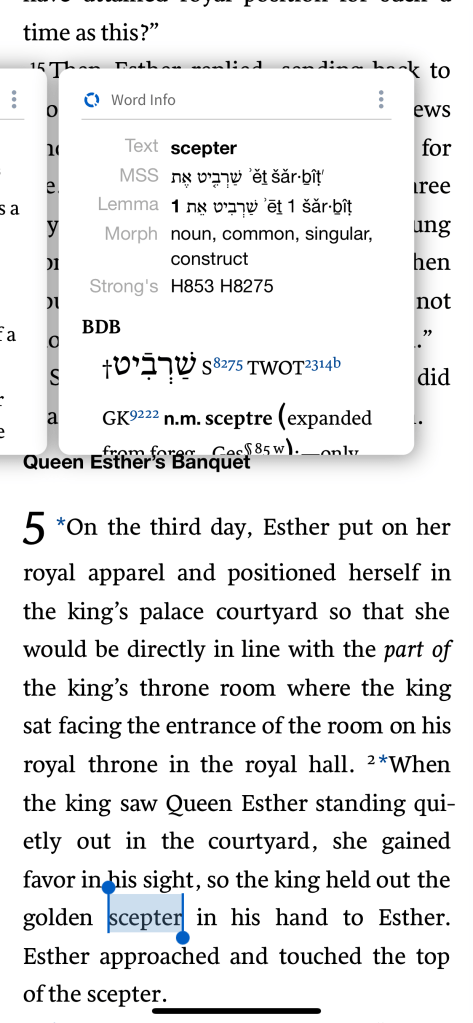
That little two-letter word et may easily be passed over. In my opinion, it is one of those things in Hebrew that point directly to Jesus.

The Hebrew letters that make up the word et are the aleph and the tav. The aleph is the first letter of the Hebrew alphabet, and the tav is the last.

Look at the screenshot included. You can see the Hebrew aleph and tav depicted in the callout box. (In the “Lemma” line next to the number 1.)

These two letters appear (sometimes untranslated) occasionally in the Hebrew Bible. An important one for me to discover was some years back. It is in the first line of the Bible. Genesis 1, in the beginning, God. Right next to the word elohim is these two Hebrew letters. In the beginning God aleph-tav (think Alpha Omega.)

Conclusion.

People say that Esther doesn’t mention God. It certainly doesn’t mention Jesus. But, a little digging into the underlying text reveals that He is indeed there. Don’t be afraid to use the vast tools available to you. There are many to allow such digging. If I can find it, you can.

I think I understand why this has been knocking around in my head for some weeks now. God had something important to show. I am also very cognizant of Michael Heiser and his adage. “If it’s weird. It’s important.” I always keep that in mind. Along with those little ideas that arise as God causes them to be stuck in your mind.

He is Just

This righteousness of God comes through faith in Jesus Christ to all and upon all who believe, for there is no distinction. For all have sinned and come short of the glory of God, being justified freely by His grace through the redemption that is in Christ Jesus, whom God has set forth to be a propitiation through faith, in His blood, for a demonstration of His righteousness, because in His forbearance God had passed over the sins previously committed, to prove His righteousness at this present time so that He might be just and be the justifier of him who has faith in Jesus.

Romans 3:22–26 — Modern English Version (Thinline Edition.; Lake Mary, FL: Passio, 2014)

I am certain all of us are familiar with this passage. In a bit of insomniac tossing and turning last night, I had a half-hearted discussion with God and He brought this to my mind.

It was after a challenging evening where past lies were dredged up and that the one doing it reported those as my legacy. Of course, the other person was a bit short on facts. Nevertheless, those old scars can hurt.

The person who brought the stuff up is rather lonely, abusive, and very embittered. That one is certainly not a believer, but an avowed atheist. The bitterness has cost lots of people time, aggravation, and real money. Some have had to endure abusive (really demonic) behavior.

I would ask God why someone like that gets to breathe His air for so long.

He gently reminded me of how longsuffering He is with me. He also gently asked why He ought not be as longsuffering with that person. And as He always does, there was that verse gently impressed into my mind… He might be Just and justifier.

You see, when we stand before God to give account, us believers have already been judged for our sins, those list of ordinances against us are nailed to the cross.

But there are those unbelievers and God-haters who will stand before Him at the Great White Throne. Those will be gently reminded of all they’ve done to rail against God. Why will be painstakingly obvious to all who watch, will be the longsuffering of God.

It’s a simple fact that His mercies are new, and He suffers long that makes Him just.

How often do we seek immediate justice for wrongs done to us?

Seriously, really give that some long consideration. Swift justice is indeed just. Yet something else comes to mind.

He has told you, O man, what is good—and what does the Lord require of you, but to do justice and to love kindness, and to walk humbly with your God?

Micah 6:8 — Modern English Version (Thinline Edition.; Lake Mary, FL: Passio, 2014)

There is so much talk around about justice. It is hard to find where the Bible instructs is to seek justice. I don’t think it does because God does. We are told to do justice, in other words, to act justly. It is our behavior we ought to control. And by the example given to us by Paul about God.

He says in another place that mercy triumphs over judgment. It is this mercy for all of us, that is supposed to gently lead us to repentance.

Think about that the next time someone disrespects you for something, I don’t care why it is or if it is for the ten-thousandth time. Your God suffers long for you, why would He not suffer just as long for your adversaries?

Why Stay in Exile?

We will surely die and are like water spilled on the ground, which cannot be gathered up again. Yet God does not take away a life; He devises plans so that His banished ones will not be cast out from Him.

2 Samuel 14:14 — Modern English Version (Thinline Edition.; Lake Mary, FL: Passio, 2014)

This is from a woman speaking to King David. The context is an account of David bringing back his son Absalom for blood-guilt over the killing of his brother. This is a sin that demanded an avenger of blood, that is the death of Absalom.

This account is a typification of the penalty of sin… All sin… Even the little lies we use. Sin brings death.

The woman succinctly speaks the truth to David. The corruption that Adam brought to humanity is death. We all die. Death cannot be undone; its water spilled on the ground and cannot be gathered up again.

Yet, she is also speaking of the mercy of God. In that, though the justice needed for sin is death, and justice delayed is not just. God is indeed merciful. Remember in the garden, He said in the day you do it you shall die. Yet this woman knows the mercy available to all, God does not take a life.

She goes on to say He devises plans. This is a veiled inference to Jesus and the mercy He worked at the cross. The Bible says Jesus tasted death for every man. His banished ones… Those with a blood-guilt upon them waiting for the avenger of blood are free to go. That’s you and I with our sin… We are not yet cast out from Him.

If we were cast out, we would have no hope at all.

Yet we’re not. We’re still alive. We can still be reconciled. While we draw breath, we can still approach God to seek remission of sins.

In the account, David doesn’t permit Absalom in his presence. Eventually, Absalom does insist and enter the presence to be reconciled.

The latter is more a representation of the exile we place on ourselves. When we sin, our sin keeps us separated from God. As it was for Abalsom, it is like we are in exile.

Don’t ever be tricked into thinking your own sin is so bad or shameful that you cannot go to God about it. Jesus died for each of us to make that way clear.

You can fix it now.

Especially to Those Who Believe

For to this end we both labor and suffer reproach, because we trust in the living God, who is the Savior of all men, especially of those who believe.

1 Timothy 4:10 — Modern English Version (Thinline Edition.; Lake Mary, FL: Passio, 2014)

Sometimes, Scripture is very precise in what is being said. Many times, that precision is glossed over. This is one of those things that is passed over, and more often than not argued over.

Paul is teaching his disciple Timothy. He is explaining the reason for suffering reproach. Trusting in the living God will do that. Yet in that Paul states, God is the Savior of all men.

Wasn’t it Jesus Who died?

Let’s find out. Paul is blatantly saying Jesus is God. I love that. It’s a precise statement that might be overlooked.

But what about Savior of all men… Did God save all men?

Let’s see what Paul reveals elsewhere.

For if while we were enemies, we were reconciled to God by the death of His Son, how much more, being reconciled, shall we be saved by His life.

Romans 5:10 — Modern English Version (Thinline Edition.; Lake Mary, FL: Passio, 2014)

This is another place where the precision of what is real is overlooked. For now, I want to focus on reconciliation. We were reconciled to God by the death of His Son. It’s a simple statement. It’s done. That is what Jesus did when He said “It is finished!” You and I, in fact, all humanity was reconciled to God.

That is, Jesus’ death conciliates mercy in the presence of God. It provides the forbearance of punishment to any in sin and such are not immediately cut off from living the moment sin is purposed in the heart. (Did you ever wonder why Daniel said Messiah would be cut off? It’s for this reason. It’s sudden.)

It is why the writer of Hebrews said Jesus tasted death for every man.

But we see Jesus, who was made a little lower than the angels to suffer death, crowned with glory and honor, so that He, by the grace of God, should experience death for everyone.

Hebrews 2:9 — Modern English Version (Thinline Edition.; Lake Mary, FL: Passio, 2014)

He humbled Himself, in this case, made as a man to suffer death for men. The death due for sin is sudden. It’s evident in Jesus. He died suddenly and for sin. In that way He Yates that death for every man.

He didn’t spend time in Hell serving infinite punishment or warring for your freedom. That was done already when He died. “It is finished!”

To Those Who Believe

Look back at our first text. Why would Paul differentiate Who God is from those who believe?

It’s like Paul is saying believers have something extra that not all men have.

Reread the second text. Now, note how Paul differentiates reconciliation from salvation. He says we are saved by His life.

What Paul is concisely explaining is the double nature of atonement taught in the law (Lev 16.) There is a dead offering, one that conciliates mercy. That seated mercy provides a respite from justice, but it doesn’t remove the curse of sin and the condemnation it brings. For that, confession is needed. It is typified in Leviticus 16 by the high priest leaning on the head (think authority) of the live offering. As he does, he confesses sin for the people. That offering is then led away alive and released into the wilderness carrying all the confessed sin away.

We need the resurrected Jesus. We need that authority to Whom we can confess our sin and have it removed… Forever! That is why Paul says especially to us believers.

The death of Christ is effectual for all men. Remission of sin and eternal life are the gifts given to the believer.

This is explained succinctly by one of my mentors.

“All men are commended mercy which preserves from being destroyed immediately and that so they can be and are, led to repentance and by repentance, the forgiveness of sins and by the remission of sins, salvation everlasting. Being led does not mean they will follow.” Jeff Thomas

In Conclusion

I do love how Paul seems to say these things that he would know intimately, being very familiar with the Law of Moses. Its prophetic implications are interwoven into much of what he writes.

My hope for you, as you’ve read this far… Is that you are one of those especially saved by His life. This requires a conscious decision on your part.

The Wages of Sin

For the wages of sin is death, but the gift of God is eternal life through Jesus Christ our Lord.

Romans 6:23 — Modern English Version (Thinline Edition.; Lake Mary, FL: Passio, 2014)

The wages of sin is death. It’s that simple.

Think about what Paul is saying. Understanding this critical point is a foundation for everything. To do that, consider the context…

I speak in human terms because of the weakness of your flesh, for just as you have yielded your members as slaves to impurity and iniquity leading to more iniquity, even so now yield your members as slaves to righteousness unto holiness. For when you were the slaves of sin, you were free from righteousness. What fruit did you have then from the things of which you are now ashamed? The result of those things is death. But now, having been freed from sin and having become slaves of God, you have fruit unto holiness, and the end is eternal life. For the wages of sin is death, but the gift of God is eternal life through Jesus Christ our Lord.

Romans 6:19–23 — Modern English Version (Thinline Edition.; Lake Mary, FL: Passio, 2014)

Paul is conveying spiritual truth in human terms. Particularly in that when we present ourselves to unrighteousness, it snowballs. That is, more sin leads to the suppression of the knowledge of God, which makes doing sinful things easier. This he spoke of in the opening of the letter.

The other truth is showing that the real fruit of sin is death. There is nothing that comes of it that is going to last. It’s a freedom from righteousness, meaning it is leading to lawlessness. The result of those things is death. He is urging us to present ourselves as slaves to righteousness, leading to sanctification. There is fruit in that.

Suffice it to say, humans have an appointment with death, The Bible says it is appointed unto men once to die. It also says after that comes judgment. Looking back on the text, we see that there is a dichotomy eternal life is set against death, that is the wages of sin death.

Paul has already conveyed to us that “just as sin entered into the world through one man, and death through sin, so also death spread to all people because all sinned.” (Ro 5:12) This doesn’t mean we are all born sinners as it is easy to say. It means that corruption entered the progeny of Adam and was passed down through his seed. That is death is passed down because all have sinned. Paul is saying we are all born dying which is a transgression of God’s desire for humans. We were made to live with Him forever. But because death entered by one man, and passed to all… All are already in transgression. We will all die of natural causes having lived long enough.

These are the wages of sin death. This is the death Jesus died.

For the love of Christ controls us, because we have concluded this: that one died for all; as a result all died. And he died for all, in order that those who live should no longer live for themselves, but for the one who died for them and was raised.

2 Corinthians 5:14–15 — Modern English Version (Thinline Edition.; Lake Mary, FL: Passio, 2014)

Christ died for us. Yes, that is true for us believers. Yet Paul is saying it is for all. The underlying Greek literally conveys “that if one for all died, then the whole died.” Look at the text, the ‘all’ is in noun form. Changing the noun form of ‘all’ to an adjective by claiming it to be ‘all individuals’ impose an idea on the text that isn’t there. Consequently, using a prepositional phrase as an adjective to limit the scope of ‘all’ as in saying ‘all of us’ is also imposing an idea on the text that isn’t there. This does apply to anyone reading this, and even those who do not. Jesus died that death due to sin, and we get to live.

Having been freed from the constraints of that death, live for Christ! How do we do that?

We must be reconciled to God.

So from now on we do not regard anyone according to the flesh. Yes, though we have known Christ according to the flesh, yet we do not regard Him as such from now on.

2 Corinthians 5:16 — Modern English Version (Thinline Edition.; Lake Mary, FL: Passio, 2014)

Understand the reality behind this idea. If all have died the death due for the wages of sin in Jesus Christ’s death, the flesh does eventually die. The old things have passed away.

Therefore, if any man is in Christ, he is a new creature. Old things have passed away. Look, all things have become new.

2 Corinthians 5:17 — Modern English Version (Thinline Edition.; Lake Mary, FL: Passio, 2014)

Let’s not look at any human in the old way. Those things have passed away, and the grace of God abides upon them. It is a time of mercy. A time in which Paul says each ought to live for Jesus.

All this is from God, who has reconciled us to Himself through Jesus Christ and has given to us the ministry of reconciliation, that is, that God was in Christ reconciling the world to Himself, not counting their sins against them, and has entrusted to us the message of reconciliation.

2 Corinthians 5:18–19 — Modern English Version (Thinline Edition.; Lake Mary, FL: Passio, 2014)

God has reconciled the world to Himself in Jesus. He is not counting their sins against them. The wages of sin is already satisfied.

So we are ambassadors for Christ, as though God were pleading through us. We implore you in Christ’s stead: Be reconciled to God. God made Him who knew no sin to be sin for us, that we might become the righteousness of God in Him.

2 Corinthians 5:20–21 — Modern English Version (Thinline Edition.; Lake Mary, FL: Passio, 2014)

Those that know this are now called ambassadors. As Christians, we get to implore others to be reconciled to God. The One Who took on sin to be sin for us, was for us to live for Him. That we could become the righteousness of God in Him.

His death gave a respite of time to all humans. The righteousness of God doesn’t come by His death, though. As people will still die in their sins.

He said to them, “You are from below; I am from above. You are of this world; I am not of this world. Therefore I said to you that you will die in your sins. For unless you believe that I am He, you will die in your sins.”

John 8:23–24 — Modern English Version (Thinline Edition.; Lake Mary, FL: Passio, 2014)

Jesus said those who do not believe I am He will die in their sins. They won’t die as a result of them but will die in them. What does He mean ‘I am He?’

He who comes from above is above all. He who is of the earth is earthly and speaks of the earth. He who comes from heaven is above all. He bears witness of what He has seen and heard, yet no one receives His testimony. He who has received His testimony has certified that God is true. For He whom God has sent speaks the words of God, for God gives the Spirit without measure to Him. The Father loves the Son, and has placed all things into His hand. He who believes in the Son has eternal life. He who does not believe the Son shall not see life, but the wrath of God remains on him.

John 3:31–36 — Modern English Version (Thinline Edition.; Lake Mary, FL: Passio, 2014)

I think the testimony is clear. There is only One Who is above all. Without believing ‘I am He’ one dies in their sin. To close the circle, Jesus says this:

Truly, truly I say to you, whoever hears My word and believes in Him who sent Me has eternal life and shall not come into condemnation, but has passed from death into life.

John 5:24 — Modern English Version (Thinline Edition.; Lake Mary, FL: Passio, 2014)

It’s a simple idea to be reconciled to the God Who has reconciled Himself to each of us. Yet it is most difficult, as we all must acknowledge the truth in our own hearts. This respite of the wages of sin death is a time of mercy. One where we can seek remission of sins. Yet, remission cannot happen unless we acknowledge the truth, believe the truth, and confess our sins to Him. Only then are they taken away forever.


Good People

I have a question I would like to pose to you. I want you to answer it honestly.

Do you think of yourself as a good person?

Let’s really examine what it means to be good. Remember, that Jesus told us that we really ought to judge… And do it correctly.

Do not judge according to appearance, but practice righteous judgment.

John 7:24 — Modern English Version (Thinline Edition.; Lake Mary, FL: Passio, 2014)

Jesus said this after He selflessly healed another on Shabbat. He mercifully rescued someone, showing the real purpose of the law and what others missed. We cannot be good by keeping it.

We know it is mercy that triumphs over judgment (James 2:13.) The principle is that the measure we offer to others will be given back to us in multiples. It is this sowing and reaping principle, as planting a seed the harvest is expected to be many more seeds.

“Judge not, and you shall not be judged. Condemn not, and you will not be condemned. Forgive, and you shall be forgiven. Give, and it will be given to you: Good measure, pressed down, shaken together, and running over will men give unto you. For with the measure you use, it will be measured unto you.”

Luke 6:37–38 — Modern English Version (Thinline Edition.; Lake Mary, FL: Passio, 2014)

The principle Jesus is using in the way we judge is to give. In so doing receive the good measure which is returned to us. In the market at those times, when one bought grain, a good measure was done like this: Grain would be ladled into a container until full. The container would then be pressed down, and more grain added. Then the vendor would tamp the container on a hard surface a few times. His would provide even more room. The vendor would finally ladle more grain into the container until it piled up and overflowed the sides.

That is a Good Measure.

Most of us, if not all, would have no problem meeting judgment to ourselves like this. Some of us will struggle to do that with some of our friends. I think the problem grows exponentially when we judge others by what they do that we do not like. It really is an unfair system.

And yeah, I am talking to myself, too.

What do We Do?

So let’s set out and esteem others better than ourselves like Paul instructs.

Let nothing be done out of strife or conceit, but in humility let each esteem the other better than himself. Let each of you look not only to your own interests, but also to the interests of others.

Philippians 2:3–4 — Modern English Version (Thinline Edition.; Lake Mary, FL: Passio, 2014)

The task can be daunting at first. But with practice (and the indwelling Holy Spirit,) it gets easier. You cannot do it without the Spirit in you. I promise.

But back to that question.

A certain ruler asked Him, “Good Teacher, what must I do to inherit eternal life?”
Jesus said to him, “Why do you call Me good? No one is good, except God alone. You know the commandments: Do not commit adultery, Do not murder, Do not steal, Do not bear false witness, Honor your father and your mother.”

Luke 18:18–20 — Modern English Version (Thinline Edition.; Lake Mary, FL: Passio, 2014)

Think about the answer now. Do you still think you are a good person?

I don’t want to beat you up (or myself for that matter.) I want to encourage all of us to really expect that good measure from ourselves, the same as we would expect it in return from others.

When it comes to judging ourselves against the law and being asked a question like I posed, we would immediately bring to mind all of our foibles. In light of the law, we would esteem ourselves as something less than good.

Brothers and sisters… If we are saved, we are good! We are good in Jesus’ name. It is His gift of righteousness — His, that He freely gives to us.

Let’s think of ourselves rightly. We are good people… Only in Jesus’ name.