
The Olivet Discourse: For Israelis Only?

Matthew, Mark, and Luke give much of the same testimony of the life and teaching of Jesus. The material offered is presented in the same general order of events. These three are called the synoptic gospels for that reason.

In an endeavor to understand the similarities recorded in the Olivet Discourse, it is more intriguing to notice the differences. When studying eschatological passages such as this, it isn’t difficult to encounter controversy. In an effort to avoid errant misunderstanding, context is important.

One of those controversies in interpretation is inevitably going to include the intended audience of the writers. In other words, there are some who say Matthew’s version of the Olivet Discourse was written only for the Israelis. Let’s see if such a sentiment can be demonstrated.

As He sat on the Mount of Olives opposite the temple, Peter, James, John, and Andrew asked Him privately, “Tell us, when will these things happen, and what will be the sign when all these things will be fulfilled?”

Mark 13:3–4 — Modern English Version (Thinline Edition.; Lake Mary, FL: Passio, 2014)

I give this verse for context. Matthew wasn’t present for this private briefing. Neither was Mark or Luke. Therefore, the things they wrote were as they understood from others. One thing is clear, though. They were Jewish people asking about the temple.

We also need to understand that everything Jesus taught… He taught to Israelis. His earthly ministry was to Israelis. The words He gave to them are for Israelis. He came only to them.

This is what He said to a gentile woman who came to Him to plead for her daughter.

But He answered, “I was sent only to the lost sheep of the house of Israel.”
Then she came and worshipped Him, saying, “Lord, help me.”
But He answered, “It is not fair to take the children’s bread and to throw it to dogs.”

Matthew 15:24–26 — Modern English Version (Thinline Edition.; Lake Mary, FL: Passio, 2014)

It’s only Matthew that records Jesus’ sentence, “I was sent only to the lost sheep of the house of Israel.” It follows, everything we read of Jesus and His earthly ministry must be understood first in that context. Especially as it is given to us in Matthew. It was Israel who was chosen to be God’s ambassador to the nations. When Jesus speaks and teaches, He is almost always speaking directly to Israelis.

Scholars also suggest that the synoptic gospels have intended audiences that differ. For Matthew, his audience was Jewish folks with Messianic expectations, proving Jesus is Messiah. Mark’s audience was the Gentile Romans and Greeks. Luke’s audience was new Gentile (Roman and Greek) Christians.

Can this idea be detected?

In the Olivet Discourse, when Jesus is speaking of how many will be martyred, it is recorded with some slight differences. The differences here seem to apply to the perspective of the intended audience.

And this gospel of the kingdom will be preached throughout the world as a testimony to all nations, and then the end will come.

Matthew 24:14 — Modern English Version (Thinline Edition.; Lake Mary, FL: Passio, 2014)

But take heed. For they will hand you over to councils, and in the synagogues you will be beaten. You will be brought before rulers and kings for My sake, as a testimony to them.

Mark 13:9 — Modern English Version (Thinline Edition.; Lake Mary, FL: Passio, 2014)

But before all these things, they will seize you and persecute you, delivering you up to the synagogues and prisons, and you will be brought before kings and governors for My name’s sake. It will turn out as a testimony for you.

Luke 21:12–13 — Modern English Version (Thinline Edition.; Lake Mary, FL: Passio, 2014)

Each account has Jesus speaking of the testimony of the witnessing would-be martyrs. Matthew says the testimony is “to all nations.” Mark, it’s to “them (kings and rulers.)” While Luke records it’s a testimony for the individual believer.

Yes, the similarities are important. But the differences ought not to be challenges to our understanding. They are there to enhance and bolster our understanding.
The Eagles Will be Gathered Together

It was something said by Pastor Greg tonight (would love to link to video, but is near impossible.) He held his Bible up and said there were things in it he didn’t understand. He said he understood much, and as he grew in wisdom, his understanding grew. Yet there were some things he didn’t get.

I was sitting on a bench in the back of church. My friends Dan on my right, Brian on my left. I showed them this verse.

Wherever the carcass is, there the eagles will be gathered together.

Matthew 24:28 — Modern English Version (Thinline Edition.; Lake Mary, FL: Passio, 2014)

I said I don’t understand that.

I read the immediate context before…

“So, if they say to you, ‘Look, He is in the desert,’ do not go there; or, ‘Look, He is in the private chambers,’ do not believe it. For as the lightning comes from the east and flashes to the west, so will be the coming of the Son of Man. Wherever the carcass is, there the eagles will be gathered together.

Matthew 24:26–28 — Modern English Version (Thinline Edition.; Lake Mary, FL: Passio, 2014)

Nothing immediately stood out for an explanation.

A bit of background… At the moment, I am endeavoring to search out the similarities and differences in the synoptic accounts of the Olivet Discourse. (For those less technical-minded, that would be Matthew 24, Mark 13, and Luke 21 where Jesus spoke to a small group of disciples about the end of the age.)

As it were, I peeked at the Faithlife Study Bible notes for that verse, and they were a bit lot short on the subject. The only note indicated that the word eagles is better understood as vultures. I kind of knew that.

The software I use had an annotation that pointed me here:

They asked, “Where, Lord?”
He replied, “Where the body is, there the eagles will be gathered together.”

Luke 17:37 — Modern English Version (Thinline Edition.; Lake Mary, FL: Passio, 2014)

Checking the immediate context for better understanding…

Just as it was in the days of Noah, so will it be in the days of the Son of Man. They were eating, drinking, marrying, and were given in marriage until the day when Noah entered the ark. Then the flood came and destroyed them all.
“Likewise as it was in the days of Lot: They ate, they drank, they bought, they sold, they planted, they built. But on the day that Lot departed from Sodom, fire and brimstone rained from heaven and destroyed them all.
“So will it be on the day when the Son of Man is revealed. On that day let him who is on the housetop, with his goods in the house, not come down to take them away. And likewise let him who is in the field not return to the things behind.
Remember Lot’s wife. Whoever seeks to save his life will lose it, and whoever loses his life will preserve it. I tell you, on that night two men will be in one bed; the one will be taken and the other will be left. Two women will be grinding grain together; the one will be taken and the other will be left. Two men will be in the field; the one will be taken and the other will be left.”

Luke 17:26–36 — Modern English Version (Thinline Edition.; Lake Mary, FL: Passio, 2014)

Now I know that what I didn’t understand is somehow connected to the second coming of the Messiah and not the rapture. This is clear by the very next statement in Scripture. They asked, “Where Lord?”

They are asking where the people taken will end up. I have to admit, it isn’t a pretty sight. Many have used this portion of Scripture to demonstrate the rapture. It’s not here. This is more as judgment. And I daresay, the judgment of a specific kind for a specific group of people. The ones taken are going to end up as food for vultures and other animals.

Arriving back in Matthew 24, it is clearly seen that that immediate context is also speaking of the second coming and not the rapture. (If one reads a bit backward in Luke 17, we also see the use of flashing lightning as a typification of the second coming. Yet… The immediate contexts in both passages speak of some not-so-good things for them.

As I thought about this throughout this evening and am now reclined in bed (it’s really late,) another particular piece of Scripture gnaws at the back of my mind, so to say.

Here, God is speaking of the defeat of Gog, and how there will be 7 months of cleansing the land of the dead bodies that resulted from that defeat. But before that, there’s this:

You shall fall upon the mountains of Israel, you and all your troops and the peoples who are with you. I will give you to the ravenous birds of every sort, and to the beasts of the field to be devoured.

Ezekiel 39:4 — Modern English Version (Thinline Edition.; Lake Mary, FL: Passio, 2014)

That’s the judgment against Gog. There is going to be a banquet for vultures and other animals. I hate to be graphic, but this is what the Bible clearly says.

My heritage is to Me as a speckled vulture; the vultures all around are against her. Come, assemble all the beasts of the field, bring them to devour.

Jeremiah 12:9 — Modern English Version (Thinline Edition.; Lake Mary, FL: Passio, 2014)

It will be after God defeats Israel’s enemies.

As for you, son of man, thus says the Lord God: Speak to every kind of fowl and to every beast of the field: Assemble and come. Gather on every side to My sacrifice that I sacrifice for you, even a great sacrifice upon the mountains of Israel, that you may eat flesh and drink blood. You shall eat the flesh of the mighty and drink the blood of the officials of the earth as though of rams, of lambs, and of goats, of bulls, all of them fatlings of Bashan. You shall eat fat until you are full and drink blood until you are drunk from My sacrifice which I have sacrificed for you. Thus you shall be filled at My table with horses and chariots, with mighty men, and with all the men of war, says the Lord God.

Ezekiel 39:17–20 — Modern English Version (Thinline Edition.; Lake Mary, FL: Passio, 2014)

This is something different than the other judgments. This is for those who actively oppose Israel, whether government officials or not. It’s for those who wanted her spoils.

It’s at the end of the age. It’s a sacrificial meal from God to the birds and beasts. Those specifically working to defeat Israel are the kibble.

Harmonizing the Tribulation of Those Days

“Immediately after the tribulation of those days, ‘the sun will be darkened, the moon will not give its light; the stars will fall from heaven, and the powers of the heavens will be shaken.’
“Then the sign of the Son of Man will appear in heaven, and then all the tribes of the earth will mourn, and they will see the Son of Man coming on the clouds of heaven with power and great glory. And He will send His angels with a great sound of a trumpet, and they shall gather His elect from the four winds, from one end of the heavens to the other.

Matthew 24:29–31 — Modern English Version (Thinline Edition.; Lake Mary, FL: Passio, 2014)

“But in those days, after that distress, ‘the sun will be darkened, and the moon will not give her light; the stars of heaven will fall, and the powers that are in heaven will be shaken.’
“Then they will see the Son of Man coming in clouds with great power and glory. Then He will send His angels and gather His elect from the four winds, from the farthest part of the earth to the farthest part of heaven.

Mark 13:24–27 — Modern English Version (Thinline Edition.; Lake Mary, FL: Passio, 2014)

“There will be signs in the sun and the moon and the stars; and on the earth distress of nations, with perplexity, the sea and the waves roaring; men fainting from fear and expectation of what is coming on the inhabited earth. For the powers of heaven will be shaken. Then they will see the Son of Man coming in a cloud with power and great glory. When these things begin to happen, look up and lift up your heads, for your redemption is drawing near.”

Luke 21:25–28 — Modern English Version (Thinline Edition.; Lake Mary, FL: Passio, 2014)

In the harmony of these presentations of the special briefing that Jesus gave His disciples at the end of the age, there are similarities that can be harmonized. All three are describing a time of great tumult, with signs in the sun, moon, and stars, and the heavens being shaken. We also see Jesus coming in the clouds.

To understand the coming in the clouds, we must delve into the old testament. We find over the many mentions of clouds associated with God it came in the form of divine intervention for His people. During the exodus, God led the Israelites in a pillar of cloud by day. When the cloud descended on the tent of meeting, it signified the presence of God. God coming in the clouds is a powerful and symbolic way to demonstrate divine intervention, divine judgment, or divine provision for the preservation of His people.

In this ‘sign’ we see ALL three. There is also another truth in the harmony that isn’t discussed. That is, Jesus is referring to Himself as God. If one understands the trial with the high priest, Jesus was asked if He was the Messiah, the Son of God. In His reply, He affirmed the questions the priest asked and claimed He is God. This is understood when we know the identity of Who comes in the clouds. Jesus said it would be Him by the title He chose for Himself. This title is also a direct reference to all of this.

I saw in the night visions, and there was one like a Son of Man coming with the clouds of heaven. He came to the Ancient of Days and was presented before Him. There was given to Him dominion, and glory, and a kingdom, that all peoples, nations, and languages should serve Him. His dominion is an everlasting dominion, which shall not pass away, and His kingdom that which shall not be destroyed.

Daniel 7:13–14 — Modern English Version (Thinline Edition.; Lake Mary, FL: Passio, 2014)

The differences are also important. Let’s poke at some of these.

The first is the introductory phrase to this time. In the Matthew and Mark account, the audiences’ attention is drawn toward the period after these distresses. More things would happen on Earth and in the heavens, and then the Son of Man would appear. The elect would be gathered, and a kingdom established (The latter part is inferred.) Both accounts seem to give a contemporaneous account of events.

Now note how Luke explains it, paying special attention to where he wants the audiences’ attention drawn. From the outset, Luke is asking his reader to understand the time before these events occur. This is clearly understood by this phrase “of what is coming on the inhabited earth.” Luke describes the same events that will happen, not contemporaneously.

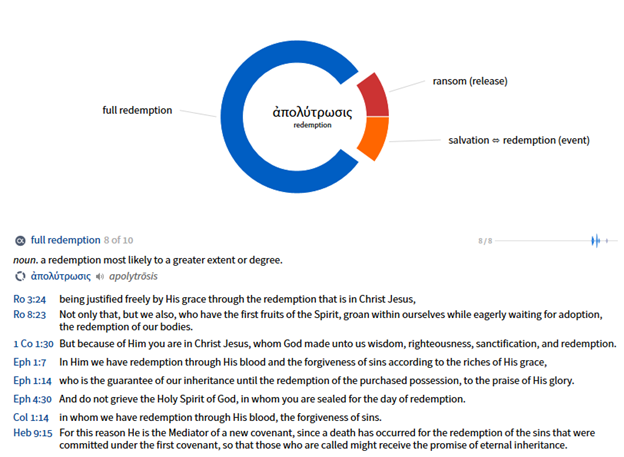
Then we encounter the last sentence. “When these things begin to happen, look up and lift up your heads, for your redemption is drawing near.” Luke is a gentile writing to gentiles. He is admonishing them to pay attention to when these things begin to happen. We also have the use of a unique word, ‘redemption.’

Matthew and Mark are drawing attention to the time of God’s intervention, judgment, and preservation of His people. Perhaps it could be redemption. Yet they did not use the word. I think it is because the attention of the reader is being drawn to two different events. Luke is drawing attention to redemption that occurs before the harmonized disasters that are described.

Considering redemption and the way the word is used in the New Testament, we can readily see the references of the majority of forms in the graphic. There are two other uses, one reference meaning ransom/release is cited in Hebrews 11:35 (Red.) The other is referencing an event and is the one word from Luke 21:28 we are discussing, ‘Redemption.’

A Word to the Wise: How to Known When to Present Yourself at the Opening of the Womb.

The iniquity of Ephraim is bound up; his sin is stored up. The pains of childbirth come for him. He is an unwise son, for he does not present himself at the opening of the womb.

Hosea 13:12–13 — Modern English Version (Thinline Edition.; Lake Mary, FL: Passio, 2014)

God is patient and kind. These ideas we have are rooted in Who He is. Even in the writings of the Old Testament prophets, time and again we encounter this long-suffering compassion from the Ancient of Days. It is compassion that is demonstrated from the beginning of creation to this day.

Let us further explore this analogy akin to “You must be born again.” We all know, before a birth comes a warning. That warning comes in the form of labor pains.

We know before Israel was taken captive, there was a long siege against the nation. City after city fell to the invaders. Prophets were sent to speak forth of the coming judgment, urging the nation to repent.

What started as the discomfort was now impending judgment.

God is longsuffering.

Do you despise the riches of His goodness, tolerance, and patience, not knowing that the goodness of God leads you to repentance?

Romans 2:4 — Modern English Version (Thinline Edition.; Lake Mary, FL: Passio, 2014)

His goodness and tolerance are leading each of us to repentance. The simple truth is disobedience has a just recompense.

For if the word spoken by angels was true, and every sin and disobedience received a just recompense, how shall we escape if we neglect such a great salvation, which was first declared by the Lord, and was confirmed to us by those who heard Him?

Hebrews 2:2–3 — Modern English Version (Thinline Edition.; Lake Mary, FL: Passio, 2014)

God’s patient leading to repentance is like birth pangs. At first, there is a bit of discomfort, which over time becomes more insistent. It is designed to bring us to the throne of God where confession brings remission.

If we confess our sins, He is faithful and just to forgive us our sins and cleanse us from all unrighteousness.

1 John 1:9 — Modern English Version (Thinline Edition.; Lake Mary, FL: Passio, 2014)

God patiently awaited those in His chosen nation to repent… Judgment was surely upon them. What started as raids in a few cities was now urgent. The impending doom was quickly becoming a reality—many would die and others led away to enslavement. What started as a bit of discomfort quickly escalated.

There is another application.

For many will come in My name, saying, ‘I am the Christ,’ and will deceive many. You will hear of wars and rumors of wars. See that you are not troubled. For all these things must happen, but the end is not yet. For nation will rise against nation, and kingdom against kingdom. There will be famines, epidemics, and earthquakes in various places. All these are the beginning of sorrows.

Matthew 24:5–8 — Modern English Version (Thinline Edition.; Lake Mary, FL: Passio, 2014)

These are the beginning of birth pangs. This is Jesus giving a briefing to His disciples with the signs that are the warnings of the end. Some of these have been around, others seem to be looming in the very near future. Days of which many think we are living in now.

Earthquakes are increasing in number. Famine and disease do not go away. Saber rattling is more popular than ever. Natural disasters occur with more frequency and severity.

With what is going on in the world we can match it to some of the things in the Bible. Scripture says these days may be the very beginning of birth pangs. Perhaps maybe we’re not even there yet.

That mild discomfort is going to steadily grow. Most importantly, to lead each of us to repentance and freedom from the condemnation of sure judgment coming.

Look… If you’re reading this it’s not by mistake. God may be leading you to repentance.

For the unbeliever, the stark reality is a confrontation with death. Our past deviations from goodness cannot be undone. The condemnation that comes from each of those deviations is death. We’re guilty many times over.

The believer knows the same fear of judgment. It may not be death unto perdition, nevertheless, it is what sin brings… Death.

You can have life. That is what birth brings… Life. If you’ve not ever belied God and confessed your sins… Do it now. If you’re a Christian and God is showing you your sin, confess it now.

And LIVE!

The End of it Shall Come with a Flood.

After the sixty-two weeks Messiah shall be cut off and shall have nothing. And the troops of the prince who shall come shall destroy the city and the sanctuary. The end of it shall come with a flood. And until the end of the war desolations are determined.

Daniel 9:26 — Modern English Version (Thinline Edition.; Lake Mary, FL: Passio, 2014)

I had highlighted this during the week to pursue later. What caught my attention is the phrase “The end of it shall come with a flood.” It in this case would be the city Jerusalem, or better the temple sanctuary in it.

Yet somewhere in the back of my mind, I remember hearing an account of a certain ancient civilization wanting to extract the last vestiges of gold from a sacked place, they flooded it with water. As the water washed through the ruins it then gushed over a grassy plain before eventually finding an outlet to a body of water. The treasure was lifted from the ruins by the water and caught in the grass of the plains. It was then retrieved. I think somewhere in my mind I always want to connect this idea with the temple but can find no sources for even the account. There is plenty of speculation on how the alleged melted gold was retrieved, but that is for another time.

Setting out this morning to try and understand, I have at least settled in my mind what is being said.

“The end of it shall come with a flood.”

In the passage, the word flood is translated from the Hebrew sheṭeph (שֶׁטֶף.) I think I want to read an English primary understanding into the translated word, meaning a flood with water. However, it seems as if the idea conveyed is just overwhelming devastation. A little later in Daniel, that same word is used as connected with armies to convey an overwhelming military army that is swept away.

A flood of armies shall be swept away before him and be broken, and the prince of the covenant as well.

Daniel 11:22 — Modern English Version (Thinline Edition.; Lake Mary, FL: Passio, 2014)

I think that helps to understand the context being offered. Still not satisfied, I checked out how the Septuagint translated the idea. The English transliteration is something like this:

Will come its end with destructive anger.

I think that better suits the idea as a judgment sent from God and overwhelming on many fronts; militarily, vast and emotional. Given some of the scant historical gleanings, the Israelis were so protective of that sanctuary. That was their identity, as the only ones who could approach and serve God.

Yet clearly in the prophecy, the Anointed One is cut off. We know Jesus was crucified. His death wasn’t for Himself (and shall have nothing.)

It is the troops of the prince who shall come who set to destroy the sanctuary. The command to do so wasn’t from Rome, a local legion set the fire. I can imagine the overwhelming confusion of the moment.

“And until the end of the war desolations are determined.”

Let’s not confuse the term desolations with what is commonly called the abomination of desolation. The former is specifically speaking of the desolations that are decreed to Jerusalem (and its people.) It is this very thing Jesus spoke of in the Olivet discourse. He was speaking of the second diaspora, the scattering of Israelis, and the desolations to come upon the city and its people.

When you see Jerusalem surrounded by armies, then you know that its desolation has drawn near. Then let those who are in Judea flee to the mountains, and let those who are in the city depart, and let not those who are in the country enter it. For these are the days of vengeance, that all things which are written may be fulfilled. But woe to those who are pregnant and to those who nurse in those days! For there will be great distress in the land and wrath upon this people. They will fall by the edge of the sword and will be led away captive to all nations. And Jerusalem will be trampled on by the Gentiles until the times of the Gentiles are fulfilled.

Luke 21:20–24 — Modern English Version (Thinline Edition.; Lake Mary, FL: Passio, 2014)

There would be a specific season for this diaspora and will end when the times of the Gentiles are fulfilled. Even in recent history, we continue to see the desolations that happen to the Jewish people; expulsion from Spain, the pogroms in Russia, and the Holocaust. These readily come to mind as modern desolations. Even now we see continued desolations spoken of in our media. The zeitgeist would shame Israel for settlements, for defending herself. The same would also divide Jerusalem for the sake of peace. Even then, the end of war won’t come until Messiah arrives.

Then the sign of the Son of Man will appear in heaven, and then all the tribes of the earth will mourn, and they will see the Son of Man coming on the clouds of heaven with power and great glory. And He will send His angels with a great sound of a trumpet, and they shall gather His elect from the four winds, from one end of the heavens to the other.

Matthew 24:30–31 — Modern English Version (Thinline Edition.; Lake Mary, FL: Passio, 2014)

The flood destroyed the city and sanctuary, and with all floods, the aftermath seems hopeless. These are the desolations that are decreed until the end of the war.

Pray for the peace of Jerusalem:
“May they prosper who love you!
Peace be within your walls
and security within your towers!”

Psalms 122:6–7 — Modern English Version (Thinline Edition.; Lake Mary, FL: Passio, 2014)

This is not meant to be an extensive explanation of prophecies, but of clearly understanding that phrase in the light of Scriptures.