The Transitory Nature of the Old Covenant, Sin and an Angry God

We have such trust through Christ toward God, not that we are sufficient in ourselves to take credit for anything of ourselves, but our sufficiency is from God, who has made us able ministers of the new covenant, not of the letter but of the Spirit. For the letter kills, but the Spirit gives life.

2 Corinthians 3:4–6 — Modern English Version (Thinline Edition.; Lake Mary, FL: Passio, 2014)

In his lengthy introduction to writing this letter, Paul explains why he didn’t visit Corinth as planned. This letter also serves as a lengthy defense of his ministry as an apostle of Jesus Christ. He points to God as enough to show his own commendation because of the Spirit of God working in the people to whom Paul ministers.

This is a contrast between what is written by hand and what is written by Spirit. The background is itinerant ministers were accompanied by written letters of recommendation from those in authority. The apostles in Jerusalem sent Paul to Antioch with a written letter (Acts 15:22–31.) The church at Corinth is a recommendation letter written by the Spirit of God.

The difference between physical writing that will fade away, and the work of the Spirit that doesn’t.

If the ministry that brought death, written and engraved on stones, was glorious, so that the children of Israel could not look intently at the face of Moses because of the glory of his countenance, the glory which was to fade away, how will the ministry of the Spirit not be more glorious?

2 Corinthians 3:7–8 — Modern English Version (Thinline Edition.; Lake Mary, FL: Passio, 2014)

Paul uses that idea to teach a greater truth. The ministry that brought death is the giving of the law. It is not that it wasn’t good. It had the purpose to bring bondage. Bondage of countless sacrifices day and night. It was a ministry of death. One that clearly demonstrated that sin brings a penalty of death. The reminder was constant. Sin brings death. That is the ministry of condemnation.

That ministry was delivered with glory. Glory was clearly reflected in the face of Moses as he brought the tablets of stone down to the people.

When Moses came down from Mount Sinai with the two tablets of testimony in the hands of Moses, when he came down from the mountain, Moses did not know that the skin of his face shone while he talked with Him. So when Aaron and all the children of Israel saw Moses, amazingly, the skin of his face shone, and they were afraid to come near him.

Exodus 34:29–30 — Modern English Version (Thinline Edition.; Lake Mary, FL: Passio, 2014)

Even the reflection of the glory of God was enough to remind the Israelites of that terrifying meeting with God at Sinai (Exodus 19:16–19; 20:18–21.)

At this point, reflecting on why the people were terrified is good. Even before the ministry of the law that brought condemnation, the people understood their condition in the presence of the holiness of God. The idea of holiness is separation. The people knew inherently that there was a problem. The giving of the law would draw that problem into clarity. It would also point directly to the Solution to that problem.

Is the law then contrary to the promises of God? God forbid! For if there had been a law given which could have given life, righteousness would indeed come through the law. But the Scripture has confined all things under sin, that the promise through faith in Jesus Christ might be given to those who believe.

But before faith came, we were imprisoned under the law, kept for the faith which was later to be revealed. So the law was our tutor to bring us to Christ, that we might be justified by faith. But now that faith has come, we are no longer under a tutor.

Galatians 3:21–25 — Modern English Version (Thinline Edition.; Lake Mary, FL: Passio, 2014)

The Old Covenant was Transitory

The ministry of the law was to fade away just as the glory of God reflected in Paul’s face would diminish. In a greater sense, the enslavement of sin was to be obliterated.

For if the ministry of condemnation is glorious, the ministry of righteousness much more exceeds it in glory. Even that which was made glorious had no glory in comparison to the glory that excels. For if that which fades was glorious, that which remains is much more glorious.

2 Corinthians 3:9–11 — Modern English Version (Thinline Edition.; Lake Mary, FL: Passio, 2014)

For us to contemplate that condemnation could be glorious might present itself as an oxymoron. Yet we now know that the purpose of that ministry contained a scarlet thread that brings us to the cross. The cross was the definitive point of the end of the law. The resurrection is the permanent victory over death. That is the glory that excels.

Seeing then that we have such hope, we speak with great boldness, not as Moses, who put a veil over his face, so that the children of Israel could not look intently at the end of what was fading away.

2 Corinthians 3:12–13 — Modern English Version (Thinline Edition.; Lake Mary, FL: Passio, 2014)

In contrast to the veil Moses placed over the glory to conceal its fading nature, we Christians speak with boldness. The new covenant doesn’t fade away. Its permanence is the impetus to share it.

Instead, their minds were blinded. For until this day the same veil remains unlifted in the reading of the old covenant, the veil which was done away with in Christ. But even to this day, when Moses is read, the veil is in their hearts.

2 Corinthians 3:14–15 — Modern English Version (Thinline Edition.; Lake Mary, FL: Passio, 2014)

Their minds were blinded in the same way that the veil Moses put on concealed the glory of God reflected in his face. The transitory nature of the law would be hidden from the Israelites. The same veil remains, not because it was already done away with by the work of Jesus. It remains because of the hardness of the heart.

Who is to blame?

Hear this now, O foolish people and without understanding, who have eyes but do not see, who have ears but do not hear.
Do you not fear Me? says the Lord. Will you not tremble at My presence? For I have placed the sand for the boundary of the sea by a perpetual decree so that it cannot pass over it. And though the waves toss themselves, yet they cannot prevail; though they roar, yet they cannot pass over it. But this people has a revolting and a rebellious heart; they have revolted and gone aside. They do not say in their heart, “Let us now fear the Lord our God, who gives rain, both the former and the latter, in its season. He reserves for us the appointed weeks of the harvest.” Your iniquities have turned away these things, and your sins have withheld good things from you.

Jeremiah 5:21–25 — Modern English Version (Thinline Edition.; Lake Mary, FL: Passio, 2014)

The veil remains because of the hardness of the heart. A hardness that begins in one’s own mind, but like Pharaoh can remain because God removes His influences.

Clearly, it is our sin that hardens.

We see that in the reaction of the Israelites to God coming down on Mount Sinai. They didn’t need the law to know their sinfulness. Being in the presence of a righteous God was terrifying.

The law was to showcase the problem and point to the solution. It became a point of national pride that eventually hid sin. Which in due course, suppresses the knowledge of God (Romans 1:21.)

There is a Problem and a Solution.

Nevertheless when anyone turns to the Lord, the veil is removed.

2 Corinthians 3:16 — Modern English Version (Thinline Edition.; Lake Mary, FL: Passio, 2014)

This is the fulcrum that the matter teeters on… The individual will. Since the bondage of sin no longer remains, a choice is available.

Any of us can approach the Word of God. We can read it, and maybe get some good points for living, just like reading any self-help book. That’s the veil.

Some read it and seem to stumble at the presentation of the angry God of the Old Testament. He is contrasted with a loving Jesus. It’s as if the two ideas become a contradiction. That’s the veil.

Some read it and just don’t get it. That’s the veil.

Turn to the Lord. That is exactly what repentance is. It is turning to the Lord. It is not trusting in your own intellect to understand, but turning to Him. It’s like saying “God I believe, help my unbelief.” That is the beginning. That is the pint of salvation.

For the belief, it is a constant reminder to change our minds toward God for understanding.

I will tell you personally, that the God of the Old Testament is just as loving as Jesus. As the law was to point out an obvious problem. Its ultimate purpose was to usher folks to Jesus, that is to have them turn to the Lord.

Glorious Liberty

Now the Lord is the Spirit. And where the Spirit of the Lord is, there is liberty.

2 Corinthians 3:17 — Modern English Version (Thinline Edition.; Lake Mary, FL: Passio, 2014)

There is no truer liberty than to be free of the bondage of death that comes with sin.

It is true for the individual. It is also true in a collective sense. There are no more bloody sacrifices needed. No daily ministrations of a priestly class that never rested because of the pervasiveness of sin, whether that sin was individual or collective… Intentional or not. The priests worked day and night. Fires burned with the stench of death. Until Jesus came… And as Priest, He sat down.

But every priest stands daily ministering and repetitively offering the same sacrifices, which can never take away sins. But this Man, after He had offered one sacrifice for sins forever, sat down at the right hand of God.

Hebrews 10:11–12 — Modern English Version (Thinline Edition.; Lake Mary, FL: Passio, 2014)

The work of the law is finished. Its ministry has faded away. What is permanent remains. Jesus rested as the work of redemption is done. The purchase price is satisfied.

But we all, seeing the glory of the Lord with unveiled faces, as in a mirror, are being transformed into the same image from glory to glory by the Spirit of the Lord.

2 Corinthians 3:18 — Modern English Version (Thinline Edition.; Lake Mary, FL: Passio, 2014)

For us believers, we can look to the Lord with unveiled faces. Faces that reflect His glory. We Spirit-baptized believers are being transformed into the same image of Jesus. From His glory, we are given glory.

No. That last line is not a mistake.

I will trace this backward for you to draw on the Spirit to understand the greatest privilege extended to us by the God of the Old Testament.

“I do not pray for these alone, but also for those who will believe in Me through their word, that they may all be one, as You, Father, are in Me, and I in You. May they also be one in Us, that the world may believe that You have sent Me. I have given them the glory which You gave Me, that they may be one even as We are one: I in them and You in Me, that they may be perfect in unity, and that the world may know that You have sent Me, and have loved them as You have loved Me.

John 17:20–23 — Modern English Version (Thinline Edition.; Lake Mary, FL: Passio, 2014)

Jesus prays for you to have the same glory He has received from the Father.

And now, O Father, glorify Me in Your own presence with the glory which I had with You before the world existed.

John 17:5 — Modern English Version (Thinline Edition.; Lake Mary, FL: Passio, 2014)

It’s the same glory Jesus had from eternity past.

For My own sake, even for My own sake, I will do it; for how can My name be polluted?
And I will not give My glory to another.

Isaiah 48:11 — Modern English Version (Thinline Edition.; Lake Mary, FL: Passio, 2014)

Keep looking up.

The Harvest of the Earth is not a Rapture

Revelation 1:7 (MEV): Look! He is coming with clouds, and every eye will see Him, even those who pierced Him. And all the tribes of the earth will mourn because of Him. Even so, Amen.

This is John’s introduction to an event that is sometimes confused with the rapture. This idea of coming in the clouds is always about judgment. In 1 Thessalonians 4:17, Paul clearly states that the saints (Spirit-baptized believers) that are alive meet the previously dead saints (Spirit-baptized believers) in the clouds together. Paul does not tell us Jesus comes in the clouds. That is because the rapture is not judgment. This is the precision of the message.

Then What is It?

Revelation 14:14–20 (MEV): I looked. And there was a white cloud, and on the cloud sat One like a Son of Man, having on his head a golden crown, and in His hand a sharp sickle. Then another angel came out of the temple, crying with a loud voice to Him who sat on the cloud, “Thrust in Your sickle and reap. The time has come for You to reap, for the harvest of the earth is ripe.” So He who sat on the cloud thrust His sickle on the earth, and the earth was harvested.

Another angel came out of the temple which is in heaven. He also had a sharp sickle. Yet another angel who had authority over fire came out from the altar. He cried with a loud voice to him who had the sharp sickle, saying, “Thrust in your sharp sickle and gather the clusters of the vine of the earth, for her grapes are fully ripe.” The angel thrust his sickle into the earth and gathered the vintage of the earth, and threw it into the great winepress of the wrath of God. The winepress was trampled outside the city, and blood came out of the winepress, up to the horses’ bridles, for one hundred and eighty-six miles.

All the nations will be brought to battle Jerusalem. God will gather them just as a vintner gathers grapes.

I under that that is graphic language. This event is not going to be very enjoyable. The earth is being harvested for judgment. This is the gathering of the nations in the final battle at what is known as Armageddon. (More on that in a later post.)

But first, some background.

Space Invaders

There is a modern fascination with mastering the heavens. We fly planes and have sent rockets zooming through space. There has been a push to militarize the heavens. The US even has established a Space Force branch of the military.

Weaponizing the air began soon after the Wright brothers invented flight. Hubs were affixed to plains.

That progressed to delivering bombs with rockets. Wernher von Braun mastered rocketry during WWII. He was swiftly brought to the US and he revolutionized the air and beyond.

In the 80s Ronald Reagan, then President of the United States proffered an idea that helped broker a peace agreement with the USSR. It came after both sides would stubbornly not move on their position. He had a private meeting with Mikhail Gorbachev, then Secretary General of the Communist Party of the Soviet Union. Reagan asked if the USSR would aid the US if an invader from space were to attack. Both men agreed they would help each other. This became the impetus for finding agreement for a stand down if the Cold War.

In a speech before a gathering of the United Nations, Reagan spoke of the meeting and what was discussed. It shocked the world that leaders would discuss a fringe topic like space aliens. I fondly remember the lampooning Reagan took.

But the issue is serious. In that, a different kind of threat was hinted at. A vastly greater one that could unite humanity for a common goal.

There would be weaponry needed to neutralize that threat. Some were already being considered and even built. The idea has certainly been embraced in the last 40 years. And now we have the Space Force.

The Science

Science now embraces it, as the idea of panspermia is theorized to deal with the seeming impossibility of abiogenesis. That is, the science of the first cell becoming alive. Panspermia is the theory that life was seeded by some alien race on Earth. To me, that sounds like God did it, but hey. That just cannot be.

The idea offered is that earth is just one giant science excitement of hybridization and selection.

Do I believe there are space aliens?

Maybe… But I don’t think so. I think it will be part of the fake story that will be used as an explanation for the mass disappearance of people will be needed when the body of Christ is raptured. There will be what is called space aliens or space brothers that come down when we go up. They will tell those remaining that they were responsible for removing those that cannot move to the next vibration or evolve. They will also say they seeded life here and can help fix the problems.

Many of those in the New Age movement also teaches this.

Why Say This?

I know that sounds kooky. Humans are building weapons to fight an invader. The enemy is also building an army of humans because he is vastly outnumbered. The world will come together to fight what they will call space invaders. It will be an attack from above.

A Day of the Lord

Zechariah 12:1–10 (MEV): The oracle of the word of the Lord against Israel.
Thus says the Lord, the One who stretches out the heavens and establishes the earth and forms the spirit of man within him: I am going to make Jerusalem a cup of reeling before all the surrounding nations. And when there is a siege against Judah, it is also against Jerusalem. And it will be on that day that I will set Jerusalem as a weighty stone to all the peoples. All who carry it will surely gash themselves, and all the nations of the land will be gathered against it. On that day I will strike every horse with confusion and its rider with madness, but for the house of Judah I will keep My eyes open although I will strike with blindness every horse of the peoples. Then the clans of Judah will say in their hearts, “There is strength for us with those residing in Jerusalem by the Lord of Hosts, their God.” On that day I will set Judah like a fiery pot among wood and as a flaming torch among cut grain. And they will devour to the right and left all the surrounding peoples, while Jerusalem will still reside in her place, the place of Jerusalem.

The Lord will deliver the tents of Judah as before, so that the glory of the house of David and the glory of those dwelling in Jerusalem will not eclipse Judah. On that day the Lord will defend those residing in Jerusalem; and even the one who stumbles among them will be as David on that day. And the house of David will be like God, like the angel of the Lord going out before them. On that day I will seek to destroy all the nations who come out against Jerusalem. And I will pour out on the house of David and over those dwelling in Jerusalem a spirit of favor and supplication so that they look to Me, whom they have pierced through. And they will mourn over him as one mourns for an only child and weep bitterly over him as a firstborn.

On that day… Count how many times it’s there in that passage. It’s a future day for Jerusalem. A day of loving kindness from the One whom they have pierced. It will cause them to mourn.

John cites that in the introductory passage above. He is coming and will be seen even by those who pierced Him. That’s Jesus.

To Jewish Readers

Consider that passage in Zechariah. The word Lord used there is the unspeakable name of God, Jehovah. He is the One speaking and plainly says they (Israelis) look to Him Who they pierced through. Ask yourself one question, when did Jehovah get pierced?

The Lord Fights

That day will be cleansing for the people of God, the Israelis. They will be reconciled to their God. They will also divide spoil from the battle He fought.

Zechariah 14:1–4 (MEV): A day of the Lord is coming when your spoil will be divided in your midst. For I will gather all the nations against Jerusalem for battle. The city will be captured and the houses plundered and the women ravished. Half of the city will go to exile, but the remainder of the people will not be cut off from the city. Then the Lord will go out and fight those nations as He fights in the day of war. On that day His feet will stand on the Mount of Olives, which is to the east of Jerusalem. And from east to west the Mount of Olives will be split in two halves by a very great valley so that one half moves to the north and the other to the south.

It will be a two-fold battle, the nations will be gathered and seek to take the city. To all those dwelling there, the cause would be dire. Then sudden destruction comes upon the attackers.

In That Day

Even in the much-talked-about invasion by God of Magog (Ezekiel 38-39,) there seems to be a multi-pronged conflict. Look at the phrases God uses… I will turn you back, drive you on, take you up, and bring you against.

Ezekiel 39:1–4 (MEV): Moreover you, son of man, prophesy against Gog and say: Thus says the Lord God: I am against you, O Gog, prince of Rosh, Meshek, and Tubal. And I will turn you back, drive you on, and take you up the north parts and bring you against the mountains of Israel. And I will strike your bow out of your left hand and will cause your arrows to fall out of your right hand. You shall fall upon the mountains of Israel, you and all your troops and the peoples who are with you. I will give you to the ravenous birds of every sort, and to the beasts of the field to be devoured.

Also pay attention to the familiar phrases encountered; on that day, in that day, and in the latter years. The reference is to the day of the Lord and is not necessarily always meant to encompass just a singular day.

This is also the call to the great feast I’ve written of before.

Ezekiel 39:17 (MEV): As for you, son of man, thus says the Lord God: Speak to every kind of fowl and to every beast of the field: Assemble and come. Gather on every side to My sacrifice that I sacrifice for you, even a great sacrifice upon the mountains of Israel, that you may eat flesh and drink blood.

Jesus said, wherever the carcass is, the eagles will be gathered together (Matthew 24:28.) He is referencing this particular day.

It’s the Lord Who fights for Israel.

The Gathering Place

Isaiah 29:1–2 (MEV): Woe to Ariel, to Ariel,
the city where David lived! Add year to year, observe your feasts on schedule. Yet I will distress Ariel, and she shall be a city of lamenting and sorrow, and she shall be as an Ariel to me.

Fascinating is the name Isaiah applies to Jerusalem. It’s Ariel. While many consider the meaning as Lion of God, it also connotes a gathering of God (like from exile) or the place of assembly.

This is indeed weighty material to consider. God is telling us in advance what will happen. But consider the words of the Psalmist….

Psalm 48:1–8 (MEV): Great is the Lord, and greatly to be praised in the city of our God, in His holy mountain.

Beautiful in elevation, the joy of the whole earth, is Mount Zion, on the sides of the north, the city of the great King. God is known in her citadels as a refuge.

For the kings were assembled, they passed by together. They saw it, and so they were astounded; they were alarmed, they hurried away. Trembling seized them there, and pain like a woman in labor; You break the ships of Tarshish with an east wind.

As we have heard, so have we seen in the city of the Lord of Hosts, in the city of our God; God will establish it forever. Selah

At the beginning of the song, there is no hint of its prophetic nature. The nations are gathered to Jerusalem. What did they see that caused sudden alarm?

Jerusalem will be rescued by the One the world considers space invaders. It will be led by Jesus and His army of saints. They will come down with the host of heaven. He will come and vanquish His enemies.

The entire portion of the Psalm is really a prophetic song to be sung in yet future. The refrain ends with the admission that God told them the things that would happen before they did and they did happen.

Jesus will rescue Jerusalem.

Surely Goodness and Mercy

The Lord is my shepherd; I shall not want.
He makes me lie down in green pastures;
He leads me beside still waters.
He restores my soul;
He leads me in paths of righteousness for His name’s sake.
Even though I walk through the valley of the shadow of death, I will fear no evil;
for You are with me;
Your rod and Your staff, they comfort me.
You prepare a table before me in the presence of my enemies;
You anoint my head with oil;
my cup runs over.
Surely goodness and mercy shall follow me all the days of my life,
and I will dwell in the house of the Lord forever.

Psalm 23:1–6 — Modern English Version (Thinline Edition.; Lake Mary, FL: Passio, 2014)

It’s a beloved passage. Many have it memorized as it brings comfort in stressful times.

Have you actually pondered the ideas in the last verse?

There is a hymn we sing called “Surely Goodness and Mercy.” It is this last line of this Psalm. The religion of the verse drives an important point.

Goodness and mercy shall follow me.

We get that language from the King James Version. The word shall hints at a deeper meaning of the Hebrew word it is translated from to form the verb shall follow. The Hebrew root is radaph. It is translated correctly.

But let us look in another version of the Bible that may add some higher definition.

Surely goodness and loyal love will pursue me all the days of my life,
and I will stay in the house of Yahweh
for a very long time.

Psalm 23:6 — The Lexham English Bible (Bellingham, WA: Lexham Press, 2012)

Yes, the word can be translated as pursue, here. Other meanings include chase and persecute.

This goodness and mercy of God doesn’t ever give up. It is always there, chasing and persecuting us… Forever.

One Day is Day One

God called the light Day, and the darkness He called Night. So the evening and the morning were the first day.

Genesis 1:5 — Modern English Version (Thinline Edition.; Lake Mary, FL: Passio, 2014)

It occurs to me that there are many foundational ideas present in Genesis, as there are even in this verse. I hate to use the word first, but it is probably best suited.

This is the first mention of the naming of the light period of the day as day, and the dark period of the day as night. The Hebrew word for the day is yom. It is used twice in the verse as is reflected in the English.

Two other words are introduced, erev and boker, the Hebrew words for evening and morning. These have another intriguing usage. Erev generally reflects the idea of mixing, when things become less discernible just as in twilight. Boker connotes the idea of dawn when things become more discernible. Boker also means a splitting of the day. In the Biblical reckoning, dawn is midday.

God is teaching us that these things combined make one day. That is what the Hebrew literally says, one day. It is misleading to think the Bible calls it the first day.

When we read Genesis, most of us are familiar with the idea that there is the first day of creation followed by a short series of more creation days. Consider the idea of reading this without any prior assumptions, like another day following. Also think that there was not a day before, either. What God has done is show us the defining characteristics of one day… Dark and light… Evening and morning. These are the first occurrences of each, and the pair makes one day.

The Hebrew word that is translated as first is echad. It is a cardinal number. It also can serve as an ordinal number. One and two are considered cardinal numbers. First and second are ordinal numbers. Interestingly, echad can be translated one and it can be translated first. It is a seeming peculiarity this one day is day one and the first day.

One day as day one, as there is no second day yet to make this a first day. It is just one day as day one. It is only when the second day comes that the word can mean first.

Therefore a man will leave his father and his mother and be joined to his wife, and they will become one flesh.

Genesis 2:24 — Modern English Version (Thinline Edition.; Lake Mary, FL: Passio, 2014)

As we venture forward, the idea introduced earlier is reinforced.

God draws the woman from the man. He takes a part of the man to fashion the helpmate. In this verse are also the first mentions of the words father and mother as well as spouse. The man and wife become one flesh.

There is that Hebrew word echad again. And it is used to again to unify a plurality. Just as evening and morning make one (day,) man and wife make one (flesh.)

And we will roll backward just a bit.

In the beginning God created the heavens and the earth.

Genesis 1:1 — Modern English Version (Thinline Edition.; Lake Mary, FL: Passio, 2014)

This is fascinating. God introduces Himself. But underlying the proper English grammar here is Hebrew that doesn’t follow grammar.

The word translated to God is elohim in Hebrew. It is a plural word used as a singular. Hebrew plurals are different. There are two types of plural, the dual plural which uses a suffix of -ayim, and the more-than-two plural which uses the suffix -im.

The singular is eloha.

The dual-plural is elohayim.

The more-than-two plural is elohim.

There is already this idea of a plurality being one. We clearly see the usage of the word echad to convey a unity of parts.

Hear, O Israel: The Lord is our God. The Lord is one!

Deuteronomy 6:4 — Modern English Version (Thinline Edition.; Lake Mary, FL: Passio, 2014)

This is the Shema. It is the central affirmation of faith for Israelis. It is also a spoken affirmation of God.

This will show the blazing truth.

Note back to the Shema, let’s substitute some Hebrew words for the English.

Hear, O Israel: YHWH is our Elohim. YHWH is Echad!

Storm’s a’Comin’

The voice of the Lord is over the waters; the God of glory thunders; the Lord is over many waters.

Psalm 29:3 — Modern English Version (Thinline Edition.; Lake Mary, FL: Passio, 2014)

From our previous excursion, the mighty ones were giving praise and glory to God. Now, the mood of the psalm changes. Some of the commentaries allude to this being a storm that comes over Canaan from north to south. It could be a surface understanding. But let’s check it out.

Our introduction comes to the voice of the Lord. There are lots to be said about the voice of the Lord, it is powerful. It makes and sustains all of creation. It thunders. It sounds like a trumpet. It is even pictured as Jesus with a sword coming out of His mouth. The voice of the Lord can bring comfort. It can also bring judgment. The psalmist is speaking a reassuring word. He repeats the phrase. The voice of the Lord is over the waters.

The idea of waters as we will see a bit later is an allusion to the flood of Noah. It can also be taken as a collective metaphor for the people of earth (not God’s people.) I think it may be both. And the idea of unsaved folks being chaotic intrigues.

The voice of the Lord thunders. Here we have another storm reference. The storm and thunder language aptly describe judgment. God does judge. We know that an approach to God Himself is daunting. Look at how the writer of Hebrews approaches the event at Mount Sinai when God asked the people to come to Him.

You have not come to a mountain that can be touched and that burned with fire, and to blackness and darkness and storm, and to the sound of a trumpet and to a voice speaking words, such that those who heard them begged that the word not be spoken to them anymore.

Hebrews 12:18–19 — Modern English Version (Thinline Edition.; Lake Mary, FL: Passio, 2014)

Their response was fear. They didn’t have intimate personal experience with this God as Moses did. They had seen what He did for them, yet that particular stormy scene was terrifying, even for Moses.

So terrible was the sight that Moses said, “I am terrified and trembling.”

Hebrews 12:21 — Modern English Version (Thinline Edition.; Lake Mary, FL: Passio, 2014)

I think that is the proper frame of reference for this. There is nothing that is greater than God, not chaos or the whole of humanity.

The voice of the Lord sounds with strength; the voice of the Lord—with majesty.

Psalm 29:4 — Modern English Version (Thinline Edition.; Lake Mary, FL: Passio, 2014)

Those at Sinai understood the strength. They also knew the majesty, but they weren’t going anywhere near that mountain. (You can read the account in Exodus 19.)

The voice of the Lord breaks the cedars; the Lord breaks the cedars of Lebanon. He makes them skip like a calf, Lebanon and Sirion like a wild ox. The voice of the Lord flashes like flames of fire. The voice of the Lord shakes the wilderness; the Lord shakes the Wilderness of Kadesh.

Psalm 29:5–8 — Modern English Version (Thinline Edition.; Lake Mary, FL: Passio, 2014)

This is yet more judgment language. He breaks the cedars of Lebanon. These trees had trunks 40 feet in girth. That’s unimaginable. Yet God’s voice breaks them and causes them to skip.

The reference to Sirion and Lebanon adds another interesting insight. Sirion is Mount Hermon. It has significance in that it is the mountain where the gods (mighty ones) came down in sedition. Sirion and Lebanon are mentioned in Baal poetry, too. Baal was the Canaanite storm god.

With those two references and another, we also know there is geography involved. But as is often the case, the named geography is used as an allusion to cosmic geography. (That is, geography from the perspective of God.)

Mount Hermon would be the northern edge of Israel. Mount Hermon would be the north reference point (thnk “sides of the north.) Kadesh would be the southern edge of Israel. The storm would encompass the whole land of God’s people. And cosmically speaking from God’s reference, all people in general.

As I understand, it is prophetic in that way of God’s coming judgment on Israel and the peoples of the world. (We are currently doing verse-by-verse in Revelation.) Reading this psalm connects to Revelation 16, in my mind.

The voice of the Lord makes the deer to give birth, and strips the forests bare; and in His temple everyone says, “Glory!”

Psalm 29:9 — Modern English Version (Thinline Edition.; Lake Mary, FL: Passio, 2014)

He gives and takes away. The mighty ones in His heavenly temple give Him the glory due His name.

The Lord sits enthroned above the flood, the Lord sits as King forever.

Psalm 29:10 — Modern English Version (Thinline Edition.; Lake Mary, FL: Passio, 2014)

There is nothing that is going to move God. It is His voice that ensures His will is done.

The Lord will give strength to His people; the Lord will bless His people with peace.

Psalm 29:11 — Modern English Version (Thinline Edition.; Lake Mary, FL: Passio, 2014)

The people of God can rest knowing they won’t be moved either. They have peace with the God enthroned above all.

This psalm praises God for things to come… The ultimate storm. That storm will break up seeming unbreakable thrones. Principalities that really have no real power over God’s people. The people of God rest completely at peace.

Glory to God.

Give to the Lord, O Mighty Ones

“Give to the Lord, O mighty ones,
give to the Lord glory and strength.
Give to the Lord all the glory due His name;
worship the Lord in the beauty of His holiness.”

Clay Hecocks – “His Holiness

I start with a paraphrase of a psalm turned into praise lyrics. This was something we used to sing in church some time ago. It has a gorgeous melody. I think it was written by Clay Hecocks. (Listen here: His Holiness.)

It was one of my favorite things to sing at church. I hope I can explain it well enough. (Don’t believe what I write. Check it out for yourself, Acts 17:11. Read the references and above them and below them.)

Let’s start with the text from the psalm.

Give to the Lord, you heavenly beings,
give to the Lord glory and strength.
Give to the Lord the glory of His name;
worship the Lord in holy splendor.

Psalm 29:1–2 — Modern English Version (Thinline Edition.; Lake Mary, FL: Passio, 2014)

This has many levels of meaning, and it is centered around the Hebrew phrase beneha elim translated to heavenly beings. In some translations, the term sons of God is used. That is also correct given the Hebrew phrase.

That phrase hints back to Job, where a similar Hebrew phrase is used beneha elohim.

Recent scholarship thinks the term elohim describes a class of beings that includes the Most High God. This is similar to the English word gods that denotes a class of beings, with the capitalized singular form God meaning the Most High. (Of note, the Hebrew elohim is always a plural, even when used as a proper noun Elohim as a name for the Most High.)

These elohim are part of the family of God present in His mountain (garden of Eden.) They are His divine council written of in psalm 82. That psalm points to something wrong happening in this council. Something that rocked the foundations of the earth. God will eventually judge these in the council and condemn them to die “like men.”

Can you imagine what that would be?

I think the Bible points to the insurrection that occurred in the garden and God’s necessary enslavement of the creation to futility. In today’s language, the term is entropy.

The purpose of His council is outlined in the first two verses of David’s psalm. Give to the Lord the glory due His name.

They failed at that task. God could create more beings for His council. But did it in what may seem is a peculiar way. Peculiar, because there’s nothing else like it.

The Adoption

You are all sons of God by faith in Christ Jesus.

Galatians 3:26 — Modern English Version (Thinline Edition.; Lake Mary, FL: Passio, 2014)

Paul begins an important point in one sentence that he will elaborate upon. He sums it up this way…

God sent forth His Son, born from a woman, born under the law, to redeem those who were under the law, that we might receive the adoption as sons. And because you are sons, God has sent forth into our hearts the Spirit of His Son, crying, “Abba, Father!” Therefore you are no longer a servant, but a son, and if a son, then an heir of God through Christ.

Galatians 4:4–7 — Modern English Version (Thinline Edition.; Lake Mary, FL: Passio, 2014)

I hope that your mind is making connections here. Not much is ever said about this, though it is an important concept to grasp.

There was an insurrection. Some of those members of the divine council fell miserably. Jude says they left their first estate. (Think of the impetus for the flood in Genesis 6. I am purposefully being vague to leave you some crumbs for your own pursuit.)

Back to what Paul is saying of… The adaption. We Christian saints of this age have a unique purpose. We are called sons of God.

Could it be we replace the failed members of the divine council?

I think so. There are far too many references. The Bible says we will judge angels. Look at that psalm 82… Who is it that judges angels?

I’m not saying we will be God. But somehow, someway, we have such an intimate relationship within the Godhead. Jesus said it.

“I do not pray for these alone, but also for those who will believe in Me through their word, that they may all be one, as You, Father, are in Me, and I in You. May they also be one in Us, that the world may believe that You have sent Me. I have given them the glory which You gave Me, that they may be one even as We are one: I in them and You in Me, that they may be perfect in unity, and that the world may know that You have sent Me, and have loved them as You have loved Me.

John 17:20–23 — Modern English Version (Thinline Edition.; Lake Mary, FL: Passio, 2014)

Jesus speaks of an intimate unity just as He has with the Father, “May they also be one in Us.” Furthermore, it says Jesus gives us the glory that the Father gave Him. The significance of that statement ought to rock your socks off!

I am the Lord, that is My name; and My glory I will not give to another, nor My praise to graven images.

Isaiah 42:8 — Modern English Version (Thinline Edition.; Lake Mary, FL: Passio, 2014)

This isn’t a contradiction. Paul is correct in saying we are adopted sons. We are joint-heirs. What Jesus gets, we get.

I can’t even begin to fathom such things. But that’s what is there… Plainly. It short-circuits my brain because I have no real concept of all that it entails.

This isn’t pantheism. It isn’t panentheism. (Search engines are friends.) This isn’t me saying we are going to be God. But we are destined for something intimately special with God because of Jesus.

Give to the Lord, o mighty ones. That’s going to be us believers. Give to the Lord glory and strength. From Whom did we get glory and strength?

Give to the Lord all the glory due His name. Worship the Lord in the beauty of His holiness.

One Becomes Like the God One Worships

Not unto us, O Lord, not unto us, but unto Your name give glory, for the sake of Your mercy, and for the sake of Your truth.

Psalm 115:1 — Modern English Version (Thinline Edition.; Lake Mary, FL: Passio, 2014)

The opening of the psalm is a chorus of worship. The Lord is worthy of it just for His mercy and truth. These aren’t just attributes of God, but they are part of Who He is. You don’t think of God without thinking of Mercy or Truth among other immutable things.

Why should the nations say, “Where now is their God?” But our God is in the heavens; He does whatever He pleases.

Psalm 115:2–3 — Modern English Version (Thinline Edition.; Lake Mary, FL: Passio, 2014)

It’s those mocking and scorning questions. They are designed to make one question God. As Christian, people may ask each of us this or similar at times.

Our answer, like the psalmist’s, God is in the heavens. We never have to wonder. He doesn’t leave. He doesn’t go on vacation. I would offer that the heavens include creation itself. It is in some way an immutable part of Him, meaning it cannot exist without Him.

There is another important point that is presupposed by the question. It asks, where?

God is in a place. The place is called the heavens. If we remember the creation account there are multiple heavens, including the expanse encompassing our planet. God is here, too.

For thus says the High and Lofty One who inhabits eternity, whose name is Holy: I dwell in the high and holy place and also with him who is of a contrite and humble spirit, to revive the spirit of the humble,
and to revive the heart of the contrite ones.

Isaiah 57:15 — Modern English Version (Thinline Edition.; Lake Mary, FL: Passio, 2014)

We have a clear answer to the question of where. God inhabits eternity. There’s not a place to go where (and when) He isn’t. Yet, He also says He dwells with the contrite and humble spirit.

We also have a hint to the things that He pleases to do. it’s to revive the spirit of the humble and the heart of the contrite ones He dwells with. That is who believes in Him. (To understand more, continue reading around that citation in Isaiah 15, it gives a glimpse into the character of God.)

Their idols are silver and gold, the work of men’s hands.
They have mouths, but they cannot speak;
eyes, but they cannot see; they have ears, but they cannot hear; noses, but they cannot smell; they have hands, but they cannot feel; feet, but they cannot walk; neither can they speak with their throat.

Psalm 115:4–7 — Modern English Version (Thinline Edition.; Lake Mary, FL: Passio, 2014)

The psalmist turns the mockery back to where it squarely belongs. Those that mock make for themselves their own gods. They give them the appearances of the attributes of a human (or even possibly an animal.) But those things cannot do what a living being can do.

Think of the juxtapositions in the text. One God inhabits eternity and dwells with others. Idols can only remain in one place at a time. The idols have no senses, or motor skills and cannot talk. But our God does.

Those who make them are like them; so is everyone who trusts in them.

Psalm 115:8 — Modern English Version (Thinline Edition.; Lake Mary, FL: Passio, 2014)

The indictment from the psalmist is clear. One becomes like the God He worships. This is an important biblical principle that is plainly evident in our world. It’s not just limited to religion. Look around and see how that can be identified. I think you might be surprised and maybe shocked.

There is an application for us. As we examine ourselves against what we know of our God, are we like Him?

In this passage, God dwells with the contrite and humble to revive them. The psalmist also says our God has mercy and is truthful.

I’m not intending this to be condemning, a downer, or something that brings conviction. But if it does become a downer, I hope you see clearly the difference in the two other points. Each experience can lower our feelings, but discern what it is.

Condemnation always brings shame. It comes from the pit of hell.

Conviction is gentle and always comes with the prodding to do better. Being convicted by God means there is hope! We can change.

I encourage you to read the Bible, even the Old Testament. Ask God to show you Who He is, you will also learn about what He likes to do. Then set out to ask Him to change you from the inside to be more like Him. This is you to yield yourself to Him. Sometimes it is going to feel a bit awkward, or even like you don’t really mean it. There’s an answer for that, too.

A man brought his son to Jesus in desperation. This boy is terrorized by a foul entity. It endangers and even harms the boy. When brought to Jesus, the demon seizes the boy and makes him crash to the ground and foam at the mouth uncontrollably.

The father knows he can do nothing. He aches and fears for his boy. And brings his son to Jesus.

Jesus said, “If you can believe, all things are possible to him who believes.”
Immediately the father of the child cried out with tears, “Lord, I believe. Help my unbelief!”

Mark 9:23–24 — Modern English Version (Thinline Edition.; Lake Mary, FL: Passio, 2014)

This is a poignant exchange. Jesus encourages the father to believe. The father wants to believe but knows there is some hesitation, or as I see it, like lip service. When we believe something with a bit of skepticism.

Jesus is okay with that. He healed that boy. (Read the encounter for yourself, it will bless you.)

And in the same way, when you come to God skeptical of your own motivations, He understands. He can even change those motivations if you let Him.

I challenge you to get to know Him. Let Him change you. You will never regret it.

The Name: Scepter

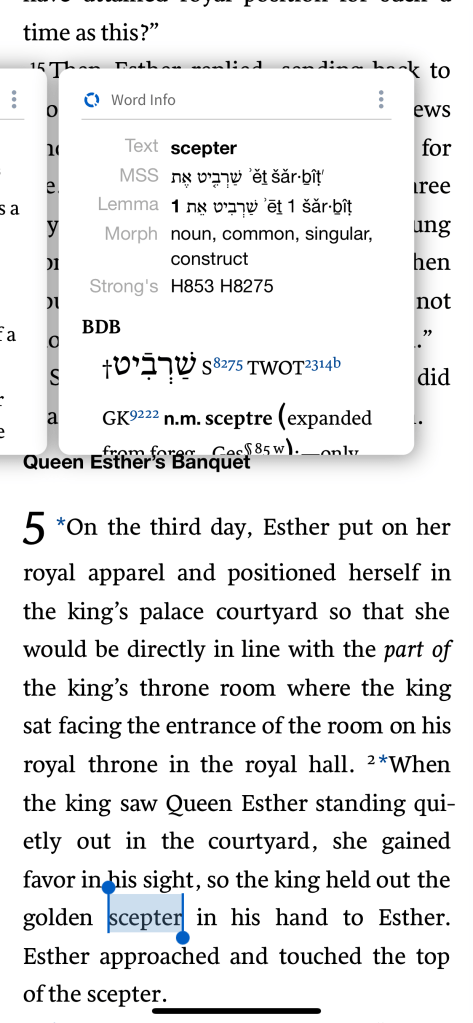
On the third day, Esther put on her royal apparel and positioned herself in the king’s palace courtyard so that she would be directly in line with the part of the king’s throne room where the king sat facing the entrance of the room on his royal throne in the royal hall. When the king saw Queen Esther standing quietly out in the courtyard, she gained favor in his sight, so the king held out the golden scepter in his hand to Esther. Esther approached and touched the top of the scepter.

Esther 5:1–2 — Modern English Version (Thinline Edition.; Lake Mary, FL: Passio, 2014)

I love the types and shadows that are present in the Scriptures. I think there is one here that, like all, is profound.

For those not familiar with Esther, she is the queen of Persia and Media. The entire account is a fascinating read. In defeating the evil Haman by exposing his plot to destroy her cousin Mordecai. The king had Haman hung on his own gallows.

There was also a law written in the books created by this Haman, that on a certain day the citizens were permitted and expected to kill all the Jewish folk in the nation. The culture in that nation didn’t allow for the voiding of laws.

How was Esther going to save her people?

The laws didn’t permit anyone to approach the king, even his bride, without an invitation. The penalty was death.

To the types and shadows…

It’s that golden scepter… The extension of it toward Esther granting her favor to enter the presence of the king. It is the extension of favor wherein she may now let the king know her petition without fear in his very presence.

The underlying word in Hebrew makes connections that are astounding. Our English translations also make the connection.

But first I want to point out that scholars think this scepter was a small version of a shepherd’s crook. You are probably familiar with an Egyptian version. It is represented in ancient carvings. Even Disney has an accurate depiction at Epcot in Spaceship Earth.

This scepter as a representative shepherd’s crook is a good reminder to us all, that the leaders of a nation are appointed by God to be good stewards of the people, just as a shepherd cares for sheep. In that way, they are to be like Jesus. This brings this digression back to the point. In Numbers, there was a prophecy of Jesus given.

“I will see him, but not now; I will behold him, but not near; a star will come out of Jacob, and a scepter will rise out of Israel, and will crush the borderlands of Moab, and destroy all the children of Sheth. Edom will be a possession, and Seir, a possession of its enemies, while Israel does valiantly. One out of Jacob shall have dominion, and destroy the survivors of the city.”

Numbers 24:17–19 — Modern English Version (Thinline Edition.; Lake Mary, FL: Passio, 2014)

Here, Jesus is referred to as “a scepter.” The underlying Hebrew words are related. This one Numbers is the Hebrew shêbeṭ. Whereas in Esther, it is the derivative sharbı̂yṭ. It is only used four times in the Old Testament and all of them are in Esther. Our reference word for scepter is specific and exclusive, yet is derived from the same word in the Numbers prophecy.

Furthermore, the phrase “the golden scepter” is used three times in Esther. The Hebrew phrase is ’eṯ sharbı̂yṭ hǎ zāhāḇ. Each time it is used it is a demonstration of grace and acceptance extended by the king.

That is Jesus.

He is the Sceptre, the extension of grace and acceptance from God. Jesus told us…

For God so loved the world that He gave His only begotten Son, that whoever believes in Him should not perish, but have eternal life.

John 3:16 — Modern English Version (Thinline Edition.; Lake Mary, FL: Passio, 2014)

In Hebrews, it is explained this way.

Since then we have a great High Priest who has passed into the heavens, Jesus the Son of God, let us hold firmly to our confession. For we do not have a High Priest who cannot sympathize with our weaknesses, but One who was in every sense tempted like we are, yet without sin. Let us then come with confidence to the throne of grace, that we may obtain mercy and find grace to help in time of need.

Hebrews 4:14–16 — Modern English Version (Thinline Edition.; Lake Mary, FL: Passio, 2014)

Saved or unsaved… pagan or Christian… Jew or Gentile… There is only one Way to enter the presence of the King. And that’s via the Sceptre extended to us in favor… Jesus Christ.

Not convinced? There’s more.

That little two-letter word et may easily be passed over. In my opinion, it is one of those things in Hebrew that point directly to Jesus.

The Hebrew letters that make up the word et are the aleph and the tav. The aleph is the first letter of the Hebrew alphabet, and the tav is the last.

Look at the screenshot included. You can see the Hebrew aleph and tav depicted in the callout box. (In the “Lemma” line next to the number 1.)

These two letters appear (sometimes untranslated) occasionally in the Hebrew Bible. An important one for me to discover was some years back. It is in the first line of the Bible. Genesis 1, in the beginning, God. Right next to the word elohim is these two Hebrew letters. In the beginning God aleph-tav (think Alpha Omega.)

Conclusion.

People say that Esther doesn’t mention God. It certainly doesn’t mention Jesus. But, a little digging into the underlying text reveals that He is indeed there. Don’t be afraid to use the vast tools available to you. There are many to allow such digging. If I can find it, you can.

I think I understand why this has been knocking around in my head for some weeks now. God had something important to show. I am also very cognizant of Michael Heiser and his adage. “If it’s weird. It’s important.” I always keep that in mind. Along with those little ideas that arise as God causes them to be stuck in your mind.

God has Regrets

Then came the word of the Lord to Samuel, saying, “I regret that I have set up Saul to be king because he has turned back from following Me, and he has not carried out My words.” And it grieved Samuel, and he cried to the Lord all night.

1 Samuel 15:10–11 — Modern English Version (Thinline Edition.; Lake Mary, FL: Passio, 2014)

Is it surprising to know that God has regrets?

It is hard to understand the reality, God says, “I regret.” I mean, God knows all things. This didn’t blindside Him. He had to know this event when He chose Saul. Time doesn’t restrict God.

What is clear is God can be disappointed or grieved when we don’t trust Him. When we do not do what He asks of us, we turn our back on Him.

Samuel spent much time in intercession. He understood the task at hand. He went to Saul. Saul set up a monument for himself. Imagine that.

Samuel came to Saul. And Saul said to him, “Blessed are you of the Lord. I have carried out the word of the Lord.”

1 Samuel 15:13 — Modern English Version (Thinline Edition.; Lake Mary, FL: Passio, 2014)

Look at Saul’s perspective. He did what he thought was the word of the Lord. Samuel asks about the bleating of the sheep. Saul insists he did right by God. It was the people who spared the best of the best for sacrifice to God.

Samuel said,
“Does the Lord delight in burnt offerings and sacrifices
as much as in obeying the voice of the Lord?
Obedience is better than sacrifice,
a listening ear than the fat of rams.
For rebellion is as the sin of witchcraft,
and stubbornness is as iniquity and idolatry.
Because you have rejected the word of the Lord,
He has also rejected you from being king.”

1 Samuel 15:22–23 — Modern English Version (Thinline Edition.; Lake Mary, FL: Passio, 2014)

One lesson we get from Samuel’s response is clear. Saul’s sin affected his calling from God in a particular office of service. He was rejected from his place as king.

We don’t think much of that, yet it is important. God forgives the sin, yes. But there are consequences.

In this case, Saul’s usage as a vessel of honor was marred by his own disobedience. I am using a specific reference because the clay becomes marred in the Potter’s hands. The Potter then must remold it. It won’t be like it was before (rejected from being king.)

Read the rest of the account. See how Saul confessed his guilt, but God won’t change His mind (the word used is repent.) Eventually, Samuel went with Saul to worship the Lord.

Saul’s sin affected how God would use him, in this case, God could not use him as king anymore. That’s what sin does. It affects how we can be used by God and it can have devastating consequences.

God wanted Saul to succeed. But Saul didn’t follow God, He succumbed to the pressure of the people who wanted to do something seemingly good.

The Name: See Jesus LORD

But Moses said to the people, “Fear not! Stand firm! And see the salvation of the Lord, which He will show you today. For the Egyptians whom you have seen today, you shall never see again. The Lord shall fight for you, while you hold your peace.”

Exodus 14:13–14 — Modern English Version (Thinline Edition.; Lake Mary, FL: Passio, 2014)

I love the Old Testament shadows that are given for our edification. At this particular point in history, the Israelis are being pursued by Pharaoh’s army and are in a seeming dead-end. They are hemmed in by mountains and the Red Sea, and the old ways are dogging them. There is no perceivable way of escape. (Israel serves as a type of the world and its sin.)

There are some important points that we must see clearly. First, Moses commands the Israelis to not be afraid. Fear is a tool of the enemy. It leads us to doubt God. Moses is telling those to stand firm. That is to be ready. God makes ways where there are none.

He makes a statement at the end to show the entirety of what he is speaking about. “The LORD shall fight for you.” When the word LORD is capitalized in English it is to convey what some say is the unspeakable name of God… YHWH. It’s odd that Moses used it twice in just the passage cited above.

What is expected of the Israelis to keep their salvation from the Egyptians?

  • Fear not.
  • Stand firm.
  • Hold your peace.

What is the promise to the Israelis?

They will never see the Egyptians again.

The application is easy. As we are saved from the world and sin, our admonition is to not be afraid and to stand firm holding our peace. It isn’t to work or find a way out. Trust God. He promises they will never see that again.

Amidst all of that Moses explains to the Israelis “see the salvation of the LORD.” In English, it is easy to brush over the phrase. But knowing just a bit about Hebrew leads us to dig just beneath the text. We know the word LORD is the name of God, YHWH. The other word, salvation is a translation of the Hebrew word Yeshua.

In the screenshot of an interlinear Bible, reading from right to left the phrase is literally Yeshua Yahweh (or Yeshua Jehovah.) Yeshuah is the Hebrew word that is the name of Jesus. What Moses is telling the Israelis hundreds of years before Jesus came is “Fear not. Stand firm! And see Jesus LORD.