
No One Can Come, Really?

No one can come to Me unless the Father who has sent Me draws him. And I will raise him up on the last day.

John 6:44

I had a hyper-Calvinist quote this to me recently. He then gets on his preacher mode and says: “There are several arguments/interpretations of this verse.”

The first point, is that logical fallacy. He is building a straw man he will dutifully attempt to destroy. He pitched it this way: “(B)ut the truth is simple. Coming here is believing(.)”

This kind of thinking is very flawed. But it is the kind some use to prop up the fatalism expressed in their understanding of this verse. Oh, they may argue and say this is determinism. But that is the proverbial lipstick on the pig of fatalism. It may be dressed up, but it is still fatalism.

The fallacy exists because their beliefs do not reconcile. Truth always reconciles.

Simply put… Coming is coming… And believing is believing. Neither are compulsory, and coming doesn’t mean one believes. That is why the conjunction exists between the two separate ideas. One comes to Jesus, and one must believe, too. They are not the same. Simple elementary school language lessons reveal this. But the tricksters are taught to use flowery religious language to obscure the truth.

Jesus said to them, “I am the bread of life. Whoever comes to Me shall never hunger, and whoever believes in Me shall never thirst.

John 6:35

Jesus is speaking to a crowd that was already drawn to Him by the Father. He is explaining that point to them. They were in His presence on account of the Father’s drawing. And they came to Him at least twice, according to the context. They came to Him, saw Him, and even spoke with Him. Yet something is missing.

But I told you that you have seen Me, and yet do not believe.

John 6:36

Yet oddly, they don’t believe. So Jesus debunks the reformers’ fatalism the right there. Jesus goes further. He upends the idea that coming is believing. And frankly any other reformed notion centering on the text in John 6.

All whom the Father gives Me will come to Me, and he who comes to Me I will never cast out.

John 6:37

Reading the entirety of John 6, it is clear that all of those that came to Jesus that day were not ever turned away by Him. They left of their own accord and in disbelief.

For I came down from heaven, not to do My own will, but the will of Him who sent Me. This is the will of the Father who has sent Me, that of all whom He has given Me, I should lose nothing, but should raise it up at the last day.

John 6:38–39

Jesus is telling them that if they don’t believe Him, it’s on them. Because all things are given to Jesus, He’s not going to lose any… And He alone has the power of resurrection. This should not be a surprise to anyone who knows and honors the Father Who has the power of life and death. There is not a human that Jesus will not raise… Some to life, others to perdition, and He has already told them that in another place before they came to Him in Capernaum.

“Do not marvel at this. For the hour is coming in which all who are in the graves will hear His voice and come out—those who have done good to the resurrection of life, and those who have done evil to the resurrection of judgment.

John 5:28–29

But just because one comes to the Son and even sees and hears Him… Does not mean one has eternal life. One must do something with what they see and hear.

This is the will of Him who sent Me, that everyone who sees the Son and believes in Him may have eternal life, and I will raise him up on the last day.”

John 6:40

In case you are not able to understand exactly what Jesus is saying, the Jewish folk present at that time did. Their reaction is recorded for our edification.

The Jews then murmured about Him, because He said, “I am the bread which came down from heaven.” They said, “Is this not Jesus, the son of Joseph, whose father and mother we know? How is it then that He says, ‘I have come down from heaven’?”

John 6:41–42

They know His claim is to be the very God of their Fathers. They struggled at that because of the legalism inherent in their beliefs. They could not quite grasp the truth, even though their Scriptures plainly spoke it. A Son is given. He shall be called Mighty God, Everlasting Father. He is rightly expecting them to expect Him, God in flesh!

Jesus therefore answered them, “Do not murmur among yourselves. No one can come to Me unless the Father who has sent Me draws him. And I will raise him up on the last day.

John 6:43–44

In other words: You are here in My presence because I, the Father have drawn you here. I Am (He,) because nobody else raises people from the dead.

It is written in the Prophets, ‘They shall all be taught by God.’ Therefore everyone who has heard and has learned of the Father comes to Me.

John 6:45

You should know this!

Not that anyone has seen the Father, except He who is from God. He has seen the Father. Truly, truly I say to you, whoever believes in Me has eternal life. I am the bread of life. Your fathers ate manna in the wilderness, and they died. This is the bread which comes down from heaven, that one may eat of it and not die. I am the living bread which came down from heaven. If anyone eats of this bread, he will live forever. The bread which I shall give for the life of the world is My flesh.”

John 6:46–51

It’s necessary that you do something, other than just coming to Him, seeing Him, and hearing Him.

Don’t let a reformer (whether Calvinist or Arminian) twist this text to say something it does not. They will try to teach it is from a god with stingy grace only available to a few chosen people, the rest this God sends to perdition. What this text is showing, and the entire macro level view of John 5 through John 6 is the lavish and extravagant love of the Father to save anyone who wants it.

To understand takes one back to the lesson of the loaves from when Jesus fed these people earlier. Though all of them ate until they were glutted there were twelve baskets left over. The extravagance in providing for their needs left nobody wanting, and what is leftover is not wasted.
Harmonizing the Tribulation of Those Days

“Immediately after the tribulation of those days, ‘the sun will be darkened, the moon will not give its light; the stars will fall from heaven, and the powers of the heavens will be shaken.’
“Then the sign of the Son of Man will appear in heaven, and then all the tribes of the earth will mourn, and they will see the Son of Man coming on the clouds of heaven with power and great glory. And He will send His angels with a great sound of a trumpet, and they shall gather His elect from the four winds, from one end of the heavens to the other.

Matthew 24:29–31 — Modern English Version (Thinline Edition.; Lake Mary, FL: Passio, 2014)

“But in those days, after that distress, ‘the sun will be darkened, and the moon will not give her light; the stars of heaven will fall, and the powers that are in heaven will be shaken.’
“Then they will see the Son of Man coming in clouds with great power and glory. Then He will send His angels and gather His elect from the four winds, from the farthest part of the earth to the farthest part of heaven.

Mark 13:24–27 — Modern English Version (Thinline Edition.; Lake Mary, FL: Passio, 2014)

“There will be signs in the sun and the moon and the stars; and on the earth distress of nations, with perplexity, the sea and the waves roaring; men fainting from fear and expectation of what is coming on the inhabited earth. For the powers of heaven will be shaken. Then they will see the Son of Man coming in a cloud with power and great glory. When these things begin to happen, look up and lift up your heads, for your redemption is drawing near.”

Luke 21:25–28 — Modern English Version (Thinline Edition.; Lake Mary, FL: Passio, 2014)

In the harmony of these presentations of the special briefing that Jesus gave His disciples at the end of the age, there are similarities that can be harmonized. All three are describing a time of great tumult, with signs in the sun, moon, and stars, and the heavens being shaken. We also see Jesus coming in the clouds.

To understand the coming in the clouds, we must delve into the old testament. We find over the many mentions of clouds associated with God it came in the form of divine intervention for His people. During the exodus, God led the Israelites in a pillar of cloud by day. When the cloud descended on the tent of meeting, it signified the presence of God. God coming in the clouds is a powerful and symbolic way to demonstrate divine intervention, divine judgment, or divine provision for the preservation of His people.

In this ‘sign’ we see ALL three. There is also another truth in the harmony that isn’t discussed. That is, Jesus is referring to Himself as God. If one understands the trial with the high priest, Jesus was asked if He was the Messiah, the Son of God. In His reply, He affirmed the questions the priest asked and claimed He is God. This is understood when we know the identity of Who comes in the clouds. Jesus said it would be Him by the title He chose for Himself. This title is also a direct reference to all of this.

I saw in the night visions, and there was one like a Son of Man coming with the clouds of heaven. He came to the Ancient of Days and was presented before Him. There was given to Him dominion, and glory, and a kingdom, that all peoples, nations, and languages should serve Him. His dominion is an everlasting dominion, which shall not pass away, and His kingdom that which shall not be destroyed.

Daniel 7:13–14 — Modern English Version (Thinline Edition.; Lake Mary, FL: Passio, 2014)

The differences are also important. Let’s poke at some of these.

The first is the introductory phrase to this time. In the Matthew and Mark account, the audiences’ attention is drawn toward the period after these distresses. More things would happen on Earth and in the heavens, and then the Son of Man would appear. The elect would be gathered, and a kingdom established (The latter part is inferred.) Both accounts seem to give a contemporaneous account of events.

Now note how Luke explains it, paying special attention to where he wants the audiences’ attention drawn. From the outset, Luke is asking his reader to understand the time before these events occur. This is clearly understood by this phrase “of what is coming on the inhabited earth.” Luke describes the same events that will happen, not contemporaneously.

Then we encounter the last sentence. “When these things begin to happen, look up and lift up your heads, for your redemption is drawing near.” Luke is a gentile writing to gentiles. He is admonishing them to pay attention to when these things begin to happen. We also have the use of a unique word, ‘redemption.’

Matthew and Mark are drawing attention to the time of God’s intervention, judgment, and preservation of His people. Perhaps it could be redemption. Yet they did not use the word. I think it is because the attention of the reader is being drawn to two different events. Luke is drawing attention to redemption that occurs before the harmonized disasters that are described.

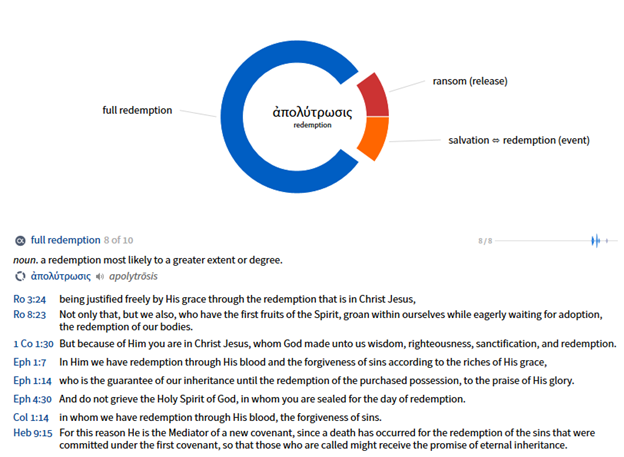
Considering redemption and the way the word is used in the New Testament, we can readily see the references of the majority of forms in the graphic. There are two other uses, one reference meaning ransom/release is cited in Hebrews 11:35 (Red.) The other is referencing an event and is the one word from Luke 21:28 we are discussing, ‘Redemption.’

I the Lord have Called You

Thus says God the Lord,
who created the heavens and stretched them out,
who spread forth the earth and that which comes out of it,
who gives breath to the people on it,
and spirit to those who walk in it:
I the Lord have called You in righteousness,
and will hold Your hand,
and will keep You and appoint You
for a covenant of the people,
for a light of the nations,
to open the blind eyes,
to bring out the prisoners from the prison,
and those who sit in darkness out of the prison house.
I am the Lord, that is My name;
and My glory I will not give to another,
nor My praise to graven images.
See, the former things have come to pass,
and new things I declare;
before they spring forth
I tell you of them.

Isaiah 42:5–9 — Modern English Version (Thinline Edition.; Lake Mary, FL: Passio, 2014)

As we continue in Isaiah 42, we see this Elect Servant of God is indeed called to a specific purpose. That is Biblical election. It isn’t being elect to salvation, but to a purpose.

Perhaps as you’ve read Romans 9, you miss what is taught. Paul introduces the chapter outlining the service Israel was appointed to do for God.

to whom belong the patriarchs, and from whom, according to the flesh, is Christ, who is over all, God forever blessed. Amen.

Romans 9:5 — Modern English Version (Thinline Edition.; Lake Mary, FL: Passio, 2014)

It is this exclusive calling given to Israel. But with Isaiah’s prophecy we can see that this calling is also to an Individual, One we know as Jesus Christ. One of the names applied to Jesus is Israel. As He fulfills the purposes of their calling.

As the One do the calling, we see God establish His “bona fides,” which is His right to elect. He does that in a specific way, which will be demonstrated in the next post on this subject.

God then promises to be the One to uphold and establish this Servant. He appoints unique characteristics and abilities to this Servant to help us identify Him. He would be the covenant of the people and to open blind eyes.

God then calls out attention back to Who He is. In the midst of that, He also gives us another way to identify this unique Servant. It is how John identifies this Servant.

The Word became flesh and dwelt among us, and we saw His glory, the glory as the only Son of the Father, full of grace and truth.

John 1:14 — Modern English Version (Thinline Edition.; Lake Mary, FL: Passio, 2014)

We saw His glory, that is God’s glory… given to another. John is establishing this Servant as God Himself.

The Elect One

Here is My servant, whom I uphold, My chosen one, in whom My soul delights. I have put My Spirit upon him; he shall bring forth justice to the nations. He shall not cry out, nor lift up his voice, nor cause his voice to be heard in the street. A bruised reed he shall not break, and the smoking flax he shall not quench; he shall bring forth justice faithfully. He shall not be disheartened nor be discouraged, until he has set justice in the earth; and the coastlands shall wait for his law.

Isaiah 42:1–4 — Modern English Version (Thinline Edition.; Lake Mary, FL: Passio, 2014)

“Here is My Servant,” says God. Here is My Chosen One. This is God speaking of Jesus. Of course, there will be much agreement on that.

However, there is another truth here that is overlooked and ignored. The idea of being chosen by God isn’t connected to salvation, not in the sense that we’ve been taught to believe. Here, God is calling the Chosen One “My Servant.”

God is speaking through Isaiah of Jesus and the service He has been chosen to render to God. We have the benefit of reading this with hindsight. When pondering this passage, we have written history of what Jesus did. Yet the completion of this something future. That is, to bring forth justice.

During Jesus’ earthly advent, of which the Gospels testify, we clearly see that His ministry was one where folks were drawn to Him. He didn’t have to preach loudly in the streets. People came to Him, being drawn to Him.

We also see in this ministry His compassion toward those who were downtrodden and weak. The informed and lame came to Him and He turned none away. Those with the littlest of faith were ministered to with compassion and mercy. The little faith they exercised wasn’t quenched. I am certain the Holy Spirit is recalling some of these to your mind as He is mine as I write.

The promise of justice on earth had begun. The kind of justice God gives, that is rendered with compassion through His Servant.

Even when He went to the cross, we read of His anguish. That is preserved for us also in the Gospels. The night of His arrest, He prayed and prayed… and prayed again. Even while His friends were fast asleep. He wasn’t disheartened, nor was He discouraged. Yet He presses on, toward that upward calling of His Father.

For each of us believers now, we hope. Because He isn’t disheartened or discouraged. Neither ought we be. It’s His task to bring justice to the Earth, and it is coming.

You may be bruised… Even close to being burnt out. You can take that burden to Jesus. Yes, you can choose to go to Him. He won’t turn you away. It doesn’t matter what you’ve done. He’s promised to not break you or extinguish you. But there is a time limit… While you yet live and justice hasn’t yet been set on earth.

Come now, He offers. Why wait?