The Message to the Church at Laodicea

“To the angel of the church of the Laodiceans write:
“The Amen, the Faithful and True Witness, the Beginning of the creation of God, says these things: I know your works, that you are neither cold nor hot. I wish you were cold or hot. So then, because you are lukewarm, and neither cold nor hot, I will spit you out of My mouth. For you say, ‘I am rich, and have stored up goods, and have need of nothing,’ yet do not realize that you are wretched, miserable, poor, blind, and naked. I counsel you to buy from Me gold refined by fire, that you may be rich, and white garments, that you may be dressed, that the shame of your nakedness may not appear, and anoint your eyes with eye salve, that you may see.

Revelation 3:14–18 — Modern English Version (Thinline Edition.; Lake Mary, FL: Passio, 2014)

The message here (so far) is to a church, a corporate-whole body of believers. Jesus is addressing the body as a whole. In so doing, this body gets a wretched report card. He calls them lukewarm.
To hear someone call any individual believer lukewarm is an immediate indication of abuse of this scriptural text. Oftentimes it is done to shame and/or control other Christians. Nevertheless… It is abuse.

So what now?

You find yourself in a congregation that appears very much like it is lukewarm (or maybe even cold.) Jesus is standing on the outside of this body, waiting to be let in. You don’t have to leave to have fellowship with Jesus. Perhaps the spark needed for a body to catch fire is yours.

There’s good news for you here.

Those whom I love, I rebuke and discipline. Therefore be zealous and repent. Listen! I stand at the door and knock. If anyone hears My voice and opens the door, I will come in and dine with him, and he with Me.

Revelation 3:19–20 — Modern English Version (Thinline Edition.; Lake Mary, FL: Passio, 2014)

If you’re a saved believer, that is you believe Jesus is the God-Man come to ransom you, forgive you of your sins, and give you eternal life. Jesus rebukes and disciplines. He never throws us out. We can repent of sins and have fellowship with Jesus restored.
If you’re not a saved believer, the invitation is to you, too.
Jesus stands at the door and knocks. Repentance is available to anyone, anytime in this life. If anyone individual hears His voice and opens the door… That is you believe He is. He died and rose again, ascended to heaven. And you’ve confessed your sin… You’ve opened the door.
He promises to fellowship with you.
To open the door to Jesus, it’s easy.

Acknowledge that you are a sinner and completely unable to get to heaven on your own merit. And that Jesus is Who He claimed to be, God.

Believe that Jesus died on the cross for your sins, and rose again to give you eternal life.

Confess those facts aloud, with your mouth. Confess your sins, ask for forgiveness and receive the gift of eternal life.

On Contradictions: 1 Kings 15:14 and 2 Chronicles 14:2-3

But the high places were not all removed, even though Asa’s heart was wholly devoted to the Lord all his days.

1 Kings 15:14 — Modern English Version (Thinline Edition.; Lake Mary, FL: Passio, 2014)

Asa did what was good and right in the eyes of the Lord his God. He took down the foreign altars and high places, and he shattered the pillars and cut down the images of Asherah.

2 Chronicles 14:2–3 — Modern English Version (Thinline Edition.; Lake Mary, FL: Passio, 2014)

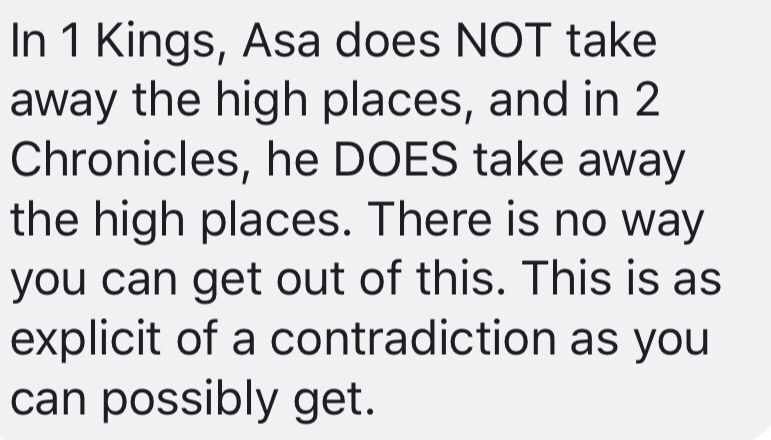
In an online conversation recently, these two texts were cited as contradictory. Here is part of a screenshot that shows the contradiction as posted.

As one sees, the assertion offered is that Asa did not remove the high places in the former and he does in the latter. The 1 Kings passage doesn’t say assign responsibility to anyone for not removing the high places. That is the first error.

In contrast, the 2 Chronicles passage clearly states Asa removes the high places. Already, we begin to see this alleged contradiction unraveling.

Greg Koukl is a Christian author and apologist. One of the points he takes the time to emphasize is never read a verse (or passage) alone. Read above and below to get a better understanding of the context.

Given that instruction, we can clearly see how both passages are truncated purposefully to prove a point. When we read the entire account of Asa’s reign in both passages and compare them, we clearly see the harmonization. Let’s expand the citation of 1 Kings:

Asa did what was right in the eyes of the Lord, just as his father David had done. He expelled the male cult prostitutes from the land and removed all the idols that his fathers had made. In addition he even deposed his grandmother Maakah as queen, because she had made an idol in a grove. Asa destroyed her idol and burned it by the Kidron brook. But the high places were not all removed, even though Asa’s heart was wholly devoted to the Lord all his days.

1 Kings 15:11–14 — Modern English Version (Thinline Edition.; Lake Mary, FL: Passio, 2014)

Now considering the account of Asa, 2 Chronicles is more detailed. If we just read verses 14:2-3, we would miss the entire explanation of the disposition of those high places. In this more detailed account of the reign of Asa, we eventually come to a better understanding of what actually happened and where.

King Asa even removed his mother Maakah from being queen mother because she had made a detestable image for Asherah. Asa cut down her image, crushed it, and burned it in the Kidron Valley. But they did not remove the high places from Israel. Nevertheless the heart of Asa was wholly committed all his days.

2 Chronicles 15:16–17 — Modern English Version (Thinline Edition.; Lake Mary, FL: Passio, 2014)

Asa has nothing to do with the remaining high places. Those were in Israel, a different nation under a different king. And they, not he, didn’t remove them. In Judah, the high places were removed, but not in Israel.

The conclusion is, each statement is correct when the context is understood clearly. There is no contradiction from which to ‘get out of.’

The End of it Shall Come with a Flood.

After the sixty-two weeks Messiah shall be cut off and shall have nothing. And the troops of the prince who shall come shall destroy the city and the sanctuary. The end of it shall come with a flood. And until the end of the war desolations are determined.

Daniel 9:26 — Modern English Version (Thinline Edition.; Lake Mary, FL: Passio, 2014)

I had highlighted this during the week to pursue later. What caught my attention is the phrase “The end of it shall come with a flood.” It in this case would be the city Jerusalem, or better the temple sanctuary in it.

Yet somewhere in the back of my mind, I remember hearing an account of a certain ancient civilization wanting to extract the last vestiges of gold from a sacked place, they flooded it with water. As the water washed through the ruins it then gushed over a grassy plain before eventually finding an outlet to a body of water. The treasure was lifted from the ruins by the water and caught in the grass of the plains. It was then retrieved. I think somewhere in my mind I always want to connect this idea with the temple but can find no sources for even the account. There is plenty of speculation on how the alleged melted gold was retrieved, but that is for another time.

Setting out this morning to try and understand, I have at least settled in my mind what is being said.

“The end of it shall come with a flood.”

In the passage, the word flood is translated from the Hebrew sheṭeph (שֶׁטֶף.) I think I want to read an English primary understanding into the translated word, meaning a flood with water. However, it seems as if the idea conveyed is just overwhelming devastation. A little later in Daniel, that same word is used as connected with armies to convey an overwhelming military army that is swept away.

A flood of armies shall be swept away before him and be broken, and the prince of the covenant as well.

Daniel 11:22 — Modern English Version (Thinline Edition.; Lake Mary, FL: Passio, 2014)

I think that helps to understand the context being offered. Still not satisfied, I checked out how the Septuagint translated the idea. The English transliteration is something like this:

Will come its end with destructive anger.

I think that better suits the idea as a judgment sent from God and overwhelming on many fronts; militarily, vast and emotional. Given some of the scant historical gleanings, the Israelis were so protective of that sanctuary. That was their identity, as the only ones who could approach and serve God.

Yet clearly in the prophecy, the Anointed One is cut off. We know Jesus was crucified. His death wasn’t for Himself (and shall have nothing.)

It is the troops of the prince who shall come who set to destroy the sanctuary. The command to do so wasn’t from Rome, a local legion set the fire. I can imagine the overwhelming confusion of the moment.

“And until the end of the war desolations are determined.”

Let’s not confuse the term desolations with what is commonly called the abomination of desolation. The former is specifically speaking of the desolations that are decreed to Jerusalem (and its people.) It is this very thing Jesus spoke of in the Olivet discourse. He was speaking of the second diaspora, the scattering of Israelis, and the desolations to come upon the city and its people.

When you see Jerusalem surrounded by armies, then you know that its desolation has drawn near. Then let those who are in Judea flee to the mountains, and let those who are in the city depart, and let not those who are in the country enter it. For these are the days of vengeance, that all things which are written may be fulfilled. But woe to those who are pregnant and to those who nurse in those days! For there will be great distress in the land and wrath upon this people. They will fall by the edge of the sword and will be led away captive to all nations. And Jerusalem will be trampled on by the Gentiles until the times of the Gentiles are fulfilled.

Luke 21:20–24 — Modern English Version (Thinline Edition.; Lake Mary, FL: Passio, 2014)

There would be a specific season for this diaspora and will end when the times of the Gentiles are fulfilled. Even in recent history, we continue to see the desolations that happen to the Jewish people; expulsion from Spain, the pogroms in Russia, and the Holocaust. These readily come to mind as modern desolations. Even now we see continued desolations spoken of in our media. The zeitgeist would shame Israel for settlements, for defending herself. The same would also divide Jerusalem for the sake of peace. Even then, the end of war won’t come until Messiah arrives.

Then the sign of the Son of Man will appear in heaven, and then all the tribes of the earth will mourn, and they will see the Son of Man coming on the clouds of heaven with power and great glory. And He will send His angels with a great sound of a trumpet, and they shall gather His elect from the four winds, from one end of the heavens to the other.

Matthew 24:30–31 — Modern English Version (Thinline Edition.; Lake Mary, FL: Passio, 2014)

The flood destroyed the city and sanctuary, and with all floods, the aftermath seems hopeless. These are the desolations that are decreed until the end of the war.

Pray for the peace of Jerusalem:
“May they prosper who love you!
Peace be within your walls
and security within your towers!”

Psalms 122:6–7 — Modern English Version (Thinline Edition.; Lake Mary, FL: Passio, 2014)

This is not meant to be an extensive explanation of prophecies, but of clearly understanding that phrase in the light of Scriptures.

Good People

I have a question I would like to pose to you. I want you to answer it honestly.

Do you think of yourself as a good person?

Let’s really examine what it means to be good. Remember, that Jesus told us that we really ought to judge… And do it correctly.

Do not judge according to appearance, but practice righteous judgment.

John 7:24 — Modern English Version (Thinline Edition.; Lake Mary, FL: Passio, 2014)

Jesus said this after He selflessly healed another on Shabbat. He mercifully rescued someone, showing the real purpose of the law and what others missed. We cannot be good by keeping it.

We know it is mercy that triumphs over judgment (James 2:13.) The principle is that the measure we offer to others will be given back to us in multiples. It is this sowing and reaping principle, as planting a seed the harvest is expected to be many more seeds.

“Judge not, and you shall not be judged. Condemn not, and you will not be condemned. Forgive, and you shall be forgiven. Give, and it will be given to you: Good measure, pressed down, shaken together, and running over will men give unto you. For with the measure you use, it will be measured unto you.”

Luke 6:37–38 — Modern English Version (Thinline Edition.; Lake Mary, FL: Passio, 2014)

The principle Jesus is using in the way we judge is to give. In so doing receive the good measure which is returned to us. In the market at those times, when one bought grain, a good measure was done like this: Grain would be ladled into a container until full. The container would then be pressed down, and more grain added. Then the vendor would tamp the container on a hard surface a few times. His would provide even more room. The vendor would finally ladle more grain into the container until it piled up and overflowed the sides.

That is a Good Measure.

Most of us, if not all, would have no problem meeting judgment to ourselves like this. Some of us will struggle to do that with some of our friends. I think the problem grows exponentially when we judge others by what they do that we do not like. It really is an unfair system.

And yeah, I am talking to myself, too.

What do We Do?

So let’s set out and esteem others better than ourselves like Paul instructs.

Let nothing be done out of strife or conceit, but in humility let each esteem the other better than himself. Let each of you look not only to your own interests, but also to the interests of others.

Philippians 2:3–4 — Modern English Version (Thinline Edition.; Lake Mary, FL: Passio, 2014)

The task can be daunting at first. But with practice (and the indwelling Holy Spirit,) it gets easier. You cannot do it without the Spirit in you. I promise.

But back to that question.

A certain ruler asked Him, “Good Teacher, what must I do to inherit eternal life?”
Jesus said to him, “Why do you call Me good? No one is good, except God alone. You know the commandments: Do not commit adultery, Do not murder, Do not steal, Do not bear false witness, Honor your father and your mother.”

Luke 18:18–20 — Modern English Version (Thinline Edition.; Lake Mary, FL: Passio, 2014)

Think about the answer now. Do you still think you are a good person?

I don’t want to beat you up (or myself for that matter.) I want to encourage all of us to really expect that good measure from ourselves, the same as we would expect it in return from others.

When it comes to judging ourselves against the law and being asked a question like I posed, we would immediately bring to mind all of our foibles. In light of the law, we would esteem ourselves as something less than good.

Brothers and sisters… If we are saved, we are good! We are good in Jesus’ name. It is His gift of righteousness — His, that He freely gives to us.

Let’s think of ourselves rightly. We are good people… Only in Jesus’ name.

I Am the Lord, I Will not Share my Glory with Another

I am the Lord, that is My name;
and My glory I will not give to another,
nor My praise to graven images.
See, the former things have come to pass,
and new things I declare;
before they spring forth
I tell you of them.

Isaiah 42:8–9 — Modern English Version (Thinline Edition.; Lake Mary, FL: Passio, 2014)

Here is God telling us yet again Who He is.

In the former post, we saw how Jesus quoted the verses before these and said they have come to pass in the very presence of His audience.

My Glory I Will not Give to Another

There are teachings that abound that deny Who Jesus Christ is. Some declare Him to be just the brother of Satan — another created being. Other teachings say He is Michael. Suffice it to say, those are wrong. It is because of these very words. God doesn’t share His glory with another.

In this Messianic prophecy, the identities of the Father are established. We’ve also witnessed from previous posts that the identity of this Chosen Servant, this Messiah is Jesus. We’ve also understood that Jesus is the fulfillment of the calling of Israel. The two ideas are so intertwined that Jesus really is the True Israel.

But here, we are given a bit of information that when coupled with Jesus’ own words… He is clearly God.

When Jesus spoke these words, He lifted His eyes toward heaven and said:
“Father, the hour has come. Glorify Your Son, that Your Son may also glorify You. As You have given Him authority over all flesh, He will give eternal life to all whom You have given Him. This is eternal life: that they may know You, the only true God, and Jesus Christ, whom You have sent. I have glorified You on the earth. I have finished the work You have given Me to do. And now, O Father, glorify Me in Your own presence with the glory which I had with You before the world existed.

John 17:1–5 — Modern English Version (Thinline Edition.; Lake Mary, FL: Passio, 2014)

In the words of Jesus, as He prays, He tells us He shared the glory with the Father.

It is the Son Who reveals the Father. We see the glory of the Father as Jesus went to the cross, and was glorified by being raised up doing the veg thing the prophet Isaiah wrote hundreds of years in advance.

There is an assent to the prohibition of graven images. God won’t share the praise given to them. It is an encouragement to us to understand Who Jesus is in the rightway. Not running afoul of the command to not praise idols.

Former things have come to pass, and as we read this it encompasses some of the things prophesied of this Servant.

But… There is only One God Who can tell you of something before it happens. He wrote it in Isaiah as a pattern for us. We see the pattern partially fulfilled. But more is yet to come.

Then they will see the Son of Man coming in a cloud with power and great glory.

Luke 21:27 — Modern English Version (Thinline Edition.; Lake Mary, FL: Passio, 2014)

He is yet to come in great glory. For some, it will be a blessing. To the whole creation that awaits redemption, it will be a blessing. But for many, this will be a day of dread.

Jesus is Best in Every Way

This is what is being taught in the book of Hebrews. It teaches of the superiority of the new covenant in Jesus. It relies on a familiarity with the Torah and the commands set forth there.

Therefore, leaving the elementary principles of the doctrine of Christ, let us go on to maturity, not laying again a foundation of repentance from dead works and of faith toward God, of instruction about washings, the laying on of hands, the resurrection of the dead, and eternal judgment. This we will do if God permits.

Hebrews 6:1–3 — Modern English Version (Thinline Edition.; Lake Mary, FL: Passio, 2014)

In other words…

Therefore, since Jesus is better let’s be moving forward and not forsaking those Old Testament things that were the foreshadows of Jesus. These are called here the elementary principles of the doctrine of Christ. Let us go on that is keep going–pressing forward – on to maturity. That is, let us be carried to salvation.

Don’t lay again a foundation for yourselves of those foreshadows, the ordinances that pointed forward to Jesus. These were commands of repentance given in the Old Testament laws to be pure and righteous.

Let’s not just put our faith toward God the Father but in Jesus. The Father is revealed in the Son.

Let’s not wander back to the instruction about washings. This is not baptism but the ceremonial washings prescribed in the law.

Let’s not continue the laying on of hands. This is not laying hands on brothers and sisters in prayer. It is pointing to the symbolic imputation of sins that was done by the priest and the one offering a sacrifice for sins.

Let’s clearly understand the resurrection of the dead, and eternal judgment. Not being entangled in Pharisee and/or Sadducee teachings.

Jesus is best. He is the only Way to heaven. The only real Salvation.

The True Israel

I the Lord have called You in righteousness,
and will hold Your hand,
and will keep You and appoint You
for a covenant of the people,
for a light of the nations,
to open the blind eyes,
to bring out the prisoners from the prison,
and those who sit in darkness out of the prison house.

Isaiah 42:6–7 — Modern English Version (Thinline Edition.; Lake Mary, FL: Passio, 2014)

This Servant is now being identified in another unique way. He is being given the same identity as Israel. The nation was called in righteousness, with the sure promise of God to uphold and defend it. It was given a covenant and a particular calling. These things are established beginning in Exodus chapter 19.

Now therefore, if you will faithfully obey My voice and keep My covenant, then you shall be My special possession out of all the nations, for all the earth is Mine. And you will be to Me a kingdom of priests and a holy nation.’ These are the words which you shall speak to the children of Israel.

Exodus 19:5–6 — Modern English Version (Thinline Edition.; Lake Mary, FL: Passio, 2014)

These are God’s words to Moses which he was to deliver to the people. Israel is to be a light to the nations. Priests are the ones who make God known to people, they intercede. This peculiar kingdom of priests was called to be a witness to all nations of the goodness of God.

For you are a holy people to the Lord your God. The Lord your God has chosen you to be His special people, treasured above all peoples who are on the face of the earth.

Deuteronomy 7:6 — Modern English Version (Thinline Edition.; Lake Mary, FL: Passio, 2014)

For you are a holy people to the Lord your God, and the Lord has chosen you to be a peculiar people to Himself, treasured above all the nations that are on the earth.

Deuteronomy 14:2 — Modern English Version (Thinline Edition.; Lake Mary, FL: Passio, 2014)

The intertwined calling of the Chosen Servant is applicable to the nation Israel. As prophecy is given to us as patterns, the calling of the nation Israel serves as a pattern for the Messiah. He would ultimately fulfill the mission the nation failed at. Jesus is the True Israel.

This is purposeful, in the earliest texts that tell the history of Israel.

Israel is My son, even My firstborn.

Exodus 4:22b — Modern English Version (Thinline Edition.; Lake Mary, FL: Passio, 2014)

The calling of Israel is extended to Jesus by another prophet.

When Israel was a child, I loved him, and out of Egypt I called My son.

Hosea 11:1 — Modern English Version (Thinline Edition.; Lake Mary, FL: Passio, 2014)

The way Israel is called by God serves as a pattern to identify the Coming Messiah.

Not so unexpectedly, I find a particular peculiarity in this pronouncement of the Chosen Servant. As the One called to open blind eyes, heal the sick, and release captives, this is the calling of priests. Israel is a kingdom of priests.

Yet we know they were blinded in their own pride. Some couldn’t recognize the Messiah. The most likely cause is an errant identity. The nation identified in their calling and not the One Who called them. Even when He spoke clearly of Who He is.

He came to Nazareth, where He had been brought up. And as His custom was, He went to the synagogue on the Sabbath day. And He stood up to read. The scroll of the prophet Isaiah was handed to Him. When He had unrolled the scroll, He found the place where it was written:
“The Spirit of the Lord is upon Me,
because He has anointed Me
to preach the gospel to the poor;
He has sent Me to heal the broken-hearted,
to preach deliverance to the captives
and recovery of sight to the blind,
to set at liberty those who are oppressed;
to preach the acceptable year of the Lord.”
Then He rolled up the scroll, and He gave it back to the attendant, and sat down. The eyes of all those who were in the synagogue were fixed on Him. And He began to say to them, “Today this Scripture is fulfilled in your hearing.”

Luke 4:16–21 — Modern English Version (Thinline Edition.; Lake Mary, FL: Passio, 2014)

We see all of these things fulfilled in Jesus’ ministry on earth by His own words. Jesus would build His church and give to them all of the privileges of service extended to the nation Israel. It would be another body identified solely in Him. But would mean the nation Israel would be set aside for a time.

For I could wish that I myself were accursed from Christ for my brothers, my kinsmen by race, who are Israelites, to whom belong the adoption, the glory, the covenants, the giving of the law, the service of God, and the promises, to whom belong the patriarchs, and from whom, according to the flesh, is Christ, who is over all, God forever blessed. Amen.

Romans 9:3–5 — Modern English Version (Thinline Edition.; Lake Mary, FL: Passio, 2014)

There is a different body that has been grafted into these privileges through Jesus. It is the body that does those things cited by the prophet Isaiah as part of the identity of the Chosen One.

That is how the church is now called elect… Chosen… To serve God in a peculiar way. It is to shine the light of Jesus to all nations.

We see clearly that the call of election is not to salvation, nor would salvation be limited to a group of people. It was the calling to a peculiar appointment of service to God.

The Everlasting Kingdom

I saw in the night visions, and there was one like a Son of Man coming with the clouds of heaven. He came to the Ancient of Days and was presented before Him. There was given to Him dominion, and glory, and a kingdom, that all peoples, nations, and languages should serve Him. His dominion is an everlasting dominion, which shall not pass away, and His kingdom that which shall not be destroyed.

Daniel 7:13–14 — Modern English Version (Thinline Edition.; Lake Mary, FL: Passio, 2014)

This Son of Man Cloud-Rider is the One given an everlasting kingdom. We know this is Jesus, as Jesus has been given all things by the Father.

He who comes from above is above all. He who is of the earth is earthly and speaks of the earth. He who comes from heaven is above all. He bears witness of what He has seen and heard, yet no one receives His testimony. He who has received His testimony has certified that God is true. For He whom God has sent speaks the words of God, for God gives the Spirit without measure to Him. The Father loves the Son, and has placed all things into His hand. He who believes in the Son has eternal life. He who does not believe the Son shall not see life, but the wrath of God remains on him.

John 3:31–36 — Modern English Version (Thinline Edition.; Lake Mary, FL: Passio, 2014)

Jesus uses this language to identify Himself as the Cloud Rider given all things by the Ancient of Days. There is a default kingdom in which all who can understand find themselves in. There is another one… His.

The carnal kingdom whose master is death by sin leads to everlasting perdition. Perdition isn’t annihilation or soul sleep, but a real eternity away from everything God gives freely to all. Think about that… The air we breathe is His. As is cooling rain, water to quench thirst, food to date hunger, and the fellowship and camaraderie of others. Imagine being conscious without these things. It gets ugly.

The other, better kingdom is eternal and everlasting. It is a dominion given to Jesus. It doesn’t pass away. It is a kingdom of life. Those who enter into it are also everlasting by definition. The only way into this kingdom is to be born again into it.

Jesus answered, “Truly, truly I say to you, unless a man is born of water and the Spirit, he cannot enter the kingdom of God. That which is born of the flesh is flesh, and that which is born of the Spirit is spirit. Do not marvel that I said to you, ‘You must be born again.’

John 3:5–7 — Modern English Version (Thinline Edition.; Lake Mary, FL: Passio, 2014)

Once born into that kingdom, there is no way out.

We are physically born into this carnal kingdom where death reigns over our bodies encumbering our soul and spirit. We cannot leave it. Death isn’t a way out, it is the portal to judgment and perdition.

But we can be born again into this new everlasting kingdom. Just like in that carnal kingdom, where there is no death. This everlasting kingdom also has no way out.

Of which kingdom would you be a citizen?

The Lord Who Created the Heavens is the Servant

Thus says God the Lord,
who created the heavens and stretched them out,
who spread forth the earth and that which comes out of it,
who gives breath to the people on it,
and spirit to those who walk in it:
I the Lord have called You in righteousness,
and will hold Your hand,
and will keep You and appoint You
for a covenant of the people,
for a light of the nations,
to open the blind eyes,
to bring out the prisoners from the prison,
and those who sit in darkness out of the prison house.
I am the Lord, that is My name;
and My glory I will not give to another,
nor My praise to graven images.
See, the former things have come to pass,
and new things I declare;
before they spring forth
I tell you of them.

Isaiah 42:5–9 — Modern English Version (Thinline Edition.; Lake Mary, FL: Passio, 2014)

Thus says God the Lord

We don’t take His words lightly. When God makes a pronouncement, it’s important. God is identifying Himself as the Creator. The One Who made all things.
Remember the verses that come before this. They are a proclamation of the coming Servant, Messiah.

Who Created the Heavens

Creator is a unique identifier of God. He made the heavens. He had no help.

That’s the first declaration of the Bible for a reason. It is the foundation for all of reality. That is why God calls attention to these simple truths repeatedly. God is, and He made the heavens and the Earth.

In the beginning God created the heavens and the earth.

Genesis 1:1 — Modern English Version (Thinline Edition.; Lake Mary, FL: Passio, 2014)

And Stretched them Out

Long ago, there was a Servant of God named Job. The important parts of his life are recorded for us. In them, we know Job knew God. Even in the midst of a great trial, his friends offered counsel on his situation. Job’s faith didn’t waver. He made a declaration about God to his friends. In it, there is an identity of God that I think is enlightening.

He who alone spreads out the heavens, and treads on the waves of the sea. He who makes the Bear, Orion, and Pleiades, and the constellations of the south.

Job 9:8–9 — Modern English Version (Thinline Edition.; Lake Mary, FL: Passio, 2014)

It is God alone Who spread out the heavens. It’s He Who makes the stars. The Psalmist agrees.

The heavens declare the glory of God, and the firmament shows His handiwork.

Psalm 19:1 — Modern English Version (Thinline Edition.; Lake Mary, FL: Passio, 2014)

It is His Handiwork

Bless the Lord, O my soul!
O Lord my God, You are very great!
You are clothed with honor and majesty,
covering Yourself with light as a garment,
who stretches out the heavens like a tent curtain,
who lays the upper beams of His chambers on the waters above,
who makes the clouds His chariot,
who rides upon the wings of the wind,
who makes His angels as winds,
His ministers a flaming fire.

Psalm 104:1–4 — Modern English Version (Thinline Edition.; Lake Mary, FL: Passio, 2014)

Though poetic, the language is telling us the heavens we created. They were made by God. They have a message for us. It is a testament of this great God Who would come to serve His creations made of dust.
Now, these last citations have referenced water and waves as a unique identifier in connection to this great God. The Psalmist includes another, He makes the clouds His chariot. This great God walks on water and has chariots of clouds.
To recap, we see the Servant in this prophecy would make advent. We are given many ways to identify this Chosen Servant. Now God chooses to identify Himself uniquely as Creator.

This Chosen Servant is the Creator

This Creator treads on the waves. We know Jesus walked on water. It is recorded in the Gospels for our edification, and to help us identify the Chosen Servant. The Gospels also identify the Servant as the Creator in many ways.

In the beginning was the Word, and the Word was with God, and the Word was God. He was in the beginning with God. All things were created through Him, and without Him nothing was created that was created. In Him was life, and the life was the light of mankind. The light shines in darkness, but the darkness has not overcome it.

John 1:2–5 — Modern English Version (Thinline Edition.; Lake Mary, FL: Passio, 2014)

There is layer upon layer of truths through the Scriptures. There are more crumbs that have fallen from the Master’s table for us.

The Cloud Rider

Let’s go to an episode toward the end of the Servant’s ministry on Earth. He has been arrested and is brought before the then High Priest of Israel. This is the one man who was assigned to intercede for Israel before God. One would think he would know the Scriptures that speak about God.
The priest demands succinctly, “I adjure You by the living God, tell us whether You are the Christ, the Son of God.”

Jesus said to him, “You have said so. But I say to you, hereafter you will see the Son of Man seated at the right hand of Power and coming on the clouds of heaven.”
Then the high priest tore his clothes, saying, “He has uttered blasphemy. What further need do we have for witnesses? See, now you have heard His blasphemy. What do you think?”

Matthew 26:64–66 — Modern English Version (Thinline Edition.; Lake Mary, FL: Passio, 2014)

Caiaphas knew Who Jesus claimed to be. He also knew from the other identifiers in the Old Testament, exactly those things exclusive to the Messiah.
Those same Scriptures also give us exclusive identifiers of the Great God. He treads on waves of the sea. This Man before him did that. This Man calls Himself publicly the Son of Man. Now He identifies Himself as this chariot-of-clouds riding God.

I saw in the night visions, and there was one like a Son of Man coming with the clouds of heaven. He came to the Ancient of Days and was presented before Him. There was given to Him dominion, and glory, and a kingdom, that all peoples, nations, and languages should serve Him. His dominion is an everlasting dominion, which shall not pass away, and His kingdom that which shall not be destroyed.

Daniel 7:13–14 — Modern English Version (Thinline Edition.; Lake Mary, FL: Passio, 2014)

This Chosen Servant is given an everlasting kingdom. This Servant is none other than God.

Of this Coming Servant… As Caiaphas asked, “What do you think?”

Is this You?

For land that drinks in the rain that often falls upon it and bears a crop useful to those for whom it is cultivated receives a blessing from God. But land that bears thorns and thistles is rejected and near to being cursed. Its destiny is to be burned.

Hebrews 6:7-8 — Modern English Version (Thinline Edition.; Lake Mary, FL: Passio, 2014)

This is a parable. The land that drinks in the rain is those who readily hear the Word of God and welcome it. Such may even serve in church, soup kitchens or volunteer for other worthy causes. You see, we can receive God’s Word and we can serve others. We can spend a lot of our time volunteering and helping others. The parable offers a caveat.

The crop is the service you do. In order for it to be blessed, it must be done with the proper motivation.

The rain and fruit must be useful for Whom it is cultivated. That is, it must be useful for God. In other words, think of it like this:

For the heart that receives the Word of God readily, and serves because their faith solely for salvation is in Jesus, and they do it for Him… Those receive the Holy Spirit and eternal life.

In other words, there is no other way to know the Father than through Jesus. You cannot know the Father by doing any of the Old Testament commandments. You cannot be doing it by going to confessional or adhering to the dictates of some organization like the Watchtower or Latter-Day Saints. The only way to know the Father is through Jesus.

Jesus said to him, “I am the way, the truth, and the life. No one comes to the Father except through Me. If you had known Me, you would have known My Father also. From now on you do know Him and have seen Him.”

John 14:6-7 — Modern English Version (Thinline Edition.; Lake Mary, FL: Passio, 2014)

Those that don’t have the former, a heart cultivated by Jesus to receive the truth of His Word and bear fruit for Him… Are rejected and near being cursed. If that is you, as you read this, there is still hope for you.

Acknowledge that Jesus is God.

Believe (the Bible says in your heart) that He is God, that He lived on earth as recorded, He died to forgive your sins and He rose again and lives today.

Confess it aloud with your mouth!