The Name: Yours

For the sake of Zion I will not keep silent, and for the sake of Jerusalem I will not rest until her righteousness goes forth as brightness and her salvation as a lamp that burns. The nations shall see your righteousness, and all kings your glory. And you shall be called by a new name, which the mouth of the Lord shall name. You shall also be a crown of glory in the hand of the Lord and a royal diadem in the hand of your God. You shall no more be termed Forsaken, nor shall your land be termed Desolate; but you shall be called My Delight Is In Her, and your land Married; for the Lord delights in you, and your land shall be married. For as a young man marries a virgin, so your sons shall marry you; and as the bridegroom rejoices over the bride, so your God shall rejoice over you.

Isaiah 62:1–5

As Isaiah writes, it is easy to see the love that God has for Israel. Even though her disobedience produced many problems and the land became forsaken, God promises restoration. With that restoration also comes another surprising promise. One is this principle I want to explore.

Years ago, I wrote a small series of posts on the idea of The Name. It was to show the importance of names, and specifically related to the promises of God. With redemption and restoration, God gives new names. Just as the one we bear now passed on to us by our parents, the Father will give new names to His children.

Back to Isaiah, the prophet is relating how God perceives Zion. That is, the mountain of God… Jerusalem. Sometimes when names like Zion, Jerusalem, and others are used, it is as a rhetorical device. In this case, Jerusalem is a synecdoche for the people of Israel.

Many years ago, Mark Twain visited the Holy Land and wrote a travelogue entitled “Innocents Abroad.” There is some controversy in quoting him. Some say it is out-of-context to make it appear as some sort of proof of what the Bible says. But much of what he described in his experience of traveling through the Holy Land is that the land did appear forsaken and desolate. He said of the city of Jerusalem, that it could be circumnavigated on foot at a normal pace in about an hour.

That was long before Israel became a nation in the early 20th century. For almost 2,000 years, there was no nation. The Israeli people were scattered among the nations of the world. Even though they retained their national identity in diaspora, it would be apt to describe their plight as forsaken.

We have had and continue to have the privilege to witness firsthand this saga of redemption as God promised would happen. Isaiah wrote much of the future for Israel. There are controversial opinions that the prophecies have been fulfilled, while others think there is yet a future consummation of these. Yet since the birth of the nation in 1948, much seems to bloom as we watch.

The wilderness and the solitary place shall be glad, and the desert shall rejoice and blossom as the rose; it shall blossom abundantly and rejoice even with joy and singing. The glory of Lebanon shall be given to it, the excellency of Carmel and Sharon. They shall see the glory of the Lord and the excellency of our God.

Isaiah 35:1–2

It is a controversial statement to say that the modern state of Israel made the desert blossom. That’s because the world wants Israel to be thought of by her old names Forsaken and Desolate. Perhaps it is just a bit of jealousy. This seeming increasing favor to Israel becomes a silent portent of urgency. I think deep inside, we all know the time of the end is near. It is Israel that is God’s timepiece.

We mere mortals living now have witnessed an extraordinary move of God in our lifetimes. Some of you may be a bit older than I… Many perhaps younger. But there is no mistake. It is now almost 80 years into the existence of Israel, and the land has had remarkable and noteworthy changes. It is hard not to acknowledge those. It is almost as if Israel were a bride being gussied up for a wedding!

And what happens to a bride when she gets married?

Well, traditionally… She takes on a new name. After all, the name is what I am writing about.

Israel will have a new name. It will be given by the mouth of the Lord. It is a promise of the Lord’s delight in His people.

Recently, in our small group as we study the book of Exodus, we chatted about how most people perceive the God of the Tanakh as different than how Jesus is portrayed. Having read through the Old Testament many times, it is remarkable how quickly one can be disabused of that idea. He is the same God. Jesus attested to the fact.

Then they said to Him, “Where is Your Father?”
Jesus answered, “You know neither Me nor My Father. If you knew Me, you would know My Father also.”

John 8:19

If one knows the Father, they would immediately know Jesus. It follows, if one knows Jesus, they would know the Father. It is an inescapable conclusion that they are the same God with the same purpose.

Some call it the romance of redemption. As Israel is redeemed, a new name will be given. Yet surprisingly, this is a principle that applies to each of us as individuals. God wants to redeem us in the same way He redeems His people collectively. This is one of those promises that is for you.

I know for me, the world programmed my inner voice to go along with the names it wanted me to go by… Ugly, Fat, Unimportant… Whatever. But now, since I have been redeemed… God calls me His son. Jesus calls me a brother. Yet I know there is something greater in store. Something that is intimately between God and I.

He who has an ear, let him hear what the Spirit says to the churches. To him who overcomes I will give the hidden manna to eat. And I will give him a white stone, and on the stone a new name written, which no one knows except he who receives it.

Revelation 2:17

There is far more than just getting a new name… Being redeemed means to never perish and to never be forsaken. Things the promise to Israel. It is the same promise that Jesus extends to each of us. Jesus Himself will publicly proclaim the name He gives to me before others.

He who overcomes shall be clothed in white garments. I will not blot his name out of the Book of Life, but I will confess his name before My Father and before His angels.

Revelation 3:5

As extraordinary as all of that sounds, I will also be inscribed with Jesus’ own new name.

He who overcomes will I make a pillar in the temple of My God, and he shall go out no more. I will write on him the name of My God and the name of the city of My God, the New Jerusalem, which comes down out of heaven from My God, and My own new name.

Revelation 3:12

What does this mean?

Well, I think if you’ve ruined your reputation, there is redemption in Jesus for each of us. I also know, as we watch Israel become more prosperous, it is a reminder of the urgency to be right with God. And that is easy.

Wherever you are, whatever you’re doing… You can stop and acknowledge God right now. Believe that He came to redeem you. He sent His Son Who satisfied your moral failures taking them upon Himself. He died taking them to the grave. And He rose again, giving the gift of eternal life to any who wishes to have it. Then confess that belief out loud. You may also confess your sins and He takes them away.

Salvation is easy…

Acknowledge He is. The Bible calls this repentance.

Believe He died and rose again for you.

Confess, tell others about it.

Hananiah, Mishael, and Azariah

Many years ago, I was challenged to remember the Hebrew names of the three young boys that are mentioned with Daniel. I did, and it is something salted away. Sometimes I count this stuff as information that has no real purpose other than maybe pride. Boy, did I get a shock recently!

Let’s lay this out. When Nebuchadnezzar defeated King Jehoiakim of Judah, he carried away the treasures of the land to Babylon. Among the things also brought to Babylon were the nobles and royals. Also taken were the handsome and skilled youth. These would be trained for three years in the ways of Babylon and to eventually serve in Nebuchadnezzar’s court.

Now among them were of the sons of Judah: Daniel, Hananiah, Mishael, and Azariah, to whom the commander of the officials gave names. And he gave to Daniel the name of Belteshazzar; to Hananiah, Shadrach; to Mishael, Meshach; and to Azariah, Abednego.

Daniel 1:6–7

We are introduced to four of the young ones; Daniel, Hananiah, Mishael, and Azariah. In order to inculcate them in the ways of Babylon, their names were changed to honor Babylon’s gods. They became known as Belteshazzar, Shadrach, Meshach, and Abednego. As the account continues, Daniel is usually referred to by his Hebrew name. The other three youths eventually are not.

Perhaps there is something obscured in the details here. Maybe there is something else to find. Rarely might anyone think, what’s in a name?

God has Favored

And in the second year of the reign of Nebuchadnezzar, Nebuchadnezzar had dreams, and his spirit was troubled and his sleep left him. Then the king gave the command to call the magicians and the astrologers and the sorcerers and the Chaldeans to tell the king his dreams. So they came and stood before the king. The king said to them, “I have had a dream, and my spirit is anxious to understand the dream.”
Then the Chaldeans spoke to the king in Aramaic, “O king, live forever. Tell your servants the dream, and we will tell the interpretation.”

Daniel 2:1–4

After the introduction of the characters and setting, we come to an account of life with Nebuchadnezzar. As it goes, he is bothered by a dream. He calls for the magi to interpret the dream. They ask for him to recount the dream. But there is a less than gracious response.

The king answered and said to the Chaldeans, “The command from me is firm: If you will not make known to me the dream with its interpretation, you shall be cut in pieces and your houses shall be made a dunghill. But if you tell the dream and its interpretation, you shall receive from me gifts and rewards and great honor. Therefore tell me the dream and its interpretation.”

Daniel 2:5–6

What stands out there is the king refuses to tell and wants the magi to both retell the dream and give the interpretation. It is an impossible task, or so it seems. The stark reality shows a lack of graciousness.

The magi plead with the king to tell the dream. The king will not relent in his indifference toward his servants.

The king answered and said, “I know of certainty that you are bargaining for time, because you see that the command from me is firm: If you will not make known to me the dream, there is but one decree for you. For you have agreed to speak lying and corrupt words before me until the circumstance is changed. Therefore tell me the dream so that I know that you can tell me its interpretation.”

Daniel 2:8–9

Things become dark quickly. The magi were despairing at the insurmountable ask from the king. And Nebuchadnezzar became angry and furious which made him rather more impatient. He commanded all the wise men to be killed jot quite grasping that his rash decision would be very costly to him personally.

But alas… Enter Daniel. With wisdom and discretion he asked the captain of the king’s guard about the urgency of the decree. When the guard replied, Daniel sought time from the king to provide an interpretation of the dream.

Daniel returned to his three companions, and asked them to pray for favor from the Lord. Daniel and his friends would be of the ones that would succumb under the king’s selfish decree. At night, the secret dream of the king was revealed to Daniel in a vision.

Daniel blessed God for revealing the dream and giving the interpretation of it. Urgently, he then sought the captain of the guard and an audience with the king. Daniel explained the dream and the interpretation of the dream.

Then King Nebuchadnezzar fell upon his face and did homage to Daniel, and commanded that they should present an offering and sweet incense to him. The king answered Daniel and said, “Truly your God is a God of gods, and a Lord of kings, and a revealer of secrets, since you could reveal this secret.”

Daniel 2:46–47

I think that Nebuchadnezzar learned of the graciousness of God toward him through his servant Daniel.

Who is What God Is?

The next account in the life of the king is probably the most familiar. It is the telling of the three companions of Daniel and the fiery furnace.

Nebuchadnezzar the king made an image of gold, whose height was sixty cubits and its width six cubits. He set it up in the plain of Dura in the province of Babylon.

Daniel 3:1

The king had built a 90 foot statue of gold to represent himself. His kingdom would not be just the head as in his previous dream, but the whole thing would be his. It’s rather pretentious.

He called all of the government officials out. This signifies the power he holds over the kingdom. But then musicians are mentioned. And when the music started, all were to bow down and worship the statue. Nebuchadnezzar was exalting himself as king of the world and god of the world.

Then a herald cried aloud: “To you it is commanded, O peoples, nations, and languages, that at the time you hear the sound of the cornet, flute, harp, sackbut, psaltery, dulcimer, and all kinds of music, you should fall down and worship the golden image that Nebuchadnezzar the king has set up. And whoever does not fall down and worship shall the same hour be cast into the midst of a burning fiery furnace.”

Daniel 3:4–6

The punishment for not obeying the decree is an immediate and fiery death. The people dutifully worshipped when they heard the music. As it was, there is some intrigue as the three companions of Daniel refuse.

Therefore at that time certain Chaldeans came near and accused the Jews. They spoke and said to King Nebuchadnezzar, “O king, live forever. You, O king, have made a decree, that every man who hears the sound of the cornet, flute, harp, sackbut, psaltery, and dulcimer, and all kinds of music should fall down and worship the golden image. And whoever does not fall down and worship should be cast into the midst of a burning fiery furnace. There are certain Jews whom you have set over the affairs of the province of Babylon: Shadrach, Meshach, and Abednego. These men, O king, have not regarded you. They do not serve your gods or worship the golden image which you have set up.”

Daniel 3:8–12

Of course this infuriates the king. (I see the pattern.) But the rage is palpable. He calls for the three young ones to be brought before him.

Nebuchadnezzar spoke and said to them, “Is it true, Shadrach, Meshach, and Abednego, that you do not serve my gods or worship the golden image which I have set up? Now if you are ready at the time you hear the sound of the cornet, flute, harp, sackbut, psaltery, and dulcimer, and all kinds of music to fall down and worship the image which I have made, very well. But if you do not worship, you shall be cast the same hour into the midst of a burning fiery furnace. And who is that god who can deliver you out of my hands?”

Daniel 3:14–15

Who is that God indeed?

They don’t bow and Nebuchadnezzar becomes even more visibly infuriated. He calls for the furnace to be made seven times hotter. (Is it because his rage was likewise seven-times greater?)

Well, the three companions are thrown into the dangerously hot furnace. It was so hot that the men of valor who tossed them in died instantly. As before, the king’s rage wasn’t potentially costly, he now lost some of his best men.

Our heroes fell down in the furnace.

Then Nebuchadnezzar the king was astonished, and rose up in haste, and spoke, and said to his counselors, “Did we not cast three men bound into the midst of the fire?”
They answered and said to the king, “True, O king.”
He answered and said, “But I see four men loose and walking in the midst of the fire, and they are unharmed. And the form of the fourth is like the Son of God!”

Daniel 3:24–25

It was pointed out recently that the Septuagint says these men were singing and praising God, and Nebuchadnezzar heard that. It is a blessing that I have access to a the Lexham English translation of the Septuagint. It was difficult to find a resource online, but I did. You can read the Septuagint version of Daniel 3 here. (I am only using that website as a reference for the work itself. It is not an endorsement of the site or teachings therein.)

Yet I digress…

The singing is fascinating, and very apropos as worship music is part of the vignette. Except now the praise and worship isn’t for the people to bow to the king. It is praise pouring all to God. The God who stood with these men in the fire.

As it is, the astonished king see the Son of God in the fire with the three young men. I can imagine the thought in his mind, “Who is that God?” If he heard the singing, he would have to know the answer.

He then calls to the three to come out. They came out alive. There was no evidence surrounding them that would lead one to think they had been in the midst of an exceedingly hot fire. There was not even the smell of smoke on their garments.

Then Nebuchadnezzar spoke and said, “Blessed be the God of Shadrach, Meshach, and Abednego, who has sent His angel and delivered His servants who trusted in Him. They have defied the king’s word, and yielded their bodies, that they might not serve nor worship any god, except their own God. Therefore I make a decree that every people, nation, and language which speaks anything amiss against the God of Shadrach, Meshach, and Abednego shall be cut in pieces, and their houses shall be made a dunghill, because there is no other God who can deliver in this way.”

Daniel 3:28–29

It seems as the more Nebuchadnezzar has personal experiences with God that his heart toward the Most High changes. We’ve encountered the changes in him and now see he acknowledges Who God is. He has yet to come to terms with his pride in himself.

God has Healed

Nebuchadnezzar the king,
to all peoples, nations, and languages, who dwell in all the earth:
Peace be multiplied to you.
I thought it good to declare the signs and wonders that the Most High God has done for me.
How great are His signs,
and how mighty are His wonders!
His kingdom is an everlasting kingdom,
and His dominion is from generation to generation.

Daniel 4:1–3

The first thing I notice is the stark change in the attitude of the king toward the Most High God. He now has a personal testimony of what God has done for him. But as it is in this third account of the life of Nebuchadnezzar, he has an another dream.

I, Nebuchadnezzar, was at rest in my house, and flourishing in my palace. I saw a dream which made me afraid, and the thoughts upon my bed and the visions of my head troubled me. Therefore I made a decree to bring in all the wise men of Babylon before me, that they might make known to me the interpretation of the dream.

Daniel 4:4–6

This seems to be a very similar situation to the previous dream. The vision besets him and he calls for the magi to help him with understand the dream.

Then came in the magicians, the astrologers, the Chaldeans, and the soothsayers, and I told the dream before them; but they did not make known to me its interpretation.

Daniel 4:7

Unlike the first account, Nebuchadnezzar relates the dream to his wise men. He doesn’t threaten them. He’s not impatient. He seems to have learned a lesson of graciousness. Then Daniel comes before the king, who relates the dream. And the king asks Daniel to interpret the dream knowing there is none like Daniel’s God.

Then Daniel, whose name was Belteshazzar, was astonished for a while, and his thoughts troubled him. The king spoke and said, “Belteshazzar, do not let the dream, or its interpretation, trouble you.”
Belteshazzar answered and said, “My lord, if only the dream was for those who hate you, and its interpretation for your enemies!

Daniel 4:19

There is palpable trepidation for Daniel. Nebuchadnezzar picks up on that. He encourages Daniel to speak anyway and to not be afraid. Daniel’s answer reveals that the dream is about the king and some unsettling things that will happen to him. Daniel’s gives the interpretation, which included a decree from God.

“This is the interpretation, O king, and this is the decree of the Most High, which has come upon my lord the king: You shall be driven away from men, and your dwelling shall be with the wild animals. You shall be given grass to eat like oxen, and wet with the dew of heaven. And seven times shall pass over you, until you have learned that the Most High rules over the kingdom of men and gives it to whomever He chooses. Inasmuch as they commanded to leave the stump of the tree roots, your kingdom shall be assured to you after you acknowledge that Heaven rules.

Daniel 4:24–26

For seven years, Nebuchadnezzar would be like an ox and eat grass. He would be like one of the lowliest of the animals. It is a lesson in humility that the king must learn. But there is hope of the horizon. He will be restored to his kingdom.

All this came upon King Nebuchadnezzar. At the end of twelve months he walked on the roof of the palace of the kingdom of Babylon. The king spoke, saying, “Is this not Babylon the Great that I myself have built as a royal residence by my mighty power and for the honor of my majesty?”

Daniel 4:28–30

Life for Nebuchadnezzar continues. A year later, when he exalted himself in pride… The decree came.

While the word was in the king’s mouth, there fell a voice from heaven: “O King Nebuchadnezzar, to you it is spoken: The kingdom has departed from you! And you shall be driven away from men, and your dwelling shall be with the animals of the field. You shall be given grass to eat as oxen, and seven periods of time shall pass over you until you know that the Most High rules over the kingdom of men and gives it to whomever He wills.”

Daniel 4:31–32

After seven years of a lowly existence eating grass, Nebuchadnezzar comes to his senses. He blesses the Most High and praises Him. In the same instant, the king was healed and restored.

At the same time my reason returned to me. And for the glory of my kingdom, my honor and splendor returned to me. And my counselors and my lords sought me out. Then I was established in my kingdom, and excellent majesty was added to me. Now I, Nebuchadnezzar, praise and extol and honor the King of heaven, for all His works are true and His ways just, and those who walk in pride He is able to abase.

Daniel 4:36–37

The account of Nebuchadnezzar is fascinating. Here is the prideful king of the greatest nation to rule the world setting aside his pride to worship God. It wasn’t that God changed his heart. But brought him dreams and others around him to tell him about God. And God revealed Himself to Nebuchadnezzar in the midst of a few object lessons.

What is in a Name?

Everything in your Bible is there by design. There are no coincidences in it. The message it has is integrated within the text in various ways. The details that are in the first chapter of Daniel provide an introduction to who Daniel is. In the midst of that, we are introduced to some other companions of him. And we are told their names were changed. Daniel and his three companions are given new names.

Is there a corelating significance that we are also given three vignettes of the life of Nebuchadnezzar as king?

The Babylonian training of these young men lasted three years. I think the fact that there are three companions and three radical vignettes told in three chapters is there by design. And I think it has to do with the names given to those young men. No, not the new Babylonian names, but the Hebrew names they were given.

Daniel means God is my judge. In a sense, Daniel becomes the one who pronounces the judgment of God in the two dreams. And it is through Daniel that we learn of the judgment of God on Nebuchadnezzar.

In the first account of the first dream. Nebuchadnezzar is characterized as far less than gracious. But by the favor of God, he is provided an interpretation of a dream that frightened him. The name Hananiah means Yah has acted graciously. That is exactly what we see, God acting graciously toward Nebuchadnezzar. There is a stark change in the king to acknowledge that grace.

The first dream led Nebuchadnezzar to exalt himself as not only king of the world but God of the world. He demanded worship by decree and immediate death to those who don’t comply. In his tantrum he asks, “And who is that god who can deliver you out of my hands?” Mishael means who is what God is. The king had an answer to his question. He learned that there is no god like the Most High God.

The third vignette is set with another dream. The king’s fits of anger and fury have seemed to go away. He is grace to others is real. And he acknowledges God. But there is that kingly pride in himself that must go. A decree comes from God to make the king to suffer the lowliest of existences for seven years until he comes to his senses. Eventually he does and he is restored to himself and his kingdom. Azariah means Yah has helped. And the king knows God has restored him.

Four Truths

Nebuchadnezzar learned some things about God. As he did, the changes in himself become apparent. By his own personal testimony, the king could say about God:

He is Judge.

He acts graciously.

There is no other like Him.

He heals and restores.

Read your Bible. And be surprised at those things that are obscured just beyond your perception. They are there for a reason. Don’t be afraid to dig them out.


The Efficient Work of the Cross

For all have sinned, and come short of the glory of God; Being justified freely by his grace through the redemption that is in Christ Jesus:

Romans 3:23–24

I am certain the former verse has been cited to everyone reading. It is used to demonstrate that everyone has failed to make the mark God has set. For those of us in the church, we say all are sinners.

It is one of the most disheartening things to encounter, by the time we understand clearly, we know the reality that each of us has already missed the mark set by God. Yet that is the truth being declared.

In the wake of what appears to be stultifying judgment comes the next thought. The same folks that have already fallen short… Are being justified freely. Meaning, that they are treated as if the offense didn’t happen. (It doesn’t mean that the offense did not happen, just that the penalty for the offense is delayed.

What is being offered here is clear. Jesus died sufficiently and efficiently for those that have fallen short. That’s what He did at the cross. That freedom comes to all, believers or not.

But… There’s always a but… What Jesus did at the cross isn’t about eternity. It’s about physical existence now… When you decide your eternity.

The cross alone gets nobody to heaven. It provides a “day of salvation.” That is, time to consider reality and repent. Repent means to change direction.

When confronted with the fact that Jesus died for your own shortcomings, what do you do?

You could ignore it, shun it, mock it, or whatever. Clearly, you have that freedom. Freedom came at a great cost to Jesus.

Or you could use that delay as a time to change your mind. You could believe that what He did is for you. (And it is because you’re alive right now reading this.) You could confess it aloud to Jesus. Then confess your sins to Him, and receive the gift of eternal life.

It’s clear from the context that Jesus did indeed die efficiently for all, believer and unbeliever alike. But what will you do with the freedom Jesus gave you?

What Seems to be Vengeance Becomes a Beautiful Picture of Redemption

So these things will be for a statute of judgment to you throughout your generations in all your dwelling places.

Numbers 35:29 — Modern English Version (Thinline Edition.; Lake Mary, FL: Passio, 2014)

Moses by direction from God had just given established the idea of sanctuary cities. These are places where someone who accidentally kills another person can flee and escape vengeance.

When reading through this portion, it is quick to realize that the cities of refuge become a typification of our refuge in Jesus. It is a fascinating concept to study. Let’s leave that for another time.

After Moses declares the statute to the Israelites, there are other important concepts that must be understood.

The Bondage of Blood Vengeance

Whoever kills another person, the murderer will be put to death by the testimony of witnesses, but one witness will not testify against a person for death.

Numbers 35:30 — Modern English Version (Thinline Edition.; Lake Mary, FL: Passio, 2014)

This establishes the idea of capital punishment. It would be easy to read past this and think nothing further. One who willfully murders must be killed. A closer examination also reveals how that is to happen. Multiple witnesses are required. Think about that.

The Bible tells us that the wages of sin are death. We know from the Gospel of John that by the time people can understand right and wrong, and the standard needed to be righteous… Each of us has already failed. We stand condemned to capital punishment.

We also know that there is a purpose for it. Every person has the same Redeemer.

For God has imprisoned them all in disobedience, so that He might be merciful to all.

Romans 11:32 — Modern English Version (Thinline Edition.; Lake Mary, FL: Passio, 2014)

As that is established and to avoid digression, let’s move forward.

There is tension just underneath the surface of the idea that multiple witnesses are necessary for a sentence of capital punishment to be imposed. If this is true for the murderer, it must be true for other instances of capital punishment. Deuteronomy 19:15 clearly establishes precedent. When we think of the judgment of God and the penalty of death for sins, who are the witnesses against us?

What I am thinking, is that this is a hint to the nature of God. Specifically, the idea of personhood in the Godhead. Informally, we use the word triune (or Trinity) to convey this idea.

Nevertheless, the requirement is for more than one witness to establish a matter. While that is an interesting bit of enlightenment, let’s move on and see if we can find any more information on the nature of God.

Ransom

And you will not take a ransom for the life of a murderer who is guilty of death, but he will surely be put to death.
You will not take a ransom for him who fled to the city of his refuge, that he should come out again to dwell in the land, until the death of the priest.

Numbers 35:31–32 — Modern English Version (Thinline Edition.; Lake Mary, FL: Passio, 2014)

The Hebrew word translated into English ransom specifically infers the use of money. There would be no way to fix this with money. Cash payment cannot fix bloodshed.

As we will soon encounter, bloodshed has a much broader impact. It defiles the land. The murderer cannot be freed by an act of ransom, nor can the one who has caused another to die by accident escape by ransom.

That presents a unique conundrum, as we often speak of what Jesus did at Calvary as ransom or better redemption. The Bible uses those terms to describe it. Jesus even declared He would do just that, ransom many.

It shall not be so among you. Whoever would be great among you, let him serve you, and whoever would be first among you, let him be your slave, even as the Son of Man did not come to be served, but to serve and to give His life as a ransom for many.”

Matthew 20:26–28 — Modern English Version (Thinline Edition.; Lake Mary, FL: Passio, 2014)

In the midst of the text that speaks of vengeance for homicide and capital punishment for murder, we clearly see Jesus. In fact, He is woven intricately into this entire chapter in typologies. The Bible says the law is a schoolmaster to lead us to Jesus. Here, He is a sure Refuge for the person. He is the place (or city of) refuge from vengeance. He is the place to flee to escape the sword. We have respite until the death of the high priest. We know Jesus is the ultimate High Priest. We also know that He doesn’t die.

But what if one purposefully sins?

In this context, it’s the murderer. The murderer is cut-off by the testimony of more than one witness. In other words, the murderer has his blood shed in vengeance on the testimony of multiple witnesses. There is no ransom by money.

So you will not defile the land which you are in, because blood defiles the land, and the land cannot be cleansed of the blood that is shed in it, except by the blood of him that shed it. So do not defile the land which you are dwelling in, where I am residing, because I the Lord am residing among the children of Israel.

Numbers 35:33–34 — Modern English Version (Thinline Edition.; Lake Mary, FL: Passio, 2014)

Since the very first murder, God declared the truth about death… Blood on the land cries out.

And then He said, “What have you done? The voice of your brother’s blood is crying out to Me from the ground.

Genesis 4:10 — Modern English Version (Thinline Edition.; Lake Mary, FL: Passio, 2014)

The very creation itself demands justice!

Bloodshed defiles the land. The land cannot be cleansed except by the blood of the person who shed it. This stands true for both the willful and accidental shedding of blood.

This idea of redemption has to be much greater than just an application to an individual. It has to be much greater than applying it to the entire human race. The creation itself yearns to be redeemed.

For the creation was subjected to futility, not willingly, but by the will of Him who subjected it, in hope that the creation itself also will be set free from its slavery to corruption into the glorious freedom of the children of God.

Romans 8:20–21 — Modern English Version (Thinline Edition.; Lake Mary, FL: Passio, 2014)

The Redemption of Creation.

So then, as the children share in flesh and blood, He likewise took part in these, so that through death He might destroy him who has the power of death, that is, the devil, and deliver those who through fear of death were throughout their lives subject to bondage.

Hebrews 2:14–15 — Modern English Version (Thinline Edition.; Lake Mary, FL: Passio, 2014)

Death was introduced into creation by one man. It came through insurrection, really. Nevertheless, it was introduced as something foreign.

This isn’t the idea of original sin or even spiritual death. Those ideas are over-simplifications that lead to gross error.

We also know that the bondage of death is something God placed all men under. And He came as a Kinsman… As a human… To shed His own blood to satisfy all of this at once. You and I are redeemed… Purchased… Ransomed not with money. We are rescued from bondage by His blood. This is true for the entirety of Adam’s race, also. (It doesn’t mean that everyone goes to heaven, though.)

But it was through this foreign enemy introduced into His perfect creation by insurrection. God would seize death and use it to deliver the entire creation from bonds. Though the enemy had the power of death and used the fear of it to enslave humanity. It is ultimately God Who placed all under that bondage of futility.

In essence, when a man dies the blood on the ground cries out!

Death is something forbidden in creation. It’s not permitted. Yet, it is here nevertheless. As the enemy uses it to place us in the bondage of fear, God uses it to vanquish the enemy. He has shed His own blood to free us (and the creation) from that nasty intrusion.

Truth reconciles.

It was God who prescribed the penalty for sin… Death. It’s not that death is a good thing. It is not. It is the very enemy. It is the sharpest tool in the enemy’s arsenal to subdue humanity. Yet, in all his craftiness, the nefarious one cannot out-maneuver God. God wrenched that tool from the grip of Satan. He used it to defeat the enemy.

I don’t think I can adequately explain all of the details to come to this conclusion, but I hope I have supplied enough to pique interest.

God alone has the power of life and death. The blood of humanity cries out for redemption. It pollutes creation. The only way to cleanse it is by vengeance on the one who shed the blood.

God steps in as the One Who ultimately is responsible for shedding the blood (placing all under the bondage of futility.) Not that He murders, as it is a just recompense. Nevertheless, the blood is shed. And it defiles the land. So God also steps in to shed His own blood to cleanse the land.

Escape to Another

“The brother will deliver up the brother to death, and the father the child. And the children will rise up against their parents and cause them to be put to death. You will be hated by all men for My name’s sake. But he who endures to the end will be saved. But when they persecute you in this city, escape into another. For truly I say to you, you will not have gone through the cities of Israel before the Son of Man comes.

Matthew 10:21–23 — Modern English Version (Thinline Edition.; Lake Mary, FL: Passio, 2014)

Jesus told of trying times that will come. He spoke of persecution. He said when they persecute in one city, go to another.

It might be tempting to think that fleeing to another city is a temporary solution. It could be… But the promised end is not temporary.

That is hope for us at any time. For a believer, the future is secure in Jesus.

You Are the Children of the Living God

Yet the number of the children of Israel will be as the sand of the sea, which cannot be measured nor numbered. And in the place where it was said to them, “You are not My people,” there it will be said to them, “You are the children of the living God.” Then will the Judahites and the children of Israel be gathered together, and appoint themselves one head, and they will come up out of the land, for great will be the day of Jezreel.

Hosea 1:10–11 — Modern English Version (Thinline Edition.; Lake Mary, FL: Passio, 2014)

The things that are hidden just below the surface reading of the text are amazing. In reading tonight there were many things to see. This one stands out.

The prophet Hosea took a wife by the command of God. Not just any wife, but he was told to take a wife of harlotry. In the entire account of Hosea, there is much to learn about relationships with people and to forgive them their foibles as we have our own, too. Most importantly, the book shows us God’s love for His people.

The union of Hosea and Gomer produced children. The first born was Ammi meaning my people. The second was Lo-Ruhamah meaning not pitied. The third was Lo-Ammi meaning not my people. Already one can perceive a story is written in the meanings of the names. It is in this account of the third which leads to the discovery at hand.

Here is God saying to those who are His people that you aren’t pitied and are not His people. Those who aren’t His people are to be His people. The overt meaning is that Gentiles would be called His people. This is the mystery hidden in the text. Part of which Paul wrote of about a body that consisted of Gentiles being called His people.

Being the people of God isn’t a birthright thing. This is part of what kept Israelites from believing Jesus when He came to them. They thought they had a physical birthright to the Father. And they did. But that alone didn’t make them His people.

Jesus answered him, “Truly, truly I say to you, unless a man is born again, he cannot see the kingdom of God.”

John 3:3 — Modern English Version (Thinline Edition.; Lake Mary, FL: Passio, 2014)

This is God saying that any person could be His people.

Then… That word then imposes itself in the text. This adds a timey-wimey element to the discussion. In this case after when those “not His people” become His people something else happens. That something else is what we are eyewitnesses of today.

Of course, the translation I used says the Judahites and the children of Israel will come up out of the land… But is better understood that the whole of Israelites will be gathered together as one in the land.

Oh, I know there was a previous regathering of Israelis from the diaspora but that was limited to Judah and part of another tribe as they returned from Babylon. Throughout the prophets, there is a second exile that isn’t quite explained as a second exile. Maybe it was a continuation of the first. But the twelve tribes have not been regathered into the land until recent times.

And Many Animals

Sometimes I cannot read the Bible without other ideas swirling in my brain. Most of those ideas are just vapidity. Yet every once in a while, an idea coalesces with the Scriptures that is intriguing. It happened this morning.

In reading Jonah, this stood out.

Then he made a proclamation in Nineveh:
“By decree of the king and his nobles:
No man or animal, no herd or flock, shall taste anything. They shall not eat or drink water. Both man and animals shall cover themselves with sackcloth and cry mightily to God. All shall turn from their evil ways and from the violence that is in their hands. Who knows? God may relent and change His mind. He may turn from His fierce anger, so that we will not perish.”

Jonah 3:7–9 — Modern English Version (Thinline Edition.; Lake Mary, FL: Passio, 2014)

To give some context, Jonah was sent to Nineveh because of the wickedness practiced in the city. It is said that the wickedness itself came up before God.

Of course, Jonah didn’t heed God’s command to go and purposed to go to sea traveling in the opposite direction away from Nineveh. God sent a storm on the ship, Jonah persuaded the shipmates to throw him overboard. God appointed a fish to swallow Jonah. In that fish, Jonah came to his senses and was spit out on dry land.

The fish must have brought Jonah very near Nineveh as God commanded Jonah yet again to go and give them His message.

Upon this second command, Jonah complied and did as God said. He preached the coming destruction of Nineveh to the inhabitants of the vast city. The message was heard, even by the leaders of the city. That takes us to the passage above.

Aside from the repentance and crying to God for mercy, there is a tacit confession of sin in the decree. Not only that, all people and animals were to participate in this plea for mercy.

That is where ideas collide. Sometimes, I read scriptures with the objections of skeptics in mind. In this instance, clearly the animals are involved in the plea for mercy. That says to my way of thinking, that the animals are also complicit in the evil of the city, most likely not of their own volition.

The objections skeptics raise are sometimes centered around the genocidal portions of the Old Testament where God wiped out entire nations that included men, women, children and animals. Why “innocent” animals is what some ask.

Implicit in this king’s decree is that animals are used in ways perhaps to perpetrate calamity on others.

It was a passing thought on encountering that, and I pushed on thinking that was probably a fancy imagination.

There is a biblical principle, on the testimony of two or three witnesses, a thing is established. I tend to apply this to what the Scriptures say. But God wants to make sure we understand.

After God relents in bringing judgment to Nineveh because of their confession, Jonah disdains the compassion of God. God gives Jonah a practical lesson in compassion. He uses a plant to comfort Jonah in his angry grief.

God concludes that lesson in a succinct summary.

The Lord said, “You are troubled about the plant for which you did not labor and did not grow. It came up in a night and perished in a night. Should I not, therefore, be concerned about Nineveh, that great city, in which there are more than a hundred and twenty thousand people, who do not know their right hand from their left, and also many animals?”

Jonah 4:10–11 — Modern English Version (Thinline Edition.; Lake Mary, FL: Passio, 2014)

It was this last interaction recorded between God and Jonah. The very last phrase is a second witness to that what I thought was my fancy imagination.

Somehow animals are involved in perpetrating evil.

Some commentators think that herds would be destroyed as collateral damage. That is why they are mentioned. I don’t think that is why.

Suffice it to say, cattle… Especially bulls were venerated in the pagan cults. The motif is clear in the Bible, even when Aaron says “these be your gods” for the Israelites. Baal is depicted as a mating bull.

Much of these ancient cults (religious systems) used practices that would upset or modern sensibilities. These cult practices involved sex with animals as well as burning their own children.

It’s easy for a skeptic to reject the Bible on a sophomoric surface level not understanding the contexts in which it is written.

I get this is a bit controversial. But I think that the ideas included in Jonah’s text demonstrate clearly that God is just.

Guard your Minds

Therefore guard your minds, be sober, and hope to the end for the grace that is to be brought to you at the revelation of Jesus Christ. As obedient children do not conduct yourselves according to the former lusts in your ignorance. But as He who has called you is holy, so be holy in all your conduct, because it is written, “Be holy, for I am holy.”

1 Peter 1:13–16 — Modern English Version (Thinline Edition.; Lake Mary, FL: Passio, 2014)

In the text leading to this, Peter talks about salvation and how it came to us. It was foretold by prophets who saw it dimly, not quite understanding. They wanted to know it better. We also know that angels want to look into it. The conclusion Peter arrives at is to be warily sober as we live. Knowing that redemption is ours now, even though it will be complete at Jesus’ coming.

Think about it. The prophets of old did as God obstructed. They knew God and feared Him. Not that they were afraid, it is a very real reverence. In that, they were careful to do the things He instructed.

Reading the Old Testament, these prophets did say and do some rather memorable things at the instruction of God. They, too, were sober and circumspect to do things orderly as He directed.

Some of the things these prophets are asked to do include cooking food over fires made with dung and marrying a harlot who would return to her harlotry only to take her back again. These ideas seem outlandish.

They were for our instruction.

As Peter said, it was revealed to these prophets that they weren’t serving themselves, but us. Peter is exhorting us to know that we are serving others presently and in the future. Someone is paying attention to how we live out our Christianity. In fact, I am going to say that someone’s salvation may hinge on it. Not because we saved them, but right conduct in daily living pointed them to Jesus.

Conduct ourselves righty.

This naturally follows guarding our minds. We live new lives and not in the former old way. Peter uses the word lusts. It doesn’t necessarily connote a sexual idea. It is better understood as seeking first to the satisfaction of our own needs before we do so for others.

Formerly, we did that because we knew no other way. Now, having been enlightened, we are called to live circumspectly. He reminds us of the words of our Master, “Be holy, for I am holy.”

And if you address as Father the One who impartially judges according to each one’s work, conduct yourselves in fear during the time of your sojourning.

1 Peter 1:17 — Modern English Version (Thinline Edition.; Lake Mary, FL: Passio, 2014)

If we are conducting ourselves in reverence to God, we live out holiness.

We must be careful to not do the works that have nothing lasting, that is caring primarily for just our own needs. These things will be confined under judgment. We must have an outward focus, directed toward others’ needs and meeting them. These are the things that will survive judgment.

For you know that you were not redeemed from your vain way of life inherited from your fathers with perishable things, like silver or gold, but with the precious blood of Christ, as of a lamb without blemish and without spot.

1 Peter 1:18–19 — Modern English Version (Thinline Edition.; Lake Mary, FL: Passio, 2014)

Vanity is the old life of ignorance.

Before Jesus, the way to survive was to look out for numero uno. We did what was needed to survive and try to accumulate stuff. For some of us, that accumulation was enhanced by inheriting our parents’ things at their death. Either way, the practice was inherited for not knowing any better.

Our corruptible bodies would eventually expire. We all have an appointment with death. But what if we’ve worked hard to accumulate… If we couldn’t consume it all, it would be passed on to our progeny.

Without Jesus, most live this way, to accumulate and consume possessions. That is vanity.

All that energy is expended for things that perish and have no value in the next life. None of it redeems us. It cannot. It will perish. As would we without Jesus. Rich or poor, it’s the same way.

Without blemish or without spot.

He could only be perfect. He had to be God. It was only the blood of Christ that did redeem.

Remember that God took on this humanity. In that glorious union of the Divine with human, was a man with blood. Precious blood came from a perfect life. God is imperishable, and the blood price He paid is imperishable.

That is the better way. It is the better inheritance to share with our progeny, and everyone else.

Harmonizing the Tribulation of Those Days

“Immediately after the tribulation of those days, ‘the sun will be darkened, the moon will not give its light; the stars will fall from heaven, and the powers of the heavens will be shaken.’
“Then the sign of the Son of Man will appear in heaven, and then all the tribes of the earth will mourn, and they will see the Son of Man coming on the clouds of heaven with power and great glory. And He will send His angels with a great sound of a trumpet, and they shall gather His elect from the four winds, from one end of the heavens to the other.

Matthew 24:29–31 — Modern English Version (Thinline Edition.; Lake Mary, FL: Passio, 2014)

“But in those days, after that distress, ‘the sun will be darkened, and the moon will not give her light; the stars of heaven will fall, and the powers that are in heaven will be shaken.’
“Then they will see the Son of Man coming in clouds with great power and glory. Then He will send His angels and gather His elect from the four winds, from the farthest part of the earth to the farthest part of heaven.

Mark 13:24–27 — Modern English Version (Thinline Edition.; Lake Mary, FL: Passio, 2014)

“There will be signs in the sun and the moon and the stars; and on the earth distress of nations, with perplexity, the sea and the waves roaring; men fainting from fear and expectation of what is coming on the inhabited earth. For the powers of heaven will be shaken. Then they will see the Son of Man coming in a cloud with power and great glory. When these things begin to happen, look up and lift up your heads, for your redemption is drawing near.”

Luke 21:25–28 — Modern English Version (Thinline Edition.; Lake Mary, FL: Passio, 2014)

In the harmony of these presentations of the special briefing that Jesus gave His disciples at the end of the age, there are similarities that can be harmonized. All three are describing a time of great tumult, with signs in the sun, moon, and stars, and the heavens being shaken. We also see Jesus coming in the clouds.

To understand the coming in the clouds, we must delve into the old testament. We find over the many mentions of clouds associated with God it came in the form of divine intervention for His people. During the exodus, God led the Israelites in a pillar of cloud by day. When the cloud descended on the tent of meeting, it signified the presence of God. God coming in the clouds is a powerful and symbolic way to demonstrate divine intervention, divine judgment, or divine provision for the preservation of His people.

In this ‘sign’ we see ALL three. There is also another truth in the harmony that isn’t discussed. That is, Jesus is referring to Himself as God. If one understands the trial with the high priest, Jesus was asked if He was the Messiah, the Son of God. In His reply, He affirmed the questions the priest asked and claimed He is God. This is understood when we know the identity of Who comes in the clouds. Jesus said it would be Him by the title He chose for Himself. This title is also a direct reference to all of this.

I saw in the night visions, and there was one like a Son of Man coming with the clouds of heaven. He came to the Ancient of Days and was presented before Him. There was given to Him dominion, and glory, and a kingdom, that all peoples, nations, and languages should serve Him. His dominion is an everlasting dominion, which shall not pass away, and His kingdom that which shall not be destroyed.

Daniel 7:13–14 — Modern English Version (Thinline Edition.; Lake Mary, FL: Passio, 2014)

The differences are also important. Let’s poke at some of these.

The first is the introductory phrase to this time. In the Matthew and Mark account, the audiences’ attention is drawn toward the period after these distresses. More things would happen on Earth and in the heavens, and then the Son of Man would appear. The elect would be gathered, and a kingdom established (The latter part is inferred.) Both accounts seem to give a contemporaneous account of events.

Now note how Luke explains it, paying special attention to where he wants the audiences’ attention drawn. From the outset, Luke is asking his reader to understand the time before these events occur. This is clearly understood by this phrase “of what is coming on the inhabited earth.” Luke describes the same events that will happen, not contemporaneously.

Then we encounter the last sentence. “When these things begin to happen, look up and lift up your heads, for your redemption is drawing near.” Luke is a gentile writing to gentiles. He is admonishing them to pay attention to when these things begin to happen. We also have the use of a unique word, ‘redemption.’

Matthew and Mark are drawing attention to the time of God’s intervention, judgment, and preservation of His people. Perhaps it could be redemption. Yet they did not use the word. I think it is because the attention of the reader is being drawn to two different events. Luke is drawing attention to redemption that occurs before the harmonized disasters that are described.

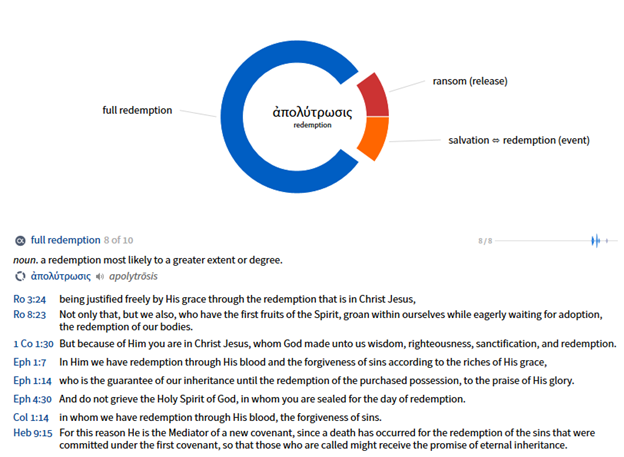
Considering redemption and the way the word is used in the New Testament, we can readily see the references of the majority of forms in the graphic. There are two other uses, one reference meaning ransom/release is cited in Hebrews 11:35 (Red.) The other is referencing an event and is the one word from Luke 21:28 we are discussing, ‘Redemption.’