The righteous man perishes, and no man lays it to heart; and merciful men are taken away while no one understands, for the righteous man is taken away from the evil to come. He shall enter into peace; they shall rest in their beds, each one walking in his uprightness.
Isaiah 57:1–2 — Modern English Version (Thinline Edition.; Lake Mary, FL: Passio, 2014)
I love little surprises. There is one here.
The book of Isaiah is filled with apocalyptic descriptions of Jesus in both advents. That is to say, the events are not written as separate in the book. God’s program for Israel was for the kingdom to come after the death and resurrection of Jesus. Israelis as a nation rejected that.
Though Isaiah is not quite narrative, portions of it read that way. The first phrase about a righteous man perishing is a rebuke of pervasive evil. People do not care when a righteous man perishes. Nor would those consider changing their behavior to right.
Those that practice mercy are taken away. Of course, there is a change in the phrase. Maybe it is in assent to the idea that when someone dies it is God taking them out. Yet, this is where the surprise is.
The one that dies and the one taken away enter into rest. They walk in their own uprightness. These are the ones that have moved on to the next life where they live eternally.
There is that “evil to come.” As I read that, it was impressed upon me that this is specifically referencing what we would call The Tribulation.
And the surprise… Those “taken away” is a veiled reference to the rapture.
To impress the point further, it is done in such a way that the rapture will be easily explained away so as most will just go on with life as If deceived.
But now is Christ risen from the dead and become the firstfruits of those who have fallen asleep. For since death came by man, by man came also the resurrection of the dead. For as in Adam all die, even so in Christ shall all be made alive. But every man in his own order: Christ the first fruits; afterward, those who are Christ’s at His coming. Then comes the end when He will deliver up the kingdom to God the Father, when He puts an end to all rule and all authority and power.
1 Corinthians 15:20–24 — Modern English Version (Thinline Edition.; Lake Mary, FL: Passio, 2014)
Jesus is Firstfruits of the resurrection of the dead. As Paul continues to explain the resurrection, we’ve understood from that context before, it is bodily. It is to a new type of body that isn’t subject to sin. (This idea is elaborated upon later in the text.) In his continuing instruction, there is something more for us to understand. Rightly, it points to Jesus. He is the Firstfruits, but of what?
The term firstfruits is significant. But first, let’s explore the significance of this term from one perspective; the feasts established in the Torah, The law is called a schoolmaster.
But before faith came, we were imprisoned under the law, kept for the faith which was later to be revealed. So the law was our tutor to bring us to Christ, that we might be justified by faith.
Galatians 3:23–24 — Modern English Version (Thinline Edition.; Lake Mary, FL: Passio, 2014)
It was to bring us to Christ. Therefore the feasts established for Israel in the law would also be a tutor. These feats are patterns to help us identify the Messiah. There were seven established, some of which have been fulfilled by Jesus on Earth.
The first is Passover. In the first Passover we learn that the blood of an unblemished lamb protected the household where it was applied to the doorposts from the death of the firstborn. In the same way, Jesus fulfilled this by shedding His own blood. That when properly applied by the believer, metaphorically on the doorposts of the heart. It protects the firstborn of that house, the believer himself from sudden death. This isn’t protection from any death, but the death that comes as a judgment from God.
The second is The Feast of Unleavened Bread. Biblically, leaven is a typification of sin. The idea conveyed is the haste to escape Egypt. They had no time to leaven their bread. It is also at this time that leaven is also removed from houses. In the same way, Jesus takes away the leaven in our lives. In a sense… We also ought to hurry to believe when we are confronted with the truth.
The third is The Feast of Firstfruits. This is a celebration of the firstfruits and is done at the beginning of the spring harvest. It was signified by waving a sheaf of the first grain harvested to the priest. He would then wave this before the Lord in an offering. In like manner, Jesus also had to be presented before God.
Jesus said to her, “Stop holding on to Me, for I have not yet ascended to My Father. But go to My brothers and tell them, ‘I am ascending to My Father and your Father, to My God and your God.’ ”
John 20:17 — Modern English Version (Thinline Edition.; Lake Mary, FL: Passio, 2014)
These are the spring feasts, the first three of seven ordained for Israel. All three have been fulfilled by Jesus just as the Old Testament patterns indicate. The fourth feast Pentecost, is also one said to be fulfilled, but I will leave for another time.
I want to talk about firstfruits. Just as the pattern is established in the feasts, this was the first of the entire harvest. What then is the significance?
Paul shows the order of the harvest. “Christ the firstfruits; afterward, those who are Christ’s at His coming. Then comes the end when He will deliver up the kingdom to God the Father.” I think that’s inclusive of the harvest. What I mean is, we have the beginning of the harvest given and the end when Christ comes, which is not the rapture. This is clearly explained to us in another place.
I saw thrones, and they sat on them, and the authority to judge was given to them. And I saw the souls of those who had been beheaded for their witness of Jesus and for the word of God. They had not worshipped the beast or his image, and had not received his mark on their foreheads or on their hands. They came to life and reigned with Christ for a thousand years. The rest of the dead did not come to life until the thousand years were ended. This is the first resurrection.
Revelation 20:4–5 — Modern English Version (Thinline Edition.; Lake Mary, FL: Passio, 2014)
Jesus has to come again to reign on Earth. At His coming, those who died justified (Acts 24:15) will be raised up to reign with Him. “Then comes the end.”
The harvest that Jesus is Firstfruits of began with His resurrection. It will end with the beginning of His Millennial reign. The harvest will continue, meaning there will be multiple resurrections in between. All of which is part of the First Resurrection of the just (Luke 14:14) to life (John 5:29.)
“Immediately after the tribulation of those days, ‘the sun will be darkened, the moon will not give its light; the stars will fall from heaven, and the powers of the heavens will be shaken.’ “Then the sign of the Son of Man will appear in heaven, and then all the tribes of the earth will mourn, and they will see the Son of Man coming on the clouds of heaven with power and great glory. And He will send His angels with a great sound of a trumpet, and they shall gather His elect from the four winds, from one end of the heavens to the other.
Matthew 24:29–31 — Modern English Version (Thinline Edition.; Lake Mary, FL: Passio, 2014)
“But in those days, after that distress, ‘the sun will be darkened, and the moon will not give her light; the stars of heaven will fall, and the powers that are in heaven will be shaken.’ “Then they will see the Son of Man coming in clouds with great power and glory. Then He will send His angels and gather His elect from the four winds, from the farthest part of the earth to the farthest part of heaven.
Mark 13:24–27 — Modern English Version (Thinline Edition.; Lake Mary, FL: Passio, 2014)
“There will be signs in the sun and the moon and the stars; and on the earth distress of nations, with perplexity, the sea and the waves roaring; men fainting from fear and expectation of what is coming on the inhabited earth. For the powers of heaven will be shaken. Then they will see the Son of Man coming in a cloud with power and great glory. When these things begin to happen, look up and lift up your heads, for your redemption is drawing near.”
Luke 21:25–28 — Modern English Version (Thinline Edition.; Lake Mary, FL: Passio, 2014)
In the harmony of these presentations of the special briefing that Jesus gave His disciples at the end of the age, there are similarities that can be harmonized. All three are describing a time of great tumult, with signs in the sun, moon, and stars, and the heavens being shaken. We also see Jesus coming in the clouds.
To understand the coming in the clouds, we must delve into the old testament. We find over the many mentions of clouds associated with God it came in the form of divine intervention for His people. During the exodus, God led the Israelites in a pillar of cloud by day. When the cloud descended on the tent of meeting, it signified the presence of God. God coming in the clouds is a powerful and symbolic way to demonstrate divine intervention, divine judgment, or divine provision for the preservation of His people.
In this ‘sign’ we see ALL three. There is also another truth in the harmony that isn’t discussed. That is, Jesus is referring to Himself as God. If one understands the trial with the high priest, Jesus was asked if He was the Messiah, the Son of God. In His reply, He affirmed the questions the priest asked and claimed He is God. This is understood when we know the identity of Who comes in the clouds. Jesus said it would be Him by the title He chose for Himself. This title is also a direct reference to all of this.
I saw in the night visions, and there was one like a Son of Man coming with the clouds of heaven. He came to the Ancient of Days and was presented before Him. There was given to Him dominion, and glory, and a kingdom, that all peoples, nations, and languages should serve Him. His dominion is an everlasting dominion, which shall not pass away, and His kingdom that which shall not be destroyed.
Daniel 7:13–14 — Modern English Version (Thinline Edition.; Lake Mary, FL: Passio, 2014)
The differences are also important. Let’s poke at some of these.
The first is the introductory phrase to this time. In the Matthew and Mark account, the audiences’ attention is drawn toward the period after these distresses. More things would happen on Earth and in the heavens, and then the Son of Man would appear. The elect would be gathered, and a kingdom established (The latter part is inferred.) Both accounts seem to give a contemporaneous account of events.
Now note how Luke explains it, paying special attention to where he wants the audiences’ attention drawn. From the outset, Luke is asking his reader to understand the time before these events occur. This is clearly understood by this phrase “of what is coming on the inhabited earth.” Luke describes the same events that will happen, not contemporaneously.
Then we encounter the last sentence. “When these things begin to happen, look up and lift up your heads, for your redemption is drawing near.” Luke is a gentile writing to gentiles. He is admonishing them to pay attention to when these things begin to happen. We also have the use of a unique word, ‘redemption.’
Matthew and Mark are drawing attention to the time of God’s intervention, judgment, and preservation of His people. Perhaps it could be redemption. Yet they did not use the word. I think it is because the attention of the reader is being drawn to two different events. Luke is drawing attention to redemption that occurs before the harmonized disasters that are described.
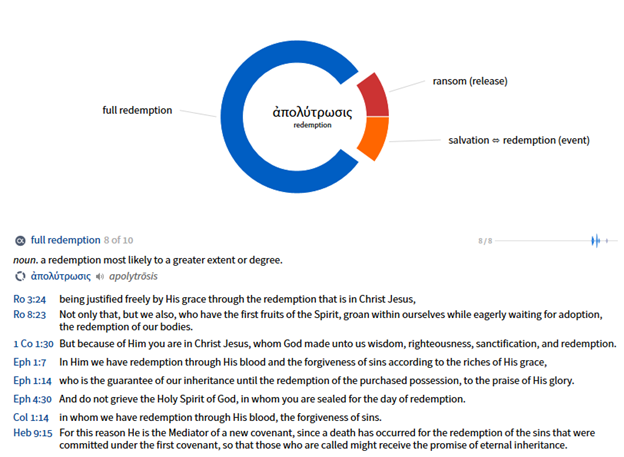
Considering redemption and the way the word is used in the New Testament, we can readily see the references of the majority of forms in the graphic. There are two other uses, one reference meaning ransom/release is cited in Hebrews 11:35 (Red.) The other is referencing an event and is the one word from Luke 21:28 we are discussing, ‘Redemption.’
When He had spoken these things, while they looked, He was taken up. And a cloud received Him from their sight. While they looked intently toward heaven as He ascended, suddenly two men stood by them in white garments. They said, “Men of Galilee, why stand looking toward heaven? This same Jesus, who was taken up from you to heaven, will come in like manner as you saw Him go into heaven.”
Acts 1:9–11 — Modern English Version (Thinline Edition.; Lake Mary, FL: Passio, 2014)
I was just reading where someone was attempting to claim Jesus has already returned in the first century. That is, He came to Paul. Given the testimony above, let’s examine the evidence for such a claim.
As he went he drew near Damascus, and suddenly a light from heaven shone around him. He fell to the ground and heard a voice saying to him, “Saul, Saul, why do you persecute Me?” He said, “Who are You, Lord?” The Lord said, “I am Jesus, whom you are persecuting. It is hard for you to kick against the goads.” Trembling and astonished, he said, “Lord, what will You have me do?” The Lord said to him, “Rise up and go into the city, and you will be told what you must do.” The men traveling with him stood speechless, hearing the voice, but seeing no one. Saul rose up from the ground. And when his eyes were opened, he saw nothing. So they led him by the hand and brought him into Damascus. For three days he was without sight, and neither ate nor drank.
Acts 9:3–9 — Modern English Version (Thinline Edition.; Lake Mary, FL: Passio, 2014)
“As I journeyed and came near Damascus, about noon suddenly a great light from heaven shone around me. I fell to the ground and heard a voice saying to me, ‘Saul, Saul, why do you persecute Me?’ “I answered, ‘Who are You, Lord?’ “He said to me, ‘I am Jesus of Nazareth, whom you are persecuting.’ Those who were with me saw the light and were afraid, but they did not hear the voice of Him who was speaking to me. “I said, ‘What shall I do, Lord?’ “The Lord said to me, ‘Rise and go into Damascus. There you will be told what you have been appointed to do.’ Since I was blinded by the glory of that light, those who were with me led me by the hand into Damascus.
Acts 22:6–11 — Modern English Version (Thinline Edition.; Lake Mary, FL: Passio, 2014)
These are the two accounts of Paul’s experience. The latter seems to be a quotation of Paul recounting the event to others. Let’s note some things.
The angels at Jesus’ ascension said Jesus would come again in like manner. To wit: “a cloud receive Him from their sight.” Do notice that there are multiple eyewitnesses to this event. The angels said this same Jesus would come again in like manner. They… Many… Saw Him go into heaven.
In contrast to the Damascus Road experience. Neither Paul nor his companions saw Jesus come from heaven. His companions didn’t see Jesus.
There is also something that is easily overlooked. Jesus had a body as He ascended. If He has a body at Damascus Road, how is it such was veiled from Paul’s companions, who heard a disembodied voice?
Luke helps with another witness of the event.
While He blessed them, He parted from them and was carried up into heaven.
Luke 24:51 — Modern English Version (Thinline Edition.; Lake Mary, FL: Passio, 2014)
We clearly see that there are multiple eyewitnesses present at Jesus’ ascension to heaven. For the Damascus Road experience to qualify as the second coming, it necessitates multiple eyewitnesses to the event. As we’ve covered Paul’s experience, at best, there could only be one eyewitness. It is debatable that Paul did not see Him there either, since his own testimony declares he was blinded by the light.
Then they returned to Jerusalem from the Mount of Olives, which is a Sabbath day’s walk from Jerusalem.
Acts 1:12 — Modern English Version (Thinline Edition.; Lake Mary, FL: Passio, 2014)
We also see another qualification for the like manner… Location. To meet the qualifications the angels gave to the eyewitnesses, As Paul “came near to Damascus,” this is now not even near the Mount of Olives.
I must also point out the reaction to Paul’s companions. They were in fear!
Read what Paul writes about this event…
For the grace of God that brings salvation has appeared to all men, teaching us that, denying ungodliness and worldly desires, we should live soberly, righteously, and in godliness in this present world, as we await the blessed hope and the appearing of the glory of our great God and Savior Jesus Christ, who gave Himself for us, that He might redeem us from all lawlessness and purify for Himself a special people, zealous of good works.
Titus 2:11–14 — Modern English Version (Thinline Edition.; Lake Mary, FL: Passio, 2014)
Unless there is a third time Jesus comes, Paul’s experience by his own testimony cannot qualify as the second coming.


 Master's Crumbs