
Listen! I Stand at the Door and Knock.

Listen! I stand at the door and knock. If anyone hears My voice and opens the door, I will come in and dine with him, and he with Me.

Revelation 3:20 — Modern English Version (Thinline Edition.; Lake Mary, FL: Passio, 2014)

I cannot help but to see how urgent and insistent this declaration is.

Our church gives doctrinal studies for those who want to go a bit deeper into basic doctrine. I love to attend because I always learn something new. I have come to understand that anyone can open the Bible and teach, and I can learn from them. I like that about the Holy Spirit. Enough on that.

We were taking an overview of the epistles Jesus wrote to the seven churches in His Revelation to John. Here is one part of what I learned.

Of the letters to the churches, there can be a loose grouping of them applied. It is done using the simple closing phrase in all epistles. “He who has an ear, let him hear what the Spirit says to the churches.” In each epistle, promises are given to the overcomer. Their placement becomes conspicuous. In the first three epistles, these promises are a postscript to the letter, coming after the close. The latter four, the promises to the overcomer are included in the epistle.

It is believed by some that these messages to the churches encompass the character of the entire age of the church of Jesus Christ, from its foundation to its end. The message to Thyatira represents the character of the medieval church. In a more specific way, it would be the Roman church. A further delineating factor to pay attention to comes in the middle epistle, to the church at Thyatira. Thyatira conveys the meaning of continuing sacrifice.

But I have a few things against you: You permit that woman Jezebel, who calls herself a prophetess, to teach and seduce My servants to commit sexual immorality and eat food sacrificed to idols. I gave her time to repent of her sexual immorality, but she did not repent. Look! I will throw her onto a sickbed, and those who commit adultery with her into great tribulation, unless they repent of their deeds.

Revelation 2:20–22 — Modern English Version (Thinline Edition.; Lake Mary, FL: Passio, 2014)

I want to point out the words great tribulation. Those who don’t repent of idolatry will be judged. These words of Jesus are not to be taken lightly. Perhaps it is to draw our attention to the end of the age. We still have the vestiges of the medieval church age with us. Simply for that reason, the words great tribulation are important.

We move to the next epistle. Just as the message to Thyatira is representative of the character of the Roman medieval church, the epistle to Sardis represents the reformation age. Sardis conveys a meaning of an escaping remnant.

Remember therefore how you have received and heard; hold fast and repent. Therefore if you will not watch, I will come upon you as a thief, and you will not know what hour I will come upon you.

Revelation 3:3 — Modern English Version (Thinline Edition.; Lake Mary, FL: Passio, 2014)

The admonition for this church is to watch. If it truly represents the character of the church of the reformation age, those churches exist contemporary with us. The admonition to them also reveals something yet future. Just as the previous epistle hinted toward great tribulation, this one hints to Jesus coming back as a thief. These will be surprised when He comes.

The next epistle is that to Philadelphia. In representing the character of the church, this is one of the great evangelistic soul-winning-missionary-minded churches. Philadelphia conveys the meaning of brotherly love.

Because you have kept My word of patience, I also will keep you from the hour of temptation which shall come upon the entire world, to test those who dwell on the earth.

Revelation 3:10 — Modern English Version (Thinline Edition.; Lake Mary, FL: Passio, 2014)

The admonition to this church includes the idea of wholly being rescued from the hour of temptation which shall come upon the whole world. This temptation is a test of those who dwell on Earth. These that are kept from this hour are most likely not on Earth. If not, such would necessarily be included in the whole world and would still be dwelling on Earth.

So far, Jesus tells those who don’t repent will have to go through great tribulation. With increased urgency we are told to watch so as we are not surprised. By keeping His word of patience we are kept from the test of those who dwell on Earth.

Look, I am coming quickly. Hold firmly what you have, so that no one may take your crown.

Revelation 3:11 — Modern English Version (Thinline Edition.; Lake Mary, FL: Passio, 2014)

There is an urgency that is increasing and becoming more specific. Time is closing in fast. He is coming quickly.

When we encounter the last epistle to Laodicea, this is the characterization of the church in the last days. Laodicea conveys a meaning of the people judging, or the people are in charge. (That says much about modern churches. Many do surveys to determine how to best meet people’s felt needs. That’s another discussion.)

Listen! I stand at the door and knock. If anyone hears My voice and opens the door, I will come in and dine with him, and he with Me.

Revelation 3:20 — Modern English Version (Thinline Edition.; Lake Mary, FL: Passio, 2014)

If this is the last age of the church, it would also follow that the urgency would increase. That is exactly what we see. Instead, He’s not coming quickly, or as a surprise. He’s right there at the door… Knocking!

There isn’t much time. But you can still open the door to Him.
Where I Am Going, You Cannot Come

Again, Jesus said to them, “I am going away, and you will seek Me, and you will die in your sins. Where I am going, you cannot come.”

John 8:21 — Modern English Version (Thinline Edition.; Lake Mary, FL: Passio, 2014)

That simple truth is a stumbling block for many. Jesus said it to the very leaders of His chosen people, Israel. Their leaders were told that where Jesus is going they cannot come.

It wasn’t an outright prohibition to them, nor were these born condemned for that destiny. Quite the contrary, they were born Jewish, with all of the privileges that entail. (Paul outlines these in the first few verses of Romans 9.) Jesus was really saying… Where they could not go is heaven.

In this verse are some important things we can glean about salvation and election. Most importantly, they aren’t the same. Election doesn’t guarantee salvation.

Israelites are elect. They are God’s people. But clearly, being chosen isn’t enough to get one into heaven.

In the conversation preceding Jesus’ statement we’re considering, He is telling these Pharisees that they do not know the Father. Nor do they know Him. Consider that. The Father’s (and the Son’s) chosen didn’t know Him.

Furthermore, because they did not know Him they cannot know where He is going. He is going to heaven. They wouldn’t know where.

It’s not that Jesus condemned them to such a fate either. Jesus explained that succinctly to Nicodemus.

For God did not send His Son into the world to condemn the world, but that the world through Him might be saved. He who believes in Him is not condemned. But he who does not believe is condemned already, because he has not believed in the name of the only begotten Son of God.

John 3:17–18 — Modern English Version (Thinline Edition.; Lake Mary, FL: Passio, 2014)

The apparent condemnation Jesus proclaimed over these Pharisees wasn’t from Him. It was because they didn’t know Him. Not knowing Him means they would not know the Father. Jesus said so (John 8:19.)

Jesus told them He would go away. After He left, these Pharisees would seek Him but not find Him. They would die in their sins.

Many today are in that same condition… In danger of dying in their sins because they refused to believe Jesus. Many still seek Him. Some do it in vain, they never believe. Others believe and are saved.

Of which are you?

The ones who seek Jesus and never find Him, because one doesn’t believe they themselves have fallen short and are in need of rescue.

Or…

Of the redeemed, who know Jesus and the Father. They know where Jesus was going. Therefore they are going there, too.

Jesus has been Gifted Everything

For as the Father raises the dead and gives them life, even so the Son gives life to whom He will. The Father judges no one, but has committed all judgment to the Son, that all men should honor the Son, just as they honor the Father. He who does not honor the Son does not honor the Father who sent Him.

John 5:21–23 — Modern English Version (Thinline Edition.; Lake Mary, FL: Passio, 2014)

Everything the Father has is given to Jesus; just as we see here, Jesus even has the power to raise the dead. More importantly, Jesus has the power to give life!

Maybe you’ve never thought that through. Yet right here… Jesus is making a bold statement. Wait, you’ve never really thought that Jesus is God?

That first statement is an attestation to that simple fact.

The Son Gives Life to Whom He Will

Then the Lord God formed man from the dust of the ground and breathed into his nostrils the breath of life, and man became a living being.

Genesis 2:7 — Modern English Version (Thinline Edition.; Lake Mary, FL: Passio, 2014)

I get it. The Father has to draw. The Father has to grant life. That is also given to Jesus.

He gave life to you! How do I know?

You’re breathing and reading this. He breathed the breath of life into you. Furthermore, the Father wants all of me to honor the Son. So that they may have access to the Father.

He who believes in the Son has eternal life. He who does not believe the Son shall not see life, but the wrath of God remains on him.

John 3:36 — Modern English Version (Thinline Edition.; Lake Mary, FL: Passio, 2014)
That Judgment Thing

God has even given the authority to judge solely to Jesus. He is the One Who chooses. He is the One Who judges.

Yet Jesus would have you honor Him just as any of us would honor God. Remember, He chooses.

All of us have had the wrath of God on us. Some may still be under that encumbrance. Yet we know the Father and the Son don’t want that for you. Don’t believe me. It’s right there…

“that all men should honor the Son, just as they honor the Father. ”

All men is better understood as all humans. He chose to give you life by sending His Son for you to believe and believe in.

The math is simple… Those that want to honor the Father must honor the Son. There is simply no other way.

If you think Jesus was a good man and a great Hebrew, that’s not good enough.

If you think Jesus was a great teacher and an example to follow, that’s not still good enough.

If you think Jesus came to teach us how to love others, that won’t work.

Even if you think Jesus died on a cross thousands of years ago, neither is that good enough.

You must honor Jesus as you honor God. And we do that by first believing He is Who He said He is… God. We can then believe His death was personal… Sufficient for each of us. Proven in that we’re still breathing.

The Father sent the Son to save the world; thus giving everyone enough time to understand these things. All who inhabit the world ought to honor the Son and be given life… Eternal life.

Men Fainting from Fear and Expectation

“There will be signs in the sun and the moon and the stars; and on the earth distress of nations, with perplexity, the sea and the waves roaring; men fainting from fear and expectation of what is coming on the inhabited earth. For the powers of heaven will be shaken. Then they will see the Son of Man coming in a cloud with power and great glory. When these things begin to happen, look up and lift up your heads, for your redemption is drawing near.”

Luke 21:25–28 — Modern English Version (Thinline Edition.; Lake Mary, FL: Passio, 2014)

These are the words of Jesus to His disciples during a private briefing He gave them in the week before His death. Clearly, we can understand that the events portrayed here will happen around the time closely preceding Jesus’ return to judge the world.

Reading through this, there was something that stood out. Jesus speaks of the signs that seem to be unprecedented at any time heretofore. He then makes an interesting statement, that there will be humans “fainting from fear and expectation of what is coming.”

What is Coming

Perhaps He is speaking to that period of signs and distress He spoke of in the immediately preceding context. But then He could be speaking of the immediately preceding context, as bad as it was, things coming would be more perilous and frightening.

I am thinking the latter is probably a better explanation. Those people faint from fear connect right here:

In those days men will seek death but will not find it. They will desire to die, but death will elude them.

Revelation 9:6 — Modern English Version (Thinline Edition.; Lake Mary, FL: Passio, 2014)

As the revelation unfolds beginning in Revelation 6, seals are opened. As each seal is opened, it reveals an event among other things.

The Seals

As the first is opened, it reveals a horseman given the ability to conquer. This is most likely what will bring a one world leader into power. Yet it will not be without bloodshed. The second reveals peace being taken the earth. Again, this will probably prove fatal to some humans. The next brings massive inflation. How much death would occur during each of these?

The fourth horseman brings death to one-quarter of the Earth’s population. The next seal reveals comfort and encouragement given to the servants of God murdered during this time. They seem to have already been informed that God would avenge them. They ask God, “How long?”

The sixth seal reveals massive earthquakes and signs in the sky. The stars of heaven fall to the Earth. This could be figurative, or it could be the fallen angels coming to Earth as the marshaling of forces to confront Jesus when He comes to Earth to judge at the end of these events.

So far we see that this stuff is so disconcerting, people will go underground and hide in caves. They will hide from what they know is the great day of His (Jesus’) wrath.

A pause ensues, the servants of God on Earth are marked. We also see the saints that were murdered for their testimony during this time of perplexity worshipping Jesus. We see the prayers from those still alive being heard in the heavens and answers to them are prepared.

As the seventh seal is opened, there is a short period of silence. After the silence, angels are revealed, seven of them have trumpets.

The first angel sounds his trumpet, a third of all vegetation burns up. The second sounds and a great rock falls into the sea destroying a third of the living creatures in it and a third of the ships on it. The third blares, a star falls from heaven and makes a third of the freshwater rivers bitter; killing those who drink the water. The fourth angel sounds and a third of the day and a third of the night have no light.

There is yet another pause.

Then I watched, and I heard an angel flying through the midst of heaven, saying with a loud voice, “Woe, woe, woe to the inhabitants of the earth, because of the other trumpet blasts of the three angels, who are yet to sound!”

Revelation 8:13 — Modern English Version (Thinline Edition.; Lake Mary, FL: Passio, 2014)

Now considering all that has been revealed so far from Revelation 6 through 8 and how it is easily and succinctly summed up in Luke 21:25. Think of the reaction you might have to an angel flying over your head saying loudly, “Woe, woe, woe.” Would there be overwhelming fear so bad you would want to die?

God says they will desire to die, but death will elude them.

men fainting from fear and expectation of what is coming on the inhabited earth. For the powers of heaven will be shaken.

Luke 21:26 — Modern English Version (Thinline Edition.; Lake Mary, FL: Passio, 2014)
The Powers of Heaven Will Be Shaken

The fifth angel sounded, and I saw a star fallen from heaven to the earth. The star was given the key to the bottomless pit. He opened the bottomless pit, and smoke ascended from the pit, like the smoke of a great furnace. The sun and the air were darkened by the smoke from the pit. And out of the smoke locusts came upon the earth. Power was given them as the scorpions of the earth have power. They were commanded not to harm the grass of the earth, or any green thing, or any tree, but only those men who did not have the seal of God on their foreheads. They were given authority, not to kill them, but to torment them for five months. Their torment was like the torment of a scorpion when it stings a man. In those days men will seek death but will not find it. They will desire to die, but death will elude them.

Revelation 9:1–6 — Modern English Version (Thinline Edition.; Lake Mary, FL: Passio, 2014)

I cannot even begin to imagine the things that would follow. An angel opens a pit, from which locusts thick as clouds come. These won’t bother anything other than those men who do not have the seal of God. These will have a painful sting and cannot kill either.

That Time Approaches Quickly

Given the greater context of our primary text in Luke 21, this setting is in the period before these things happen. By the parable of the fig tree that comes immediately after, we can surmise we are most likely in that time period.

What is coming is a drastic and systematic reduction of the population of the Earth. It’s going to happen. God didn’t write this to scare anyone, but to warn those who have ears to hear… So they may prepare.

That preparation is to become a servant of God… Not a servant of the needy, the culture, or yourself.

Harmonizing the Tribulation of Those Days

“Immediately after the tribulation of those days, ‘the sun will be darkened, the moon will not give its light; the stars will fall from heaven, and the powers of the heavens will be shaken.’
“Then the sign of the Son of Man will appear in heaven, and then all the tribes of the earth will mourn, and they will see the Son of Man coming on the clouds of heaven with power and great glory. And He will send His angels with a great sound of a trumpet, and they shall gather His elect from the four winds, from one end of the heavens to the other.

Matthew 24:29–31 — Modern English Version (Thinline Edition.; Lake Mary, FL: Passio, 2014)

“But in those days, after that distress, ‘the sun will be darkened, and the moon will not give her light; the stars of heaven will fall, and the powers that are in heaven will be shaken.’
“Then they will see the Son of Man coming in clouds with great power and glory. Then He will send His angels and gather His elect from the four winds, from the farthest part of the earth to the farthest part of heaven.

Mark 13:24–27 — Modern English Version (Thinline Edition.; Lake Mary, FL: Passio, 2014)

“There will be signs in the sun and the moon and the stars; and on the earth distress of nations, with perplexity, the sea and the waves roaring; men fainting from fear and expectation of what is coming on the inhabited earth. For the powers of heaven will be shaken. Then they will see the Son of Man coming in a cloud with power and great glory. When these things begin to happen, look up and lift up your heads, for your redemption is drawing near.”

Luke 21:25–28 — Modern English Version (Thinline Edition.; Lake Mary, FL: Passio, 2014)

In the harmony of these presentations of the special briefing that Jesus gave His disciples at the end of the age, there are similarities that can be harmonized. All three are describing a time of great tumult, with signs in the sun, moon, and stars, and the heavens being shaken. We also see Jesus coming in the clouds.

To understand the coming in the clouds, we must delve into the old testament. We find over the many mentions of clouds associated with God it came in the form of divine intervention for His people. During the exodus, God led the Israelites in a pillar of cloud by day. When the cloud descended on the tent of meeting, it signified the presence of God. God coming in the clouds is a powerful and symbolic way to demonstrate divine intervention, divine judgment, or divine provision for the preservation of His people.

In this ‘sign’ we see ALL three. There is also another truth in the harmony that isn’t discussed. That is, Jesus is referring to Himself as God. If one understands the trial with the high priest, Jesus was asked if He was the Messiah, the Son of God. In His reply, He affirmed the questions the priest asked and claimed He is God. This is understood when we know the identity of Who comes in the clouds. Jesus said it would be Him by the title He chose for Himself. This title is also a direct reference to all of this.

I saw in the night visions, and there was one like a Son of Man coming with the clouds of heaven. He came to the Ancient of Days and was presented before Him. There was given to Him dominion, and glory, and a kingdom, that all peoples, nations, and languages should serve Him. His dominion is an everlasting dominion, which shall not pass away, and His kingdom that which shall not be destroyed.

Daniel 7:13–14 — Modern English Version (Thinline Edition.; Lake Mary, FL: Passio, 2014)

The differences are also important. Let’s poke at some of these.

The first is the introductory phrase to this time. In the Matthew and Mark account, the audiences’ attention is drawn toward the period after these distresses. More things would happen on Earth and in the heavens, and then the Son of Man would appear. The elect would be gathered, and a kingdom established (The latter part is inferred.) Both accounts seem to give a contemporaneous account of events.

Now note how Luke explains it, paying special attention to where he wants the audiences’ attention drawn. From the outset, Luke is asking his reader to understand the time before these events occur. This is clearly understood by this phrase “of what is coming on the inhabited earth.” Luke describes the same events that will happen, not contemporaneously.

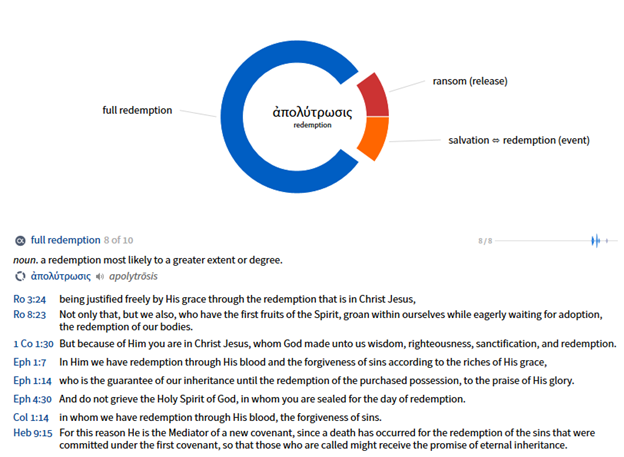
Then we encounter the last sentence. “When these things begin to happen, look up and lift up your heads, for your redemption is drawing near.” Luke is a gentile writing to gentiles. He is admonishing them to pay attention to when these things begin to happen. We also have the use of a unique word, ‘redemption.’

Matthew and Mark are drawing attention to the time of God’s intervention, judgment, and preservation of His people. Perhaps it could be redemption. Yet they did not use the word. I think it is because the attention of the reader is being drawn to two different events. Luke is drawing attention to redemption that occurs before the harmonized disasters that are described.

Considering redemption and the way the word is used in the New Testament, we can readily see the references of the majority of forms in the graphic. There are two other uses, one reference meaning ransom/release is cited in Hebrews 11:35 (Red.) The other is referencing an event and is the one word from Luke 21:28 we are discussing, ‘Redemption.’

Is This not the Carpenter?

He went away from there and came into His own country. And His disciples followed Him. When the Sabbath came, He began to teach in the synagogue. And many hearing Him were astonished, saying, “Where did this Man get this? What is this wisdom that is given Him, that even miracles are done by His hands? Is this not the carpenter, the Son of Mary and the brother of James and Joseph and Judas and Simon? Are not His sisters here with us?” And they took offense at Him.

Mark 6:1–3 — Modern English Version (Thinline Edition.; Lake Mary, FL: Passio, 2014)

When Jesus returned to the place of His rearing and taught in the synagogue, people were astonished. These knew Him better than the other places He visited. They knew His upbringing. He was the carpenter.

Because these had a more intimate knowledge of Jesus growing up and working… What they thought He is became a stumbling block. How could a carpenter have so much wisdom teaching in the synagogue and even do miracles?

Jesus said to them, “A prophet is not without honor, except in his own country, and among his own relatives, and in his own house.”

Mark 6:4 — Modern English Version (Thinline Edition.; Lake Mary, FL: Passio, 2014)

Speaking truth is just that. For anyone who does it to strangers, they may be more apt to listen. They may have no preconceptions. But when it is done with those who you grew up with, objections start to rise. Not because the truth is spoken. These know you or think they do be preconceptions.

For those who have preconceptions, what you say is going to be measured by who they think you are. A stranger speaking the truth is going to appear to have great wisdom. If that stranger is labeled conservative, what truth offered is going to be measured through what the label means to the person hearing.

What you say is going to be measured by who or what your audience thinks you are. The words themselves will be filtered through that myopia. The more specific the preconception applied to you, the more easily it will provoke some offense.

People will judge what you say by preconceived ideas.

In the instance above, to those who knew Him, it was a carpenter speaking with great wisdom and doing miracles. To the stranger, the inherent baggage of a carpenter didn’t exist. Jesus’ humble upbringing was more of a stumbling block to those who were around Him growing up.

Today, those who have a preconceived notion of what a Christian is will filter the truth spoken by that Christian through that idea. In fact, most likely the Christian will seem hypocritical, even among other Christians.

It’s not that the hometown folks didn’t honor Jesus. It was their preconceived idea of Who they thought He is… That became the offense. In other words, He didn’t fit in their box.

Don’t let the box another person wants to put you in to be the prison for you. It is actually a prison for them.

He could not do any miracles there, except that He laid His hands on a few sick people and healed them. And He was amazed because of their unbelief.

Mark 6:5–6 — Modern English Version (Thinline Edition.; Lake Mary, FL: Passio, 2014)

Because they had imprisoned themselves, it became difficult for Jesus to do anything really good in their lives.

There is a deeper theological issue here, too. It has to do with synergy. There will be lots of folks who balk at that term. What is clearly being taught is that the people themselves weren’t receptive to Jesus. It became an impediment to them. He couldn’t help them.

If He could have changed their hearts by His own will and turned a faith-switch on, don’t you think He would have done that to have compassion on them?

Yet He didn’t. Perhaps it is because we have to come to Jesus in child-like faith, setting aside our own preconceptions of what we think is really real, believing what He says. Only then can He do miracles.

Let’s go Now

When the angels went away from them into heaven, the shepherds said to each other, “Let us now go to Bethlehem and see what has happened, which the Lord has made known to us.”
So they came hurrying and found Mary and Joseph, and the Baby lying in a manger. When they had seen Him, they made widely known the word which was told them concerning this Child.

Luke 2:15–17 — Modern English Version (Thinline Edition.; Lake Mary, FL: Passio, 2014)

After the heavenly choir sang to these shepherds, they immediately left their flocks and went into Bethlehem to see with their own eyes what had happened. After all, God chose to make the birth announcement to them.

They hurried and found the announced babe just as they had been told.

Those shepherds went and spread the word. Despite the fact that a shepherd’s testimony had no value in that society. They spoke plainly of what had happened to them.

Do you think we sometimes consider ourselves in the position of a shepherd?

I mean… People won’t believe our testimony of what God has done in our lives. We don’t share it because of the rejection and disbelief we presume we will get. We might think, why bother?

If we don’t talk about Jesus… Who will?

We must be like the shepherds and speak regardless if those we speak to believe what we say.

Let There be Peace on Earth

Suddenly there was with the angel a company of the heavenly host praising God and saying, “Glory to God in the highest, and on earth peace, and good will toward men.”

Luke 2:13–14 — Modern English Version (Thinline Edition.; Lake Mary, FL: Passio, 2014)

Part of our Christmas tradition is visiting Disney World. We were able to stay and watch one of the final performances of Illuminations in Epcot. At Christmas, there is an additional ending added to the show. It is a song called “Let There be Peace on Earth.”

I love that song, especially in the version used for the show. It is sung by children. The message of the song is simple and can be summed up in the lyrics.

“Let there be peace on earth,
And let it begin with me.”

The fireworks were stunning… As was that verse in my mind.

God has already brought peace to the Earth! That is what we celebrate tonight. Peace on earth, goodwill to men. Peace begins with God. He began that idea from the foundation of the world. He gave us the Prince of Peace.

You can bring peace to earth, especially your parts of it. Let it begin with you. Repent, that is turn around!

Acknowledge the truth. That you and I are helpless to live rightly without Him.

Believe He is God. He lived and died as a human. He rose again, all for you and I.

Confess it aloud. Confess that Jesus is God. It will then lead you to confess sins and other things. Set yourself right toward God while you can.

Let there be peace on earth. It can be with you.

A Child is Born

And in the same area there were shepherds living in the fields, keeping watch over their flock by night. And then an angel of the Lord appeared to them, and the glory of the Lord shone around them, and they were very afraid.

Luke 2:8–9 — Modern English Version (Thinline Edition.; Lake Mary, FL: Passio, 2014)

It was a night like any other for those shepherds. They were keeping watch over the clocks that would be used for the daily sacrifice in the temple in Jerusalem. From our perspective, shepherding is quaint and bucolic. Being a shepherd in that day was among the lowest of the rungs of that society. Meekly, they attended to their flocks with great care.

It was God (in Theophany) Who appeared to them suddenly. He came without notice of fanfare. His glory encompassed them in a flash. From darkness, it was suddenly brighter than daylight. It made them very afraid — as it would any of us.

But the angel said to them, “Listen! Do not fear. For I bring you good news of great joy, which will be to all people. For unto you is born this day in the City of David a Savior, who is Christ the Lord. And this will be a sign to you: You will find the Baby wrapped in strips of cloth, lying in a manger.”

Luke 2:10–12 — Modern English Version (Thinline Edition.; Lake Mary, FL: Passio, 2014)

Fear not! It wasn’t a command to them. They are intended as words of comfort. God was announcing favor to those most undesirable. A shepherd’s testimony in that society trusted or even sought out. The favor announced to them wouldn’t be for them alone but to all people. Who could believe them?

Yet… This is Christmas!

God announces His favor to even you. I don’t know anything about you. If you’re like me, you couldn’t think God would be favorable in your direction. Yet He is. Christmas demonstrates it. For God has caused it to be written:

For unto us a child is born, unto us a son is given, and the government shall be upon his shoulder. And his name shall be called Wonderful Counselor, Mighty God, Eternal Father, Prince of Peace.

Isaiah 9:6 — Modern English Version (Thinline Edition.; Lake Mary, FL: Passio, 2014)

Unto us, a child is born. That is for you and me, too. He is born just a wee human Babe from our perspective. God gave dearly… A Son. He didn’t give just any Son, but His unique Son. There’s not another like Him anywhere.

This Babe would eventually rule the world. He would be wise beyond His years. He is God, the One Who brings peace.

These are the good tidings to all people. God has set aside His anger toward people. Glory goes to God. Yet in the transaction, we get goodwill and peace from Him.

Suddenly there was with the angel a company of the heavenly host praising God and saying, “Glory to God in the highest, and on earth peace, and good will toward men.”

Luke 2:13–14 — Modern English Version (Thinline Edition.; Lake Mary, FL: Passio, 2014)

Take His Gift to you.

God’s Bread

In those days a decree went out from Caesar Augustus that the entire inhabited earth should be taxed. This taxation was first made when Quirinius was governor of Syria. And everyone went to his own city to be taxed.
So Joseph also departed from the city of Nazareth in Galilee to the City of David which is called Bethlehem, in Judea, because he was of the house and lineage of David, to be taxed with Mary, his betrothed wife, who was with child. So while they were there, the day came for her to give birth. And she gave birth to her firstborn Son, and wrapped Him in strips of cloth, and laid Him in a manger, because there was no room for them in the inn.

Luke 2:2–7 — Modern English Version (Thinline Edition.; Lake Mary, FL: Passio, 2014)

As we’ve discussed before, God is present in every moment. The fact that Caesar Augustus decreed a tax that would ensure Joseph to be in the city of his lineage was known to God when David called the prophet Samuel.

The Lord said to Samuel, “How long will you mourn for Saul, since I have rejected him from ruling over Israel? Fill your horn with oil and go. I will send you to Jesse the Bethlehemite, for I have chosen a king for Myself from among his sons.”

1 Samuel 16:1 — Modern English Version (Thinline Edition.; Lake Mary, FL: Passio, 2014)

Bethlehem is the birthplace of Kings. It is the birthplace of God’s Chosen. In this way, God’s choosing of David was a pattern for Israel, and by extension the whole world. That’s for us!

David’s anointing would be when Israel already had a king… Saul. In the same way, Jesus’ advent was when Israel already had a king… Caesar.

It is Bethlehem. The word that means house of bread. The Bread of Heaven would be born there.

But you, Bethlehem Ephrathah, although you are small among the tribes of Judah, from you will come forth for Me one who will be ruler over Israel. His origins are from of old, from ancient days.

Micah 5:2 — Modern English Version (Thinline Edition.; Lake Mary, FL: Passio, 2014)

Least among the tribes of Judah.

Everything about His birth doesn’t make us think of kings or rulers. Jesus was born to a regular working-class couple. He was born away from home, in a stall for animals. His first resting place was most likely a trough hewn from stone used for fodder. And Bethlehem… Which was a relative backwater near bustling Jerusalem.

David was born there, too. He was the least of his brothers. He was the shortest in stature. He was a dirty shepherd. Shepherds in those days were the least esteemed of people if they were even considered that. David serves as the pattern.

We were to know that pattern.

God chooses the weak to confound the strong. He chooses the base to offend the intellectual. We choose according to stature, prowess, mental acumen and wealth. These are the things humans esteem. This is not so with God.

A dirty and lowly shepherd boy was chosen to be king over Israel. This David is like a sling stone forging through time to that lands in the midst of that lowly carpenter’s Boy’s circumstance of birth.

It’s that day.

Today (the eve of Christmas,) when you think of Jesus and His birth, it’s not the trappings of silver and gold, the red and the white and the green… Santa Claus or turkey… Or even what skeptics say that really matters.

It’s Who Jesus is that does. God’s desire is that you eat His Bread! Seriously. He wants you to take Jesus into your body by believing He is Emmanuel, God among men… Your King.