
A Word to the Wise: How to Known When to Present Yourself at the Opening of the Womb.

The iniquity of Ephraim is bound up; his sin is stored up. The pains of childbirth come for him. He is an unwise son, for he does not present himself at the opening of the womb.

Hosea 13:12–13 — Modern English Version (Thinline Edition.; Lake Mary, FL: Passio, 2014)

God is patient and kind. These ideas we have are rooted in Who He is. Even in the writings of the Old Testament prophets, time and again we encounter this long-suffering compassion from the Ancient of Days. It is compassion that is demonstrated from the beginning of creation to this day.

Let us further explore this analogy akin to “You must be born again.” We all know, before a birth comes a warning. That warning comes in the form of labor pains.

We know before Israel was taken captive, there was a long siege against the nation. City after city fell to the invaders. Prophets were sent to speak forth of the coming judgment, urging the nation to repent.

What started as the discomfort was now impending judgment.

God is longsuffering.

Do you despise the riches of His goodness, tolerance, and patience, not knowing that the goodness of God leads you to repentance?

Romans 2:4 — Modern English Version (Thinline Edition.; Lake Mary, FL: Passio, 2014)

His goodness and tolerance are leading each of us to repentance. The simple truth is disobedience has a just recompense.

For if the word spoken by angels was true, and every sin and disobedience received a just recompense, how shall we escape if we neglect such a great salvation, which was first declared by the Lord, and was confirmed to us by those who heard Him?

Hebrews 2:2–3 — Modern English Version (Thinline Edition.; Lake Mary, FL: Passio, 2014)

God’s patient leading to repentance is like birth pangs. At first, there is a bit of discomfort, which over time becomes more insistent. It is designed to bring us to the throne of God where confession brings remission.

If we confess our sins, He is faithful and just to forgive us our sins and cleanse us from all unrighteousness.

1 John 1:9 — Modern English Version (Thinline Edition.; Lake Mary, FL: Passio, 2014)

God patiently awaited those in His chosen nation to repent… Judgment was surely upon them. What started as raids in a few cities was now urgent. The impending doom was quickly becoming a reality—many would die and others led away to enslavement. What started as a bit of discomfort quickly escalated.

There is another application.

For many will come in My name, saying, ‘I am the Christ,’ and will deceive many. You will hear of wars and rumors of wars. See that you are not troubled. For all these things must happen, but the end is not yet. For nation will rise against nation, and kingdom against kingdom. There will be famines, epidemics, and earthquakes in various places. All these are the beginning of sorrows.

Matthew 24:5–8 — Modern English Version (Thinline Edition.; Lake Mary, FL: Passio, 2014)

These are the beginning of birth pangs. This is Jesus giving a briefing to His disciples with the signs that are the warnings of the end. Some of these have been around, others seem to be looming in the very near future. Days of which many think we are living in now.

Earthquakes are increasing in number. Famine and disease do not go away. Saber rattling is more popular than ever. Natural disasters occur with more frequency and severity.

With what is going on in the world we can match it to some of the things in the Bible. Scripture says these days may be the very beginning of birth pangs. Perhaps maybe we’re not even there yet.

That mild discomfort is going to steadily grow. Most importantly, to lead each of us to repentance and freedom from the condemnation of sure judgment coming.

Look… If you’re reading this it’s not by mistake. God may be leading you to repentance.

For the unbeliever, the stark reality is a confrontation with death. Our past deviations from goodness cannot be undone. The condemnation that comes from each of those deviations is death. We’re guilty many times over.

The believer knows the same fear of judgment. It may not be death unto perdition, nevertheless, it is what sin brings… Death.

You can have life. That is what birth brings… Life. If you’ve not ever belied God and confessed your sins… Do it now. If you’re a Christian and God is showing you your sin, confess it now.

And LIVE!
Sin is Stored Up, Present Yourself at the Opening of the Womb

The iniquity of Ephraim is bound up; his sin is stored up. The pains of childbirth come for him. He is an unwise son, for he does not present himself at the opening of the womb.

Hosea 13:12–13 — Modern English Version (Thinline Edition.; Lake Mary, FL: Passio, 2014)

Like Israel, putting off repentance and redemption is unwise. One never knows what a day will bring, and already standing condemned in sin, swift judgment can come at any time.

Here, through the prophet Hosea, God is instructing Israel that He waits for them to repent from sin. He wants them to turn around, and come to Him while compassion can be found.

When we put off turning from our own sin, we are unwise. As sinners, each of us is condemned. The Bible calls it being dead. I don’t mean spiritually. We are dead. We are already part of the kingdom of this world where death reigns.

God wants to move us from that kingdom where death reigns to another.

I will ransom them from the power of Sheol. I will redeem them from Death. O Death, where are your plagues? O Sheol, where is your sting?

Hosea 13:14a — Modern English Version (Thinline Edition.; Lake Mary, FL: Passio, 2014)

In order to truly live, each of us needs to be birthed again. New birth brings new life. Yet here, Israel had put off that new birth. Their delay resulted in an abrupt judgment that came upon them.

God is waiting for someone to come to that point of redemption and He likens it to getting to the opening of the womb. It could be you.

The analogy is intentional. Perhaps your mind is being led like mine by Hosea’s point. It explains how Jesus expected Nicodemus to know “you must be born again.”

Jesus answered him, “Truly, truly I say to you, unless a man is born again, he cannot see the kingdom of God.”

John 3:3 — Modern English Version (Thinline Edition.; Lake Mary, FL: Passio, 2014)

Nicodemus didn’t make that connection. Yet Jesus expected him to know.

Now that you know… Would you delay and be unwise in that moment of redemption into the new kingdom where life is?

The unwise thing to do is remain in a state of condemnation where the power is Sheol controls.

You can change things right now. You must be born again.

Taking Every Thought Captive

For though we walk in the flesh, we do not war according to the flesh.

2 Corinthians 10:3 — Modern English Version (Thinline Edition.; Lake Mary, FL: Passio, 2014)

We live in a time of great technology, reason, and medical advances. Our modern lives are overflowing with information and ideas. Yet many of us are caught up with the overload of life that we become isolated, physically and mentally. It can happen to anyone, and given what we see in the media, it is rampant.
In this age of advancement and reason, even we Christians may mildly scoff at what Scripture says. That verse above gives a glimpse of a truth of which we need a constant reminder. We walk in the flesh, but what wars against us is not flesh. Its principalities and powers are in heavenly places.
Many resorts to the technology and the modern tools available to alleviate fear, pain, and suffering. I am not advocating against this at all, but to be aware of the real problem that may linger untreated.

For the weapons of our warfare are not carnal, but mighty through God to the pulling down of strongholds, casting down imaginations and every high thing that exalts itself against the knowledge of God, bringing every thought into captivity to the obedience of Christ, and being ready to punish all disobedience when your obedience is complete.

2 Corinthians 10:4–6 — Modern English Version (Thinline Edition.; Lake Mary, FL: Passio, 2014)

We war spiritually.
Sometimes the results of our own behavior bring this fear, pain, and suffering to us. It can then manifest in the flesh as a disease of one sort or another. Sometimes this disease may have other spiritual causes.
We can use the tools of the world that are available to us. But if some of the cause of our fear, pain, and suffering is spiritual in nature, these tools may not be enough.

For the weapons of our warfare are not carnal.

When we become isolated, we are in a prone position. We see that demonstrated in the wild, those isolated from the herd become easy prey.
One of our first needs is a like-minded close community. We Christians are sheep. We need a herd for protection and fellowship.
We can easily stray off our own accord. That is why we need this herd of like-minded brothers and sisters around us. We must be careful to not stray or become isolated. This is where we encourage and pray for others and are encouraged and prayed for by them.
There’s strength in numbers.

But mighty through God to the pulling down of strongholds.

Look, I give you authority to trample on serpents and scorpions, and over all the power of the enemy. And nothing shall by any means hurt you. Nevertheless do not rejoice that the spirits are subject to you, but rather rejoice that your names are written in heaven.

Luke 10:19–20 — Modern English Version (Thinline Edition.; Lake Mary, FL: Passio, 2014)

I love that we have that authority given to us by Jesus. This is the true power that we have in Him. Nothing can take away our salvation. That is where the real power is, there is no more shame or fear.
Our names are written in heaven. That is the one thing those serpents and scorpions (principalities and powers) don’t have. Every time we declare the name of Jesus Christ, those powers are reminded of their own eternal perdition. That is why the demons Jesus encountered in the Gadarene begged not to be put in the pit (Luke 8:31.)

Casting down imaginations and every high thing that exalts itself against the knowledge of God

Jesus made the shame of the principalities and powers public!

And you, being dead in your sins and the uncircumcision of your flesh, He has resurrected together with Him, having forgiven you all sins. He blotted out the handwriting of ordinances that was against us and contrary to us, and He took it out of the way, nailing it to the cross. And having disarmed authorities and powers, He made a show of them openly, triumphing over them by the cross.

Colossians 2:13–15 — Modern English Version (Thinline Edition.; Lake Mary, FL: Passio, 2014)

When we live our lives in this way, we boldly proclaim the power of Jesus. Since He alone has removed the guilt and shame of our sin, it no longer has any power over us. Those powers and authorities are really disarmed.
Of course, any of us can always place your own selves back in subjection to them by sin. Remember what Paul said? You are slaves to who you present yourselves to obey (Romans 6:16.)
Don’t place yourselves under their authority. There is no need to do that.

He has delivered us from the power of darkness and has transferred us into the kingdom of His dear Son, in whom we have redemption through His blood, the forgiveness of sins.

Colossians 1:13–14 — Modern English Version (Thinline Edition.; Lake Mary, FL: Passio, 2014)

If you have. Renounce it now, out loud. Confess it to Jesus, and it is removed (1 John 1:9.) The power in the fear of retribution, guilt, and shame is removed immediately upon confessing sin to Jesus (In addition, it even helps to confess it to trusted others, as the shame is removed.)

Bringing every thought into captivity to the obedience of Christ.

The battle against isolation is not so much physical. It is a struggle in our minds. Our minds are our spiritual center. It is where we reason things. It is also where the enemy begins the attack. And there, we are bombarded with messages all the time. Some are good. Some are bad.
As Christians, we know the enemy uses a distance weapon, fiery darts (Ephesians 6:16.) Those fiery darts are these messages that come to us from the enemy. If we’re not careful to discern the difference in the messages… That is to take every thought captive to the obedience of Christ… We may end up embracing the bad ones that give the enemy an entrance.
Jesus teaches us to judge righteously. We need to do that in our own minds, toward the messages we embrace, too. How do we do that?
Since Jesus is the focus of all of this, and everything that we have that is good is from Him… Let’s test those messages in His name. Consider these messages:

  • Nobody likes me.
  • I’m ugly.
  • I’m a good person.
  • Nobody would miss me if I were gone.
  • I’m not loved at all.
  • I’m loved.

These are just some examples. The messages we receive come in all different varieties. Some of us are sometimes bothered by these. There may be even some who have embraced these and they think this is who they are.
It’s not true!
That shield of faith can quench those fiery darts before they even get to you.
There are some who’ve heard these messages for a long time. They may have even embraced them to the point they think that is who they are.
If that is you… Renounce all of them in Jesus’ name… out loud. Then we can begin to take these messages captive.
As those messages come to you about you, add the words ‘in Jesus’ name’ to the end of them. Those that don’t make sense or are not true are from the enemy and can be readily ignored.
I’m ugly in Jesus’ name. That doesn’t make sense. For messages like that… Throw ’em out! You have that authority.
I’m a good person in Jesus’ name. That is true only in His name. I can embrace that message, and think rightly of myself.
When we think rightly of ourselves, we can learn to easily avoid the traps of the enemy. We can also then help others in our herd as we’ve gained wisdom.
All of this has a promised end for us believers.

And being ready to punish all disobedience when your obedience is complete.

Do you not know that the saints will judge the world? If the world will be judged by you, are you unworthy to judge the smallest matters? Do you not know that we shall judge angels? How much more the things that pertain to this life?

1 Corinthians 6:2–3 — Modern English Version (Thinline Edition.; Lake Mary, FL: Passio, 2014)

Get that! There will come a time when we Christians get to judge the very principalities and powers that bother us now.
When the attacks come. You can know how to identify them… And avoid them. Understand the end destined for the sources of those messages. They’ve been shamed by Jesus at the cross, where the handwriting of ordinances against us has been nailed to the cross.
It’s all in knowing your identity in Jesus.

The Message to the Church at Laodicea

“To the angel of the church of the Laodiceans write:
“The Amen, the Faithful and True Witness, the Beginning of the creation of God, says these things: I know your works, that you are neither cold nor hot. I wish you were cold or hot. So then, because you are lukewarm, and neither cold nor hot, I will spit you out of My mouth. For you say, ‘I am rich, and have stored up goods, and have need of nothing,’ yet do not realize that you are wretched, miserable, poor, blind, and naked. I counsel you to buy from Me gold refined by fire, that you may be rich, and white garments, that you may be dressed, that the shame of your nakedness may not appear, and anoint your eyes with eye salve, that you may see.

Revelation 3:14–18 — Modern English Version (Thinline Edition.; Lake Mary, FL: Passio, 2014)

The message here (so far) is to a church, a corporate-whole body of believers. Jesus is addressing the body as a whole. In so doing, this body gets a wretched report card. He calls them lukewarm.
To hear someone call any individual believer lukewarm is an immediate indication of abuse of this scriptural text. Oftentimes it is done to shame and/or control other Christians. Nevertheless… It is abuse.

So what now?

You find yourself in a congregation that appears very much like it is lukewarm (or maybe even cold.) Jesus is standing on the outside of this body, waiting to be let in. You don’t have to leave to have fellowship with Jesus. Perhaps the spark needed for a body to catch fire is yours.

There’s good news for you here.

Those whom I love, I rebuke and discipline. Therefore be zealous and repent. Listen! I stand at the door and knock. If anyone hears My voice and opens the door, I will come in and dine with him, and he with Me.

Revelation 3:19–20 — Modern English Version (Thinline Edition.; Lake Mary, FL: Passio, 2014)

If you’re a saved believer, that is you believe Jesus is the God-Man come to ransom you, forgive you of your sins, and give you eternal life. Jesus rebukes and disciplines. He never throws us out. We can repent of sins and have fellowship with Jesus restored.
If you’re not a saved believer, the invitation is to you, too.
Jesus stands at the door and knocks. Repentance is available to anyone, anytime in this life. If anyone individual hears His voice and opens the door… That is you believe He is. He died and rose again, ascended to heaven. And you’ve confessed your sin… You’ve opened the door.
He promises to fellowship with you.
To open the door to Jesus, it’s easy.

Acknowledge that you are a sinner and completely unable to get to heaven on your own merit. And that Jesus is Who He claimed to be, God.

Believe that Jesus died on the cross for your sins, and rose again to give you eternal life.

Confess those facts aloud, with your mouth. Confess your sins, ask for forgiveness and receive the gift of eternal life.

On Contradictions: 1 Kings 15:14 and 2 Chronicles 14:2-3

But the high places were not all removed, even though Asa’s heart was wholly devoted to the Lord all his days.

1 Kings 15:14 — Modern English Version (Thinline Edition.; Lake Mary, FL: Passio, 2014)

Asa did what was good and right in the eyes of the Lord his God. He took down the foreign altars and high places, and he shattered the pillars and cut down the images of Asherah.

2 Chronicles 14:2–3 — Modern English Version (Thinline Edition.; Lake Mary, FL: Passio, 2014)

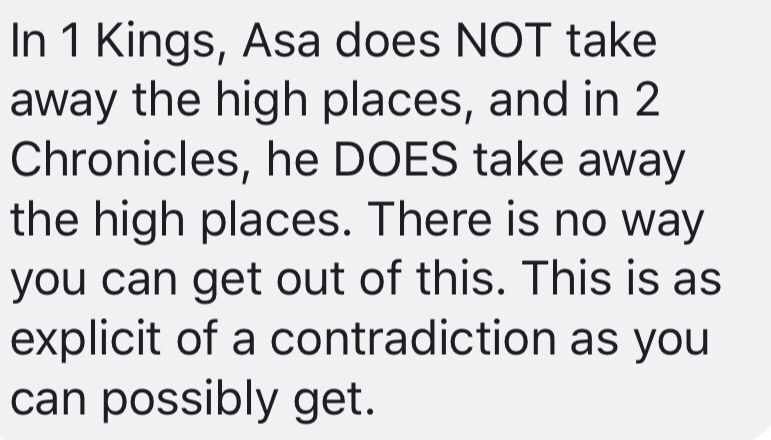
In an online conversation recently, these two texts were cited as contradictory. Here is part of a screenshot that shows the contradiction as posted.

As one sees, the assertion offered is that Asa did not remove the high places in the former and he does in the latter. The 1 Kings passage doesn’t say assign responsibility to anyone for not removing the high places. That is the first error.

In contrast, the 2 Chronicles passage clearly states Asa removes the high places. Already, we begin to see this alleged contradiction unraveling.

Greg Koukl is a Christian author and apologist. One of the points he takes the time to emphasize is never read a verse (or passage) alone. Read above and below to get a better understanding of the context.

Given that instruction, we can clearly see how both passages are truncated purposefully to prove a point. When we read the entire account of Asa’s reign in both passages and compare them, we clearly see the harmonization. Let’s expand the citation of 1 Kings:

Asa did what was right in the eyes of the Lord, just as his father David had done. He expelled the male cult prostitutes from the land and removed all the idols that his fathers had made. In addition he even deposed his grandmother Maakah as queen, because she had made an idol in a grove. Asa destroyed her idol and burned it by the Kidron brook. But the high places were not all removed, even though Asa’s heart was wholly devoted to the Lord all his days.

1 Kings 15:11–14 — Modern English Version (Thinline Edition.; Lake Mary, FL: Passio, 2014)

Now considering the account of Asa, 2 Chronicles is more detailed. If we just read verses 14:2-3, we would miss the entire explanation of the disposition of those high places. In this more detailed account of the reign of Asa, we eventually come to a better understanding of what actually happened and where.

King Asa even removed his mother Maakah from being queen mother because she had made a detestable image for Asherah. Asa cut down her image, crushed it, and burned it in the Kidron Valley. But they did not remove the high places from Israel. Nevertheless the heart of Asa was wholly committed all his days.

2 Chronicles 15:16–17 — Modern English Version (Thinline Edition.; Lake Mary, FL: Passio, 2014)

Asa has nothing to do with the remaining high places. Those were in Israel, a different nation under a different king. And they, not he, didn’t remove them. In Judah, the high places were removed, but not in Israel.

The conclusion is, each statement is correct when the context is understood clearly. There is no contradiction from which to ‘get out of.’

The End of it Shall Come with a Flood.

After the sixty-two weeks Messiah shall be cut off and shall have nothing. And the troops of the prince who shall come shall destroy the city and the sanctuary. The end of it shall come with a flood. And until the end of the war desolations are determined.

Daniel 9:26 — Modern English Version (Thinline Edition.; Lake Mary, FL: Passio, 2014)

I had highlighted this during the week to pursue later. What caught my attention is the phrase “The end of it shall come with a flood.” It in this case would be the city Jerusalem, or better the temple sanctuary in it.

Yet somewhere in the back of my mind, I remember hearing an account of a certain ancient civilization wanting to extract the last vestiges of gold from a sacked place, they flooded it with water. As the water washed through the ruins it then gushed over a grassy plain before eventually finding an outlet to a body of water. The treasure was lifted from the ruins by the water and caught in the grass of the plains. It was then retrieved. I think somewhere in my mind I always want to connect this idea with the temple but can find no sources for even the account. There is plenty of speculation on how the alleged melted gold was retrieved, but that is for another time.

Setting out this morning to try and understand, I have at least settled in my mind what is being said.

“The end of it shall come with a flood.”

In the passage, the word flood is translated from the Hebrew sheṭeph (שֶׁטֶף.) I think I want to read an English primary understanding into the translated word, meaning a flood with water. However, it seems as if the idea conveyed is just overwhelming devastation. A little later in Daniel, that same word is used as connected with armies to convey an overwhelming military army that is swept away.

A flood of armies shall be swept away before him and be broken, and the prince of the covenant as well.

Daniel 11:22 — Modern English Version (Thinline Edition.; Lake Mary, FL: Passio, 2014)

I think that helps to understand the context being offered. Still not satisfied, I checked out how the Septuagint translated the idea. The English transliteration is something like this:

Will come its end with destructive anger.

I think that better suits the idea as a judgment sent from God and overwhelming on many fronts; militarily, vast and emotional. Given some of the scant historical gleanings, the Israelis were so protective of that sanctuary. That was their identity, as the only ones who could approach and serve God.

Yet clearly in the prophecy, the Anointed One is cut off. We know Jesus was crucified. His death wasn’t for Himself (and shall have nothing.)

It is the troops of the prince who shall come who set to destroy the sanctuary. The command to do so wasn’t from Rome, a local legion set the fire. I can imagine the overwhelming confusion of the moment.

“And until the end of the war desolations are determined.”

Let’s not confuse the term desolations with what is commonly called the abomination of desolation. The former is specifically speaking of the desolations that are decreed to Jerusalem (and its people.) It is this very thing Jesus spoke of in the Olivet discourse. He was speaking of the second diaspora, the scattering of Israelis, and the desolations to come upon the city and its people.

When you see Jerusalem surrounded by armies, then you know that its desolation has drawn near. Then let those who are in Judea flee to the mountains, and let those who are in the city depart, and let not those who are in the country enter it. For these are the days of vengeance, that all things which are written may be fulfilled. But woe to those who are pregnant and to those who nurse in those days! For there will be great distress in the land and wrath upon this people. They will fall by the edge of the sword and will be led away captive to all nations. And Jerusalem will be trampled on by the Gentiles until the times of the Gentiles are fulfilled.

Luke 21:20–24 — Modern English Version (Thinline Edition.; Lake Mary, FL: Passio, 2014)

There would be a specific season for this diaspora and will end when the times of the Gentiles are fulfilled. Even in recent history, we continue to see the desolations that happen to the Jewish people; expulsion from Spain, the pogroms in Russia, and the Holocaust. These readily come to mind as modern desolations. Even now we see continued desolations spoken of in our media. The zeitgeist would shame Israel for settlements, for defending herself. The same would also divide Jerusalem for the sake of peace. Even then, the end of war won’t come until Messiah arrives.

Then the sign of the Son of Man will appear in heaven, and then all the tribes of the earth will mourn, and they will see the Son of Man coming on the clouds of heaven with power and great glory. And He will send His angels with a great sound of a trumpet, and they shall gather His elect from the four winds, from one end of the heavens to the other.

Matthew 24:30–31 — Modern English Version (Thinline Edition.; Lake Mary, FL: Passio, 2014)

The flood destroyed the city and sanctuary, and with all floods, the aftermath seems hopeless. These are the desolations that are decreed until the end of the war.

Pray for the peace of Jerusalem:
“May they prosper who love you!
Peace be within your walls
and security within your towers!”

Psalms 122:6–7 — Modern English Version (Thinline Edition.; Lake Mary, FL: Passio, 2014)

This is not meant to be an extensive explanation of prophecies, but of clearly understanding that phrase in the light of Scriptures.